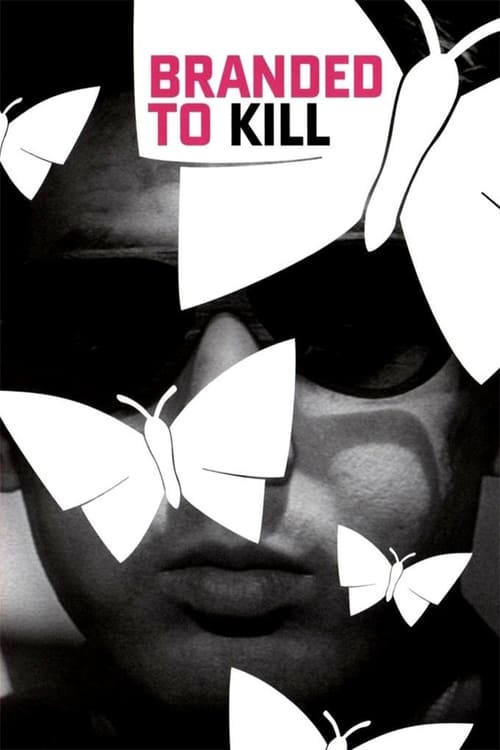
Branded to Kill
1967 · Seijun Suzuki
For an adventurous night when you want cinema at its weirdest and coolest — a midnight movie for people who like their thrillers unhinged. Definitely challenge, gloriously so.
What it's about
Japan's number-three hitman botches a job when a butterfly lands on his rifle scope, and suddenly he's no longer the hunter — the mysterious Number One is coming for him. What starts as a stylish black-and-white yakuza thriller warps, scene by scene, into something stranger: a fever dream about obsession, rank, and a killer with a fetish for the smell of boiling rice.
The experience
Disorienting, deadpan, and frequently hilarious in ways you can't quite explain afterward — it plays like a genre film dreamed by someone falling asleep during a genre film. You stop asking what's happening and start enjoying that anything can.
Performances
Joe Shishido, with his unmistakable puffed cheeks, plays the hitman with total commitment to the absurdity — icy professional one moment, sweating wreck the next.
The craft
Suzuki shoots in slashing black-and-white with compositions that fracture space like a comic strip gone feral — doors, rain, birds, and butterflies keep invading the frame with dream logic. The set pieces are staged with an invention that still looks radical; every shot seems designed to top the last.
Why it matters
The studio found it so incomprehensible it fired Suzuki outright — and the film's afterlife turned him into a cult hero whose anarchic style echoes through generations of stylized crime cinema worldwide.
Snapshot
Branded to Kill (Koroshi no rakuin, 殺しの烙印) is a 91-minute black-and-white yakuza-hitman picture made for Nikkatsu studio that mutates, across its own running time, from genre exercise into something approaching avant-garde cinema. It follows Goro Hanada, a professional assassin ranked third in Japan's underworld hierarchy, who botches a kill after a butterfly lands on his rifle scope and then finds himself hunted by the enigmatic Number One — a rival who exists less as a character than as an existential principle. The film became immediately notorious when Nikkatsu president Kyusaku Hori viewed it and declared it incomprehensible, firing Suzuki on the spot and effectively blacklisting him from the Japanese industry for the better part of a decade. What Hori read as incoherence, subsequent generations of critics have read as deliberate formal rupture — a sustained assault on the conventions of the very genre the studio had spent years asking Suzuki to produce. Branded to Kill is now routinely cited among the great works of Japanese cinema and among the most radical commercial films ever made.
Industry & production
Suzuki had worked at Nikkatsu since 1954, directing a string of studio-assigned action and genre pictures across the late 1950s and 1960s. By the mid-1960s, Nikkatsu's dominant product line was the so-called Nikkatsu Action cycle — stylish, low-budget crime and youth pictures aimed at a mass audience — and Suzuki had become one of its most prolific hands. His immediately preceding films, Gate of Flesh (1964) and Tokyo Drifter (1966), had already pushed the studio's tolerance: Tokyo Drifter was shot partly in color at Suzuki's insistence and was openly eccentric in its staging, and Nikkatsu had reportedly demanded cuts before release. Branded to Kill was produced under the same constraints — a modest budget, a compressed schedule, a genre brief — but Suzuki, apparently aware that his position at the studio was precarious, treated the assignment as an opportunity for uninhibited formal experimentation. The studio's commercial expectations and Suzuki's artistic direction were simply incompatible, and the firing that followed the film's release made that conflict permanent and public. Suzuki subsequently sued Nikkatsu for wrongful dismissal; the case attracted considerable attention in Japanese film industry circles and he ultimately prevailed in the litigation, though the professional exile lasted years regardless.
Technology
The film was shot in black and white on standard 35mm by cinematographer Kazue Nagatsuka, using Nikkatsu's house equipment and facilities. The monochrome palette was not Suzuki's first choice for every film — Tokyo Drifter had been shot in color — but in Branded to Kill the black-and-white register functions expressively rather than merely economically, allowing extreme contrast ratios, blown-out highlights, and dense shadow masses that would read differently in color. The format and technology are resolutely those of a low-budget studio picture; what distinguishes the film is not equipment but what is done with it.
Technique
Cinematography
Nagatsuka's work here is among the most formally adventurous in the Nikkatsu action corpus. The film consistently refuses the neutral, legible coverage that the genre convention and the studio's budget logic demanded. Wide-angle lenses are used at unusually close distances, creating spatial distortion around faces and objects; the famous image of Hanada's face pressed against a fish-bowl glass is a signature of this approach. Extreme close-ups — eyes, mouths, hands, the barrel of a gun — are cut together in ways that break apart the coherent space of a scene rather than illustrating it. High-angle shots and low-angle shots alternate without the motivation of character identification, producing a persistent unease about whose perceptual position the camera occupies. The contrast between harshly lit, almost abstract compositions in the latter portion of the film and the more conventional — if still stylized — action grammar of the early reels produces the effect of the film gradually losing interest in its own visual rules.
Editing
The editing is where the film's formal rupture is most pronounced and most systematic. Standard continuity logic — the 180-degree rule, eyeline matches, shot-reverse-shot structures that orient a viewer within a scene — is observed only intermittently and then abandoned without announcement. The final extended duel between Hanada and Number One is edited in a manner that is explicitly non-spatial and durational in a way that defies conventional narrative time: it is unclear where the action is taking place, in what temporal order, or whether what we are seeing is event, memory, or hallucination. The editing in these sequences has invited comparison with the most radical European art cinema of the period — Resnais, late Godard — though the texture of the imagery remains rooted in pulp genre rather than bourgeois modernism.
Mise-en-scène / staging
Suzuki stages scenes in ways that refuse psychological realism in favor of graphic and emblematic effect. Characters are positioned and move in relation to the frame rather than to each other; action that should carry dramatic weight is staged with a deadpan flatness while moments of apparent inconsequence are given elaborate, slow staging. The production design incorporates elements that read as deliberately artificial: sets that feel like sets, symbolic objects (the pinned butterfly, the pot of boiling rice whose steam Hanada fetishistically inhales) that are presented as literal rather than metaphoric. The female characters, particularly Misako (played by Annu Mari), are staged in configurations — often nude, often combined with images of death or entrapment — that sit uncomfortably between genre convention and something more formally disturbing. The staging throughout has a quality of spatial arbitrariness that denies the viewer any stable sense of geography, psychological motivation, or dramatic consequence.
Sound
The sound design and music deserve more scholarly attention than they have typically received. Naozumi Yamamoto's score oscillates between jazz idioms — consistent with the contemporary Nikkatsu action sound — and passages of atonal or near-abstract music that mirror the film's visual disintegration. Diegetic sound is sometimes used naturalistically and sometimes in ways that call attention to its own construction; silence is deployed in scenes where conventional sound design would motivate it. The overall sonic texture participates in the film's larger strategy of alternating genre legibility with formal estrangement.
Performance
Joe Shishido, who had worked with Suzuki repeatedly within the Nikkatsu system, plays Hanada with a quality that sits between genre stoicism and something harder to name — a blankness that is not quite dead-eyed cool but that increasingly, across the film, reads as ontological vacancy. Shishido's face, modified by cheek augmentation surgery that had become a signature of his persona, is treated by Nagatsuka's camera as an object of formal interest as much as a site of dramatic expressivity. The supporting performers, including Mariko Ogawa as Hanada's scheming wife Mami, tend toward the heightened register of melodrama, which produces a tonal inconsistency that seems deliberate rather than accidental — the film does not settle into any stable performance mode.
Narrative & dramatic mode
The film begins in an idiom that is recognizably genre fiction: a hitman, a botched job, a pursuing antagonist, a femme fatale structure. These elements are present throughout, but Suzuki progressively evacuates them of their expected narrative function. Plot connections that should be causal are presented as merely sequential or are withheld entirely. Character motivations that genre convention would establish are left unexplained. The final act — in which Hanada and Number One face each other in a surreal confined space, over a duration that seems to exceed clock time — has no satisfactory genre resolution. Whether Hanada lives or dies, wins or loses, is rendered in terms the film refuses to clarify through conventional means. The dramatic mode is thus simultaneously genre film and genre critique: it uses the materials of the thriller to enact a deconstruction of the thriller's epistemological assumptions.
Genre & cycle
Branded to Kill belongs to and simultaneously terminates the Nikkatsu Action cycle, the wave of B-picture crime, youth, and action films that Nikkatsu had been producing since the late 1950s as its dominant commercial mode. Within that cycle, it participates in a subgenre sometimes called Nikkatsu noir — pictures with hitman, yakuza, or organized crime protagonists, drawing on American hardboiled tradition filtered through Japanese genre conventions. Suzuki had made numerous entries in this cycle; Branded to Kill is both its apotheosis and its logical self-destruction. By taking the cycle's conventions to an extreme of internal consistency — following the logic of genre abstraction all the way through — the film arrives at a place where genre itself dissolves.
Authorship & method
Suzuki's position within questions of auteurism is complex. He consistently described himself as a craftsman working within studio assignment rather than as an artist with a personal vision, and much of his career supports this account: he made many unremarkable pictures within the Nikkatsu system without evident ambition toward formal experiment. Yet the cluster of films he made in the mid-1960s — Fighting Elegy, Tokyo Drifter, Branded to Kill — displays a coherent escalating formal radicalism that is difficult to attribute to studio direction alone. The screenplay for Branded to Kill is credited to Hachirō Guryu; Suzuki's contribution appears to have been in the translation of script to image, in the decisions of staging, coverage, and cutting that transform an assignable genre story into an unassignable formal object. Kazue Nagatsuka's cinematography was essential to the realization of Suzuki's intentions; the two had worked together and developed a shared visual language within the Nikkatsu system. The film should be understood as a collaboration in which Suzuki's directorial choices were decisive but were executed through and with the contributions of others whose specific roles in shaping the final work are not fully documented in the available scholarship.
Movement / national cinema
The film is inseparable from Japanese studio cinema of the 1960s and from the specific institutional conditions of Nikkatsu during the period — a studio that was simultaneously demanding commercially viable product and, in effect, allowing enough directorial latitude that figures like Suzuki could use that latitude destructively. It also participates in a broader international current: the influence of the French New Wave, and of Godard in particular, is legible in the film's self-referential relationship to genre, its discontinuous editing, and its willingness to prioritize formal effect over narrative legibility. Suzuki was not the only Japanese director of the period absorbing these European influences — the Japanese New Wave associated with Nagisa Oshima, Masahiro Shinoda, and Yoshishige Yoshida was doing so simultaneously, though from a more overtly political position. Branded to Kill sits at an angle to both the Nikkatsu commercial system and the Japanese New Wave: it is not an art-house film in the conventional sense, nor is it merely a genre picture, but something produced in the gap between those categories.
Era / period
The mid-to-late 1960s were a period of acute formal self-consciousness in global cinema, in which filmmakers across multiple national traditions were actively examining and contesting the conventions of genre and commercial narrative. Branded to Kill belongs to this moment, alongside Godard's Weekend (1967), Raoul Walsh's late films being reassessed through auteurist criticism, and the broader international circulation of formally experimental cinema. In Japan specifically, the period saw the simultaneous collapse and transformation of the studio system; Nikkatsu's commercial crisis in the early 1970s, which eventually led to the studio's pivot to softcore pink films, was already visible as a structural condition in the late 1960s. Suzuki's firing can be read as one symptom of this institutional pressure — the studio's intolerance for a film that would not recoup its costs being inseparable from a broader inability to sustain the conditions under which such films could be made.
Themes
The film concerns, at its most explicit level, the logic of hierarchy and competition within a criminal system — the ranked order of hitmen, the anxiety of displacement, the desire to reach Number One. But this social-satirical dimension is quickly subordinated to something more abstract: questions about identity, reality, and the relationship between desire and destruction. Hanada's fetish for boiling rice functions as a literalized image of an irrational attachment that is simultaneously comic and disturbing — desire displaced onto a banal domestic object. The butterfly that causes the missed shot introduces chance, contingency, and natural beauty into the ordered world of professional killing, and the butterfly motif returns, in the figure of pinned dead specimens associated with Misako, as an image of desire fixed and preserved through death. The relationship between Hanada and Number One, in the film's final movement, takes on qualities less of professional rivalry than of a metaphysical confrontation — two principles rather than two characters. Whether this thematic content constitutes a coherent argument or is better understood as associative and imagistic remains a point of critical debate.
Reception, canon & influence
Influences on the film (backward). American hardboiled fiction and film noir — the world of professional killers, compromised women, and corrupt hierarchies — provided the narrative skeleton. Suzuki was clearly aware of the French New Wave, and Godard's systematic dismantling of genre conventions is a recognizable precursor to the formal strategies deployed here. Jean-Pierre Melville's hitman pictures, particularly Le Samouraï (released the same year, 1967), share thematic territory, though the two films approach the hitman figure from very different formal positions. Within Japanese cinema, the yakuza genre that Nikkatsu and Toei had been developing through the early 1960s provided the immediate generic context.
Reception. Nikkatsu's response to the film is well-documented: the studio effectively shelved it after its initial release, and Suzuki's firing ensured that the film did not receive the kind of domestic critical attention it might otherwise have attracted. The film's first significant critical recuperation came gradually, through retrospectives and the work of critics — in Japan and internationally — who approached Suzuki's Nikkatsu work through the lens of auteur theory and formal analysis. By the 1980s and 1990s, Branded to Kill was circulating in repertory cinema and film studies contexts as a discovered masterpiece, a film whose radicalism had been evident from the first and whose suppression by the studio was itself part of its meaning. The Criterion Collection's eventual release of the film on home video (it appears in their Eclipse series devoted to Suzuki's early work) was part of the film's canonization in Western cinephile culture.
Legacy (forward). The film's documented influence includes Jim Jarmusch's Ghost Dog: The Way of the Samurai (1999), which explicitly draws on the ritualized hitman mythology of the Nikkatsu pictures and cites Suzuki as a reference point. The wave of stylized East Asian crime cinema of the 1990s — John Woo's Hong Kong pictures, Takashi Miike's early work in Japan, Park Chan-wook's Korean revenge films — takes place in a broader context in which Branded to Kill is a canonical antecedent, though the specific lines of influence are difficult to trace precisely. The film's more general impact on the aesthetics of crime cinema — the proposition that genre conventions can be simultaneously honored and destroyed, that formal extremity is compatible with commercial genre materials — has been diffuse and wide. Within Japanese cinema, Suzuki's rehabilitation after his blacklisting was itself a consequence of the film's eventual reputation; his late work, including the Taisho Trilogy (beginning with Zigeunerweisen in 1980), would not have been possible without the recognition that Branded to Kill eventually achieved.
A Deleuzian reading
Start with the smell.
The full Deleuzian reading of Branded to Kill →
Reception
Nikkatsu found it so baffling that studio president Kyusaku Hori fired Suzuki for making 'incomprehensible' films — a sacking that sparked protests from students and filmmakers and left Suzuki blacklisted for a decade. Today the film that ended his studio career is his most canonized: an early Criterion release and a touchstone of cult Japanese cinema.
How Branded to Kill was received, from release to now →
Influences: the films it descends from and the films it influenced
- Breathless (1960) — Godard's systematic jump-cut editing and deliberate 180° rule violations established continuity-violation as expressive strategy rather than error — the formal vocabulary Suzuki systematizes into non-spatial sequence construction.
- Last Year at Marienbad (1961) — Resnais's refusal to maintain spatial or temporal coherence across cuts — each edit potentially displacing the viewer into a different time or location — is the structural antecedent for Suzuki's non-spatial sequence editing as narrative method.
- Shoot the Piano Player (1960) — Truffaut's alternation of genre registers — slapstick, thriller, melodrama — within a single crime framework established mixed-register performance logic and tonal destabilization as genre-deconstruction tools that Suzuki radicalizes.
- Elevator to the Gallows (1958) — Miles Davis's modal jazz improvisation, recorded against the projected film and allowed to structure emotional response independent of narrative beats, established jazz-as-tonal-displacement in noir that Suzuki extends to atonal oscillation.
- Touch of Evil (1958) — Welles's extreme wide-angle lenses physically distort faces and spaces in noir while high-contrast B&W flattens characters into graphic masks — the precise cinematographic strategies Kazue Nagatsuka developed with Suzuki.
- Shock Corridor (1963) — Fuller's staging privileges visual shock and graphic composition over psychological motivation within exploitation genre assignment — proposing that formal extremity inside commercial constraints is not aberration but method, the direct precedent for Suzuki's approach.
- Ghost Dog: The Way of the Samurai (1999) — Jarmusch explicitly cites Suzuki's Nikkatsu hitman mythology; RZA's Wu-Tang-inflected score functions structurally as Inoue's jazz atonal oscillation does in Branded to Kill — genre-displacing music against a ritualized killer-code narrative that consumes its own protagonist.
- Fallen Angels (1995) — Christopher Doyle's extreme wide-angle distortion and high-contrast underexposure combined with discontinuous non-spatial editing in a hitman-noir framework extend Suzuki's cinematographic-editing grammar directly into Hong Kong crime cinema.
- Pistol Opera (2001) — Suzuki's own return to Branded to Kill's ranked-assassin world reprises the literalized symbolic objects (butterfly, staircase) and genre-deconstruction methodology through digital color saturation rather than B&W extreme contrast, making explicit the formal program implicit in the 1967 film.
- Ichi the Killer (2001) — Miike inherits Suzuki's proposition that yakuza-genre violence can be simultaneously literalized and abstracted — graphic staging detached from psychological motivation as formal argument rather than exploitation — deploying it at an excess that acknowledges Branded to Kill as structural precedent.
- Sympathy for Mr. Vengeance (2002) — Park structures the crime narrative around withheld causality — motivation deferred, consequence displaced from action — and literalized symbolic objects functioning as genre citation rather than psychology, formal strategies continuous with Suzuki's approach.
- A Bittersweet Life (2005) — Kim deploys the ranked-hitman hierarchy-and-displacement narrative with graphic staging systematically privileged over interior psychology, operating within the professional-killer formal grammar that Suzuki's Nikkatsu films established as a Korean continuation of the same lineage.
- Fireworks (1997) — Suzuki structures yakuza narrative as tonal rhythm rather than causal sequence, using abrupt scene-to-scene cuts that discard connective tissue and treat each episode as a discrete visual unit—the structural-rhythm editing approach Kitano inherits.
- Sonatine (1993) — Suzuki's practice of fragmenting yakuza narrative through elliptical cuts — scenes beginning mid-action and terminating before their conclusions, without orienting connective tissue — is the formal precursor to Kitano's strategic omission editing, which withholds cause-and-effect confirmation (the gunshot that connects, the death confirmed) as a philosophical rather than merely stylistic gesture.
- Violent Cop (1989) — Suzuki's dissolution of Nikkatsu crime-film conventions through irrational narrative ellipsis and anti-climactic violence staging created the template within Japanese genre cinema for formal subversion that Kitano inherits — replacing Suzuki's surrealist playfulness with nihilistic deadpan.
- Outrage (2010) — Suzuki's collapse of yakuza institutional hierarchy into arbitrary, absurdist violence—the hitman rank-system as black comedy—anticipates Outrage's bureaucratic plot machinery in which organizational authority dissolves into reciprocal elimination without cathartic resolution.
- Kill Bill: Vol. 1 (2003) — Suzuki's pop-art saturated color, abrupt black-and-white shifts, and anti-realist presentational staging of the hitman genre prefigure Tarantino's medium-shifting, stylization-over-coherence approach.
- Last Life in the Universe (2003) — Suzuki's absurdist, abstracted gangster iconography underwrites the half-ironic, dislocated yakuza figure Last Life gestures toward.
- Fighting Elegy (1966) — Made the year before within the same Nikkatsu assignment system, Fighting Elegy deploys the same graphic-over-psychological staging and escalating formal radicalism, establishing the methodology Branded to Kill carries to its destructive conclusion.
- Tokyo Drifter (1966) — Applies the identical hitman-hierarchy-displacement narrative in abstracted pastel color rather than B&W extreme contrast — the direct formal sibling executing the same graphic-over-psychological staging logic in the register of garish artifice.
- Le Samouraï (1967) — Both films released in the same year construct the hitman as a figure of ontological vacancy through opposite means — Melville via ascetic reduction of action to ritual silence, Suzuki via amplification of genre excess into formal incoherence — two formal solutions to the same problem.
- The Sword of Doom (1966) — Suzuki applies the same formal cluster — protagonist of psychological vacancy, jazz score functioning as genre estrangement device, editing fragmentation that refuses narrative coherence, abrupt unresolved ending — to yakuza genre rather than samurai, confirming that these are Japanese New Wave formal properties portable across genres rather than period-specific conventions; the two films share a method of using genre expectation as a surface to systematically perforate.
- Pale Flower (1964) — Suzuki's simultaneous demolition of yakuza genre logic through tonal rupture and surrealist formal intrusion — retaining genre iconography as primary material while refusing cathartic resolution — is the direct parallel strategy to Shinoda's deformation of yakuza-eiga conventions through existentialist austerity.
- Point Blank (1967) — Contemporaneous sibling that, like Point Blank, detonates the hitman genre through elliptical editing, abstract spatial composition and a refusal of conventional motivation.
- Gozu (2003) — Japanese precedent for hijacking the yakuza programmer and warping it into absurdist, near-incoherent surrealism — the V-Cinema-to-art-house subversion Miike inherits wholesale.
- The Killers (1964) — Parallel modernization of the contract-killer film into stylized, near-abstract color — the professional assassin's ritual stripped to formal procedure.
Similar films
- Tokyo Drifter (1966) — influence & lineage
- Ichi the Killer (2001) — influence & lineage
- Ghost Dog: The Way of the Samurai (1999) — influence & lineage
- Le Samouraï (1967) — influence & lineage
- Gozu (2003) — shared sensibility
- Bullet Ballet (1998) — shared sensibility
- Sanjuro (1962) — shared sensibility
- Harakiri (1962) — shared sensibility
All the films related to Branded to Kill →