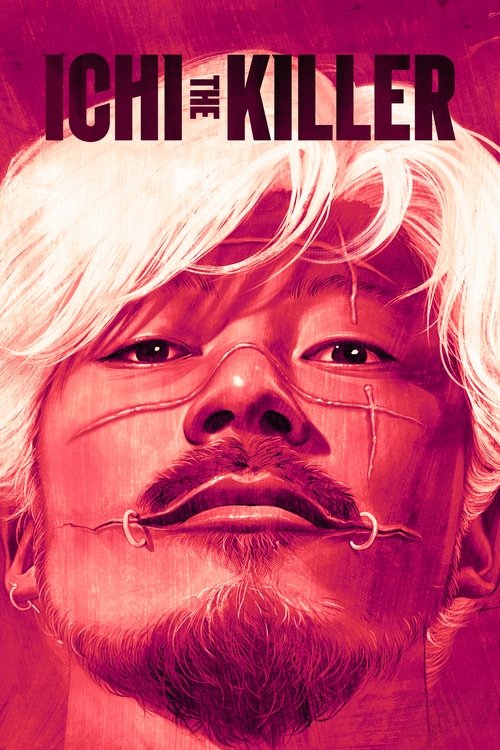
Ichi the Killer
2001 · Takashi Miike
Only when you're deliberately seeking the far edge of what cinema will show you — a dare, not an evening's entertainment. Absolutely not comfort viewing, and not for anyone sensitive to graphic violence, including violence against women.
What it's about
A yakuza boss vanishes, and his enforcer Kakihara — a scarred, pierced connoisseur of pain — tears through Tokyo's underworld looking for him. His search points toward Ichi, a weeping, psychologically broken young man being manipulated into acts of unthinkable violence, and the two are set on a collision course. It's a gangster manhunt reimagined as a portrait of two damaged men who need each other in the worst possible way.
The experience
Genuinely extreme — grueling, transgressive, sometimes blackly funny, and designed to make you question why you're watching. The violence isn't a thrill ride; it's an assault, and the film knows it.
Performances
Tadanobu Asano is magnetic as Kakihara — cool, wounded, and strangely elegant, he turns a monster into the film's most watchable presence.
The craft
Takashi Miike directs with anarchic energy: lurid color, jolting edits, grotesque practical effects, and tonal swerves from splatter to slapstick that keep you permanently off balance. Adapted from a notorious manga, it uses excess deliberately, pushing genre violence until it stops being fun and starts being the subject.
Why it matters
One of the defining provocations of the early-2000s Asian extreme wave — banned or cut in several countries, it made Miike an international cult name and became a benchmark for how far genre cinema could go.
Snapshot
Ichi the Killer (Japanese: Koroshiya 1) is Takashi Miike's most notorious film and one of the defining provocations of early-2000s extreme cinema — a yakuza-underworld splatter picture that turns the genre's habitual violence inside out to ask what violence is for. Adapted from Hideo Yamamoto's serialized manga, it follows two interlocking pathologies. Kakihara (Tadanobu Asano), a peroxide-blond yakuza enforcer whose mouth is slit at the corners and pinned with piercings, is a connoisseur of pain searching for his vanished boss, Anjo, and increasingly searching for someone who can hurt him as profoundly as he hurts others. Ichi (Nao Omori) is the weapon being aimed at Kakihara's gang: a weeping, sexually broken man-child, conditioned and controlled by the manipulator Jijii, who kills with blades concealed in the heels of his boots and dissolves into hysterical tears even as he eviscerates. The film stages their mutual pursuit as a perverse love story between a masochist and a sadist who can never quite meet on the terms each needs. It arrived as the most extreme expression of Miike's hyper-prolific turn-of-the-millennium output, became an instant festival scandal, and was cut, seized, or banned across multiple territories — establishing itself as a touchstone for debates about screen violence that continue to surround it.
Industry & production
Ichi the Killer was produced and released in 2001 during the most frantic stretch of Takashi Miike's career, a period in which he was directing several features and direct-to-video projects a year, moving fluidly between theatrical films, the low-budget "V-Cinema" straight-to-video market that had been his training ground, and prestige festival work. That industrial context is essential to the film: Miike's speed, his comfort with genre disreputability, and his V-Cinema-honed efficiency are legible throughout. The film was adapted from Hideo Yamamoto's manga, which ran in the late 1990s and was already infamous for its sexual and physical brutality, giving the production a built-in cult readership and a deliberately transgressive brief.
The film's public life was shaped as much by censorship as by exhibition. Its international launch at the 2001 Toronto International Film Festival's Midnight Madness program became legendary for the reported distribution of branded "barf bags" to the audience — a piece of showmanship that crystallized the film's reputation before most critics had written a word. In the years that followed it was subjected to cuts and bans in numerous jurisdictions: the British Board of Film Classification required substantial cuts (widely reported at roughly three minutes, concentrated on sexual violence) for its UK release; it was banned outright or heavily censored in several other territories and reportedly seized in others. In the United States it circulated through cult-genre distribution channels associated with the "Asia Extreme" marketing wave. Precise figures on budget and box office are not reliably part of the established public record, and I will not invent them; the film's commercial significance lies less in grosses than in its outsized cultural and home-video afterlife.
Technology
Ichi the Killer sits at a transitional moment in screen-gore technology, combining heavy practical prosthetic and makeup effects with then-emerging digital compositing. Much of the film's extreme imagery — flayed flesh, severed limbs, a face split open — is achieved with practical appliances, but the production also leans on early-2000s digital effects to extend and exaggerate the carnage: sprays of blood, the surreal vertical slices of bodies cleaved by Ichi's bladed boots, and other flourishes that push past what practical work alone could stage. The digital blood of the era reads, by later standards, as stylized rather than photoreal, and that very artificiality suits the film's cartoon-grotesque register, which is consciously derived from manga rather than from naturalism. The result is a hybrid aesthetic in which tactile, wet practical horror collides with frankly synthetic digital embellishment — a signature of low-to-mid-budget genre filmmaking at the moment digital tools were becoming cheap enough to reach it.
Technique
Cinematography
The film was photographed by Hideo Yamamoto, a frequent Miike collaborator whose credits with the director include Audition and later 13 Assassins. (His name coincides with that of the manga's author, also romanized Hideo Yamamoto; they are, by the established record, different individuals working in different media — a coincidence worth flagging precisely because it invites confusion.) The cinematography is restless and eclectic, shifting registers to match the film's tonal whiplash: grimy, handheld immediacy in the underworld interiors; lurid, saturated color in the more delirious set pieces; and a willingness to deploy distorting lenses, abrupt angles, and a roving, almost documentary mobility. The camera does not flinch from the violence but neither does it fetishize it with conventional "cool" coverage; it observes atrocity with an unsettling matter-of-factness that is more disturbing than stylization would be. The look is deliberately impure, mixing the textures of cheap genre filmmaking with moments of striking composition.
Editing
Cut by Yasushi Shimamura, a regular Miike editor, the film's construction is jagged and tonally volatile by design. Comedy, horror, and pathos are juxtaposed with deliberate harshness, so that grotesque violence can pivot into slapstick or sudden sentiment without transitional cushioning. The editing also manages the film's bifurcated structure — Kakihara's investigation and Ichi's conditioning advancing on separate tracks toward their collision — and its frequent withholding of clear cause and effect, which keeps the viewer disoriented about who is manipulating whom. Pace lurches deliberately, with longueurs of dread giving way to bursts of frenzied carnage.
Mise-en-scène / staging
The film's production design renders the Shinjuku underworld as a seedy, neon-edged warren of clubs, apartments, and torture rooms. Its most celebrated staging choices are emblematic of Miike's provocation: the opening title card, in which the word that becomes the film's name is formed from spilled semen on the ground beside a scene of voyeuristic violence, announces the marriage of sex and brutality that drives the whole film. Costume is doing heavy thematic work — Kakihara's split-cheek piercings, slicked blond hair, and dandyish coats make him a peacock of pain, while Ichi's black rubber bodysuit emblazoned with a "1" turns him into a fetish-object weapon. The torture sequences are staged with an almost theatrical precision (the suspension-and-skewering of a rival, the hot-oil interrogation), foregrounding the body as a site of spectacle and meaning rather than mere shock.
Sound
The sound design amplifies the film's assault, with squelching, visceral foley making the violence tactile and inescapable, and abrupt silences used to unsettling effect around moments of dread and humiliation. The musical score has been credited to the group Karera Musication; I am not fully certain of the finer attributions and will not overstate them, but the soundtrack's restless, eclectic, sometimes abrasive character matches the image track's refusal of a single stable tone. Sound is used as another instrument of discomfort — the film wants the audience's bodies implicated in its violence, and the audio mix is central to that strategy.
Performance
Performance is where the film's provocations acquire their disturbing humanity. Tadanobu Asano's Kakihara is the film's magnetic center — a controlled, almost courtly sadomasochist whose physical grotesquerie (the pierced, splittable face) is played with eerie poise; Asano locates the genuine yearning beneath the depravity, so that Kakihara's hunt for a worthy tormentor reads as a thwarted romance. Nao Omori's Ichi is his deliberate opposite: a sniveling, arrested, sexually traumatized figure whose murderous violence erupts from helplessness rather than mastery, so that the film's "killer" is also its most pitiable victim. The casting of director Shinya Tsukamoto (of Tetsuo: The Iron Man) as the puppet-master Jijii adds an intertextual charge, aligning the film with Tsukamoto's own body-horror cinema. The ensemble plays the extremity straight, which is precisely what makes it land.
Narrative & dramatic mode
The film operates in a hybrid mode that is one of its most distinctive and divisive features: it is at once a yakuza crime thriller, a splatter-horror film, and a blackly comic, almost satirical character study, and it refuses to settle the proportions. Structurally it runs two converging lines — Kakihara's increasingly unhinged search for Anjo and for the source of the killings, and the revelation that Ichi is a programd instrument, his rage and tears engineered by Jijii through false memories and sexual manipulation. The dramatic engine is not whodunit suspense but a study in the mutual dependency of cruelty: the sadist who needs to be hurt and the "killer" who is himself the most thoroughly brutalized person in the film. The narrative deliberately destabilizes the categories of perpetrator and victim, manipulator and tool, and its ending withholds the clean catharsis the genre normally promises, leaving the central encounter unresolved in a way that is more conceptual than plot-driven.
Genre & cycle
Ichi the Killer belongs to several cycles at once. It is a late, deconstructive entry in the long Japanese yakuza-film tradition — descended from the ninkyo chivalry films and the grittier jitsuroku (true-account) gangster films of the 1970s — but it treats that tradition's codes of honor and violence as pathology rather than romance. It is simultaneously a key text of the turn-of-the-millennium wave of "extreme" Asian cinema that Western distributors packaged under the "Asia Extreme" banner, sitting alongside the broader international visibility of Japanese horror (Ring, Audition) even as it is splattier and more transgressive than the ghost-story J-horror mainstream. And it is a splatter/body-horror film in direct dialogue with the manga-derived ero-guro (erotic-grotesque) sensibility. Its particular contribution to the cycle is its self-awareness: it deploys genre extremity while interrogating the audience's appetite for it.
Authorship & method
Takashi Miike's authorship is defined less by a consistent visual signature than by a sensibility: prolific, fearless, genre-promiscuous, and committed to tonal collision as an aesthetic principle. Ichi the Killer is among the purest expressions of that sensibility, made in the same hyper-productive window as films like Visitor Q and other 2001 work, and it shares with Audition (1999) a willingness to lull and then assault the viewer. Miike's method is rooted in the speed and resourcefulness of the V-Cinema apparatus — fast shoots, genre fluency, an embrace of disreputable material — repurposed toward authorial provocation. The screenplay is credited to Sakichi Sato, a frequent Miike collaborator (and a figure later visible to Western audiences for his on-screen appearance in Tarantino's Kill Bill), who adapted Yamamoto's manga. Key collaborators reinforce the film's identity: cinematographer Hideo Yamamoto and editor Yasushi Shimamura were part of Miike's recurring creative circle, and the casting of fellow director Shinya Tsukamoto folds another transgressive auteur's presence into the work. The film is best understood as the product of a director using a fast, cheap, genre-machine method to make something deliberately unassimilable.
Movement / national cinema
This is Japanese commercial-genre cinema operating at its most transgressive edge, emerging from the V-Cinema direct-to-video economy that incubated Miike and many of his peers and feeding into the internationally marketed "Asia Extreme" phenomenon. It is not the product of a formal art movement so much as of an industrial moment — a robust low-budget genre sector colliding with a global festival and home-video appetite for confrontational Asian cinema around 2000. Within Japanese film history it represents the disreputable, exportable underside of a national cinema simultaneously gaining art-house prestige through other figures, and it helped define how international audiences perceived contemporary Japanese genre filmmaking for a decade.
Era / period
Ichi the Killer is unmistakably a film of its precise moment: the turn of the millennium, when cheap digital tools were beginning to reach low-budget genre production, when Japanese horror and extreme cinema were achieving unprecedented global circulation through DVD and festival culture, and when transgression itself had a ready international market. Its preoccupations — manufactured identity and implanted memory, the spectacle of pain, the eroticization of violence, masculinity as a structure of damage — resonate with the broader fin-de-siècle anxieties that also surfaced in the era's body-horror and "extreme" art cinema worldwide. It is a document of the instant before torture-centric horror went fully mainstream internationally.
Themes
The film's governing theme is pain as a language — the only register in which its central characters can seek connection. Kakihara's masochism and sadism are two faces of a single craving for an extremity of sensation that ordinary life denies him, while Ichi's violence is the displaced discharge of trauma, bullying, and sexual humiliation engineered into him by others. Around this core the film develops a sustained meditation on the instability of the victim/aggressor binary: nearly every figure of power is also a casualty, and the film's most fearsome "killer" is its most pitiable. Manipulation and false memory — Jijii literally programming a human weapon — extend this into a theme of fabricated identity and the question of who authors a person's violence. Throughout, the film is also reflexively about spectatorship: by making its audience complicit through showmanship (the barf bags, the voyeuristic opening) it implicates the viewer's own appetite for the cruelty on screen.
Reception, canon & influence
Critically, Ichi the Killer was polarizing from the start and remains so. It was received in some quarters as an irredeemable exercise in misogynistic shock and in others as a serious, even moral, interrogation of screen violence and the desire for it; that division is itself central to its reputation. Its festival scandal at Toronto and its long history of censorship cuts and bans across multiple territories made it a recurring reference point in debates over film classification and the limits of permissible representation. Over time it has hardened into a cult canon: a fixture of "most extreme films" discourse and one of the works most consistently cited as emblematic of both Miike and of early-2000s extreme cinema.
Backward, the film draws on Hideo Yamamoto's source manga and, more broadly, on the Japanese ero-guro tradition of erotic-grotesque art; on the yakuza-film lineage it inverts; on the body-horror cinema of figures like Shinya Tsukamoto, whose presence in the cast makes the debt explicit; and on the splatter and exploitation traditions of international genre film. Forward, its influence runs through the global wave of extreme and transgressive horror that intensified in the 2000s, and through the elevated international profile it helped secure for Miike, who would later move toward more mainstream and even family-oriented projects while retaining his provocateur's reputation. Miike has been openly admired by prominent Western filmmakers — Quentin Tarantino among the most frequently cited enthusiasts of his work — and Ichi the Killer in particular became shorthand, for a generation of genre filmmakers and cinephiles, for how far a film could go and what going that far might mean. Its most durable legacy is arguably conceptual rather than stylistic: it remains a central case study in whether extreme violence on screen can be a form of inquiry rather than mere assault.
A Deleuzian reading
Ichi stands over what he has just done, and he is crying.
The full Deleuzian reading of Ichi the Killer →
Reception
In 2001 it was a scandal object — trimmed or outright banned in several countries and infamous for festival walkouts — but it's since settled into the Miike canon, increasingly read less as pure shock and more as a sly satire of the audience's own appetite for screen violence.
How Ichi the Killer was received, from release to now →
Influences: the films it descends from and the films it influenced
- Tetsuo: The Iron Man (1989) — Tsukamoto's jittery handheld camera, metal-meets-flesh body-horror prosthetics and percussive industrial sound design are folded directly into Ichi — and made literal by casting Tsukamoto himself as the gangster Fujiwara.
- Audition (1999) — Establishes Miike's signature lull-then-assault structure — long stretches of restrained tone detonated by a sustained, clinically staged torture set-piece — the dramatic architecture Ichi escalates.
- Dead or Alive (1999) — Miike's V-Cinema yakuza machine perfected here: fast, cheap genre fluency married to deliberately mismatched tonal collisions and a transgressive opening montage that primes Ichi's title-card provocations.
- Battles Without Honor and Humanity (1973) — Fukasaku's frenzied handheld documentary-style yakuza realism and freeze-frame chapter cards supply the gangster-film grammar that Ichi inherits and then inverts into self-parody.
- Blood Feast (1963) — The founding splatter aesthetic — gore staged as spectacle for its own sake, color-saturated practical viscera as the film's reason for being — that Ichi pushes to a digital-hybrid extreme.
- The Story of Ricky (1991) — Cartoonishly exploding bodies and impossible anatomical mutilation transposed straight from a gore manga, the same manga-to-splatter literalism Ichi applies to Yamamoto's source.
- The Evil Dead II (1987) — Pioneers the splatter-comedy tonal whiplash — extreme practical gore played simultaneously as horror and slapstick — the editing principle Ichi weaponizes against the viewer's moral footing.
- Salò, or the 120 Days of Sodom (1975) — The art-cinema precedent for staging extreme degradation as a clinical interrogation of the spectator's complicity, the 'is this inquiry or assault' frame Ichi inherits.
- Branded to Kill (1967) — Miike inherits Suzuki's proposition that yakuza-genre violence can be simultaneously literalized and abstracted — graphic staging detached from psychological motivation as formal argument rather than exploitation — deploying it at an excess that acknowledges Branded to Kill as structural precedent.
- Tokyo Drifter (1966) — Miike deploys hyperbolized foley — exaggerated sounds of impact and flesh — as theatrical punctuation that calls attention to genre mechanics rather than creating immersion, while the artificial primary-color set design treats the yakuza world as stageable chromatic spectacle in Suzuki's anti-naturalist mode.
- Riki-Oh: The Story of Ricky (1991) — Extends the extreme manga-adaptation-to-live-action lineage, staging finishing-move mutilation with deadpan literalism and practical fluids that quote Riki-Oh's straight-faced grotesquerie.
- Tokyo Fist (1995) — Pushes the notion that bodily damage can be a film's primary vocabulary, with sadomasochistic physical transformation as narrative engine in the lineage Tsukamoto opened internationally.
- Kill Bill: Vol. 1 (2003) — Tarantino's open admiration for Miike runs straight into the film — he cast Ichi screenwriter Sakichi Sato as Tokyo restaurateur Charlie Brown — and borrows the geyser-gore, manga-styled yakuza bloodletting.
- Martyrs (2008) — Carries Ichi's 'pain-as-language' conceit into New French Extremity, structuring sustained, unflinching bodily suffering as a philosophical interrogation rather than exploitation.
- Tokyo Gore Police (2008) — Directly extends the practical-digital-hybrid splatter and manga-derived body mutilation Ichi popularized, with arterial fountains and prosthetic excess as the film's organizing spectacle.
- A Serbian Film (2010) — The 2000s extreme-cinema wave Ichi helped license — using maximal transgression and censorship-baiting shock as a self-conscious statement about the limits of permissible representation.
- 13 Assassins (2010) — Miike's later mainstream pivot retains the Ichi-era choreography of extended, escalating violence and genre fluency, evidence of the elevated auteur profile Ichi secured for him.
- Last Life in the Universe (2003) — Miike's collaboration imports Asano's coiled containment and the stylized yakuza crime imaginary Last Life half-invokes through Kenji.
- The Night Comes For Us (2018) — Fused yakuza crime with transgressive body-horror gore and slice-anatomy practical effects, licensing the extreme-excess-as-the-point ethos TNCFU pushes to its limit.
- Visitor Q (2001) — Shot in the same hyper-productive 2001 window with the same V-Cinema speed and taboo-detonating impulse, sharing Ichi's strategy of making the family/social order grotesquely unassimilable.
- Gozu (2003) — Continues Miike's tonal-collision method and ero-guro surrealism, pairing deadpan yakuza procedure with bodily grotesquerie in the same register Ichi established.
- Suicide Club (2001) — A contemporaneous Japanese-extreme work using shock gore and an abrupt opening mass-casualty set-piece to indict the audience's appetite for spectacle, paralleling Ichi's confrontational thesis.
- Oldboy (2003) — The Asia-Extreme sibling that likewise fuses stylized revenge-genre craft with visceral foley-heavy violence (the hammer, the live octopus) framed as moral inquiry rather than mere assault.
- The World of Kanako (2014) — Same Japanese-extreme milieu: cartoonishly excessive gore staged with anti-realist artifice and tonal whiplash, sharing Kanako's strategy of stylizing brutality past the threshold of comfort.
- Zatoichi (2003) — Early-2000s Japanese ultraviolence using CGI-augmented gore as overt stylization, the digital-blood vocabulary Kitano adopts in a more controlled register.
- Survive Style 5+ (2004) — Shares Tadanobu Asano and his method of playing hyper-stylized violence with impassive, cartoon-cool detachment — the same performance register he brings to Survive Style's hitman.
- Love Exposure (2008) — Extreme-cinema shock aesthetics fusing sadomasochistic eros and gore into gleeful spectacle, the 'midnight circuit' provocation Sono shares.
Similar films
- Gozu (2003) — influence & lineage
- 13 Assassins (2010) — influence & lineage
- Kill Bill: Vol. 1 (2003) — influence & lineage
- Oldboy (2003) — influence & lineage
- Tetsuo: The Iron Man (1989) — influence & lineage
- I Saw the Devil (2010) — shared sensibility
- Audition (2000) — shared sensibility
- Outrage (2010) — shared sensibility
All the films related to Ichi the Killer →