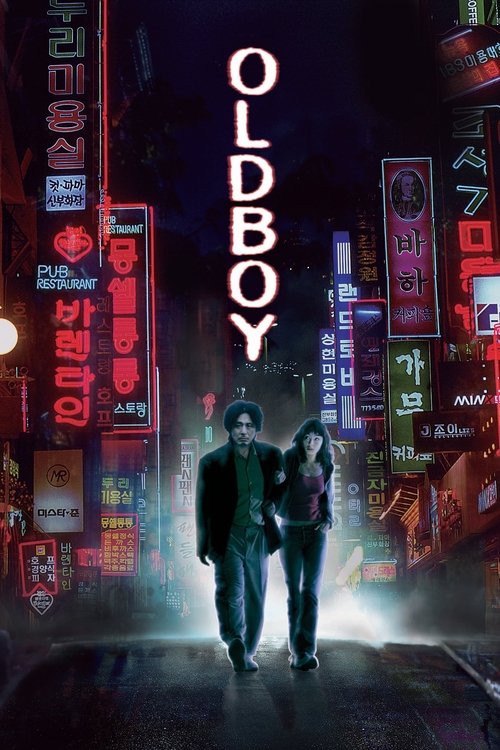
Oldboy
2003 · Park Chan-wook
Decision to Leave made him Letterboxd's romantic-obsession auteur; No Other Choice's Venice reception restarted the "greatest living Korean director" argument with Bong partisans. Elegance-plus-perversity is his brand in the discourse.
For when you want to be shaken — a film to watch with the lights off and argue about for days afterward. This is challenge viewing, not comfort viewing, and squeamish viewers should know it earns its reputation.
What it's about
A drunken Seoul businessman, Oh Dae-su, is snatched off the street and locked in a private cell — no explanation, no captor, no trial — for fifteen years. Then, just as inexplicably, he's released. With a wad of cash, a phone, and a bottomless well of rage, he sets out to find who imprisoned him and why, aided by a young sushi chef, while his unseen jailer turns the search itself into a cruel game.
The experience
Ferocious and hypnotic — a revenge thriller that plays like a fever dream, veering from pitch-black comedy to brutal violence to genuine heartbreak, sometimes within a single scene. It grabs you by the collar early and squeezes harder as the mystery closes in; the final stretch is devastating.
Performances
Choi Min-sik gives one of the great screen performances — feral, pitiful, and heartbreaking by turns, a man rebuilt entirely out of hunger and rage. Yoo Ji-tae is his chilling opposite: all silk and stillness where Choi is raw nerve.
The craft
Park Chan-wook directs with operatic confidence — bold colors, needle-sharp compositions, a mournful waltz of a score — and stages a corridor fight in one grueling, side-scrolling take that has become one of the most celebrated action scenes ever filmed. The violence is visceral, but the filmmaking around it is exquisite.
Why it matters
Its Grand Prix at Cannes in 2004 helped announce Korean cinema to the wider world, made Park an international name, and set a template for stylish, morally serious revenge films that filmmakers everywhere still chase.
Snapshot
A man named Oh Dae-su is abducted without explanation and held for fifteen years in a featureless private cell, then released without explanation into a Seoul he no longer knows. Driven by the need to identify his jailer, he follows a trail that leads to a young sushi chef named Mi-do and, finally, to the architect of his captivity: the wealthy, ice-blooded Lee Woo-jin. The film's engine is the classical revenge plot; its payload is a Greek tragedy whose Oedipal logic only becomes legible in the final act. Oldboy arrives at its twist not as a genre contrivance but as the logical terminus of everything the film has been building — a punishment calibrated not to destroy the body but to break the will to live. Park Chan-wook delivers this material in a style that is simultaneously operatic and forensic, blending visceral physical violence with images of preternatural formal beauty. The result is one of the defining films of the 2000s and the high-water mark of what international critics labeled the Korean New Wave.
Industry & production
Oldboy adapts the Japanese manga Old Boy by Garon Tsuchiya and Nobuaki Minegishi, serialized from 1996 to 1998 in the manga anthology Big Comic Spirits. Park and his co-writers — Hwang Jo-yoon and Lim Jun-hyeong — departed substantially from the source, retaining the central conceit of unexplained imprisonment and a shocking revelation about the captor's identity while overhauling the setting, tone, and the specific nature of the twist. The film was produced under the South Korean production company Egg Films and released domestically by Show East. International distribution was handled by Tartan Films (UK) under their Asia Extreme label, which had already introduced Western audiences to Park's Sympathy for Mr. Vengeance (2002) and which positioned Oldboy as the flagship title of a broader marketing strategy around extreme East Asian cinema. That label, "Asia Extreme," was commercially effective but critically contested, flattening a diverse range of filmmaking into a single brand identity organized around transgression.
Oldboy was the second entry in what Park retrospectively named the Vengeance Trilogy, bookended by Sympathy for Mr. Vengeance (2002) and Lady Vengeance (2005). The three films share no characters or plot continuity but form a philosophical suite on the nature and consequences of revenge — each film arriving at a different conclusion about whether vengeance provides the satisfaction it promises.
Technology
Oldboy was shot on 35mm film in the 2.35:1 anamorphic widescreen ratio that Park and cinematographer Chung Chung-hoon favored for its capacity to isolate figures within a horizontally expansive frame or compress them against oppressively close walls. The production employed practical sets constructed to exacting specifications — the private prison cell in which Oh Dae-su spends fifteen years is a built space photographed from angles chosen in pre-production. Digital color grading, then becoming standard practice in South Korean studio releases, was used to enforce the film's dominant palettes: the cold institutional gray-blue of the captivity sequences, the slightly warmer but still tonally suppressed register of the contemporary Seoul sequences, and the brief eruptions of warmth that accompany the romance with Mi-do — warmth the narrative will retroactively contaminate. No significant use of CGI is present; the film's violence is achieved through practical staging and performance.
Technique
Cinematography
Chung Chung-hoon, who would go on to shoot Lady Vengeance, Thirst (2009), and later a run of English-language productions (It, Doctor Strange in the Multiverse of Madness), brings to Oldboy a compositional intelligence that is always aware of the frame as a moral instrument. The camera is rarely neutral: canted angles, overhead views that reduce Oh Dae-su to a figure trapped in an architectural diagram, and extreme close-ups that make the act of eating — the live octopus being the film's most notorious image — feel simultaneously intimate and alien. The laterally tracking long corridor is the film's signature shot context: the hallway fight is filmed from a fixed side-on angle, the camera gliding along the wall as Oh Dae-su battles his way through a corridor of enemies, the framing evoking both a side-scrolling video game and a Breughelian frieze of bodies in combat. The widescreen frame is used throughout to suggest characters who are surveilled, classified, and contained — the horizontal plane becomes a register of power.
Editing
Kim Sang-bum, Park's editor on several films from this period, cuts Oldboy in a manner that refuses easy rhythmic comfort. The film's temporal structure — flashing between past and present, between Oh Dae-su's recorded journal entries and his present-tense pursuit — is handled through cuts that are sometimes abrupt to the point of violence and sometimes withheld to create agonizing duration. The editing is perhaps most consequential in what it defers: the film is built on strategic withholding, on cuts away from information that would solve the mystery, on the gradual revelation that the protagonist has been a figure in someone else's narrative all along.
Mise-en-scène / staging
The private prison cell is Oldboy's foundational mise-en-scène decision: a room of approximately twelve square meters, furnished with a television, a bed, and a calendar. Its beige walls document Oh Dae-su's mental state as wallpaper is torn away, words scratched in, fists marked against plaster. That the same cell becomes oddly domestic over time — Oh Dae-su exercises, trains, teaches himself to fight against the wall — is the film's first sustained argument about adaptation and endurance. Park stages the confined sequences with a spatial precision that makes the room feel both thoroughly understood and inescapably small. Outside the cell, the film's staging tends toward the theatrical: confrontations are staged with an almost operatic use of space, characters positioned at opposing poles of wide frames, surrounded by negative space that renders the interpersonal as cosmological.
Sound
Composer Jo Yeong-wook (also credited as Cho Young-wuk) provides a score that is central to the film's tonal range. His most prominent contribution is a recurring piano waltz — variously titled across releases — that functions as the film's emotional counterweight to its violence: lilting, melancholy, almost naively beautiful. The irony of that beauty against what is being depicted is not accidental; it is the film's thesis in sonic form. Jo's score also employs strings and occasional dissonance to mark moments of psychological rupture. Sound design tracks Oh Dae-su's perceptual state: the deadened ambience of the cell, the abrupt loudness of the outside world after fifteen years, the specific textures of combat as experienced from inside an exhausted body.
Performance
Choi Min-sik gives a performance of controlled extremity. He is required to enact fifteen years of psychological alteration through posture, gait, and the specific hunger with which Oh Dae-su inhabits the world after his release — a man who has trained himself into near-perfect physical condition but whose emotional responses remain those of a confused drunk, arrested at the moment of his abduction. The scene in which he eats a live octopus was performed with an actual live cephalopod across multiple takes; Choi Min-sik, a practicing Buddhist, reportedly prayed for the octopus between takes. The physical commitment is documentary-real. Against him, Yoo Ji-tae plays Lee Woo-jin as a figure of absolute composure — the stillness of someone whose revenge is already complete before the film begins, who watches Oh Dae-su's investigation with the detached pleasure of a man rewatching a film he directed. The contrast is the film's central dramatic engine: torment versus tranquility.
Narrative & dramatic mode
Oldboy operates in the mode of the mystery-thriller but its narrative architecture is ultimately Sophoclean. Like Oedipus Rex, it follows a protagonist engaged in an investigation whose conclusion is the revelation of his own guilt — where Oedipus seeks the murderer of Laius, Oh Dae-su seeks the identity of his jailer, and both men discover they have been asking the wrong question. The film is explicit about this parallel: Lee Woo-jin has constructed the entire scenario as an Oedipal trap, an engineered tragedy in which Oh Dae-su, given the option of knowing the truth or remaining ignorant, chooses to know. The final act reframes the entire preceding film: every scene of apparent agency on Oh Dae-su's part is revealed as choreographed, every apparent choice as a step toward the predetermined revelation. This retroactive contamination of the audience's experience — the sudden need to mentally rescreen everything one has just watched — is one of the film's most disturbing formal achievements.
Genre & cycle
Oldboy inhabits the noir thriller but also belongs to the broader early-2000s international vogue for what critics sometimes called "extreme cinema" or "torture cinema" — a loose category that included works by Michael Haneke, Gaspar Noé, and Lars von Trier alongside the Asian horror and action films that Tartan's Asia Extreme label helped circulate. Park's film is more precisely organized than much of this category suggests: the violence in Oldboy is never gratuitous in the sense of being purposeless; each act of violence carries a specific narrative and thematic charge. The film also belongs to the Korean revenge thriller cycle — a subgenre that would include Kim Jee-woon's A Bittersweet Life (2005) and I Saw the Devil (2010) — in which the moral logic of vengeance is pressed until it collapses.
Authorship & method
Park Chan-wook is the organizing intelligence of Oldboy in a manner consistent with the auteur paradigm. He is known for intensive pre-production storyboarding and a highly deliberate approach to composition in which shots are planned rather than discovered; the camera's behavior in Oldboy bears the marks of this method. His thematic obsessions — moral complicity, the inadequacy of revenge as a framework for justice, the catastrophic weight of secrets, formal beauty in proximity to horror — are consistent across the Vengeance Trilogy and his subsequent work.
Chung Chung-hoon's cinematography is indispensable to the film's register: the precise collaboration between director and DP produces images that are at once emotionally overwhelming and compositionally controlled. Jo Yeong-wook's score is the film's tonal conscience, supplying the beauty that the narrative relentlessly undermines. The screenplay, attributed to Park along with Hwang Jo-yoon and Lim Jun-hyeong, departs from the manga in ways that transform what was an effective genre thriller into something philosophically denser.
Movement / national cinema
Oldboy is the apex of what became internationally known as the Korean New Wave or the Korean Renaissance — a period of extraordinary creative and commercial productivity in South Korean cinema beginning in the late 1990s and extending through the mid-2000s. This flowering was enabled by structural conditions: the post-1997 financial crisis reorganization of the Korean film industry, government cultural policies that imposed a screen quota protecting domestic productions, and the emergence of a generation of formally ambitious directors who had grown up watching world cinema and who brought those influences to bear on distinctly Korean material. Alongside Bong Joon-ho, Kim Jee-woon, and Na Hong-jin, Park Chan-wook represented a wave of authorship-oriented filmmaking that achieved both domestic commercial success and international critical prestige. Oldboy's Cannes triumph was a key moment in that recognition, demonstrating that Korean genre cinema could operate at the highest levels of international festival culture.
Era / period
Oldboy belongs to the early-to-mid 2000s moment in global cinema when a loosely affiliated set of films — from Noé's Irréversible (2002) to von Trier's Dogville (2003) to Haneke's Caché (2005) — were interrogating the moral foundations of cinematic spectatorship, asking audiences to examine the pleasure they took in structured suffering. Oldboy participates in this interrogation while remaining more invested in genre mechanics than most of its peers; it is, formally and commercially, a thriller, but one whose conclusions about the limits of revenge and the unbearability of certain truths align it with the art cinema concerns of the period. It also belongs to the post-millennial moment of puzzle-box narratives — films structured around dramatic reversals of meaning — which, in Hollywood, produced works like Memento (2000) and Mulholland Drive (2001).
Themes
Revenge is the film's explicit subject and its most sustained irony: Oh Dae-su pursues vengeance against a man who has already achieved vengeance against him, and the pursuit only deepens his captivity. The film argues that revenge is not liberation but a further form of imprisonment — that to organize one's life around the injury done by another is to remain inside that injury indefinitely.
Memory and identity are intertwined throughout. Oh Dae-su cannot remember the act that precipitated his captivity — the careless rumor he spread as a teenager about Woo-jin and his sister — because it was not, to him, a consequential act at all. The film explores how an incident of no subjective weight can accumulate lethal objective gravity over decades. The revelation depends on the audience understanding that Oh Dae-su's guilt is real even though his memory of it is absent.
Incest functions not as exploitation but as the mechanism by which the Oedipal structure is made literal and by which the film achieves its most extreme statement: that certain knowledge, once possessed, cannot be survived intact. The final image of Oh Dae-su, post-hypnosis, encountering Mi-do in sunlight — whether that smile represents achieved amnesia or a man who has chosen ignorance over annihilation — is one of the most contested endings in contemporary cinema.
Reception, canon & influence
Critical reception: Oldboy screened in competition at Cannes in 2004, where the jury — presided over by Quentin Tarantino — awarded it the Grand Prix. The award brought the film immediate international attention and established Park Chan-wook as a director of world stature. Tarantino's advocacy was significant if also double-edged, framing the film primarily through its visceral impact rather than its philosophical architecture. Western critical reception was substantially positive, though a strand of critical unease about the film's content — specifically the treatment of its incest plot — persisted.
Influences on the film (backward): The film's debts are multiple. Greek tragedy, and Oedipus Rex specifically, provides the narrative skeleton. Alfred Hitchcock's grammar of suspense — particularly the Hitchcockian technique of giving the audience information the protagonist lacks — shapes the film's management of dread. The manga source provides the foundational conceit. Park has acknowledged a broad cinephilic formation including European art cinema and American genre filmmaking; the film's willingness to use genre conventions as a vehicle for philosophical content is characteristic of the directors, from Melville to Peckinpah to De Palma, who took that approach before him.
Legacy and forward influence: Oldboy had a generative influence on the action cinema that followed it. The corridor fight — specifically its side-on, near-single-take presentation of exhausted, attritional violence — became one of the most imitated sequences of the following decade, with explicit citations visible in Gareth Evans's The Raid (2011), James Wan's Daredevil hallway sequence in the Netflix series (2015), and numerous other action productions. The film also contributed substantially to the international appetite for Korean cinema that would, by the late 2010s, produce Bong Joon-ho's Parasite (2019) and the subsequent global mainstreaming of Korean popular culture. An American remake directed by Spike Lee was released in 2013 to largely negative critical reception; its failure by comparison with the original is itself instructive about how thoroughly the film's formal strategies are integrated with its content — the visual and structural choices are not decorative but constitutive of meaning, and they do not transfer. Oldboy remains in active critical circulation as both a landmark of Korean national cinema and a specimen of what the revenge thriller can achieve when pressed to its logical and ethical extremes.
A Deleuzian reading
The corridor is filmed flat from the side, the camera gliding along the wall like a reader's eye tracking a line of text.
The full Deleuzian reading of Oldboy →
Reception
It exploded out of Cannes 2004 with the Grand Prix — handed over by jury president Quentin Tarantino, who championed it loudly — and for a generation of Western viewers it was the gateway drug to Korean cinema; two decades, a 4K rerelease, and a post-Parasite reappraisal later, it's settled comfortably into the modern canon.
How Oldboy was received, from release to now →
Influences: the films it descends from and the films it influenced
- Chinatown (1974) — Polanski embeds a Greek incest tragedy inside a noir investigation, establishing the template Oldboy inherits: a protagonist whose relentless quest for truth arrives at a revelation that retroactively contaminates every preceding scene, with the investigator's dogged competence revealed as the very mechanism of catastrophe.
- Vertigo (1958) — Hitchcock structures strategic withholding as a formal architecture — revealing Judy's identity to the audience while concealing it from Scottie, creating the dramatic irony of a protagonist who is last to know he has been the instrument of another's design — the precise narrative engineering Oldboy replicates as its central device.
- Lady Snowblood (1973) — The manga-to-cinema pipeline that produced Oldboy's source material runs through Fujita's film: a revenge quest structured in titled chapters, with extreme violence staged in laterally composed anamorphic frames that transform brutality into formal spectacle, establishing the manga-derived aesthetics Oldboy inherits.
- Come and See (1985) — Kravchenko's performance documents bodily and psychological deterioration across the film's runtime — his face aging into trauma as a physical record of suffering — establishing the methodology of treating the actor's body as documentary evidence that Choi Min-sik inherits for his physicalized portrait of fifteen years of captivity.
- Three Colors: Blue (1993) — Preisner's unfinished concerto surfaces unbidden into Julie's consciousness as an intrusive sonic presence she cannot suppress; Oldboy's piano waltz leitmotif operates identically — a melodic fragment that ambushes characters and viewers alike as a perceptual marker of psychological state, sound crossing the boundary between diegetic and interior.
- Hard Boiled (1992) — Woo's hospital corridor climax — a sustained lateral tracking shot following gun combat through narrow institutional hallways — establishes the choreographic grammar of confined-space action filmmaking that Oldboy's hallway brawl directly inherits, substituting exhausted hand-to-hand attrition for ballistic ballet while preserving the fixed-axis, side-scrolling formal logic.
- Sympathy for Mr. Vengeance (2002) — Park's first Vengeance Trilogy entry establishes the theatrical wide-frame staging of confrontation sequences, the cold desaturated palette, and the philosophical refusal of cathartic satisfaction that Oldboy inherits; it is the formal and moral laboratory in which Park develops the visual grammar he will amplify to operatic extremity.
- Fight Club (1999) — Park's single-corridor fight sequence — exhausted, horizontal, filmed in near-unbroken side-view emphasizing endurance and ugliness over choreography — extends Fight Club's naturalistic violence aesthetic against Hollywood action grammar, while the identity-shattering incest revelation employs the same retroactive recontextualization structure as the Tyler Durden twist.
- The Usual Suspects (1995) — Park deploys a confidence-trick structure orchestrated by an off-screen mastermind whose revealed plan forces total retroactive recontextualization, extending Singer's hidden-sovereign architecture to a more formally extreme register where the mark's every action was engineered by the antagonist from the start.
- Joint Security Area (2000) — Kim Sang-beom's editing manages the climactic truth-sequence with the same rapid cutting and spatial disorientation JSA deploys for the shooting; the protagonist who discovers he was the unwitting agent of his own destruction mirrors JSA's narrative logic of self-implication through withheld evidence.
- Tokyo Drifter (1966) — The corridor fight sequence deploys a static frontal proscenium framing — the camera holds position while choreographed confrontation unfolds laterally across it — treating genre violence as theatrical tableau rather than kinetic event, sharing Suzuki's kabuki-influenced blocking strategy of spatial composition over camera movement.
- Audition (2000) — Carries Asia Extreme's fusion of art-cinema framing with sudden corporeal violence (the tendon, the hammer) into Korean revenge cinema, exporting the Japanese-extreme shock Audition helped legitimize.
- Lady Vengeance (2005) — Park's trilogy conclusion refines Oldboy's central formal devices — the theatrical wide-frame confrontation between avenger and antagonist, the piano-based score as moral accompaniment, and the Sophoclean structure in which a revenge quest ends in the protagonist's own complicity — now channeled through a female protagonist whose controlled extremity of performance directly extends Choi Min-sik's methodology.
- Stoker (2013) — Park transposes Oldboy's core formal devices into American Gothic: a house that functions as a psychological prison (confined-cell mise-en-scène logic applied to a domestic interior), a piano leitmotif that surfaces repressed character psychology, and a Sophoclean family tragedy in which a blood revelation transforms the meaning of every preceding scene.
- I Saw the Devil (2010) — Kim extends Oldboy's implicit argument that sustained revenge destroys the avenger into an explicit structural principle — the entire film is organized around the moment Soo-hyun recognizes his methodical pursuit has made him indistinguishable from his prey — with Lee Byung-hun's physical documentary commitment directly inheriting Choi Min-sik's methodology.
- The Handmaiden (2016) — Chung Chung-hoon extends the Oldboy visual language — overhead surveillance framing, figures isolated within the architecture of captivity — while the film's triple-perspective structure, in which the same events are recontextualized three times with accumulating retroactive contamination, develops Oldboy's single-twist architecture into a sustained formal principle.
- The Wailing (2016) — Na Hong-jin extends Oldboy's perceptual state design through sound — ambiguous sonic intrusions that contaminate the viewer's interpretation of whether events are supernatural or psychological — and structures the entire film around a protagonist's catastrophic misreading of available information, elevating Oldboy's strategic withholding into an epistemological principle about the unreliability of perception.
- Parasite (2019) — The Parks' overhead surveillance gaze at the Kims from their elevated living room, and the bunker's function as an architectural diagram of class captivity, extend Oldboy's vocabulary of overhead framing and confined-space mise-en-scène as instruments of social power; the structural revelation that a family has been living hidden beneath the house achieves retroactive contamination of every preceding scene.
- No Other Choice (2025) — Codifies Park's signature tonal whiplash between cruelty and absurd tenderness and his meticulously pre-visualized, rigorously controlled frame deployed for moral discomfort.
- Thirst (2009) — The editorial template developed with Kim Sang-bum — cross-register cuts that admit black comedy into traumatic narrative at precise tonal pressure points — is the method Thirst inherits and applies to horror; the sudden pivots from violence to absurdist domestic comedy are recognizable as a signature established here.
- The Yellow Sea (2010) — The corridor hammer fight codified the unglamorous-weapons aesthetic in Korean genre cinema — sustained, exhausting violence without ballistic resolution — which Na extends into the axe and bone-saw staging of The Yellow Sea's action sequences.
- The Man from Nowhere (2010) — Park's unbroken long-take corridor fight — the formal device of staging sustained combat in a single extended shot so that physical exhaustion is embedded in viewing duration, the specific technique Lee adapts for the pharmacy sequence and establishes as a Korean genre signature.
- Headhunters (2011) — Trap-structure thriller in which an antagonist's elaborate first-act plant (the protagonist's buried past crime) becomes the payoff mechanism; physical extremity as performance mode — the protagonist's body as site of sustained punishment — establishing a genre precedent Headhunters' pig-farm sequence directly inherits.
- The Raid (2012) — The corridor fight's choreography around performer exhaustion within a single unbroken take — Oh Dae-su genuinely staggering, unable to stand straight, enemies collapsing with him — is the direct template for The Raid's insistence that physical cost accumulate visibly across takes rather than being reset between cuts.
- Irreversible (2002) — Noé's reverse-chronological structure is the European parallel to Oldboy's temporal fragmentation: both deploy non-linear editing as a retroactive contamination device, making pleasure in early scenes unbearable once the film's terrible information arrives; both also center an extended, physically punishing corridor-violence sequence filmed with sustained duration and no relief.
- Memories of Murder (2003) — Bong deploys the same anamorphic widescreen register to isolate figures against the institutional landscapes of Korea, and both films use the investigation structure to arrive at an unresolved revelation about systemic failure rather than individual guilt; released within months of each other, they constitute the matched peak of Korean New Wave genre filmmaking.
- A Bittersweet Life (2005) — Kim photographs Lee Byung-hun's hitman through the same anamorphic compositional logic Chung Chung-hoon uses for Oh Dae-su — lone male figures compressed into architectural frames, violence staged as precisely choreographed formal spectacle — extending Korean extreme cinema's fusion of aesthetic beauty and physical brutality into a more classically operatic register.
- The Prestige (2006) — Park's Gothic revenge architecture builds to a revelation that retroactively reconstitutes the protagonist's identity; the antagonist as concealed puppeteer whose entire plot was a staged trap — a mechanism of total narrative entrapment — is structurally analogous to The Prestige's Angier/Borden relationship.
- Ichi the Killer (2001) — The Asia-Extreme sibling that likewise fuses stylized revenge-genre craft with visceral foley-heavy violence (the hammer, the live octopus) framed as moral inquiry rather than mere assault.
- Love Exposure (2008) — Operatic revenge built on a delayed nested-backstory reveal and taboo love, sustaining melodrama at pulp-maximalist pitch.
- Confessions (2010) — Sets the Asian-extreme revenge-thriller template — operatic reveals, stylized slow-motion, formal bravura in service of vengeance — that Confessions regionally extends.
- The Invisible Guest (2017) — Sibling revenge-mystery whose captor engineers an elaborate architectural trap so a final reveal recasts the protagonist as unwitting culprit, the orchestrated-guilt reversal Paulo prizes.
- Law Abiding Citizen (2009) — Revenge as a decade-long engineered apparatus in which confinement is the instrument rather than the punishment, with the reveal withheld until the architecture of the scheme can be presented as a single designed object.
- The Villainess (2017) — The corridor fight is the film's operative proof: hold the frame, let the fighter visibly tire, and make duration rather than cutting the source of impact — the principle Jung industrializes with rigs so the camera can stay inside the take.
Similar films
- No Other Choice (2025) — influence & lineage · same viewing thread
- The Handmaiden (2016) — influence & lineage · same viewing thread
- Memories of Murder (2003) — influence & lineage · same viewing thread
- Sympathy for Mr. Vengeance (2002) — influence & lineage
- I Saw the Devil (2010) — influence & lineage
- Lady Vengeance (2005) — influence & lineage
- A Bittersweet Life (2005) — influence & lineage
- Hard Boiled (1992) — influence & lineage
All the films related to Oldboy →
Watch it with: curated runs of related films
- New Korean Cinema — Watch these in a run and you feel one national cinema flip between monster movie, revenge thriller, gothic horror, and slow-burn procedural without ever loosening its grip on class, history, and family.
Film essays and courses that include it
- Blood Calls for Blood: The Korean Revenge Cycle
- Rage and Form: The Korean New Wave
- The Hidden Frame: A Century of the Cinematic Twist
- Blood Will Have Blood: Cinema's Long Reckoning with Revenge
- No One Gets Away Clean: The Arc of Revenge Cinema
- The Forger's Cinema: Eight Films That Teach You to Doubt Your Own Eyes
- The Justice That Solves Nothing
- The Beautiful Cruelty