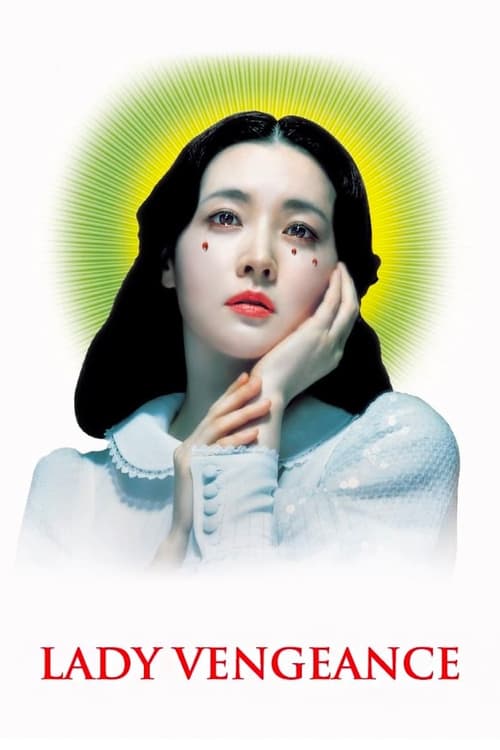
Lady Vengeance
2005 · Park Chan-wook
Decision to Leave made him Letterboxd's romantic-obsession auteur; No Other Choice's Venice reception restarted the "greatest living Korean director" argument with Bong partisans. Elegance-plus-perversity is his brand in the discourse.
For when you want a stylish revenge story that actually costs something — gripping enough for a Friday night, heavy enough to sit with afterward. Expect to be entertained first and quietly gutted later.
What it's about
Geum-ja was nineteen when she was imprisoned for the murder of a child — a crime engineered by her manipulative former teacher. For thirteen years inside a women's prison she cultivates a reputation for saintly kindness while quietly collecting allies and assembling, piece by piece, an elaborate plan. On her release she trades the saint's face for something colder and sets the machine of her retribution in motion.
The experience
Sleek, strange, and emotionally loaded — it moves like a dark fairytale, veering from sardonic comedy to scenes of real moral weight. It's gorgeous and unsettling at once, and by the end it asks harder questions about vengeance than any thriller is obliged to.
Performances
Lee Young-ae is remarkable, pivoting between angelic warmth and glacial resolve — sometimes within a single shot — while Choi Min-sik makes her target repellently, memorably human.
The craft
Park Chan-wook composes every frame like an ornate storybook illustration — baroque wallpapers, falling snow, ceremonial reds — and cuts with a trickster's wit, folding prison flashbacks into the present. The lush score and meticulous design make its beauty part of the point: the prettier it gets, the more uneasy you feel.
Why it matters
The closing film of Park's celebrated Vengeance Trilogy, it cemented his international standing and helped define the wave of Korean cinema that fused genre thrills with serious moral ambition.
Snapshot
The third and final film in Park Chan-wook's "Vengeance Trilogy," Lady Vengeance (Korean: 친절한 금자씨, Chinjeolhan Geumjassi, literally "Kind-Hearted Ms. Geum-ja") is at once the most aesthetically ornate and the most morally searching of the three. Where Sympathy for Mr. Vengeance (2002) is a muted, quasi-naturalist tragedy of class and accident, and Oldboy (2003) a labyrinthine Gothic of fate and self-destruction, Lady Vengeance is a melodrama shot through with fairytale iconography, sardonic wit, and a formal rigor that continually ironizes its own spectacle. A woman named Lee Geum-ja (Lee Young-ae), convicted at nineteen of murdering a child — a crime committed by her manipulative teacher Mr. Baek (Choi Min-sik) — is released after thirteen years and enacts an elaborate, carefully prepared revenge. The film's central and strangest gambit is to democratize that revenge: in its climactic act, the grieving families of Baek's other victims are invited to participate in his punishment, transforming individual vendetta into a collective, quasi-juridical ritual whose moral weight the film refuses to resolve. Its Korean title's irony — Geum-ja is precisely not kind-hearted — reverberates throughout a work concerned with performance, penance, and the impossibility of clean redemption.
Industry & production
Lady Vengeance was produced by Egg Films, with CJ Entertainment handling distribution — a configuration that had served the trilogy from the outset and placed Park within one of the most commercially powerful pipelines in South Korean cinema during the mid-2000s boom. CJ Entertainment's aggressive backing of prestige auteur work was a defining feature of the era, enabling films that combined art-cinema ambition with genuine domestic box-office traction.
The film arrived at a moment of peak international attention on Korean cinema. Oldboy had won the Grand Prix at Cannes in 2004 under Quentin Tarantino's jury, and the world market was primed for Park's follow-up. Domestically, Lady Vengeance was a significant commercial success, and it screened in competition at the Venice Film Festival in 2005. The casting of Lee Young-ae was itself an industry event: she had spent the preceding two years as arguably the most recognizable actress in Korea, thanks to the global phenomenon of the television period drama Jewel in the Palace (Daejanggeum, 2003–2004), which positioned her as an emblem of dignified, traditional femininity. That Park cast her as a meticulously vengeful killer was a deliberate subversion of her public image — a piece of extratextual irony built into the film before a single frame was shot.
Technology
The film was shot on 35mm, consistent with Park's practice through the mid-2000s, and the production made extensive use of controlled studio work alongside location shooting in Seoul and Busan. An alternate version of the film — released as Lady Vengeance: Fade to Black and White — was issued by Park himself, in which the image progressively desaturates as Geum-ja's plan approaches completion, until the climactic sequences run in near-total monochrome. This is not a colorization gimmick but a formally deliberate extension of the film's argument: as Geum-ja sheds the "kind-hearted" performance cultivated in prison, she also sheds the saturated artifice the film associates with self-presentation and social theater. Park has spoken publicly about both versions being equally valid readings of the film, and both circulate as legitimate release versions.
Technique
Cinematography
Chung Chung-hoon, Park's regular cinematographer across much of his output, shoots the film in a palette dominated by cold whites and dense, blood-inflected reds. Geum-ja's signature red eyeshadow — applied immediately upon release, a cosmetic declaration of intent — anchors the film's chromatic logic, while the prison flashback sequences are often coded in washed, institutional tones that throw the present-tense sequences into relief. Chung composes frequently in tight close-ups on faces, particularly Lee Young-ae's, exploiting her bone structure and the performance's subtle gradations of control and grief. The camera is precise and often coolly observational, even during scenes of violence — Park and Chung's characteristic mode is to hold steady and wide while disturbing things occur, refusing expressionist instability in favor of an almost clinical dispassion that intensifies rather than neutralizes horror.
Editing
The film's structure is episodic and fragmented, intercutting Geum-ja's post-release present with an ensemble of prison flashbacks that introduce a large supporting cast. This approach has been compared to the character-mosaic construction of classic melodrama, and it places unusual demands on pacing — the film must accumulate emotional weight across many brief sketches before delivering its extended, sustained climax. The editing, by Kim Sang-bum and Kim Jae-beom (who also cut Oldboy), is attuned to the tonal shifts the material requires, modulating between the film's register of deadpan dark comedy and its register of genuine grief without jarring collision.
Mise-en-scène / staging
Park's staging throughout is highly theatrical, in a tradition that owes something to the artificial depth of Hollywood melodrama and something to the controlled tableaux of European art cinema. The tofu scene that opens the film — Geum-ja refuses the tofu offered by a proselytizing Christian upon her release, a rejection of a Korean folk ritual of purification that signals immediately that she will not be reformed — is staged as a social ceremony punctured by a single gesture, a compressed emblem of the entire film's narrative logic. The children's-book-style chapter intertitles and the recurring motif of baked goods (Geum-ja has learned confectionery in prison) participate in the film's sustained irony: a surface of domestic sweetness laid over the machinery of punishment.
The film's climax — Baek tied in a warehouse, the victims' families invited one by one to administer or decline retribution — is staged with the deliberateness of a theatrical ritual. The families enter, observe, react, and choose; the space is lit and blocked like a performance. Park has described the sequence as posing a genuine ethical question to the audience rather than simply providing catharsis, and the staging is calibrated to resist easy identification or release.
Sound
The score makes prominent and pointed use of Western classical and baroque music. Most notably, a choral arrangement of Vivaldi's Gloria appears during Geum-ja's prison years and in transitional moments — its liturgical grandeur playing against the film's ironized Christianity and its heroine's complex relationship to guilt and sanctity. The use of sacred choral music against morally compromised action is a characteristic device in Park's work, generating meaning through dissonance rather than correspondence. The specific composers and arrangers responsible for original underscore are documented in the film's credits, but their international profile is limited, and the record on their individual contributions remains relatively thin outside Korean-language sources.
Performance
Lee Young-ae's performance is the film's primary formal instrument. Geum-ja is constructed as a performance within a performance: she performed contrition and Christian devotion for thirteen years in prison — convincingly enough to earn the nickname "kind-hearted" — and the film asks us to watch her dismantle that performance layer by layer. Lee calibrates this with exceptional control, reserving her character's authentic interiority for rare, precisely placed moments of collapse or tenderness, largely centered on her relationship with her daughter Jenny (played by the young Australian-Korean actress Kwon Yea-young). The contrast with Choi Min-sik as Baek is instructive: where Choi's work in Oldboy was all explosive physical commitment, here he plays restraint, a man whose monstrousness was invisible beneath a respectable surface — the inverse of Geum-ja's visible performance of virtue.
Narrative & dramatic mode
The film is structured in two large movements. The first is essentially an introduction of a community — Geum-ja's prison relationships, her post-release network of allies, her search for her daughter — built through episodic vignettes with tonal variety ranging from comedy to quiet pathos. The second is a sustained procedural and ethical drama: the discovery that Baek was a serial child murderer rather than a single opportunistic killer transforms individual revenge into something that must accommodate collective grief. Park has discussed the shift as an attempt to ask whether revenge can be institutionalized — whether the community's involvement purifies it or simply distributes its moral contamination. The film refuses to adjudicate, ending instead on Geum-ja's face in snow, a gesture toward penance whose sincerity or adequacy the film declines to confirm.
Genre & cycle
Lady Vengeance participates in multiple genre traditions simultaneously. It is generically a revenge film, and as such belongs to a lineage running from Greek tragedy through The Count of Monte Cristo (whose influence on the trilogy's plotting is often noted) through the Japanese pinky violence and exploitation cycles of the 1970s. It is also, distinctly, a women's melodrama in the tradition Douglas Sirk codified: a narrative in which a woman's interiority is placed under pressure by social and domestic forces, and in which excess of style is the register of suppressed feeling. The prison-community sequences draw on a genre staple (the women's prison film) while consistently refusing its titillating conventions. Park positions the film at the intersection of art cinema, genre film, and melodrama in a way that resists easy categorical settlement.
Authorship & method
Park Chan-wook co-wrote the screenplay with Jeong Seo-kyeong, his regular collaborator (Jeong also co-wrote I'm a Cyborg, But That's OK, 2006, and several subsequent projects). Their collaboration is notable for its structural ambition — both tend toward complex temporal architecture and large ensemble casts organized around a single moral or philosophical question — and for a tone that holds irony and genuine emotional investment in productive tension. Park has been consistent in interviews about his interest in the representation of revenge not as fantasy fulfillment but as ethical problem: the trilogy as a whole can be read as a sustained interrogation of why audiences desire revenge plots and what that desire reveals.
Chung Chung-hoon's cinematographic contribution to the visual system of the trilogy is substantial. His work with Park across multiple films established a visual language of saturated color, tight human geometry, and controlled camera movement that is inseparable from the films' authorial identity. Chung has subsequently worked extensively with Western directors, including Wes Anderson (The Grand Budapest Hotel effects unit work) and Sofia Coppola, bringing techniques developed in the Park collaboration into international prestige-cinema contexts.
Movement / national cinema
Lady Vengeance is a central document of what is variously called the Korean New Wave, the Korean Renaissance, or the "New Korean Cinema" — the generational and institutional shift in South Korean filmmaking that began in the late 1990s and accelerated through the 2000s. The movement emerged in part from the state's relaxation of censorship and investment in a film infrastructure, including the establishment of the Korean Academy of Film Arts, and was characterized by formal ambition, genre hybridization, and a willingness to engage historical trauma (the Korean War, the Japanese colonial period, the authoritarian decades) alongside contemporary social anxiety. Park Chan-wook, alongside directors like Bong Joon-ho, Kim Ki-duk, Lee Chang-dong, and Hong Sang-soo, was among the figures whose international visibility defined the movement's global reputation.
Era / period
The film belongs to the mid-2000s period in which Korean cinema enjoyed its first sustained wave of international critical recognition and festival success. Oldboy's Cannes prize in 2004 was a watershed, and Lady Vengeance's appearance at Venice in 2005 consolidated the sense that Park was a filmmaker whose work demanded engagement on the same terms as the canonical auteurs of European and East Asian art cinema. The period was also one of significant industrial consolidation in Korea, with the major conglomerates (CJ, Lotte) investing heavily in domestic production as a cultural-export strategy — a context that gave directors like Park unusual resources while also situating their work within commercial imperatives.
Themes
Redemption and its impossibility run through every layer of the film: Geum-ja performs redemption in prison, seeks it through revenge, and seems no closer to it in the snow of the final image. The film treats Christianity with ambivalence verging on critique — the prison pastor who claims Geum-ja as his spiritual success is a figure of comic inadequacy, and Geum-ja's baking of an elaborate cake as penance for a woman she wronged in prison is presented as simultaneously sincere and insufficient, a gesture toward reparation that the film refuses to redeem. Motherhood and its distortions — Geum-ja gave her daughter up, her daughter was raised elsewhere, their reunion is awkward and charged — constitute the film's emotional core. And the collectivization of the final revenge act raises questions about justice, community, and the limits of legal frameworks that the film associates with Geum-ja's individualism giving way to something more troubling and more human.
Reception, canon & influence
Critical reception at the time of release was largely positive, though some reviewers found the film less formally overwhelming than Oldboy, reading it as the comparatively tender or even sentimental final movement of the trilogy — a judgment that has shifted somewhat in retrospect, with several critics now arguing it is the most complex of the three. Its place in the international canon of 2000s world cinema is secure, and it appears regularly in discussions of the decade's most significant work. The film's domestic reception in Korea was strong, and Lee Young-ae's performance earned her significant awards attention.
Backward influences: The most immediate antecedents are the preceding installments of the trilogy and the broader tradition of Korean revenge drama. More distantly, the film draws on Fassbinder's use of melodrama as social critique, on the artificial color systems of Powell and Pressburger, and on the moral ambiguity of classic film noir — specifically noir's interest in protagonists whose revenge or detection projects consume and compromise them. The women's prison film and the revenge-thriller as popular genres both provide conventions the film consciously deploys and subverts. Park's acknowledged admiration for Hitchcock (whose influence on Oldboy's plotting is more direct) registers here in the film's interest in voyeurism and in the spectator's implication in morally problematic acts of looking.
Forward legacy: Lady Vengeance has been a significant point of reference for subsequent filmmakers working in feminist revenge and female-centered genre narrative. Its influence on the broadening of the revenge-film paradigm to include collective moral deliberation is documentable in discussions of films like Promising Young Woman (2020), though direct lines of influence are as always difficult to establish with precision. More broadly, the Vengeance Trilogy as a unit has been a touchstone for a generation of directors in East Asia and beyond who have sought to work within genre frameworks while submitting them to formal and ethical pressure. Park's subsequent work — Thirst (2009), Stoker (2013), The Handmaiden (2016) — developed the visual and thematic preoccupations of the trilogy in ways that have kept Lady Vengeance in active critical circulation, regularly revisited as the origin of motifs and methods that continue to define one of contemporary cinema's most distinctive bodies of work.
A Deleuzian reading
Watch the eyeshadow.
The full Deleuzian reading of Lady Vengeance →
Reception
In 2005 it landed as the 'lesser' finale to the Vengeance Trilogy — critics fresh off Oldboy found it too baroque, too muted. Two decades on it's been thoroughly reappraised, with a vocal contingent of cinephiles now insisting it's actually the best of the three.
How Lady Vengeance was received, from release to now →
Influences: the films it descends from and the films it influenced
- M (1931) — The kangaroo-court climax — an assembled group collectively judging and executing a child murderer — is the structural template for Lady Vengeance's democratized revenge ritual, where Baek's victims' families administer collective punishment; Park literalizes and ritualizes Lang's mob-justice model.
- Written on the Wind (1956) — Sirk's hyper-saturated Technicolor deployed as ironic commentary — surface glamour encoding moral corruption — is the methodological ancestor of Chung Chung-hoon's palette logic, where Geum-ja's blood-red eyeshadow and confectionery-white environments code social performance as self-conscious, hollow artifice.
- Cries and Whispers (1972) — Bergman's sustained red-and-white chromatic scheme used as moral/psychological register — combined with static, clinically wide frames held through intimate ritual suffering — is the direct formal precedent for Chung and Park's refusal of expressionist camera movement during violence.
- The Housemaid (1960) — The foundational Korean text of melodrama-horror genre hybridization, establishing the transgressive female protagonist who weaponizes domestic piety and socially performed virtue — the genealogical root of Geum-ja's prison-cultivated 'kindness' as a long-game deception.
- Three Colors: Blue (1993) — Kieślowski's technique of indexing a single dominant color to a sustained psychological state across an episodic character-sketch structure — one color encoding one moral condition — is the formal predecessor of Park's trilogy logic and Lady Vengeance's color-as-performance-index coding.
- In the Mood for Love (2000) — Chung Chung-hoon has cited Wong's use of saturated color temperature and suppressed-emotion performance framing as a formative influence; specifically, encoding interior psychological states through controlled palette and calibrated tight close-ups rather than camera movement.
- Sympathy for Mr. Vengeance (2002) — Shares editors Kim Sang-bum and Kim Jae-beom and establishes the trilogy's muted, quasi-naturalist visual baseline that Lady Vengeance deliberately overcodes against — the same editorial rhythms applied to antithetical tonal and chromatic registers.
- Oldboy (2003) — Shares Chung Chung-hoon's cinematography and the Kim Sang-bum/Kim Jae-beom editing team; the Gothic revenge labyrinth and its revelation of horror through sustained static wide framing is the direct craft precursor to Lady Vengeance's clinical dispassion during violence.
- Tokyo Drifter (1966) — Park's deliberate chromatic progression — a warm cream-and-yellow palette desaturating toward cold blue as revenge unfolds — uses color change as generic annotation rather than environmental description, deploying the same chromatic-withholding logic Suzuki pioneered as a marker of tonal transformation rather than naturalistic light or time of day.
- Thirst (2009) — Park's continuation with Chung Chung-hoon extends Lady Vengeance's ambivalent Christianity into the film's explicit structuring irony — a vampire-priest — while the dissonant sacred-profane scoring logic established through the Vivaldi Gloria is expanded into explicit liturgical counterpoint.
- I Saw the Devil (2010) — Kim adopts Lady Vengeance's central moral question — whether extended revenge corrupts the avenger — as explicit structural premise, using the same clinical wide-framing during violence to observe the protagonist's gradual ethical dissolution rather than aestheticizing it.
- Stoker (2013) — Park's first English-language film with Chung Chung-hoon transposes Lady Vengeance's theatrical staging and clinical dispassion into a Hollywood production context; the performance-of-social-propriety-concealing-violence motif recurs structurally in the Nicole Kidman arc.
- The Handmaiden (2016) — The most direct formal evolution: the episodic fragmented structure that accumulates truth through layered character-perspective sketches directly extends Lady Vengeance's editing logic; Chung Chung-hoon returns; and performance-within-performance becomes the film's central narrative mechanism rather than a character trait.
- Revenge (2017) — Extends Lady Vengeance's technique of clinical, static wide-framing during acts of violence — refusing subjective or shaky-cam expressionism — and uses color saturation (blood, desert heat) as a deliberate moral register in a female revenge narrative descended from Park's chromatic logic.
- Promising Young Woman (2020) — The structural core of Geum-ja's deception — performing socially legible vulnerability or 'kindness' as the operative weapon of vengeance — is the direct formal precedent; Fennell's hyper-saturated pastel palette as ironic commentary on performed femininity extends Park's chromatic irony into a contemporary register.
- A Tale of Two Sisters (2003) — Contemporary Korean release within the same CJ Entertainment-adjacent production ecosystem; Kim and Chung share an approach to color-saturated, precisely composed wide frames in horror-melodrama hybrids — genre hybridization as formal rather than merely tonal strategy.
Similar films
- Sympathy for Mr. Vengeance (2002) — influence & lineage · same viewing thread · often watched together
- I Saw the Devil (2010) — influence & lineage · same viewing thread
- The Handmaiden (2016) — influence & lineage · often watched together
- Oldboy (2003) — influence & lineage
- Thirst (2009) — influence & lineage
- A Tale of Two Sisters (2003) — influence & lineage
- Stoker (2013) — influence & lineage
- A Bittersweet Life (2005) — same viewing thread · often watched together
All the films related to Lady Vengeance →
Watch it with: curated runs of related films
- Elegant Savagery — A run of sleek, merciless thrillers where vengeance arrives in tailored suits and is paid in broken bone — watch these when you want beauty and brutality in the same frame.