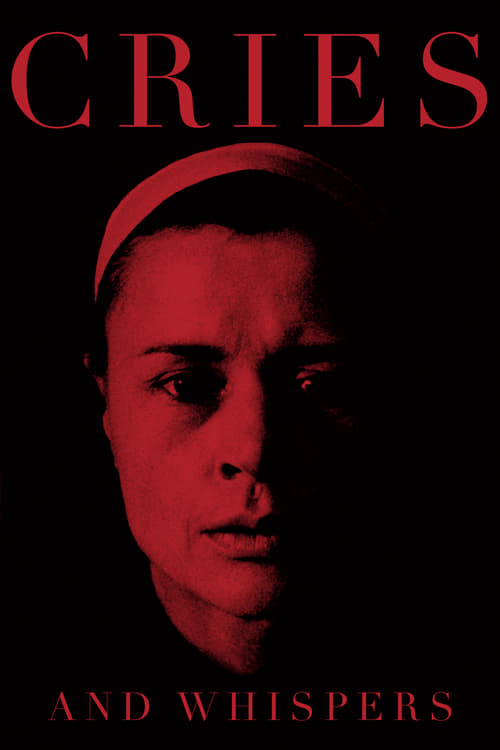
Cries and Whispers
1972 · Ingmar Bergman
For when you want to be moved and wrung out — a film for a quiet, serious night when you can give it your full attention, not background viewing. Choose it when you want cinema that goes all the way in.
What it's about
In a red-draped manor house at the turn of the twentieth century, Agnes is dying of cancer, attended by her two sisters and a devoted servant. As her final days pass, the sisters' own buried resentments, marriages, and failures of love surface around her bed — the vigil exposes everyone. It's a chamber piece about mortality and the terrible difficulty of touching another person, even family.
The experience
Intense, intimate, and emotionally raw — seventy-nine minutes of whispers, breath, and sudden anguish that feel almost physically close. It's beautiful and harrowing in equal measure, and it cuts deep.
Performances
Harriet Andersson's portrayal of the dying Agnes is one of the most unflinching depictions of physical suffering ever filmed, and Liv Ullmann and Ingrid Thulin are devastating as the sisters whose composure keeps cracking open.
The craft
Sven Nykvist's camerawork bathes everything in reds and whites that feel drawn from inside the body, with faces held in enormous close-ups until they become landscapes. Scenes dissolve into pure crimson rather than black, and the sound is stripped to whispers, ticking clocks, and cries. On a good screen the color alone is overwhelming.
Why it matters
It restored Bergman's standing after a fallow stretch and became one of the rare foreign-language films embraced at the American Oscars, cementing his reputation with a whole new audience.
Snapshot
A dying woman spends her last days in a red-draped manor house attended by her two sisters and a devoted servant. Nothing is resolved; everything is exposed. Cries and Whispers is Ingmar Bergman's most formally controlled chamber work and one of the most viscerally affecting films in the canon — a study of mortality, female interiority, and the near-impossibility of human contact, rendered in a palette that feels drawn from the inside of the body. Its seventy-nine minutes of silence, breath, and occasional anguish constitute one of cinema's sustained arguments for the close-up as the primary unit of psychological revelation.
Industry & production
Bergman conceived the film in the early 1970s, at a moment when his international prestige was unquestioned but his domestic financing was not. The Swedish Film Institute, which had backed many of his earlier productions, declined to fund the project. Bergman instead turned to his own company, Cinematograph, and to an arrangement of shared risk with his principal collaborators: Sven Nykvist (cinematography), Harriet Andersson, Liv Ullmann, Ingrid Thulin, and Kari Sylwan each deferred salaries in exchange for a percentage of the film's receipts. The arrangement was later vindicated — the film performed well internationally and won an Academy Award — but the willingness of these artists to work on spec reflects the unusual solidarity of Bergman's long-standing company of collaborators. The production was small, intimate, and concentrated; filming took place in a real Swedish manor house (Taxinge-Näsby in Södermanland), with Bergman and Nykvist converting its actual spaces into the suffocating red interior that the film requires.
In the United States, the film was distributed by Roger Corman's New World Pictures — an improbable arrangement that speaks to the arthouse market conditions of early-1970s America, when exploitation and prestige often shared distribution infrastructure. The film received five Academy Award nominations, including Best Picture, Best Director, and Best Original Screenplay, and Nykvist won for Best Cinematography.
Technology
Nykvist and Bergman shot on 35mm with a preference for long lenses and minimal artificial lighting supplemented by available light and carefully positioned practicals. The decision to bathe virtually every interior surface — walls, curtains, cushions, costumes — in deep red placed exceptional technical demands on the exposure and color grading of the period. Nykvist has described the challenge of maintaining consistent density in a monochromatic red environment while preserving tonal separation in faces; the faces are, after all, where the film lives. The result required meticulous control of light temperature and reflective surfaces. The film stock of the era — Eastmancolor negative — could bloom or crush in highly saturated environments, and the precision of the cinematography in avoiding both extremes is a significant technical achievement. No digital tools were available; every decision was committed on set.
Technique
Cinematography
Sven Nykvist's work here is among the most celebrated in the history of the medium. The dominant compositional strategy is the extreme close-up: faces fill the screen and press against its edges, eliminating spatial context and forcing the viewer into an almost physically uncomfortable proximity with suffering. Nykvist uses a slow, weighted camera that moves with deliberation — gliding toward a face as consciousness recedes, holding on eyes that cannot close. The red of the environment is not merely a color choice but a chromatic statement: Bergman has written that he conceived of the soul as a red, moist membrane, and the saturated interiors enact that interiority spatially. Against this red, the white of the women's nightgowns and the pallor of dying skin read as exposure, as the body stripped of its social covering.
Editing
Siv Lundgren edited the film, and the editing is among its most distinctive formal features. Transitions between sections of the film are accomplished through cuts to pure red frames — not fades to black but abrupt, silent immersions in red — that function as both chapter breaks and heartbeats. Within scenes, the cutting is patient; Bergman and Lundgren trust duration in a way that contravenes conventional dramatic editing. A reaction is held past the point of emotional comprehension, forcing viewers to sit with feelings the character cannot articulate. The four "episodes" or fantasy sequences — one oriented around each woman — are distinguished from the present-tense scenes by subtle shifts in cut rhythm and by the content of the images themselves, which take on a quality of interiority that the main narrative withholds.
Mise-en-scène / staging
The film is set at the turn of the twentieth century, and the production design (by Marik Vos-Lundh, who also designed the costumes) constructs a claustrophobic bourgeois world of heavy fabric, dark wood, and accumulated objects. Bergman stages scenes so that characters rarely face one another directly; they arrange themselves against walls, in doorways, in the margins of rooms — proximity without contact. The famous scene in which Anna (Kari Sylwan) holds the dead Agnes in a pietà arrangement is one of the most deliberately composed images in the film: Anna's back is to the camera, the tableau invoking Renaissance precedent while refusing the viewer access to her face. This staging decision — withholding the emotional legibility of a face at the film's most overtly spiritual moment — is characteristic of Bergman's willingness to use withholding as an instrument.
Sound
The title announces its acoustic stakes. The film's sound design distinguishes between the "cries" of open grief or physical pain and the "whispers" of private speech, withheld communication, and the ambient sound of breathing. Silence is used structurally: Bergman and sound designer (the Swedish production mixed in-house) create rooms with distinct acoustic signatures, and the dying room — Agnes's bedroom — is treated with a kind of acoustic softness that marks it as outside normal time. Two pieces of pre-existing music anchor the film: a Sarabande from one of Johann Sebastian Bach's cello suites, played unaccompanied, functions as the film's temporal toll — solemn, metronomic, counting time that is running out — and a Mazurka by Frédéric Chopin (Op. 17, No. 4 in A minor) appears in association with Anna and Agnes's shared intimacy. Neither piece is used ironically; Bergman is using music as he uses faces, as direct access to interiority.
Performance
The four principal performances are, collectively, the film's primary subject and primary instrument. Harriet Andersson as Agnes commits to a physical extremity that is difficult to watch and impossible to discount: her portrayal of advanced cancer — the contorted breathing, the slow ruin of the body's control — was praised by critics as among the most searching acts of physical characterization in European cinema. Ingrid Thulin as Karin and Liv Ullmann as Maria carry the film's psychological burden in a different register: repressed, surface-controlled, intermittently erupting. Thulin's Karin self-mutilates in a scene of quiet, horrifying precision; Ullmann's Maria is all soft vanity that suddenly shows its core of emptiness. Kari Sylwan as Anna — the servant, the only character who sustains genuine love — provides the ethical center. Bergman elicited these performances through a rehearsal process that is documented in his published writings, though the specific mechanics of his direction on Cries and Whispers have not been reconstructed in scholarly detail.
Narrative & dramatic mode
The film proceeds less through plot than through what might be called psychic excavation. Each of the four women is given an inward sequence — a memory, a fantasy, a confession — that reveals what lies beneath the social surface. Agnes dies early in the film, or appears to; she also returns, briefly, impossibly, in what Bergman refuses to code as either supernatural or hallucinatory. The film has a five-act structure that maps loosely onto the four women plus a shared epilogue, a memory of an afternoon in the garden that Agnes reads from her diary — an image of temporary happiness placed at the film's close as an unreachable past. The dramatic mode is chamber drama in the tradition of Strindberg, stripped of the explanatory apparatus of psychological realism and operating instead through symbol, juxtaposition, and accumulation.
Genre & cycle
Cries and Whispers belongs to the tradition of European art cinema at its high-water mark, alongside contemporaneous work by Robert Bresson, Michelangelo Antonioni, and Carl Theodor Dreyer's legacy. More specifically, it represents a late, severe instance of the Bergman chamber drama — the line that runs from Winter Light (1963) through Persona (1966) and The Passion of Anna (1969) — in which a small number of characters in a confined space exhaust the possibilities of a central psychic problem. The film is also legible as part of a broader early-1970s cycle of European films concerned with female experience and the inadequacy of bourgeois domestic structures: Jeanne Dielman (1975) and Bergman's own Scenes from a Marriage (1973, made the following year) represent adjacent positions in this cycle, though each arrives at its subject from a different angle.
Authorship & method
Bergman wrote the original screenplay and directed; he has described the film as emerging from a persistent private image — a red room, four women, and the sound of breathing — rather than from a developed narrative idea. He was his own producer in the most literal sense, having organized the financing himself. Sven Nykvist, who had been Bergman's cinematographer since Through a Glass Darkly (1961), is the film's essential co-author on the image level; his Oscar for Cries and Whispers was among the most widely agreed-upon recognitions of the period. Nykvist has written that Cries and Whispers represented the fullest realization of his and Bergman's shared interest in "simplicity and light on faces." Marik Vos-Lundh's production and costume design is integral to the film's visual argument: the red interiors were her realization of Bergman's conception, requiring sourcing and dyeing of fabric across the entire set. Editor Siv Lundgren collaborated with Bergman on multiple films; the structural clarity of the episode-based editing is as much her contribution as the director's.
Movement / national cinema
Cries and Whispers is a product of Swedish cinema at a moment of international prestige, though Bergman's relationship to Swedish national cinema was always ambivalent. He drew on a specifically Swedish cultural tradition — the manor house as site of repressed feeling, the Lutheran suspicion of emotional display, the long winters of existential severity — while producing films that were received as universal statements about the human condition. The film's period setting (turn of the century) places it at a remove from contemporary Sweden and situates it in the bourgeois world that Strindberg had already anatomized. Bergman is the dominant figure of Swedish cinema internationally, and Cries and Whispers is one of the films most associated with the international image of Swedish art cinema as austere, metaphysically serious, and unsparing.
Era / period
The film belongs to the high period of international art cinema, roughly 1955–1975, in which European directors commanded serious critical attention and box-office traction in North American and global markets. In the United States, this coincided with the breakdown of the Production Code and the brief ascendancy of a generation of cinephile critics who could place Bergman in a context of high artistic seriousness. The early 1970s were also a period of significant formal experimentation in international cinema — Godard, Fassbinder, Chantal Akerman — and Cries and Whispers participates in this climate while remaining committed to a kind of emotional directness that some of its formal contemporaries were deliberately evacuating.
Themes
The film's central concern is the failure of love in the face of death — or, more precisely, the failure of two sisters to offer anything to a dying woman while a servant, lacking social standing and educated interiority, manages to offer everything. This is partly a class argument, partly a psychological one: Karin and Maria are armored by self-regard and the habituated defenses of bourgeois femininity; Anna is not. The film also meditates on the body as the site of truth — physical suffering cannot be managed by social performance — and on the inadequacy of language, which is why the film's most important communications are tactile (Anna holding Agnes) or impossible (Agnes's post-death appeal for comfort that her sisters cannot answer). The long retrospective analyses by feminist film scholars have attended to the film's ambivalence about whether its sympathy lies with the women's suffering or with the structures that produce it; that ambivalence is genuine and probably unresolvable.
Reception, canon & influence
The film's reception was rapturous in serious critical circles on release. Cries and Whispers appeared on many annual ten-best lists for 1973 (its year of wider international release) and has retained a position on canonical lists since: it appears regularly on Sight & Sound poll ballots, placed in the top twenty of the 1992 and later polls, and has been included on virtually every shortlist of the greatest films of the 1970s. Pauline Kael's response was more measured than the consensus — she found Bergman's symbolism didactic — but this was a minority position. Roger Ebert gave the film four stars and returned to it repeatedly in his critical writing, calling it one of the few films to confront physical dying with full seriousness.
The film's backward influences include August Strindberg's chamber plays — The Ghost Sonata in particular — as a formal and psychological model; the chamber dramas of Bergman's own earlier career; the painting of Edvard Munch, whose use of saturated color and anguished figures Bergman and Nykvist have cited; and the tradition of Dreyer, whose Ordet (1955) had established a precedent for the spiritual inhabitation of domestic space. Rainer Werner Fassbinder's claustrophobic family dramas, overlapping chronologically, share a structural affinity with Bergman's work, though direct influence is hard to trace.
Its forward influence is extensive. The film's use of extreme close-up on faces during scenes of emotional extremity became a reference point for any subsequent director working in the register of intimate psychological drama. Terrence Malick has cited Bergman's influence in broad terms; Robert Bresson's late work shares affinities without direct causation. In contemporary cinema, the film's influence is visible in the work of filmmakers working in slow, close, chamber-drama registers — Céline Sciamma, the Dardenne brothers, Joanna Hogg — though attribution chains are often not explicitly stated. Nykvist's cinematographic solutions to the problem of faces under emotional pressure became a technical model that is now so thoroughly absorbed into the practice of intimate drama that its origins are rarely acknowledged.
The film's specific achievement — its transformation of a single persistent image (four women, a red room, the sound of breathing) into a complete and sufficient world — has not been superseded.
A Deleuzian reading
Watch what happens between the scenes.
The full Deleuzian reading of Cries and Whispers →
Reception
No flop-to-classic story here — it was a sensation on arrival, crossing over to American arthouse audiences in a way few subtitled films ever had, and snagging a Best Picture Oscar nomination. Fifty years on it's only consolidated its spot near the top of the Bergman pile.
How Cries and Whispers was received, from release to now →
Influences: the films it descends from and the films it influenced
- The Passion of Joan of Arc (1928) — Dreyer established the extreme close-up of a suffering woman's face as cinema's primary instrument of psychological revelation; Bergman's entire close-up strategy — Falconetti's face filling the frame under interrogation becomes Harriet Andersson's face filling it in agony — descends directly from this precedent.
- L'avventura (1960) — Antonioni's staging of characters who achieve physical proximity without emotional contact — figures arranged against walls, in doorways, in spatial configurations that formalize relational failure — provides a formal vocabulary for unreachable intimacy that Bergman inherits and concentrates within the manor-house rooms.
- Through a Glass Darkly (1961) — The first full crystallization of Bergman's chamber-drama methodology — minimal cast, isolated domestic space, psychic dissolution over compressed time, Nykvist's available-light precision — establishing the formal template that Cries and Whispers refines to its most austere expression.
- The Silence (1963) — First deploys structural silence as a formal rather than merely dramatic device and establishes the two-sisters dynamic of unresolvable communication failure — bodies in adjacent rooms, proximity without contact — that Cries and Whispers inherits and intensifies through the pressure of dying.
- Gertrud (1964) — Dreyer's commitment to holding duration past conventional dramatic resolution — cutting only when the emotional experience is exhausted rather than efficiently communicated — directly anticipates the patient editing rhythm Bergman and Lundgren employ, where a held reaction becomes an argument about what comprehension actually takes.
- Persona (1966) — Nykvist's extreme close-up methodology for rendering female psychological dissolution — slow camera approach toward a retreating face, the frame overwhelmed by skin and breath — was fully developed in this collaboration before Cries and Whispers transposed it into the context of bodily mortality.
- The Virgin Spring (1960) — The Bergman-Nykvist face-framing and physical economy in performance reach their apex: Nykvist's extreme close-ups of women's faces in extremis extend the photographic grammar first sustained in Virgin Spring across an entire chamber film.
- Gate of Hell (1953) — Bergman and Sven Nykvist organize the whole film around a single dominant hue as an expressive, designed system, the logical heir to color-as-composition over color-as-record.
- Shame (1968) — Continues the Bergman–Nykvist chamber project, isolating a handful of figures in a single confined interior where the camera reads erosion of the self through the face.
- Scenes from a Marriage (1973) — The immediate application of Cries and Whispers' formal vocabulary — Nykvist's extreme close-ups held on alternating faces, duration-held reactions past the point of articulation, chamber setting — transposed to a two-person relational dissolution without mortality as the external pressure.
- Jeanne Dielman, 23 quai du Commerce, 1080 Bruxelles (1975) — Akerman radicalizes the duration-holding strategy Bergman employs — using real-time rhythm and a static, unblinking camera to excavate female interiority through domestic routine rather than crisis — pushing the ethical implications of Bergman's patient editing to their logical extreme.
- Autumn Sonata (1978) — The direct re-deployment of Cries and Whispers' formal armature — Nykvist's long-lens close-ups, chamber staging that keeps bodies in proximate misalignment, duration-held reactions — applied to the mother-daughter dynamic of accumulated grievance and failed communication.
- The Sacrifice (1986) — Tarkovsky specifically engaged Sven Nykvist as cinematographer, transporting Nykvist's available-light long-lens methodology directly from his Bergman collaborations — the weighted camera, the tonal precision in interior spaces, the patience with duration — into Tarkovsky's own chamber drama of mortality and spiritual crisis.
- The Piano Teacher (2001) — Haneke sustains the extreme close-up on a suffering female face as his primary instrument, and Isabelle Huppert's physical self-harm mirrors Harriet Andersson's bodily disintegration — both films using physical extremity to render psychic conditions that resist verbal or conventional dramatic articulation.
- Caché (2005) — Haneke's structural silence — long static shots held past apparent significance, images that refuse to yield meaning — extends Bergman's editing strategy of duration-holding into a cinema of withholding where psychic unavailability is made spatially and temporally tangible.
- 4 Months, 3 Weeks and 2 Days (2007) — Mungiu's long-lens available-light cinematography of a female body navigating institutional duress extends Nykvist's technical approach to recording physical extremity without expressionist augmentation; the unbroken dinner-table duration-hold directly applies Bergman's patient editing ethics to a new political register.
- Antichrist (2009) — Von Trier adopts the monochromatic palette strategy (desaturated into black and white then ruptured by red), the use of Bach cello as structural counterpoint to physical anguish, and the grieving couple isolated in a suffocating domestic space as instruments of psychological excavation — a deliberate formal homage.
- Sound of Falling (2025) — Whispered confessional voice and women's bodies arranged in proximate, candle-and-window-lit interiors of one house, time folding via memory inserts.
- Sentimental Value (2025) — Treats domestic interiors as emotional architecture, the rooms of a single house framing and containing familial pain — the antecedent for Tuxen's interior-bound mise-en-scène.
- Three Colors: Blue (1993) — Nykvist's systematic saturation of the frame in a single primary color as a medium of consciousness — red as the film's psychological register, achieved through filtering and set design rather than total stylization — establishes the technique Idziak inherits and converts to blue.
- The Celebration (1998) — Uses a single period manor house as the complete spatial world of the drama, with ensemble performance under extreme emotional pressure distributed across rooms that function as psychological traps; Vinterberg's manor topography and its vertical/horizontal dramatic axes are a direct architectural and dramaturgical inheritance.
- Faces (1968) — Cassavetes developed in parallel an available-light extreme close-up aesthetics of faces under sustained emotional extremity, establishing an American mode of psychic excavation through accumulated physical performance that mirrors Bergman's European chamber approach without any line of influence between them.
- A Woman Under the Influence (1974) — Gena Rowlands's performance uses the same methodology as Harriet Andersson's physical collapse: the body's involuntary signals — tremor, swallowing, uncontrolled breath — as the primary language of psychological disintegration, making visible what interiority cannot otherwise exteriorize.
- The Touch (1971) — Made with Nykvist immediately after, it pushes the same desaturated color experiment further and shares the touch-as-comfort and Pietà/Madonna staging of bodies offered and withheld.
- Last Tango in Paris (1972) — Released the same year, it pursues the identical strategy of a saturated single-hue interior palette (Bergman's reds vs. Storaro's ambers) used as an emotional/psychoanalytic color program inside a closed domestic space.
- Biutiful (2010) — Bergman's deathbed intimacy and mortality-as-durational-suffering, filtered through saturated bodily interiors, feeds Biutiful's spiritual gravity and its refusal to look away from dying.
Similar films
- Through a Glass Darkly (1961) — influence & lineage · same viewing thread
- The Silence (1963) — influence & lineage · same viewing thread
- Autumn Sonata (1978) — influence & lineage · same viewing thread
- Persona (1966) — influence & lineage · same viewing thread
- Sound of Falling (2025) — influence & lineage
- Sentimental Value (2025) — influence & lineage
- Face to Face (1976) — same viewing thread
- From the Life of the Marionettes (1980) — same viewing thread
All the films related to Cries and Whispers →
Watch it with: curated runs of related films
- The Fractured Self — A run of art films where identity, memory, and sanity refuse to stay solid — watch them near each other and the faces, silences, and doublings start to rhyme.