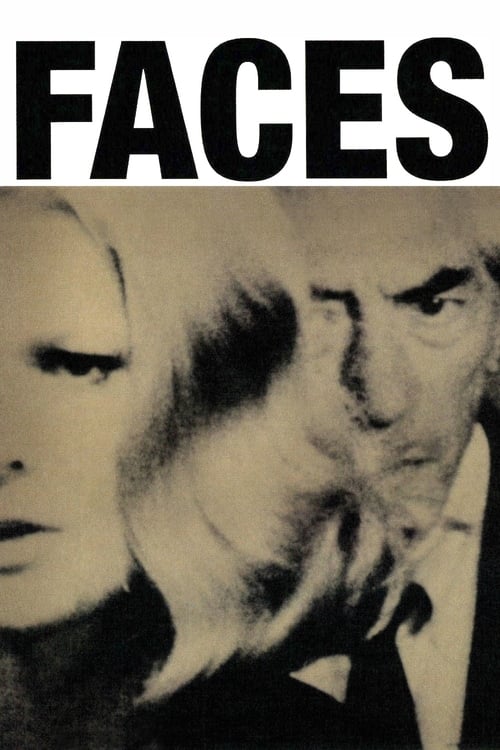
Faces
1968 · John Cassavetes
When you want the unvarnished truth about marriage and loneliness and can handle a film that offers no easy comfort. This is a lean-in, feel-everything night — devastating, not relaxing.
What it's about
Over one long Los Angeles night, a middle-aged businessman abruptly tells his wife he wants a divorce. He drifts to the apartment of a younger woman who entertains men for a living; his wife and her friends bring home a cheerful young drifter from a discotheque. What follows is both couples' flailing search for the love and excitement that have leaked out of their lives — laughter that curdles, seductions that stall, and a crisis before dawn.
The experience
Raw and uncomfortably intimate — the camera stays so close to faces for so long that polite social masks visibly crack in real time. It's exhausting in the way real arguments are, punctuated by bursts of manic laughter, and it gets under your skin like few dramas ever made.
Performances
Gena Rowlands brings startling warmth and hurt to Jeannie, the younger woman; John Marley and Lynn Carlin, as the unraveling couple, deliver some of the most naked emotional acting in American film; Seymour Cassel is live-wire charm as the young man who crashes the wives' night out.
The craft
Shot largely in Cassavetes' own house on grainy 16mm and edited over roughly three years, it looks and sounds like eavesdropping — long, unbroken scenes where performances are allowed to breathe, stumble, and combust. The roughness is the point: every frame prioritizes the human face over polish.
Why it matters
One of the founding works of American independent cinema — made entirely outside the studios, it proved a self-financed, performance-driven film could matter, and generations of indie filmmakers trace their lineage to it.
Snapshot
Faces is John Cassavetes' searing anatomy of a marriage's collapse and the hollow consolations its participants reach for over a single long night. A middle-aged Los Angeles businessman, Richard Forst, announces to his wife Maria that he wants a divorce; he drifts to a younger woman, the call-girl-adjacent Jeannie, while Maria and her friends pick up a younger man, Chet, at a discotheque. The film follows these parallel evasions through laughter that curdles, seductions that fail, and a near-fatal crisis before dawn. Shot largely in Cassavetes' own home on grainy 16mm and edited over roughly three years, it became one of the defining works of American independent cinema — financed outside the studios, performed by a mixture of seasoned character actors and untrained newcomers, and structured around the human face held under unbearable scrutiny. It earned three Academy Award nominations and helped license a generation of filmmakers to treat raw behavioral truth as a subject in itself.
Industry & production
Faces was made wholly outside the studio system, in deliberate reaction against it. Cassavetes had directed Shadows (1959) independently, then made two studio pictures — Too Late Blues (Paramount) and A Child Is Waiting (United Artists, produced by Stanley Kramer) — experiences he found creatively suffocating, the latter recut against his wishes. He funded Faces primarily from his own earnings as an actor, plowing acting fees back into the production over the long period of shooting and post. The film was shot in 1965, principally in Cassavetes' and Gena Rowlands' family home and in adjacent locations, using a small cohort of collaborators who doubled as cast, crew, and producers.
Production was protracted and informal by industry standards: long days, an evolving script-as-blueprint, and a working method that treated filming as an extension of the acting workshops Cassavetes ran. Post-production stretched across years; Cassavetes and his editors assembled an extremely long rough cut — reported in the literature as running several hours — before whittling the release print to roughly 130 minutes. The picture was blown up from 16mm to 35mm for theatrical exhibition and distributed in the United States by Continental Distributing (the theatrical arm associated with Walter Reade). Precise budget and box-office figures for Faces are not reliably documented in a single authoritative source, and Cassavetes' self-financing makes accounting murky; I flag this rather than supply numbers. What is clear is the film's outsized cultural return relative to its means: critical acclaim, festival exposure, and three Oscar nominations — Cassavetes for Best Original Screenplay, Seymour Cassel for Best Supporting Actor, and Lynn Carlin for Best Supporting Actress.
Technology
The film's technological identity is inseparable from its meaning. Cassavetes shot on 16mm black-and-white stock — a gauge associated at the time with documentary, television, and amateur work rather than theatrical features — then enlarged it to 35mm for release, a process that preserves and even intensifies the visible grain. Lightweight 16mm cameras and the ability to shoot in cramped domestic interiors with available or minimal lighting allowed an unusually mobile, intimate handheld coverage. The choice was economic but also aesthetic: it placed Faces within a lineage running through cinéma vérité and direct cinema, where portable equipment had recently made it possible to follow behavior rather than stage it. Sound was recorded under similarly rough conditions, yielding the overlapping, sometimes muddy dialogue track that became a Cassavetes signature. The grain, the contrast, the handheld instability — these are not flaws the film apologizes for but the very texture through which it claims authenticity.
Technique
Cinematography
The cinematography, credited to Al Ruban (who also served as a producer), is built on proximity and duration. The camera presses close to faces, frequently in tight, unflattering close-up, catching pores, sweat, and the small muscular betrayals of people performing emotions they don't feel. Handheld operation lets the frame search and reframe within a take, chasing a glance or drifting to a listener. The high-contrast black-and-white and 16mm grain flatten conventional glamour; light is hard and frontal, and the image often seems to be straining to see in the dim domestic spaces. This is an anti-pictorial style in the sense that beauty is never the goal — but it is acutely expressive, using the close-up as an instrument of moral exposure. The faces of the title are, literally, the film's principal landscape.
Editing
Editing — the work of Cassavetes with Al Ruban and Maurice McEndree, refined over a very long post-production — is where the film's enormous quantity of footage was shaped into rhythm. The cutting favors long takes that let scenes run past the point of comfort, holding on laughter until it sours or on silence until it accuses. Yet within scenes the editing is also restless, cutting between faces to register reaction over action, privileging the listener as much as the speaker. The film's overall architecture is associative and parallel, cross-cutting Richard's night with Maria's, so that two evasions of the same loneliness rhyme. The willingness to sustain awkward duration — to refuse the relief of a cut — is itself a dramaturgical choice, forcing the viewer to sit inside discomfort.
Mise-en-scène / staging
Staging is dominated by real, lived-in interiors: living rooms, kitchens, bedrooms, bars. Bodies crowd doorways and sofas; characters drink, dance, and clown in close quarters, their forced gaiety a kind of choreography of denial. Cassavetes blocks for behavioral truth rather than visual composition, letting actors move and collide as the emotional logic dictates while the camera adapts. The domestic setting — much of it Cassavetes' own home — collapses the distance between performance and life, and the recurring motif of people laughing too hard, too long, gives the mise-en-scène its peculiar tension between sociability and despair.
Sound
The soundtrack is rough, immediate, and dominated by overlapping speech. Dialogue tumbles over itself; jokes, songs, and sales-patter fill the air as characters use noise to keep feeling at bay. Music is used sparingly and diegetically — bar pianos, sung snatches, popular tunes — rather than as an orchestral emotional guide; specific music credits in Faces are modest, and I avoid attributing a score beyond what the record supports. The effect of the sound design is to make talk itself a symptom: these are people who cannot stop performing conviviality, and the density of their chatter measures the depth of what they are avoiding.
Performance
Performance is the film's beating center. Cassavetes drew on a mix of professionals and non-professionals: John Marley, a veteran character actor, as Richard; Lynn Carlin — reportedly an industry secretary with no prior acting experience — as Maria; Gena Rowlands as Jeannie; Seymour Cassel as Chet; and Val Avery among the men's drunken party. The acting prizes spontaneity, hesitation, and emotional overflow over polish. Carlin's untrained rawness and Cassel's loose, generous physicality earned Oscar nominations; Rowlands brings a wary intelligence to Jeannie that complicates the men's fantasy of her. The performances are not improvised in the sense of being unscripted — Cassavetes wrote detailed dialogue — but they are played with an improvisatory openness to the moment, and the workshop method behind them produced the lived, unguarded quality for which the film is famous.
Narrative & dramatic mode
Faces operates in a behavioral, near-realist mode that subordinates plot to emotional event. Its structure is the compressed long night: a single rupture (Richard's announcement) sends two characters on parallel nocturnal excursions whose escalating desperation supplies the dramatic arc, culminating in a crisis involving Maria and the young man before a chastened morning. There is little conventional exposition and no tidy resolution; the film ends on irresolution, two people stranded between a marriage they can't inhabit and a freedom they can't use. The dramatic mode is closer to theater's intimate two-handers and ensemble scenes than to classical Hollywood cause-and-effect — long, sustained encounters in which subtext erupts through banter. Meaning accrues through accumulation and recurrence rather than through narrative engineering.
Genre & cycle
Nominally a drama of marriage and middle age, Faces belongs less to a commercial genre than to an emergent cycle of American independent, vérité-influenced features that prized psychological realism. It can be read against the "marriage in crisis" pictures of the era and against European art cinema's portraits of bourgeois malaise, but its rough surfaces set it apart from the polished studio treatment of similar themes. More usefully, it is a foundational entry in the cycle Cassavetes himself would extend across Husbands (1970), Minnie and Moskowitz (1971), A Woman Under the Influence (1974), and beyond — a body of work that effectively constitutes its own genre of American behavioral cinema.
Authorship & method
Faces is the clearest early statement of Cassavetes' authorial method, which fused his identities as actor, writer, and director. He wrote the screenplay, directed, financed, and shaped the edit, working not from a shooting script imposed on actors but from a written text developed through and for performance. His key collaborators were a tight repertory: cinematographer-producer Al Ruban, editor-producer Maurice McEndree, and a recurring company of actors — Gena Rowlands (his wife and lifelong creative partner), Seymour Cassel, Val Avery, and others — who would return film after film. The method privileged trust, duration, and the actor's autonomy; Cassavetes famously valued emotional truth over technical correctness and was willing to spend years and his own money to find it in the cutting room. Music and design were kept deliberately spare so that nothing would buffer the performances. The authorship here is collective in execution yet singular in vision: the controlling sensibility — restless, humane, suspicious of comfort — is unmistakably Cassavetes'.
Movement / national cinema
The film stands as a cornerstone of the American independent movement, and is frequently positioned as the pivot between Cassavetes' pioneering Shadows and the fuller independent infrastructure that followed. It is in dialogue with international new waves — the French Nouvelle Vague's lightweight shooting and improvisatory ethos, and the broader vérité/direct-cinema turn — but its concerns are distinctly American: suburban affluence, the sales personality, the loneliness inside marriage. As national cinema, Faces offered an alternative image of American life to the one the studios marketed, and it did so at the precise moment, in 1968, when the old studio order was breaking down and the "New Hollywood" was forming.
Era / period
Released in 1968 amid the collapse of the Production Code and the rise of the American auteur, Faces both reflects and resists its moment. It shares the late-1960s appetite for frankness about sex and disillusionment, yet its subjects are not the young countercultural rebels of The Graduate or Easy Rider but their parents — the affluent, drinking, middle-aged generation whose certainties were quietly failing. The period's loosening censorship allowed its candor about adultery and despair; the period's technological and economic shifts made its independent production feasible. The film thus sits at a hinge: rooted in the social textures of mid-1960s suburban America, released into the New Hollywood that would, in part, learn from it.
Themes
At its core Faces is about alienation inside intimacy — the way long-married people become strangers, and the way strangers reach for intimacy they cannot sustain. Aging and the fear of obsolescence drive both Richard and Maria toward younger partners who promise vitality and deliver only a sharper loneliness. Performance and masking are central: the characters laugh, joke, and seduce compulsively, using sociability as armor, so that the film becomes a study of people acting out feelings to avoid having them. Money and class hover at the edges — the comfortable, transactional world of the businessman, the commerce implied in Jeannie's company. Above all, the film dramatizes the gap between the longing for love and the capacity for it, refusing to grant its characters the catharsis they crave.
Reception, canon & influence
Critically, Faces was received as a landmark of independent American filmmaking and a vindication of Cassavetes' methods after his troubled studio years, though, as with much of his work, it also drew detractors who found its longueurs and rawness self-indulgent. The Academy recognition — nominations for Cassavetes' screenplay and for Cassel and Carlin — gave an outsider film unusual establishment validation, and it has since been enshrined in the canon, preserved and reissued (including through the Criterion Collection) as a foundational independent work.
Its influences run backward to cinéma vérité and direct cinema, to the lightweight aesthetics of the international new waves, to the Method-inflected acting culture and theatrical workshop tradition Cassavetes came from, and to his own Shadows as proof of concept. Forward, its legacy is vast and concrete: Faces helped legitimize self-financed, performance-driven, location-shot American cinema and stands behind the independent filmmakers — from the dialogue-saturated naturalism of later American indies to the descendants who cite Cassavetes directly — who took its permission to film discomfort at length. Within Cassavetes' own oeuvre it is the breakthrough that opened the great run of the 1970s. As a model of how an artist might fund, make, and protect his own vision, Faces remains one of the most influential American films of its era.
A Deleuzian reading
Start with the laughter.
The full Deleuzian reading of Faces →
Reception
Shot on 16mm in Cassavetes' own house and edited over roughly three years, it looked like an amateur experiment — then it landed three Oscar nominations and has only grown, now enshrined as the founding document of American independent film.
How Faces was received, from release to now →
Influences: the films it descends from and the films it influenced
- Shadows (1959) — Cassavetes' own proof-of-concept: actors' workshop improvisation captured on grainy 16mm with available light, establishing the writing-through-performance method Faces refined.
- Rome, Open City (1945) — Neorealism's use of real locations and non-professional faces over studio polish gave Faces its license to mine emotional truth from lived-in interiors rather than constructed sets.
- Bicycle Thieves (1948) — Casting non-actors and shooting in actual streets to privilege behavioral authenticity — the documentary-of-feeling impulse Cassavetes inherits.
- On the Waterfront (1954) — The Method-inflected, mumbled, gesturally raw screen performance Cassavetes came from — emotional truth prized over diction and blocking.
- Primary (1960) — Direct-cinema's lightweight synchronous handheld rig and observational long-take ethic supplied the technical grammar for Faces' roaming close coverage.
- Breathless (1960) — The international new wave's location shooting, fast film stock and disregard for continuity slickness modeled how a cheap camera could feel alive and immediate.
- The Connection (1961) — American indie improvisation staged as faux-vérité in a single claustrophobic interior, a near-contemporary precedent for filming discomfort at length.
- Through a Glass Darkly (1961) — Cassavetes adopts extreme close-up as live-performance documentation, shooting 16mm handheld to track a marriage's psychological disintegration in real time—the American democratization of the Bergman-Nykvist conviction that truth lives in the face at maximum proximity and duration.
- A Woman Under the Influence (1974) — The Rowlands close-up held past comfort, performance duration as structure — Faces' tight-framing emotional endurance taken to its peak.
- Wanda (1970) — Self-financed 16mm-blown-up, handheld grain and an unglamorous performance-first realism that parallels Faces' independent, vérité-adjacent intimacy.
- Medium Cool (1969) — Blends scripted drama with cinéma-vérité handheld immediacy, sharing Faces' fusion of documentary texture and acted scenes.
- Mean Streets (1973) — Built scenes from actor improvisation and location shooting, citing Cassavetes' permission to let performance and overlapping talk drive structure over plot.
- Husbands and Wives (1992) — Jittery handheld faux-documentary camera and rough reaction-cutting through marital arguments — an explicit formal homage to Cassavetes' raw intimacy.
- Secrets & Lies (1996) — Long-take two-handers developed through months of actor improvisation, then held unbroken, inheriting Faces' faith in duration to surface emotional truth.
- The Celebration (1998) — Dogme 95's handheld natural-light digital ethic and unrelenting close coverage of a family imploding directly extends Faces' film-discomfort-at-length aesthetic.
- Blue Valentine (2010) — Improvisation-built relationship scenes shot intimate and handheld over a compressed emotional arc, an avowed Cassavetes descendant in method and texture.
- Marriage Story (2019) — Dialogue-saturated marital naturalism staged in lived-in interiors with sustained close-ups on escalating arguments, drawing openly on Cassavetes' performance-first drama.
- Marty Supreme (2025) — Source of the feral-naturalism aesthetic: performance wrung from improvisation and held in relentless, grainy, tight handheld close-up rather than composed coverage.
- All About My Mother (1999) — Almodóvar openly cites Cassavetes as justification for his extended close-ups held long enough for actors to breathe and contradict themselves; Cassavetes' editing rhythm that subordinates pace to performance completeness is the direct model for Salcedo's unhurried cutting.
- Short Cuts (1993) — Cassavetes' telephoto observational distance on California domestic interiors — camera slow to cut away, actors overlapping in real time without theatrical resolution — established the controlled-naturalism mode Short Cuts' ensemble directly adopts.
- Husbands (1970) — Same repertory company and improvisatory long-take method extended to male friendship, with the camera again hunting faces through real-time emotional drift.
- 12 Angry Men (1957) — Cassavetes built his New York independent ensemble from the same Method actor culture and used reaction-cutting as his primary editorial instrument, tracking emotional state across listening faces rather than speakers.
- Cries and Whispers (1972) — Cassavetes developed in parallel an available-light extreme close-up aesthetics of faces under sustained emotional extremity, establishing an American mode of psychic excavation through accumulated physical performance that mirrors Bergman's European chamber approach without any line of influence between them.
- Petulia (1968) — Cassavetes's handheld observational grammar — close-proximity camera, available or near-available light, performance allowed to run beyond conventional dramatic beats — creates internalized realism in the American domestic register that runs directly parallel to Petulia's approach to performance; both films treat bourgeois domestic violence as institutional rather than episodic, refusing melodrama's containment of that violence within a single exceptional incident.
- Who's Afraid of Virginia Woolf? (1966) — Sibling in deglamorizing black-and-white handheld intimacy and overlapping, abrasive marital dialogue, pushing the unsparing-closeup aesthetic of domestic disintegration even further toward documentary rawness.
- Gloria (1980) — Establishes Cassavetes's overlapping dialogue and his preference for holding on faces through unhurried emotional confrontation, the rhythm that fights the thriller's chase momentum in Gloria.
- If I Had Legs I'd Kick You (2025) — Relentless grainy close-ups that crowd the frame with skin and reaction until psychological space replaces geographic space — the abrasive-intimacy grammar Bronstein inherits.
- Loves of a Blonde (1965) — Independently arrives at the same aesthetic of long, naturalistic performance mining social awkwardness and failed communication in near-real-time close observation.
- Mikey and Nicky (1976) — Model for shooting faces in extended handheld, available-light close-up so the camera chases performance instead of composing it — the visual grammar Kemper reproduces in the film's grimy interiors.
- L'Amour fou (1969) — Demonstrates in the same year that a marriage can be dismantled at feature length by handheld 16mm working at close range in cramped domestic rooms, with performance built from rehearsed improvisation rather than delivered dialogue.
Similar films
- Husbands (1970) — influence & lineage · same viewing thread
- A Woman Under the Influence (1974) — influence & lineage · same viewing thread
- Opening Night (1977) — same viewing thread
- Shadows (1960) — shared sensibility
- Love Streams (1984) — shared sensibility
- sex, lies, and videotape (1989) — shared sensibility
- Mikey and Nicky (1976) — shared sensibility
- L'Amour fou (1969) — shared sensibility
All the films related to Faces →
Watch it with: curated runs of related films
- New Hollywood Unravelings — Watch these together for the rawest strain of New Hollywood — loose, lived-in character studies of Americans who can't hold the shape their lives demand.