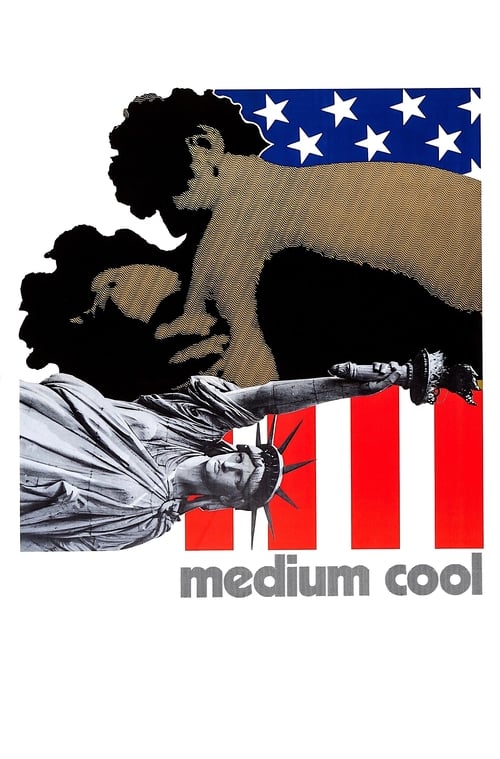
Medium Cool
1969 · Haskell Wexler
For when you want a film that doubles as a time machine — something raw, political, and thought-provoking that you'll want to argue about afterward. A challenge watch, and a thrilling one.
What it's about
A cool, detached Chicago TV news cameraman films riots, poverty, and tragedy without letting any of it touch him — until he learns his network has been quietly handing his footage to the FBI. As he drifts into a relationship with an Appalachian widow and her young son, the city around them heads toward the explosive 1968 Democratic Convention, and the film's fiction collides head-on with real history unfolding in the streets.
The experience
Jagged, alive, and unlike anything else — you're constantly aware you're watching real crowds, real tear gas, real 1968, with actors moving through it. It's less a plot than a pressure system, and it leaves you rattled about who's holding the camera and why.
Performances
Robert Forster's contained, watchful cool is perfect for a man whose job is to feel nothing, and Verna Bloom brings unforced warmth as the widow who cracks his detachment.
The craft
Wexler, one of the great American cinematographers, directed and shot it himself, filming his actors inside actual protests and the real chaos surrounding the '68 Convention — documentary and fiction fused in the same frame. The handheld street footage still crackles, and the whole film interrogates the act of pointing a camera at suffering.
Why it matters
A landmark of late-'60s American filmmaking that caught a national breaking point on film as it happened, and a founding document for every movie since that has questioned the media's role in the events it covers.
I've written the Medium Cool dossier to `dossiers/medium-cool-1969.md`. Here it is:
Snapshot
Medium Cool is the first and most important fiction feature directed by Haskell Wexler, one of the great American cinematographers, and it remains a landmark experiment in fusing documentary actuality with dramatic narrative. Its protagonist, John Cassellis (Robert Forster), is a Chicago television news cameraman — cool, detached, professionally indifferent to the suffering his lens records. The film follows him through a series of assignments and entanglements: a relationship with a Vietnam widow, Eileen (Verna Bloom), and her young son Harold (Harold Blankenship), recent Appalachian migrants to the city; an encounter with militant Black activists who turn his camera back on him and indict the white news apparatus; and his discovery that the station has been quietly handing his footage to the FBI and the police. The film's plot is almost an armature for its real subject — the act of looking, the camera as both witness and weapon, and the moral vacancy of a media culture that converts other people's pain into broadcast product. Its most famous gambit is to drive its fictional characters directly into the unscripted violence of the August 1968 Democratic National Convention in Chicago, where Wexler shot amid the real clashes between police and antiwar demonstrators. The result is a film that is at once a New Hollywood drama, a piece of cinéma-vérité reportage, and a self-reflexive essay on the politics of the image — released into a country convulsed by the very upheavals it captured.
Industry & production
Medium Cool was produced and distributed by Paramount Pictures, then under the regime that was beginning to gamble on younger, more politically charged filmmakers in the wake of Bonnie and Clyde (1967) and the collapse of the old studio formulas. Wexler, who by 1968 was an Academy Award–winning cinematographer (for Who's Afraid of Virginia Woolf?, 1966), wrote, directed, and photographed the film himself — an unusual concentration of authorship that reflects both his standing and the film's origins as a personal project. Wexler's creative control was the defining condition of the shoot.
The production is inseparable from a piece of historical fortune that Wexler partly engineered. The script was built so that its climax would coincide with the Democratic National Convention, which the filmmakers anticipated would be a flashpoint — and it became one, with Mayor Richard J. Daley's police assaulting demonstrators in scenes broadcast around the world. Wexler took his actors, principally Verna Bloom, into the actual streets and parks of Chicago and filmed them moving through the genuine chaos. The often-repeated story that a crew member shouts "Look out, Haskell, it's real!" on the soundtrack as tear gas drifts in has become the film's signature anecdote; the line was in fact added in post-production, but it crystallizes the film's method and has entered film lore. I'd flag that several production legends around the film — exactly what was staged versus seized, what was reshot — are worth verifying against Wexler's own later accounts rather than taken as settled.
The film's release was fraught. Paramount, reportedly anxious about its politics in a charged election-year climate, gave it an X rating (then newly instituted) — attributed to nudity and language, though the film's radical content surely informed the studio's caution — which constrained its commercial life. It opened in 1969 to limited distribution. I won't cite box-office figures I can't confirm; Medium Cool was not a popular hit but accrued enormous critical and scholarly stature over the following decades.
Technology
The film was shot on 35mm, but its technological identity lies in its adoption of lightweight, mobile documentary equipment and the aesthetics that came with it. Wexler worked with portable cameras and available light to a degree unusual for a studio narrative, allowing him to move into real crowds and uncontrolled locations and to capture events as they unfolded. The convention sequences in particular depend on a handheld, run-and-gun capability — the camera as a body in the street, jostled, dodging, reacting — that the heavier studio apparatus of the preceding generation could not have supplied. This is the same technological shift that underwrote cinéma-vérité and direct cinema in the 1960s: synchronous portable sound, faster film stocks, and hand-holdable cameras that let filmmakers shoot the world rather than reconstruct it on a stage. Wexler, a documentarian as well as a fiction cinematographer, brought that toolkit into a Paramount feature and let the seams between the two modes show. The precise camera and stock specifications are details a reader should confirm against technical sources rather than take from this summary.
Technique
Cinematography
The cinematography — Wexler's own — is the film's reason for being and its enduring glory. He shoots in two registers that he deliberately allows to bleed together: a composed, color-saturated, sometimes coolly beautiful narrative style for the fictional scenes, and a raw, reactive, vérité style for the documentary passages. The opening image sets the program — a car crash filmed first and helped second, the cameraman recording before he rescues — and announces a film obsessed with the camera's complicity. Wexler's framing repeatedly foregrounds the apparatus of looking: television monitors, viewfinders, the news cameraman at work, surfaces that reflect and mediate. In the convention material he abandons pictorial control for immediacy, plunging into smoke, crowds, and police lines so that the spectator shares the cameraman's exposure. The celebrated shots of Verna Bloom in her yellow dress moving through the real turmoil of Grant Park are the film's visual thesis made flesh: a fiction walking, unprotected, into history. Few films make their cinematographer's sensibility so completely the film's argument.
Editing
The film was edited by Verna Fields — later famous as the editor of Jaws (1975) — whose work here is fundamental to the film's meaning. The editing is associative and essayistic as much as narrative, cutting between the fictional storyline and documentary interludes (a roller-derby bout, a National Guard riot-control rehearsal, interviews, the convention itself) so that the film accumulates a montage portrait of America in 1968 rather than a tidy plot. Fields and Wexler juxtapose the staged and the real until the boundary becomes a deliberate provocation; the cutting forces the viewer to ask, continually, what they are watching and how it was obtained. The structure is loose, modular, and digressive by design, privileging thematic resonance and rhythmic collision over conventional continuity. It is among the clearest examples in American narrative cinema of editing used as social and philosophical commentary.
Mise-en-scène / staging
The film's staging is defined by its radical porousness to the real world. Where a conventional production seals its fiction inside controlled sets and crowds, Medium Cool repeatedly opens the frame to actuality — placing actors among non-actors, scripted action inside unscripted events, and dramatized scenes within documentary locations across Chicago, from poor Uptown apartments to the convention floor to the streets. Wexler casts and uses real people: the Appalachian boy Harold Blankenship was a non-professional, lending the Uptown scenes a documentary authenticity, and the Black militant sequence draws on real activist milieus. The mise-en-scène thus stages a constant negotiation between fiction and document, control and contingency. Even the interior, fully fictional scenes are charged by this method — we watch them knowing the film will, at any moment, step out the door into 1968.
Sound
The sound design participates in the film's documentary-fiction dialectic. Synchronous location sound carries the texture of real environments — crowds, chants, sirens, the ambient noise of the city and the convention — while the fictional scenes use more conventional dialogue recording. The film's most legendary sound element is the post-dubbed cry of "Look out, Haskell, it's real!," which, by acknowledging the camera and the danger within the film itself, performs the breaking of the fictional frame that the whole work is about. Mike Bloomfield, the blues guitarist, is credited with music for the film, contributing a contemporary rock-blues idiom consonant with the late-1960s counterculture the film documents. The soundtrack as a whole functions less as emotional underscoring than as another layer of the film's reportage of its moment.
Performance
Robert Forster, in an early starring role, gives John Cassellis a hard, watchful detachment that is the film's moral center of gravity — a man whose professional cool is gradually exposed as ethical paralysis, and whose late awakening to his own complicity arrives too late to save anyone. Verna Bloom, in her film debut, brings a grounded vulnerability to Eileen, the widowed mother whose search for her lost son becomes the human thread that pulls the fiction into the convention's maelstrom; her solitary walk through the real riot is one of the indelible performances-in-situ in American cinema. Harold Blankenship, a genuine Uptown child rather than a trained actor, supplies an unpolished authenticity that anchors the film's social-realist passages. Peter Bonerz appears as Cassellis's sound man, Gus. The performances are calibrated to survive the collision with documentary reality — naturalistic, unshowy, able to hold their truth while the world erupts around them.
Narrative & dramatic mode
Medium Cool operates in a hybrid dramatic mode that was genuinely novel for an American studio feature: part character drama, part political essay, part documentary. Its fictional plot — the cameraman, the widow, the lost boy, the surveillance revelation — is deliberately thin and at times elliptical, functioning as a vehicle for the film's reflexive inquiry into media, looking, and power rather than as an end in itself. The mode is Brechtian in its refusal to let the audience settle into illusion: by repeatedly exposing the camera, mixing registers, and rupturing the fiction with the real, the film keeps the viewer conscious of watching a constructed thing about the act of construction. It is at once engaged and analytical, emotionally invested in its characters yet insistent on stepping back to interrogate the apparatus that represents them. The ending — a car crash that mirrors the opening, observed by a camera that pans, finally, to Wexler himself — closes the loop on a film about the inescapability of the gaze.
Genre & cycle
The film resists clean genre placement, which is part of its significance. It can be read as a New Hollywood drama, a political film, a docudrama, and a self-reflexive media essay all at once. It belongs to the brief, fertile cycle of late-1960s American films that absorbed the techniques and politics of documentary and the European New Waves into the commercial system — the moment of Bonnie and Clyde, Easy Rider (released the same year), and Faces, when the studios briefly underwrote formal and ideological risk. Within that cycle, Medium Cool is the purest fusion of fiction and actuality, and one of the most explicitly political. It also stands as a foundational text in the lineage of self-reflexive "films about the media" — works preoccupied with television, news, and the ethics of the image — and in the docufiction or hybrid-cinema tradition that mixes documented and staged reality.
Authorship & method
Medium Cool is unusually unified in authorship: Haskell Wexler wrote, directed, and photographed it, making it the rare studio feature that is the singular vision of a cinematographer-author. His method — embedding fiction inside real events, foregrounding the camera, treating the image as an ethical problem — derives directly from his dual career as a documentarian (his earlier nonfiction work and his commitment to leftist political subjects) and as one of Hollywood's most accomplished directors of photography. The film is in large part an argument about Wexler's own profession: a cameraman's confession and indictment, made by a cameraman, about what it means to point a lens at suffering.
The key collaborators sharpen rather than dilute that authorship. Editor Verna Fields shaped the film's essayistic, montage-driven structure, translating Wexler's mass of staged and documentary material into a coherent argument; her contribution to the film's meaning is decisive. Musician Mike Bloomfield supplied a contemporary blues-rock idiom rooted in the same counterculture the film records. The cast — Robert Forster, Verna Bloom in her debut, the non-professional Harold Blankenship, and Peter Bonerz — committed to a method that required acting inside uncontrolled reality. But the governing intelligence is Wexler's, and Medium Cool remains the fullest statement of his belief that the camera is never neutral.
Movement / national cinema
The film is a product of American cinema at the hinge between the studio era and New Hollywood, but its formal allegiances are international. It absorbs the lessons of cinéma-vérité and direct cinema — the American and French documentary movements of the early 1960s — and of the French and broader European New Waves, particularly the politically engaged, self-reflexive cinema associated with Jean-Luc Godard, whose mixing of essay, fiction, and direct address Medium Cool clearly echoes. It thus sits at the confluence of American documentary practice and European modernist narrative, naturalized into a Hollywood feature. Nationally, it is a deeply American film — about American media, American protest, American racial and class division in 1968 — made at the moment when the U.S. industry was briefly most permeable to radical form.
Era / period
Medium Cool is among the most precisely dated of major American films: it is not merely set in 1968 but partly made out of 1968. It captures, on the actual ground, the convulsive American year of the Tet Offensive's aftermath, the assassinations of Martin Luther King Jr. and Robert F. Kennedy, the antiwar movement at full pitch, and the Chicago convention that became a symbol of the decade's fracture between the state and the street. The film breathes the era's distrust of institutions — the news media, the police, the federal government, the Democratic Party — and its conviction that the image had become a battleground. Released in 1969, it arrived as the optimism of the mid-decade curdled into confrontation, and it stands now as one of cinema's primary documents of that turning, valuable as history as well as art.
Themes
The film's central theme is the camera's complicity — the idea that to record is also to fail to act, that the news apparatus converts human suffering into spectacle and surveillance, and that detached "objectivity" is itself a moral position. From this flows the theme of media and power: the revelation that the station feeds footage to the FBI dramatizes the news camera as an instrument of state control, not merely of witness. The reality of violence and the violence of representation runs throughout, as the film collapses the distance between staged and real harm. It is acutely concerned with race and class in America — the Black activists who seize Cassellis's camera and reverse the gaze, the displaced Appalachian poor of Uptown — and with the failures of liberal detachment embodied in its protagonist. Underlying all of it is a reflexive meditation on seeing itself: who looks, who is looked at, who profits, and what is owed by the one behind the lens. The title — glossing Marshall McLuhan's notion of television as a "cool" medium — names the film's anxiety that the medium itself induces detachment.
Reception, canon & influence
On release, Medium Cool was a critical event more than a commercial one. Its X rating and Paramount's wariness limited its audience, but critics recognized it as a daring and important work, and its reputation has grown steadily into the standing of a classic; it is frequently cited as one of the essential American films of the late 1960s and a touchstone of political and self-reflexive cinema, and it has been preserved in the National Film Registry. I'd note that the specifics of its first-run reviews are best confirmed against contemporary sources rather than taken solely from this account.
Backward — influences on the film: The film draws on the documentary movements of its moment — American direct cinema and French cinéma-vérité — for its handheld, observational method, and on the politically engaged modernism of the European New Wave, especially Godard, for its essayistic mixing of fiction, document, and direct address. Marshall McLuhan's media theory supplies its title and its conceptual frame. Wexler's own documentary practice and leftist commitments are the deepest source. The New Hollywood breakthrough of Bonnie and Clyde opened the industrial space in which such a film could be financed.
Forward — its legacy: Medium Cool became a foundational reference for the docufiction and hybrid traditions — the deliberate, ethical mixing of staged and real that runs through later political and experimental cinema. Its interrogation of the news camera and media complicity anticipates the great media-critique films of the following years, from Network (1976) to the documentary self-reflexivity of decades since, and it remains a standard citation in any discussion of the camera's ethics. As a record of the 1968 Chicago convention shot from within the violence, it is an irreplaceable historical document that later films and documentaries about the era continually return to. For Wexler, it confirmed a vision of the cinematographer as moral author; for American cinema, it stands as the boldest single fusion of reportage and drama the studio system ever underwrote, and its central question — what do we owe the people we film? — has only grown more urgent.
A few places where I deliberately hedged rather than assert: the "Look out, Haskell" line's post-production origin, the staged-vs-seized production legends, exact camera/stock specs, box office, and first-run review specifics — all flagged in-text as worth verifying against primary sources rather than invented.
A Deleuzian reading
A car flips on a Chicago highway.
The full Deleuzian reading of Medium Cool →
Reception
In 1969 it got tangled up in an X rating and a wary Paramount, and reached fewer people than its moment deserved; now it's canonized as a New Hollywood landmark and a Criterion-approved classic of fiction bleeding into documentary.
How Medium Cool was received, from release to now →
Influences: the films it descends from and the films it influenced
- Man with a Movie Camera (1929) — Originates the reflexive apparatus that Medium Cool inherits — showing the cameraman, the lens, and the act of filming as the film's own subject, so that recording is foregrounded rather than concealed.
- Salt of the Earth (1954) — Models the leftist drama cast with the actual workers it depicts, the non-professional-in-situ method Wexler uses for Harold Blankenship's Appalachian boy.
- Primary (1960) — Establishes the portable sync-sound rig that lets a handheld camera follow subjects through uncontrolled crowds — the exact direct-cinema mobility Wexler carries onto the Chicago convention floor.
- Breathless (1960) — Pioneers wheelchair/handheld shooting in real streets with available light and elliptical cutting, the spontaneous location grammar Wexler adopts for staged scenes amid real life.
- Chronicle of a Summer (1961) — Coins cinéma-vérité by making subjects watch and respond to their own footage, the ethical self-implication of the camera that becomes Medium Cool's central question.
- Masculin Féminin (1966) — Supplies the Brechtian essay structure — faux-interviews, direct address, intertitles, and fiction punctuated by documentary — that Verna Fields' associative edit translates into Wexler's argument.
- The Battle of Algiers (1966) — Demonstrates staging fiction with newsreel grain and non-professional crowds so reconstruction reads as seized reportage, the docufiction illusion Wexler pushes by shooting drama inside the actual riots.
- Faces (1968) — Captures naturalistic performance with 16mm handheld coverage in cramped real interiors, the in-situ acting-inside-uncontrolled-reality discipline Wexler demanded of Forster and Bloom.
- Ace in the Hole (1951) — Radicalizes Ace's central accusation — the cameraman/journalist as complicit in, not neutral to, the suffering he frames for consumption.
- Punishment Park (1971) — Extends the docufiction crew conceit — a pseudo-documentary camera team 'covering' staged-real state repression, with the apparatus and its complicity kept visible.
- Nashville (1975) — Builds an overlapping semi-improvised ensemble of real-feeling Americana that erupts into public political violence, sharing Medium Cool's fiction-soaked-in-actuality structure.
- The Battle of Chile (1975) — Literalizes the 'look out, Haskell' ethic — the camera embedded inside real political violence keeps rolling as a cameraman films his own killing, the ultimate test of the lens-on-suffering question.
- Network (1976) — Delivers the media-complicity indictment Medium Cool's news-camera critique anticipated, dramatizing television's appetite to broadcast suffering as spectacle.
- Salvador (1986) — Carries Wexler's own cameraman-as-witness reportage drama forward — a journalist-protagonist chasing atrocity with a lens, the moral-author-cinematographer stance made narrative.
- Natural Born Killers (1994) — Pushes the associative, media-saturated montage and self-reflexive indictment of the news camera that Fields' essayistic cutting first modeled.
- Bloody Sunday (2002) — Restages a real massacre with handheld docufiction immediacy, the camera caught inside the chaos and the staged/seized boundary deliberately blurred — Medium Cool's method as full aesthetic.
- Children of Men (2006) — Embeds long-take handheld camerawork inside unstaged-feeling combat so the lens becomes a participant dodging fire, descending from Wexler shooting drama within live riot.
- The Hurt Locker (2008) — Uses multi-camera handheld reportage immediacy to place fiction inside real-time danger with documentary texture, extending the embedded-camera-in-violence tradition.
- Mean Streets (1973) — Wexler's deliberate mixing of 16mm documentary footage with 35mm fictional material to differentiate registers of reality directly prefigures Scorsese's use of grainy 16mm for Charlie's waking-nightmare prologue against the 35mm present-tense drama.
- One Flew Over the Cuckoo's Nest (1975) — Wexler's own feature as director demonstrates his handheld available-light political cinema in its fully developed form — ambient location noise instead of scored atmosphere, available-light interiors stripped of studio warmth — the same method he then applies as Cuckoo's Nest's DP.
- Dog Day Afternoon (1975) — Wexler's hybrid of staged narrative and real documentary crowd footage — actors inserted into the 1968 Chicago Democratic Convention riots — is the formal model for Lumet and Kemper placing the staged bank robbery inside an actual Brooklyn street with unrehearsed bystanders.
- Z (1969) — Cuts documentary-paced vérité urgency into political fiction the same year, treating the thriller as reportage on state violence rather than melodrama.
- F for Fake (1973) — Wexler's interweaving of scripted fictional drama with live documentary footage of the 1968 Chicago convention riots creates composite registers identical in principle to Welles's blending of Reichenbach's vérité footage with staged performance, raising the same ethical question about the camera's complicity in what it observes.
- One Way or Another (1977) — Wexler runs a scripted fiction straight into unstaged real events (the 1968 Chicago riots), blurring documentary and drama in the same seam Gómez works.
Similar films
- Punishment Park (1971) — influence & lineage · same viewing thread
- Primary (1960) — influence & lineage
- Chronicle of a Summer (1961) — influence & lineage
- Network (1976) — influence & lineage
- Breathless (1960) — influence & lineage
- In Cold Blood (1967) — shared sensibility
- Camera Buff (1979) — shared sensibility
- Good Night, and Good Luck. (2005) — shared sensibility
All the films related to Medium Cool →
Watch it with: curated runs of related films
- Bearing Witness — Watch these when you want cinema as testimony — ordinary people caught between armies, borders, prisons, and markets, filmed close to the ground and close to documentary.