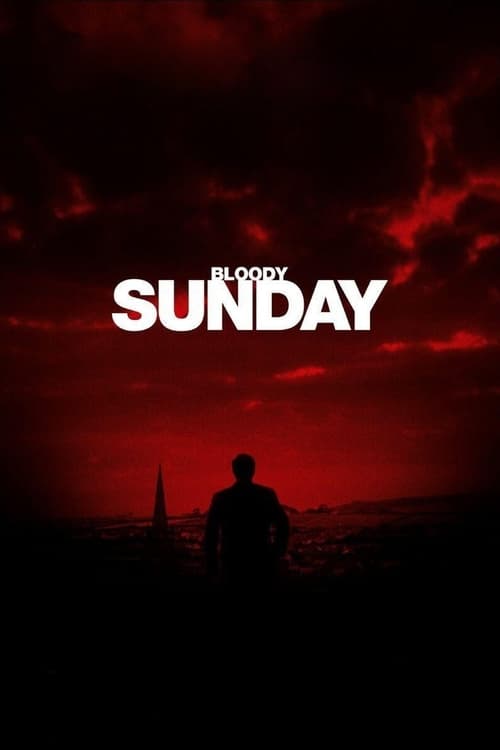
Bloody Sunday
2002 · Paul Greengrass
For when you want history unflinching, not softened — a film to sit with in silence afterward. This is a challenge, not a comfort watch.
What it's about
Derry, Northern Ireland, 30 January 1972. A civil rights march sets off through the Bogside while the British Army's Parachute Regiment takes up positions around it. The film follows the day hour by hour — the organizers led by MP Ivan Cooper preaching peaceful protest, the soldiers being briefed, ordinary people heading out the door — as history closes in on all of them.
The experience
Shot like news footage happening in front of you, it accumulates dread almost unbearably: you watch small decisions and crossed wires harden into catastrophe in real time. Sober, furious, and genuinely shattering.
Performances
James Nesbitt is remarkable as Ivan Cooper, a decent man's optimism visibly draining out of him over one day — a career-redefining dramatic turn from an actor then known for lighter work.
The craft
Paul Greengrass builds the whole film from handheld, available-light vérité and relentless cross-cutting between marchers and military, so it feels found rather than staged. The sound design — crowd noise, radio chatter, then gunfire — does devastating work, and it rewards good speakers and full attention.
Why it matters
It set the template for the real-time handheld style Greengrass carried into his later thrillers, and it stands as one of cinema's most rigorous reckonings with the Troubles.
Snapshot
Bloody Sunday reconstructs a single catastrophic day — 30 January 1972 — when soldiers of the British Army's 1st Battalion, Parachute Regiment opened fire on a Northern Ireland Civil Rights Association march in the Bogside district of Derry, killing thirteen unarmed civilians outright and wounding others, one of whom died later. Paul Greengrass, a director steeped in British current-affairs television, films the event not as memorial tableau but as something happening in real time and going wrong in real time: a procession of ordinary intentions — a protest organized, a regiment briefed, a young man flirting with a girl — that collide into massacre. The film organizes its day around the Protestant civil-rights leader and MP Ivan Cooper (James Nesbitt), cross-cutting his optimism against the hardening military posture on the other side of the barricades. Shot handheld on grainy stock with a near-documentary refusal of spectacle, it became one of the defining works of the early-2000s vérité revival, won the Golden Bear at Berlin and an audience award at Sundance, and established the restless, immersive grammar Greengrass would carry into The Bourne Supremacy, United 93, and Captain Phillips.
Industry & production
The film was a British–Irish television-led co-production, a fact central to both its budget and its aesthetic. It originated within the Granada/ITV orbit — the same world that produced the investigative series World in Action, where Greengrass had spent formative years as a producer-director — and was made in partnership with Jim Sheridan and Arthur Lappin's company Hell's Kitchen, with backing from the Irish Film Board (Bórd Scannán na hÉireann). It premiered on British television (ITV) close to a theatrical release, the docudrama straddling broadcast and cinema in the manner typical of Granada's prestige factual-drama output.
The project drew directly on Don Mullan's book Eyewitness Bloody Sunday, a compilation of survivor and witness testimony; Mullan was involved in the production. The timing was pointed. The film arrived while the Saville Inquiry — the second, long-running official investigation into the killings, established in 1998 — was still hearing evidence; its findings, which would ultimately repudiate the exculpatory 1972 Widgery Tribunal and find the victims innocent, did not appear until 2010. Bloody Sunday thus entered a live, unresolved public argument rather than a settled historical one, and its claim that the dead were unarmed and the shootings unjustified was, at the time of release, a contested political position as much as a dramatic premise.
It was not alone. Jimmy McGovern's Sunday, made for Channel 4 and broadcast the same year, dramatized the same events from a more explicitly community-rooted vantage. The coincidence of two films in 2002 reflected the convergence of the peace-process era, the Saville Inquiry's reopening of the wound, and the thirtieth anniversary of the killings. Greengrass cast widely from Northern Irish and Irish actors and used non-professionals and locals in crowd roles, reinforcing the testimonial texture. Production made extensive use of estate and street locations standing in for the 1972 Bogside; the geography of march route, barricade, and waste ground is reconstructed with care for the operational logic of how the day unfolded.
Technology
Technologically the film is defined by deliberate primitivism. It was shot on 16mm — grainy, mobile, light-rig-free — rather than the smoother 35mm of conventional period drama, a choice that yokes the image to the visual memory of 1970s television news and World in Action reportage. The graininess is not incidental but argumentative: it asserts that what we are watching belongs to the documentary record. Handheld cameras, available and practical light, and a desaturated, cold palette complete the strategy. There is no recourse to the stabilization, crane work, or designed lighting that would announce "cinema." The technical apparatus is bent entirely toward erasing its own presence and producing the impression of footage caught rather than composed.
Technique
Cinematography
Ivan Strasburg's camerawork is the film's signature instrument. The camera operates as an embedded observer — jostled, reframing on the fly, frequently late to the action it chases, occasionally losing its subject behind a head or a wall. Whip-pans and snatched focus pulls substitute for establishing geometry; the viewer is denied the orienting master shot that classical staging would supply, and so experiences the day's events with the same partial, adrenalized incomprehension as those living through them. The grain and cold light flatten the image into something that reads as found document. This is cinematography as ethical stance: by refusing the omniscient, composed view, it refuses the consolation of mastery over the atrocity.
Editing
Clare Douglas's editing is arguably the film's most influential element. Scenes are punctuated by abrupt cuts to black — brief blackouts that segment the day into discrete pulses and impose a ticking, chaptered rhythm without resort to titles or narration. The cross-cutting architecture alternates between the civil-rights organizers and the military command, building the day as two parallel mechanisms grinding toward collision. Within scenes the cutting is fast, elliptical, and sometimes deliberately disorienting, mirroring the camera's incompleteness. The montage does the structural heavy lifting that dialogue and exposition would do in a conventional drama; meaning accrues through juxtaposition and acceleration rather than through scene-setting.
Mise-en-scène / staging
The staging privileges the appearance of unrehearsed event. Crowds move with the loose, contingent energy of an actual march; dialogue overlaps and is sometimes half-audible, as in life. Greengrass worked extensively with improvisation around a documented structure of events, so that performers inhabit roles rather than deliver lines, and the camera discovers action as if unsure where it will erupt. The production design reconstructs period Derry — the streets, the rubble barricades, the army Saracens — with a muted, lived-in plausibility that avoids the over-art-directed sheen of nostalgia. Nothing in the frame is permitted to look "designed."
Sound
The soundscape is naturalistic and dense: overlapping voices, radio chatter, the bark of military communication, the concussive disorder of gunfire that arrives without the cued emphasis of a scored climax. Crucially, the film withholds a conventional orchestral score across its body, denying the audience emotional instruction. The most celebrated sonic gesture is reserved for the end, where U2's "Sunday Bloody Sunday" (from War, 1983) plays over the closing — a rare authored intrusion that connects the 1972 events to their long cultural afterlife and to the song that carried the day's name into global consciousness.
Performance
Performances are pitched toward authenticity rather than star display. James Nesbitt anchors the film as Ivan Cooper, the Protestant civil-rights MP whose belief in peaceful, Martin Luther King–style protest is the day's tragic through-line; Nesbitt charts Cooper's arc from buoyant organizer to devastated witness, and the role marked a significant dramatic turn for an actor then better known for lighter television work. Around him the ensemble — including soldiers, marchers, and command figures — works in a register of restrained realism, the improvisatory method keeping speech rhythms and reactions close to documentary plausibility. The supporting cast, drawn substantially from Northern Irish and Irish performers, lends the crowd and community scenes their grounded conviction.
Narrative & dramatic mode
The film's dramatic mode is the "real-time" or compressed-day docudrama: a tragedy in the classical sense of an outcome we know in advance, built from the small decisions and contingencies that lead inexorably to it. There is no single protagonist in the conventional sense; Cooper is the closest, but the narration is distributed across multiple vantage points — organizers, victims, soldiers, commanders — so that the day is assembled as a mosaic rather than a hero's journey. The structure is procedural and parallel: we watch two operations, a march and a military containment, prepared in alternation and then catastrophically intersecting. Greengrass refuses both melodrama and editorializing voiceover; the argument is made architecturally, through what is cross-cut against what. The mode descends from the British dramatized-documentary tradition, in which dramatic reconstruction is enlisted in the service of factual, often investigative, argument.
Genre & cycle
Bloody Sunday sits at the intersection of the historical drama, the docudrama, and the political "Troubles film." Within the cycle of cinema about the Northern Ireland conflict — a lineage running through films such as In the Name of the Father, Hidden Agenda, and Some Mother's Son — it is distinguished by its refusal of conventional dramatic shaping and its proximity to the factual record. As docudrama it belongs to a specifically British televisual genre with deep roots (discussed below). Its 2002 release alongside McGovern's Sunday marks a discrete micro-cycle: the early-2000s, peace-process-era return to the foundational traumas of the Troubles, made possible and urgent by the reopening of official inquiry and the passage of three decades.
Authorship & method
Paul Greengrass is the film's decisive author, and Bloody Sunday is the clearest statement of a method he had been developing across earlier factual and dramatized work — including the acclaimed television film The Murder of Stephen Lawrence (1999) — and would refine afterward. That method fuses rigorous documentary research with improvisation and a handheld, fragmented vérité style, in pursuit of immediacy over composure. Greengrass co-wrote the film, working from the documented sequence of events and Mullan's testimonial source material rather than a tightly pre-scripted screenplay.
His key collaborators here shaped the signature: cinematographer Ivan Strasburg, whose mobile, grainy 16mm camerawork supplied the embedded-observer image; editor Clare Douglas, whose blackout-punctuated, cross-cut structure gave the film its propulsive, segmented architecture and who would continue to work in Greengrass's orbit. Rather than a composer delivering a continuous score, the film's most authored musical statement is the licensed closing use of U2's "Sunday Bloody Sunday." The collaboration is best understood as a system for manufacturing authenticity — research feeding improvisation, improvisation captured by a deliberately imperfect camera, the imperfections sculpted in the cut.
Movement / national cinema
The film is most precisely located within the British dramatized-documentary or "docudrama" tradition, a current-affairs-adjacent lineage that uses dramatic reconstruction for investigative and political ends. Greengrass's own formation in Granada's World in Action places him squarely in this descent, which reaches back to Peter Watkins's Culloden and The War Game and runs alongside the social-realist commitment of Ken Loach. At the same time the film is a work of Irish and Northern Irish national cinema, financed in part by the Irish Film Board and engaged with the central trauma of the modern Irish/British political imagination. It thus occupies a hyphenated space — a British television-realist sensibility applied to an Irish historical wound — and that doubled vantage is part of its texture and its politics.
Era / period
Bloody Sunday is a 2002 film about 1972, and both dates matter. The 1972 setting is rendered with restrained period fidelity — the iconography of the civil-rights march, the army's containment apparatus, the Bogside's geography — but the film resists nostalgia, keeping the period present and immediate rather than embalmed. The 2002 moment of production is equally constitutive: the film belongs to the early-digital-adjacent but still photochemical turn-of-the-millennium vogue for handheld realism, and to the specific political climate of the Northern Ireland peace process and the ongoing Saville Inquiry. It speaks from a present trying to reckon, officially and culturally, with a past that the state had spent decades mischaracterizing.
Themes
At its center is the collapse of nonviolent civil-rights politics under state violence. Cooper's faith in peaceful protest — explicitly modeled on the American civil-rights movement — is the film's tragic thesis, and its destruction on the day is presented as a hinge: the moment that, in the film's understanding, fed the very militancy the army claimed to be suppressing. Adjacent themes include the machinery of escalation, the way institutional logic and chains of command convert intention into atrocity; the politics of truth and the official record, given the film's pointed proximity to a still-unresolved inquiry; the fog and contingency of violence, dramatized formally through the camera's and edit's refusal of clarity; and the asymmetry of power between an unarmed community and a militarized state. The film is unambiguous in its sympathies — it presents the dead as innocent and the shootings as unjustified — but it pursues that argument through reconstruction rather than rhetoric.
Reception, canon & influence
Critically, Bloody Sunday was received as a major achievement and a benchmark for the docudrama form, praised for its immediacy, restraint, and refusal of cliché; it won the Golden Bear at the 2002 Berlin International Film Festival (an award it shared) and a top audience prize at Sundance, an unusual double of critical and popular endorsement. As a politically contentious account released during the Saville Inquiry, it also drew the scrutiny attendant on any dramatization of disputed atrocity, though the inquiry's eventual 2010 findings broadly vindicated the film's central factual claims.
Looking backward, the film's influences are clear and self-acknowledged in its form: the British dramatized-documentary tradition and World in Action reportage from which Greengrass came; the historical-reconstruction work of Peter Watkins; the social realism of Ken Loach; and, in its handheld immersion in collective violence, the long shadow of Gillo Pontecorvo's The Battle of Algiers. Don Mullan's testimonial book supplied its evidentiary backbone.
Looking forward, Bloody Sunday is among the more consequential stylistic templates of twenty-first-century mainstream cinema. The handheld, fragmented, "you-are-there" grammar Greengrass perfected here he carried directly into The Bourne Supremacy (2004) and The Bourne Ultimatum (2007), which transplanted vérité immediacy into the studio action film and reshaped the look of the genre for a decade. He returned to the real-time reconstruction of catastrophe in United 93 (2006) and Captain Phillips (2013), films that are recognizably the descendants of this one. More broadly, the film helped legitimize the docudrama-realist aesthetic — improvisation, grain, the embedded camera, the elided establishing shot — as a serious vehicle for historical and political reckoning, and it remains a reference point in discussions of how cinema can dramatize contested history without surrendering either dramatic force or factual responsibility.
A Deleuzian reading
A brief darkness.
The full Deleuzian reading of Bloody Sunday →
Reception
Acclaimed straight out of the gate in 2002 — Sundance Audience Award, Golden Bear at Berlin — but it's grown in stature since as the origin point of the whole Greengrass handheld-docudrama style that went on to reshape Bourne, United 93 and Captain Phillips.
How Bloody Sunday was received, from release to now →
Influences: the films it descends from and the films it influenced
- The Battle of Algiers (1966) — Establishes the grainy newsreel-reconstruction grammar and the embedded handheld camera plunged into collective street violence, with a distributed crowd-as-protagonist and no star to anchor the eye — the formal template Greengrass cites for immersing the viewer inside the massacre.
- Culloden (1964) — Pioneers the dramatized-documentary reconstruction of a historical atrocity shot as if a news crew were present, with jostling handheld 16mm, to-camera testimony and the elided establishing shot — the 'you-are-there' reportage device Greengrass inherits directly.
- The War Game (1965) — Extends Watkins's faux-reportage method to imagined catastrophe, sculpting horror through cut, handheld immediacy and withheld omniscience rather than score — modeling docudrama as a vehicle for political reckoning.
- Cathy Come Home (1966) — Sets the British dramatized-documentary template of social-realist improvisation, location shooting and non-professional naturalism that dissolves the line between drama and reportage, the tradition Greengrass came up through.
- Kes (1969) — Codifies Loachian restrained-realist performance built from improvisation and a camera that observes rather than composes — the unforced naturalism Greengrass elicits from his ensemble.
- Z (1969) — Builds the propulsive political-thriller architecture of reconstructing a real state killing through fragmented, cross-cut procedural fragments and documentary urgency — the segmented, accelerating structure Clare Douglas's cutting echoes.
- Hidden Agenda (1990) — Applies Loach's realist method to the Northern Irish Troubles as a political thriller indicting state violence, the immediate generic and subject-matter precursor to Greengrass's docudrama of 1972.
- Medium Cool (1969) — Restages a real massacre with handheld docufiction immediacy, the camera caught inside the chaos and the staged/seized boundary deliberately blurred — Medium Cool's method as full aesthetic.
- State of Siege (1972) — Handheld-reportage restaging of a documented state killing in near-real-time procedural form, inheriting the desaturated, newsreel-textured commitment to the factual record.
- In the Name of the Father (1993) — Pushes the film's handheld realism to full vérité, using restless documentary camera and real-time compression to dramatize a real Troubles atrocity.
- Omagh (2004) — Written and produced by Greengrass as a direct continuation: the same handheld 16mm immediacy, withheld score and distributed-protagonist grief applied to another Troubles atrocity and its aftermath of inquiry.
- The Bourne Supremacy (2004) — Transplants the embedded, fragmented vérité grammar — shaky handheld, elided geography, blackout-fast cutting — wholesale into the studio action film, reshaping the genre's look for a decade.
- The Bourne Ultimatum (2007) — Pushes the Bloody Sunday cutting style to its limit with Christopher Rouse's near-subliminal cross-cut chases, the 'imperfect camera sculpted in the cut' system applied to set-piece action.
- United 93 (2006) — Returns to real-time reconstruction of catastrophe with a starless distributed ensemble, improvised dialogue from documented fact, handheld embedding and withheld score — recognizably the same docudrama engine.
- Captain Phillips (2013) — Sustains the real-time procedural-tension method and embedded-observer handheld camera, again casting non-professionals (the Somali crew) for restrained-realist authenticity in a reconstructed true event.
- '71 (2014) — Immerses a single soldier in a near-real-time night of Belfast chaos via handheld embedding, withheld exposition and disorienting cutting — Greengrass's Troubles-vérité grammar carried into the next generation.
- Green Zone (2010) — Greengrass's own prototype for the multi-camera 'controlled chaos' shoot and overlapping-radio-chatter soundscape reconstructing a real day's catastrophe in near-real-time.
- Jason Bourne (2016) — Greengrass's own dramatized-reality method in embryo: improvisatory blocking, available-light handheld camera, and editing that simulates the texture of unfolding fact — the toolkit he ports wholesale into the franchise.
- Selma (2014) — A single protest march building to a massacre at a chokepoint, shot in handheld docudrama immediacy — the structural and formal precedent for Selma's Edmund Pettus Bridge confrontation.
- Polytechnique (2009) — Procedural reenactment that cross-cuts victims, bystanders and authorities across a compressed single-day timeline with no expository narration or psychological framing — the mode Villeneuve adopts while stripping out Greengrass's handheld urgency.
- The Lost Bus (2025) — Establishes the documentary-coverage method Rokseth inherits — handheld cameras searching for the action mid-event, reframes and focus hunts left in the cut, and no establishing shot to grant the audience a vantage none of the participants had.
- The Murder of Stephen Lawrence (1999) — Greengrass's own immediately prior dramatized-documentary, where he first fused rigorous factual research with restrained performance and a handheld vérité camera reconstructing a contested real event — the method Bloody Sunday perfects.
- The Hurt Locker (2008) — Adopts the multi-camera handheld, grainy, geography-eliding vérité immediacy to put the viewer inside combat tension, extending Greengrass's embedded-camera aesthetic into the Iraq War film.
- Hunger (2008) — Shares the diegetic-naturalist sound design, withheld score and uninflected observational restraint applied to Troubles-era state violence, reaching for the same factual responsibility by opposite (composed, durational) formal means.
- Children of Men (2006) — Embeds the camera in unbroken handheld combat amid a crowd, eliding establishing shots so the viewer experiences chaos from inside it — the same 'you-are-there' immersion achieved through long takes rather than fragmentation.
- The Baader Meinhof Complex (2008) — Greengrass's handheld reportage docudrama reconstructing a state-protest collision in near-real-time from the historical record — the same reportorial-camera verisimilitude as Klausmann's work.
- The Wind That Shakes the Barley (2006) — Shot by Wind's own idiom-neighbor in handheld reportage naturalism, it renders British colonial violence in Ireland as unstable documentary witness rather than dramatized spectacle.
Similar films
- United 93 (2006) — influence & lineage
- Hunger (2008) — influence & lineage
- The Bourne Supremacy (2004) — influence & lineage
- The Bourne Ultimatum (2007) — influence & lineage
- The Battle of Algiers (1966) — influence & lineage · same viewing thread
- The Wind That Shakes the Barley (2006) — same viewing thread
- 1917 (2019) — same viewing thread
- Green Zone (2010) — shared sensibility
All the films related to Bloody Sunday →
Watch it with: curated runs of related films
- The Futility of War — A run of films about ordinary men fed into war's machinery — from the trenches to the Casbah to the Warsaw sewers — where the futility and human cost rhyme across a century and a dozen conflicts.