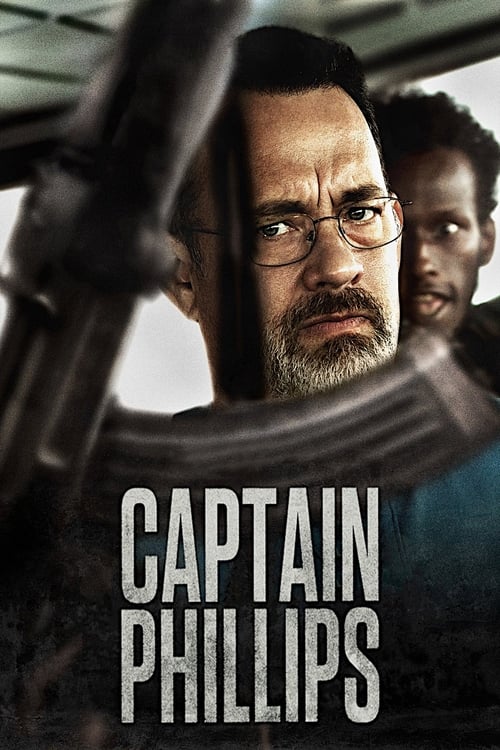
Captain Phillips
2013 · Paul Greengrass
For when you want a white-knuckle thriller that's smart about the real world — an edge-of-your-seat night that leaves you with something to talk about. Gripping rather than fun; not a wind-down watch.
What it's about
The true story of the 2009 hijacking of the American cargo ship Maersk Alabama by four Somali pirates, and the standoff that followed when its captain was taken hostage. It's a duel between two captains — a Vermont merchant mariner doing his job and a young Somali fisherman-turned-pirate doing what his warlords demand — with the machinery of the U.S. Navy bearing down on a lifeboat the size of a shipping container.
The experience
Punishingly tense from the first sighting of the skiffs to the final minutes — the handheld camerawork and tight cutting put you on the ship's bridge with your pulse up. It ends not with a fist-pump but with an emotional gut-punch that stays with you.
Performances
Tom Hanks does career-best work, capping it with a final scene of raw, unguarded shock that's among the most talked-about acting of the decade. Barkhad Abdi, in his first film role, is astonishing as the pirate leader Muse — wiry, watchful, and impossible to dismiss as a mere villain.
The craft
Paul Greengrass shoots it like breaking news: handheld cameras, real ships, ambient sound, and editing that tightens like a ratchet as the space shrinks from ocean to cargo ship to lifeboat. Big screen and loud speakers pay off — the ocean, the engines, and the claustrophobia are half the movie.
Why it matters
It cemented Greengrass's docudrama style as the modern standard for true-story thrillers, launched Barkhad Abdi's career, and reframed what a hostage movie could say about global economics and trauma.
Snapshot
Paul Greengrass's dramatization of the April 2009 hijacking of the container ship MV Maersk Alabama by Somali pirates is one of the decade's most formally accomplished docudramas: a film that turns geopolitical asymmetry into unbearable physical confinement. Tom Hanks plays Richard Phillips, the Vermont-born captain taken hostage and held for five days in an orange fiberglass lifeboat roughly the size of a shipping container. Opposite him, in a debut of startling authority, is Barkhad Abdi as the pirate leader Muse. Greengrass marshals his established verité grammar — handheld cameras, compressed cutting, ambient sound — in service of a film that is simultaneously a procedural thriller, a post-colonial economic allegory, and an unusually honest examination of trauma. The final scene, in which Hanks's Phillips is treated for shock by a Navy medical corpsman, became one of the most widely analyzed acting moments of the 2010s, and the film's casting of Somali-American non-professionals from the Minneapolis diaspora community anticipated a broader reckoning in Hollywood with authentic representation.
Industry & production
Captain Phillips was developed at Columbia Pictures by producers Scott Rudin, Dana Brunetti, and Michael De Luca, adapted from the 2010 memoir A Captain's Duty: Somali Pirates, Navy SEALs, and Dangerous Days at Sea, written by Richard Phillips with journalist Stephan Talty. The screenplay was by Billy Ray, who had already demonstrated a facility for institutional docudrama with Shattered Glass (2003) and Breach (2007). Greengrass was attached relatively early; the project aligned naturally with his established territory of real events refracted through tight procedural form.
Production took place across several locations: Malta stood in for the Indian Ocean staging areas; portions were shot on and around actual container vessels and US Navy assets; and crucially, the lifeboat sequences were filmed inside and immediately around a functional MK-V enclosed fiberglass lifeboat — the same type used in the actual incident — which imposed its own physical grammar on every scene it appeared in. Budget figures have been cited in the vicinity of $55 million, a mid-range number for a studio prestige thriller of this period, though precise production accounting has not been publicly audited in detail.
Greengrass made a deliberate choice not to introduce Tom Hanks to the actors playing the Somali pirates until the cameras were rolling for their first confrontation aboard the Maersk Alabama. The Somali actors rehearsed their scenes separately, developing their own group dynamic, and the tension visible in Hanks's face during the initial boarding sequence is widely understood to be at least partially authentic surprise. This technique — withholding encounter to preserve first-take electricity — is characteristic of Greengrass's practice and has antecedents in John Cassavetes's improvisational methods as well as documentary filmmaking.
The real Captain Phillips's crew members disputed elements of the film's characterization, particularly suggesting that Phillips had been warned about piracy risks before entering the Gulf of Aden and that the film overstated his heroism at the expense of crew agency. These disputes, reported in detail by publications including Vanity Fair, did not significantly affect the film's commercial or awards trajectory but introduced an ethical dimension to its reception that recurs in discussions of the docudrama form.
Technology
Barry Ackroyd, who had already collaborated with Greengrass on United 93 (2006) and Green Zone (2010), served as director of photography. The film was shot digitally, primarily on ARRI Alexa cameras — the sensor system that had by 2013 become the dominant choice for cinematographers seeking a latitude profile that could hold detail in both bright ocean exteriors and dim interior shadows within the same sequence. The production deployed multiple cameras simultaneously throughout, an approach Greengrass and Ackroyd had refined across their collaborations to sustain the impression of caught-in-the-moment coverage.
Inside the lifeboat, Ackroyd and his camera operators worked in conditions that were genuinely cramped: the vessel's interior offers perhaps two meters of headroom at its peak and narrows toward both ends. Custom rigging was required to allow cameras to operate in positions that would not be possible in standard narrative production. The resulting images have a compressed, suffocating geometry — walls of fiberglass filling the frame's periphery, faces thrust into foreground — that no studio set approximation would have produced with equivalent conviction. This is a case where the production constraint and the aesthetic requirement were identical.
Sound design, supervised by Oliver Tarney (who shared an Academy Award nomination for the film), exploited the same spatial compression: the lifeboat amplifies and distorts every sound made within it, and the design preserved rather than cleaned this acoustic signature.
Technique
Cinematography
Ackroyd shoots in a continuous handheld mode that Greengrass had been developing since Bloody Sunday (2002). The camera is always searching, always slightly behind the action, replicating the cognitive load of crisis observation. In the film's early ocean sequences, the camera has room to breathe — it can track across the Maersk Alabama's deck, establish spatial geography, hold a horizon. As the drama compresses into the lifeboat, the available angles contract correspondingly. Close-ups dominate; the frame is rarely stable. This is not undisciplined shakiness but a deliberate modulation of visual anxiety calibrated to the narrative's increasing pressure.
One formal decision worth noting: Greengrass and Ackroyd do not use close-ups to rescue poorly staged scenes; they use close-ups because their staging genuinely earns them. The physical performances — the sweat, the shallow breathing, the way Hanks holds his body when he believes he is about to be shot — are given to the camera, not performed past it.
Editing
Christopher Rouse, who had edited Greengrass's two Bourne sequels and Green Zone, cut Captain Phillips. He received an Academy Award nomination for the work. Rouse's method in collaboration with Greengrass is to maintain comprehensibility inside very rapid assemblies — viewers can follow geography and cause-and-effect even when individual cuts are measured in seconds. This is technically demanding: multi-camera verité coverage generates enormous amounts of material, and organizing it so that spatial logic is never sacrificed to visceral speed is an editorial intelligence in itself. The extended Navy SEAL extraction sequence, in which three simultaneous sniper shots resolve the standoff, is edited with a precision — establishing eyelines, establishing distances, then collapsing them in a single beat — that would not be out of place in classical Hollywood action construction despite its documentary surface.
Mise-en-scène / staging
Greengrass does not compose in the conventional sense; he constructs situations and allows the camera to discover blocking rather than imposing it. The boarding sequence on the Maersk Alabama depends on the actual physical architecture of the ship — its ladders, its water hoses, its bridge layout — to produce its spatial drama. The director's research habit means his staging respects institutional and material reality: how a ship's crew actually takes shelter, how a bridge is actually configured, how Navy personnel actually move through a hostage extraction. This procedural accuracy is itself a staging method, one that distinguishes Greengrass from directors who simulate crisis from outside.
Sound
The film's sound design operates in two registers. On the ocean and aboard the large vessel, there is a constant industrial ambience — diesel, water, wind, radio static — that grounds the action in material reality. In the lifeboat, this is replaced by an almost unbearable intimacy: the rasp of breathing, the creak of fiberglass, the slap of water against the hull. Henry Jackman's score is used sparingly in the film's first two acts, becoming more present as the Navy closes in. The climactic resolution — three sniper shots across open water — is rendered with a careful calibration of suppressed report and immediate consequence that prioritizes information over spectacle.
Performance
The film's two central performances define its achievement. Hanks plays Phillips with a working-man competence that deliberately suppresses star affect: the character's authority derives from professional role, not from cinematic charisma. This is one of Hanks's most controlled performances through most of its running time — watchful, calculating, aware of institutional responsibility. The final scene breaks from this control entirely. After the Navy rescue, Phillips is brought to the ship's medical bay in shock, and the examination that follows was filmed with a real Navy trauma nurse, Danielle Albert, administering genuine shock treatment protocol. Hanks's breakdown in this sequence — the uncontrolled weeping, the hyperventilation, the inability to answer simple questions — was largely unscripted and reportedly caught the crew themselves off guard. It has become a touchstone in discussions of authentic emotional access in screen performance.
Barkhad Abdi, a Somali-American who had been driving limousines in Minneapolis before being cast through an open call, won the BAFTA for Best Supporting Actor and received an Academy Award nomination. His Muse is not a villain in any melodramatic sense but a man whose choices are legible given the context the film establishes: he is operating under his own coercive hierarchy, with his own survival calculus. Abdi holds his ground in every scene with Hanks through an almost entirely physical intelligence — stance, eye contact, the way he occupies the space around him. The three other Somali actors (Barkhad Abdirahman, Faysal Ahmed, Mahat M. Ali) were also recruited without professional acting experience and perform with the same unaffected directness.
Narrative & dramatic mode
The film is structured as a procedural in two movements. The first — roughly the film's opening hour — establishes the institutional machinery on both sides of the confrontation: Phillips's ship-management responsibilities; the Somali pirates' community pressure and operational hierarchy; the mechanisms by which a vessel is hijacked. The second movement compresses all of this machinery into the lifeboat, stripping away institutional context until what remains is two men, neither of whom has full control over his situation, negotiating survival across a language barrier and a yawning economic gulf.
Greengrass resists the temptation — unusual in American studio films of this kind — to make the drama resolve into a straightforward moral validation of American power. The Navy SEAL resolution is not staged as a triumph but as an event that arrives, leaving one man dead at home and one man in physiological shock in a medical bay. The epilogue the film refuses to provide — the homecoming, the speeches, the restored normalcy — is a formal argument about what the event actually cost.
Genre & cycle
Captain Phillips belongs to the post-9/11 docudrama cycle that produced, among other films, United 93 (Greengrass, 2006), Zero Dark Thirty (Bigelow, 2012), Lone Survivor (Berg, 2013), and later Sully (Eastwood, 2016) and Dunkirk (Nolan, 2017). These films share a commitment to procedural accuracy, compressed timeframes, and the representation of institutional response to acute crisis. They are also, as a group, preoccupied with the question of American competence and vulnerability in a world that does not defer to American power automatically — a preoccupation that is legible as cultural processing of the post-9/11 decade's anxieties.
Within this cycle, Captain Phillips is notable for granting its antagonists genuine subjectivity. The opening sequence in Somalia — establishing the village, the warlord's economic pressure, the men who will become pirates — has no American counterpart scene and asks the audience to hold both perspectives simultaneously. This structural choice places the film closer to the moral complexity of Costa-Gavras's political thrillers (Z, State of Siege) than to the more triumphalist end of the war-on-terror action cycle.
Authorship & method
Paul Greengrass, born in 1955, developed his filmmaking practice in British television documentary before transitioning to dramatic features. His key works — Bloody Sunday, United 93, The Bourne Supremacy, The Bourne Ultimatum, Green Zone, Captain Phillips, 22 July — form one of the most formally consistent bodies of work in contemporary commercial cinema. His method involves immersive research, consultation with real participants, and a systematic effort to preserve institutional and material reality as dramatic scaffolding rather than backdrop.
Barry Ackroyd (director of photography) is the collaborator most directly responsible for the visual grammar Greengrass has made his signature. His background in documentary cinematography — he shot numerous documentaries before features — means the handheld register comes from practical fluency rather than stylistic imposition. Ackroyd's work with Kathryn Bigelow on The Hurt Locker (2008) and Zero Dark Thirty demonstrates that this visual approach is not exclusively tied to Greengrass; it has become a broader cinematographic idiom for the representation of contemporary conflict and crisis.
Christopher Rouse (editor) and Henry Jackman (composer) complete the key creative quartet on Captain Phillips. Jackman's score, which uses sparse electronics and orchestral strings in ways that support rather than direct emotional response, is less prominent as an authorial signature than the contributions of the above collaborators.
Billy Ray's screenplay provides the structural chassis — the two-world opening, the procedural architecture, the disciplined exclusion of material that would soften the ending — without which Greengrass's formal methods would have less to work with.
Movement / national cinema
Greengrass is a British director working within the American studio system, and Captain Phillips is a Columbia Pictures production: this hybrid condition has defined most of his Hollywood work. His British docudrama inheritance — from Loach, Watkins, and the Wednesday Play tradition — inflects his relationship to institutional subject matter and non-professional performance, while the studio context provides access to the material scale (container ships, naval vessels, CGI ocean environments) required to sustain narrative conviction. The film is neither British national cinema nor a conventional Hollywood production but a recognizable product of the transatlantic prestige film economy that has characterized British-directed American studio films since the 1990s.
Era / period
The film arrives at the end of the first Obama administration, a period in which American foreign policy had registered, without resolving, the limits of military projection in the post-9/11 decade. The Maersk Alabama incident itself occurred in 2009, shortly after Obama's inauguration, and the Navy sniper resolution was widely treated at the time as a clean demonstration of American capability after years of frustrated military intervention. Greengrass's film, arriving four years later, is subtly skeptical of this framing — the resolution is real but costs are not elided — in ways that reflect a cultural moment of greater ambivalence about what American power can achieve and what it leaves behind.
Themes
The film's organizing opposition is between institutional scale and individual exposure. The Maersk Alabama is a vast logistical organism; the lifeboat is a pod in which that organism is irrelevant. Phillips's professional authority — which the film establishes carefully — dissolves inside the lifeboat, where Muse's authority, backed by immediate physical threat, is what operates. This compression dramatizes a broader condition: the limit at which institutional belonging ceases to protect an individual.
Global economic inequality is the film's structural precondition, established in the Somalia sequence and never allowed to become mere context. The pirates are not ideologically driven antagonists but economic actors making rational choices within a devastated system. The film does not sentimentalize this but it does insist on its legibility — the line "there's got to be something other than being a fisherman or kidnapping people," spoken by Muse, is the film's most explicit statement of a theme that the narrative otherwise carries without declaration.
Trauma and its aftermath constitute the film's final, deliberately unresolved territory. The medical bay sequence refuses catharsis; what it shows is the physiological reality of sustained extreme stress returning to the body when the stimulus is removed. This is not a thriller's denouement but a clinical observation, and it is placed where the film's emotional conclusion would conventionally be.
Reception, canon & influence
Captain Phillips received strongly favorable critical response on release, with particular attention to the performances and to the formal control of the lifeboat sequences. The film was nominated for six Academy Awards, including Best Picture, Best Supporting Actor (Abdi), Best Adapted Screenplay, and three craft nominations. It won none — the ceremony was dominated by 12 Years a Slave — and Tom Hanks's absence from the acting nominations was widely identified as a significant omission. Abdi's BAFTA win remained the film's most prominent formal recognition.
The film's influence operates in several directions. Greengrass's verité procedural grammar — already established through the Bourne films and United 93 — was consolidated here as a recognizable and widely imitated approach to crisis dramatization; subsequent films including Deepwater Horizon (Berg, 2016) and elements of Dunkirk engage in evident conversation with the formal strategies Greengrass and Ackroyd developed. The casting methodology — recruiting authentic voices from diaspora communities rather than casting name actors in ethnic roles — contributed to a broader industry conversation about representation that accelerated significantly through the mid-2010s. Barkhad Abdi's subsequent career, including Eye in the Sky (2015) and Good Time (2017), has been limited relative to the quality of his debut performance, a disparity that has itself been the subject of commentary about structural inequity in casting.
The final scene has entered the pedagogical canon of acting instruction and film analysis at a level unusual for a commercial thriller. It appears regularly in discussions of physical and psychological authenticity in performance, and Hanks has described the conditions of its filming in several interviews in terms that confirm the basic account: the real Navy nurse, the absence of elaborate preparation, the decision to roll cameras and allow the examination to proceed.
The film's backward influences include Greengrass's own United 93; the Italian neorealist tradition of casting non-professionals to achieve specific kinds of authenticity; the Costa-Gavras political thriller as a model for giving antagonists structural legibility; and Dog Day Afternoon (Lumet, 1975) as a precedent for the moral ambiguity available within the hostage-crisis form. These are not necessarily influences Greengrass has claimed directly, but they are the film-historical coordinates within which Captain Phillips is most productively situated.
A Deleuzian reading
Start at the end, because the film does.
The full Deleuzian reading of Captain Phillips →
Reception
Acclaimed on release (six Oscar nominations including Best Picture), it's since become Exhibit A in the 'worst Best Actor snubs' conversation — Tom Hanks missing a nomination for that final scene looks more baffling every year.
How Captain Phillips was received, from release to now →
Influences: the films it descends from and the films it influenced
- Bicycle Thieves (1948) — Cast non-professional actors from the Roman working class to achieve social documentary authenticity — the specific methodology Greengrass replicates by recruiting Somali diaspora community members rather than trained actors for the pirate roles.
- The Battle of Algiers (1966) — Shot with newsreel-style handheld cameras and a cast of genuine Algerian participants alongside professionals, establishing the docudrama grammar of fusing fiction and documentary registers for political violence — the template Greengrass inherits most directly.
- Z (1969) — Structured a political crisis thriller to grant the antagonist faction procedural legibility and genuine motivation rather than villain reduction — the dual-perspective strategy Greengrass uses to give the Somali pirates structural weight rather than making them ciphers.
- Dog Day Afternoon (1975) — Used institutional police procedure — negotiation protocols, command hierarchy, logistical coordination — as the dramatic scaffolding for a hostage crisis, establishing that procedural realism can generate suspense without sacrificing moral ambiguity; Greengrass adopts the same strategy with the Navy chain of command.
- Bloody Sunday (2002) — Greengrass's first deployment of observational handheld cinematography for political violence in a docudrama context, establishing the rapid-assembly editing and participatory camera style — the camera within the crowd, not above it — that becomes his formal signature.
- The Bourne Supremacy (2004) — First collaboration with Ackroyd in which Greengrass translated his documentary handheld grammar into commercial action filmmaking, developing the rapid-but-spatially-legible editing system that distinguishes his action sequences from incoherent shaky-cam.
- United 93 (2006) — Direct formal predecessor: cast real air traffic controllers and FAA personnel in their actual roles; structured the film around dual simultaneous perspectives; used multi-camera simultaneous coverage to capture unrehearsed participant behavior — all three techniques replicated and refined in Captain Phillips.
- Green Zone (2010) — Greengrass's retreat to the mode Green Zone strained — fact-based reconstruction with the same multi-camera handheld intensity and star-as-moral-conduit, minus the contested partisan thesis.
- Sicario (2015) — Adapts the post-Greengrass procedural grammar — staging accuracy through institutional consultation, geopolitical asymmetry as structural theme rather than backdrop — to the US-Mexico drug war, maintaining the dual-perspective moral weight while replacing Ackroyd's handheld proximity with Roger Deakins's wider, more static register.
- Deepwater Horizon (2016) — Berg explicitly translates Greengrass's verité procedural grammar to industrial catastrophe: the confined spatial environment, multi-camera coverage of simultaneous crisis, cast consultation with actual Deepwater Horizon survivors, and the two-movement structure (routine procedure collapsing into disaster) all derive from Captain Phillips' template.
- Patriots Day (2016) — Berg's most direct adoption of Greengrass's docudrama methodology: hybrid casting of non-professionals alongside trained actors, procedural reconstruction from institutional records and survivor interviews, and the two-movement structure (bombing and manhunt) — the closest formal sequel to Captain Phillips not made by Greengrass himself.
- Dunkirk (2017) — Applies the spatial compression and diegetic sound-pressure strategies Greengrass used in the lifeboat sequences — deliberate restriction of sonic and visual space to create physiological rather than narrative urgency — to a historical crisis at larger scale, and equally eliminates conventional character psychology as the primary emotional engine.
- 22 July (2018) — Greengrass's own continuation of his formal system: recruited Norwegian survivors and participants rather than established actors, used police and survivor testimony as procedural scaffolding, and maintained dual-perspective attention to both perpetrator logic and victim experience — the method of Captain Phillips applied to the Utøya massacre.
- 13 Hours: The Secret Soldiers of Benghazi (2016) — Real-time procedural tension in a cramped, inescapable space — the lifeboat as siege location — and the acoustic design of claustrophobic siege (radio chatter, engine noise, breathing) carry directly into 13 Hours's compound sequences.
- Thirteen Lives (2022) — Multi-strand procedural intercutting a crisis with its institutional rescue response, deploying Tom Hanks's professional dissociation to defer psychological release until a single score-free ethical sequence — the template Thirteen Lives consciously echoes in its anesthesia-administration climax.
- The Lost Bus (2025) — Supplies the confined-vehicle third act wholesale: multiple long-lens cameras crammed into a moving box so performers are kept in the situation for hours, and a star's glamour stripped to an unscripted physiological collapse at the end.
- The Hurt Locker (2008) — Barry Ackroyd's documentary-trained handheld cinematography for contemporary conflict demonstrates that the observational visual grammar he and Greengrass developed is transferable across directors — the idiom belongs to Ackroyd's practice as much as to Greengrass's authorship.
- Zero Dark Thirty (2012) — Ackroyd's ARRI Alexa digital cinematography for intelligence and military operations, using the same handheld spatial compression and available-light naturalism he deploys on the Captain Phillips lifeboat sequences; also shares the procedural-two-movement structure and geopolitical asymmetry framing.
- Lone Survivor (2013) — Berg's military procedural uses multi-camera simultaneous coverage and staging consultation with actual Navy SEALs to achieve the same procedural authenticity Greengrass sought from Somali community members — released the same year and forming the other pole of the 2013 post-9/11 crisis docudrama.
- Jason Bourne (2016) — Ackroyd's available-light handheld immediacy cross-cut against Navy command-and-control rooms — the control-room-counterpoint and near-documentary tension method, refined for a true-event thriller.
Similar films
- United 93 (2006) — influence & lineage
- Zero Dark Thirty (2012) — influence & lineage
- Lone Survivor (2013) — influence & lineage
- Dunkirk (2017) — influence & lineage
- The Bourne Supremacy (2004) — influence & lineage
- The Hurt Locker (2008) — influence & lineage
- 13 Hours: The Secret Soldiers of Benghazi (2016) — shared sensibility
- Pirates of the Caribbean: The Curse of the Black Pearl (2003) — shared sensibility