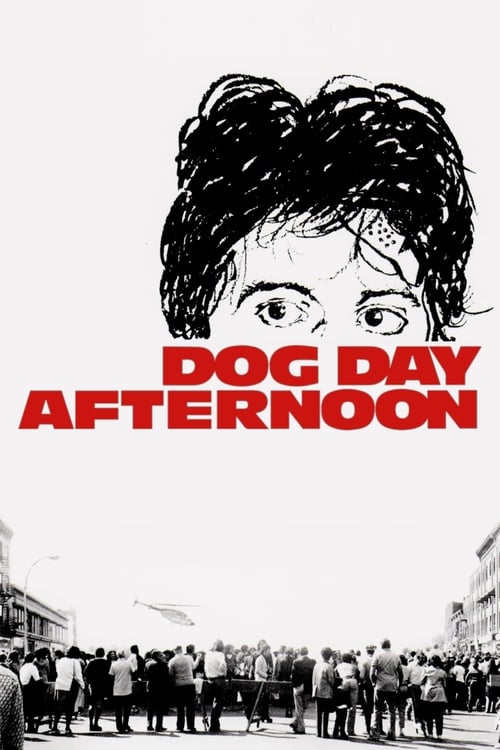
Dog Day Afternoon
1975 · Sidney Lumet
For when you want a crime movie with a pulse and a conscience — gripping enough for the edge of your seat, human enough to stay with you after. It's a challenge wrapped in entertainment, not a comfort watch.
What it's about
On a scorching August afternoon in Brooklyn, two woefully unprepared men walk into a bank to rob it, and within minutes everything goes wrong. The botched heist becomes a hostage standoff with the police, then a full-blown media circus, with crowds cheering the robbers from behind the barricades. Based on a real 1972 robbery, it follows Sonny — sweating, improvising, in way over his head — as his reasons for being there turn out to be stranger and sadder than anyone guessed.
The experience
Tense and funny in the same breath — you laugh at the chaos and then feel terrible for everyone trapped in it. The heat practically comes off the screen, and the standoff tightens hour by hour until the comedy curdles into something heartbreaking.
Performances
Al Pacino gives one of the great live-wire performances — desperate, charming, and cracking apart in real time — while John Cazale, as his quiet, unreadable partner Sal, says almost nothing and steals every scene he's in.
The craft
Sidney Lumet shoots it like it's actually happening: real Brooklyn locations, no musical score, sweat and street noise doing the work a soundtrack usually does. The camera stays close to faces and lets scenes run long, so the tension builds from behavior, not editing tricks. It plays beautifully loud, in a room where you can't check your phone.
Why it matters
It caught the anti-authority mood of post-Watergate America like almost nothing else, made 'Attica! Attica!' a permanent piece of the culture, and set the template for every hostage-standoff-as-media-event story since.
Snapshot
A sweltering August afternoon in Brooklyn: two ill-prepared men walk into a bank branch and walk into American legend. Dog Day Afternoon converts the nearly verbatim facts of the August 1972 Chase Manhattan robbery in Gravesend, Brooklyn — committed by John Wojtowicz and Salvatore Naturile — into a tragicomedy of spectacular incompetence, thwarted longing, and populist fury. By the time the fourteen-hour standoff concluded with Sal dead on a JFK Airport tarmac and Sonny cuffed on the runway, Sidney Lumet had made the film that most completely captures the paranoid, anti-authoritarian, darkly comic spirit of post-Watergate, post-Vietnam urban America. It is simultaneously a heist film that never heists, a love story with no consummation, and a live-television event projected onto a cinema screen.
Industry & production
Frank Pierson's screenplay originated in a Life magazine article, "The Boys in the Bank," written by P.F. Kluge and Thomas Moore and published in September 1972, just weeks after the real robbery concluded. The piece had the structural gift of journalism that is already stranger than fiction: Wojtowicz had robbed the bank, it emerged, partly to fund his partner Ernest Aron's sex-reassignment surgery. Producers Martin Bregman and Martin Elfand secured the rights and brought the project to Warner Bros., which was then at the height of its New Hollywood creative confidence following Deliverance, Klute, and Badlands. Sidney Lumet, who had already directed Pacino in Serpico (1973), was the natural choice: a New York filmmaker with a long track record of crime procedurals and a directorial temperament that prized spontaneity over studio polish.
The budget was modest for the era — well under $2 million by most production accounts, though precise figures are not consistently documented in the public record — and the production embraced that constraint as aesthetic method. Shooting was concentrated on a single block in Brooklyn (the production could not use the actual Gravesend site and found a stand-in location), with the claustrophobic bank interior built as a practical set that could accommodate the fluid, handheld camera style Lumet and cinematographer Victor J. Kemper had planned. The film shot roughly in sequence, an unusual logistical choice that allowed the ensemble cast — playing the bank tellers and customers as a genuine micro-community — to accumulate real familiarity and improvise within scenes.
Technology
Dog Day Afternoon belongs to the American cinema's brief but transformative flirtation with a quasi-documentary visual grammar. Victor J. Kemper shot on 35mm, using Panavision lenses but frequently coupling them with Arriflex cameras that could be operated handheld or shoulder-mounted. The priority was mobility: Kemper and his operators needed to move fluidly inside a cramped practical set, pivot instantly to cover crowd behavior outside, and track Pacino through the unscripted rhythms of his performance without imposing a studied visual geometry. Available and practical light was used wherever possible, contributing to a sweaty, sun-bleached exterior look that makes the Brooklyn afternoon feel genuinely oppressive.
The film has no original orchestral score. Elton John's "Amoreena," from the 1970 album Tumbleweed Connection, plays over the opening documentary montage of New York City — a masterstroke of economy that locates the film in a recognizable pop-cultural moment while freeing the picture from the emotional underscoring that conventional scoring would impose. For the remainder of the running time, Lumet relies on ambient sound and performance energy to generate tension.
Technique
Cinematography
Kemper's work is defined by a productive tension between control and chaos. The exterior crowd scenes feel genuinely uncontained — the camera swings, loses focus, re-finds its subject through the jostle of bystanders — while the interior of the bank is handled with more intimate precision, the lens pressed close to faces in ways that make the sweat and the fear materially present. The color palette skews toward the bleached, overexposed registers of mid-1970s American urban photography: the sky is white rather than blue, the brick facades of Brooklyn appear blanched by heat. This is not the glamorized grime of The French Connection (1971) but something more quotidian and therefore more believable.
Editing
Dede Allen, one of the paramount American editors of her generation, had already redefined what kinetic crime editing could do on Bonnie and Clyde (1967) and Little Big Man (1970). For Dog Day Afternoon she solved a different and arguably harder problem: how to maintain pace and pressure across a film that is, structurally, almost entirely talk. Allen's solution is rhythmic rather than percussive. She matches the tempo of the cutting to the temperature of individual scenes — the early passages in the bank move with an almost comical briskness as the robbery collapses into improvisation; the middle sections slow to a pressure-cooker simmer; the finale at the airport achieves a terrible, elongated dread. The film received an Academy Award nomination for Best Film Editing, and Allen's work here is as crucial to its emotional architecture as the screenplay or the performances.
Mise-en-scène / staging
Lumet's staging philosophy derives directly from his formation in live television drama at CBS in the 1950s — Kraft Television Theatre, You Are There, The Alcoa Hour — where the impossibility of cutting away from a performance in progress forced directors to compose scenes around actors rather than around predetermined visual schemes. In Dog Day Afternoon this manifests as a genuine generosity of space: the camera goes where the actors go, and the blocking evolves organically in rehearsal rather than being imposed in advance. The hostages are not background: Lumet rehearsed them as an ensemble, gave each character a name and history, and trusts the performances to generate the film's considerable comedy (particularly Sylvia Miles as a prickly customer who becomes Sonny's inadvertent ally). The result is an unusually populated, democratic frame.
Sound
The ambient sound design carries enormous weight. The sirens, the crowd noise, the oscillating roar of police-radio chatter that leaks through the bank door — these create a siege atmosphere without expressionist distortion. The telephone conversations between Sonny and the police negotiator (Charles Durning as Detective Moretti, all exhausted professionalism) are mixed so that we hear both ends of the call, collapsing the usual spatial separation of phone scenes and making the negotiation feel unnervingly immediate. When the crowd outside begins chanting "Attica! Attica!" in solidarity with Sonny, the sound mix opens up into something almost carnivalesque — the street as competing broadcast.
Performance
Al Pacino's Sonny Wortzik is one of the great performances in American cinema, and its greatness lies precisely in what it refuses. Sonny could be a tragic hero, a political icon, or a pathetic clown; Pacino holds all three possibilities in suspension simultaneously without resolving them. His verbal fluency is matched by physical comedy — a man constantly undone by his own competence in improvising the immediate while failing to plan the systemic. The famous "Attica!" scene, which Lumet has described as largely improvised in response to the extras' actual energy, captures Pacino's ability to discover performance in the moment rather than deliver it pre-formed. John Cazale as Sal brings a different and equally exquisite register: taciturn where Sonny is voluble, visibly frightened in ways that Sal himself doesn't understand. Cazale appeared in only five films before his death in 1978; all five were nominated for Best Picture. Chris Sarandon, in his screen debut as Leon — the transgender partner whose surgery has motivated the robbery — brings a delicacy and wounded dignity to a role that could easily have been either sentimentalized or caricatured. His Academy Award nomination for Best Supporting Actor was entirely warranted.
Narrative & dramatic mode
Dog Day Afternoon belongs to a specifically 1970s American mode: the anti-thriller, in which the conventions of genre are activated only to be systematically deflated. The bank robbery is over within the film's first twenty minutes, collapsing into farce before it achieves anything like the formal momentum of a heist. What remains is procedural in a different sense — the procedure of human beings trapped together by circumstance, negotiating, arguing, laughing, revealing. The dramatic structure is built on disclosure: each new revelation (Sonny is married; Sonny has a male partner; the partner is waiting for surgery; the surgery costs money Sonny doesn't have) reconfigures our understanding of what we have already seen without ever quite resolving into a stable meaning. The film is simultaneously comic and elegiac, which is a very difficult tonal combination to sustain.
Genre & cycle
The film is indelibly part of the early-to-mid 1970s New York crime cycle — The French Connection, Serpico, The Taking of Pelham One Two Three (1974), Chinatown — in which the city itself functions as a corrupt system that characters navigate rather than reform. But where most of that cycle is marked by a bleak professionalism (cops and criminals caught in mirror symmetry), Dog Day Afternoon introduces a quality of haplessness that relocates it closer to the theatrical tradition of tragic farce. The film also sits at the origin point of the hostage-negotiation subgenre that would proliferate through the 1980s and 1990s — Die Hard, Heat, Inside Man (Lumet's own 2006 variation) — though it remains the only entry in that cycle where the criminal's moral complexity consistently outweighs the procedural mechanics.
Authorship & method
Sidney Lumet (1924–2011) worked across five decades and more than forty films, always refusing auteurist mysticism in favor of a craftsman's transparency about process. His 1995 book Making Movies remains one of the most lucid accounts of directorial practice available, and the values it describes — exhaustive rehearsal, unwavering commitment to honesty over style, the director as servant of the actor — are legible throughout Dog Day Afternoon. His television background gave him a permanent preference for continuous performance over constructed coverage; he did not hide behind editing.
Frank Pierson (1925–2012) was already an established Hollywood writer (Cat Ballou, 1965; Cool Hand Luke, 1967) when he adapted the Life article. His screenplay won the Academy Award for Best Original Screenplay — a somewhat paradoxical designation for a script so rigorously factual in its dramatic scaffolding, but one that testifies to how successfully Pierson shaped the historical record into dramatic form.
Dede Allen (1923–2010) and Victor J. Kemper (b. 1927) were both at the peak of their collaboration with Lumet's preferred New York production ecology during this period. Kemper's subsequent work includes The Reincarnation of Peter Proud (1975), Audrey Rose (1977), and The Eyes of Laura Mars (1978); Allen went on to cut Slap Shot (1977), Reds (1981), and The Breakfast Club (1985), among others.
Movement / national cinema
Dog Day Afternoon is a paradigmatic text of the New Hollywood movement (roughly 1967–1980) and specifically of its New York strain — a cinema that drew on European art-film influence (the French New Wave's location shooting, Italian neorealism's social texture) while remaining committed to popular genre and studio infrastructure. Lumet belonged to no theoretical school and resisted auteurist categorization, but his body of New York films — Twelve Angry Men (1957), The Pawnbroker (1964), Serpico, Dog Day Afternoon, Network (1976), Prince of the City (1981) — constitutes the most sustained cinematic portrait of New York City as a social organism in American film history.
Era / period
The film was released in September 1975, in the trough of a decade defined by institutional distrust. The Watergate hearings had ended thirteen months earlier; the fall of Saigon was five months in the past; New York City was approaching its fiscal crisis and its nadir of urban decay. When the crowd outside the bank cheers Sonny, invokes Attica, and treats the hostage standoff as entertainment and protest simultaneously, the film is not editorializing — it is observing. The media circus Lumet stages with television cameras crowding the police line was less satiric than documentary for 1975 audiences, and the decades since have only made it more prescient.
Themes
The film's organizing tension is between visibility and concealment: Sonny has lived closeted in multiple registers simultaneously — from his wife, from his family, from the culture — and the robbery forces everything into the open at once. The movie is therefore, among other things, a film about the cost of the closet, made the same year as the sexual revolution and gay liberation movements were transforming urban American culture. Leon's situation — a transgender woman waiting for surgery, unable to access it without money, dependent on a man who loves her but cannot sustainably provide for her — is treated with unusual care and specificity for a mainstream studio film of the era. No other 1975 Hollywood release offered anything comparable.
More broadly, the film concerns celebrity as a specifically American pathology: Sonny becomes famous over the course of one afternoon, and fame changes him. The crowd's affection is real but volatile; the television cameras turn private suffering into spectacle. Network, which Lumet would make the following year from Paddy Chayefsky's screenplay, develops this theme in more satirical register; Dog Day Afternoon achieves the same diagnosis from the bottom of the social order rather than the top.
Class is the other persistent theme. Sonny is not a criminal by vocation; he is a man without resources who has reached the end of his options. The film does not excuse this, but it does insist on understanding it.
Reception, canon & influence
Influences on the film (backward): The debts are multiple and acknowledged. Lumet's live-television formation is the deep structural inheritance. Italian neorealism — Rossellini's location-shooting, De Sica's trust in non-professional behavior — inflects the visual language and the approach to the ensemble. The French New Wave contributed a permission to dwell in open, unresolved moments without imposing artificial dramatic resolution. More immediately, John Cassavetes' improvisational feature work of the late 1960s (Faces, Husbands) established a model for American independent performance-driven filmmaking that Lumet absorbed and industrialized. Arthur Penn's Bonnie and Clyde (1967), which Dede Allen also cut, is the direct predecessor in the lineage of genre films that use crime to tell stories about American contradiction.
Critical reception: The film was both a critical and commercial success on its initial release — the box office performance was substantial for a low-budget drama, though precise figures are inconsistently reported across sources. It received six Academy Award nominations: Best Picture, Best Director, Best Actor (Pacino), Best Supporting Actor (Sarandon), Best Film Editing (Allen), and Best Original Screenplay, which Pierson won. The contemporary critical consensus was that it represented Lumet working at his highest level, and that Pacino's performance was among the finest in American cinema of the decade.
Legacy and forward influence: Dog Day Afternoon sits at the headwaters of several currents in subsequent cinema. The hostage-negotiation procedural — from Inside Man to innumerable television procedural episodes — derives its basic grammar from this film, though the copies almost universally eliminate the political ambiguity that gives the original its charge. The film's treatment of LGBTQ characters as fully human subjects, whose desires and identities are treated as dramatically serious rather than comic or pathological, was not immediately followed by Hollywood, but its example became increasingly legible as the canon was reassessed; it is now routinely cited as a landmark in queer cinema history. The populist anti-authority energy — the crowd cheering the criminal, the police as occupying force — prefigures the urban-distrust films of the 1980s (including, in displaced form, much of John Carpenter's work) and has found new resonance in subsequent decades as the relationship between American citizens and institutions has continued to deteriorate. Sidney Lumet himself returned to the themes of media spectacle and institutional failure in Network (1976) and to New York crime and corruption in Prince of the City (1981) and Q&A (1990), but Dog Day Afternoon remains the film in which his gifts — for actors, for the city, for the textures of ordinary catastrophe — achieve their most complete convergence.
A Deleuzian reading
The image that stays is Sonny out on the sidewalk, arms wide, working a crowd he didn't know he had.
The full Deleuzian reading of Dog Day Afternoon →
Reception
No flop-to-classic story here — it was a hit with six Oscar nominations in 1975 and never left the canon. What's shifted is the appreciation: it's now celebrated as a queer story told with a sympathy decades ahead of its time.
How Dog Day Afternoon was received, from release to now →
Influences: the films it descends from and the films it influenced
- 12 Angry Men (1957) — Lumet developed his camera-follows-actor staging grammar here — blocking derived from rehearsal, compositions built around where performers move rather than preset marks — and transposed this method intact to the bank interior, treating the claustrophobic practical set as a stageable room.
- Fail Safe (1964) — Lumet's deliberate choice to release this Cold War crisis film without any musical score — letting dialogue and silence carry all tension — is the direct precedent for Dog Day Afternoon's score-free sound design; both films treat the absence of music as the authentic sound of dread.
- The Battle of Algiers (1966) — Marcello Gatti shot on 35mm processed to simulate newsreel grain, with handheld cameras embedded in real Algiers locations and no movie-star faces, establishing the quasi-documentary urban siege grammar — real crowds, real spaces, democratic ensemble of participants — that Lumet and Kemper adapted for the Brooklyn exterior sequences.
- Bonnie and Clyde (1967) — Dede Allen edited both films; her technique of calibrating cut rhythm to scene temperature — brisk and chaotic in the comedy of incompetence, elongated and dreadful in the finale — was developed here and carried directly into Dog Day Afternoon's editorial architecture.
- Medium Cool (1969) — Wexler's hybrid of staged narrative and real documentary crowd footage — actors inserted into the 1968 Chicago Democratic Convention riots — is the formal model for Lumet and Kemper placing the staged bank robbery inside an actual Brooklyn street with unrehearsed bystanders.
- The French Connection (1971) — Owen Roizman's bleached, overexposed street-level cinematography — white skies, washed-out brick, anti-glamour grain — established the visual grammar of the New York crime cycle that Victor Kemper explicitly adopted for Dog Day Afternoon's exterior palette.
- The Panic in Needle Park (1971) — Pacino's first starring role, shot by Adam Holender in pure available light on real Upper West Side locations, established his screen register — high-intensity improvisation inside documentary-inflected space — and the visual template for the Lumet collaborations that followed.
- Serpico (1973) — Lumet and Pacino's first collaboration established the specific working method — handheld cameras following Pacino's improvised blocking, available light, rehearsal-evolved ensemble scenes — that Dog Day Afternoon deepened and made its formal center.
- On the Waterfront (1954) — Lumet's documentary-location aesthetic — long telephoto crowd shots of actual Brooklyn streets capturing real bystanders, ensemble Method performance under institutional pressure, ambient sound texture — directly extends the Kaufman cinematographic doctrine of capturing behavioral truth in real urban geography.
- Key Largo (1948) — Lumet's one-location hostage drama is the New Hollywood endpoint of the Key Largo siege model — criminal and hostages trapped together in a spatial crucible that strips character to its moral core — now executing the same formal logic in documentary realism rather than expressionist shadow.
- High and Low (1963) — The telephone as real-time power vector in a sustained standoff: every negotiation is mediated by the phone, which determines who holds leverage and who is exposed, directly reprising High and Low's structural conceit of telephonic communication as the instrument of class-power asymmetry.
- Prince of the City (1981) — Lumet extends his actor-centered verité grammar into a three-hour procedural — same rehearsal-evolved blocking, same camera-following-performance approach — applied to a twenty-person ensemble of New York narcotics officers, scaling Dog Day Afternoon's democratic ensemble framing to its logical maximum.
- Elephant (2003) — Van Sant adopts Dog Day Afternoon's democratic ensemble framing — no performance hierarchy, camera committed to each figure in turn through long tracking takes — and its ambient sound design without score, applying the grammar to a real-time institutional siege with the same refusal to impose dramatic shape from outside.
- United 93 (2006) — Greengrass's reconstruction of a real event using handheld available-light cameras, democratic ensemble casting with no recognizable stars, and compressed real-time duration is the most direct formal descendant of Dog Day Afternoon's quasi-documentary siege grammar applied to a contemporary historical subject.
- Inside Man (2006) — Lee stages an NYC bank robbery in direct dialogue with Dog Day Afternoon — the crowd of spectators outside, the media-circus dynamic, the negotiator building rapport with the robbers — while inverting DDA's genre-deflation by making the criminal the most strategically competent figure in the room.
- Uncut Gems (2019) — The Safdies, citing Lumet as a primary influence, deploy the same ambient siege soundscape and handheld close-up pressure cinematography while refusing conventional orchestral underscoring; their protagonist's operatic incompetence and doomed self-sabotage directly continues Dog Day Afternoon's tragicomic criminal anti-hero register.
- The Dark Knight (2008) — The criminal as involuntary media spectacle who manipulates public narrative in real time; Lumet's procedural mapping of police, media, and government as three mutually undercutting institutional systems is the template for TDK's institutional-erosion structure.
- Donnie Brasco (1997) — Claustrophobic interior staging generating sustained psychological pressure, Pacino in his pre-operatic behavioral mode that Donnie Brasco directly recalls, and Lumet's durational scene construction that refuses to cut away from emotional confrontation.
- Mesrine: Killer Instinct (2008) — Lumet's documentary-adjacent handheld grammar applied to a real criminal who performs his legend for media cameras directly prefigures Mesrine's bank-robbing staged for photographers — the criminal as conscious media producer of his own outlaw mythology.
- Mesrine: Public Enemy #1 (2008) — Lumet's staging of a criminal protagonist performing for the surrounding media crowd while law enforcement closes the perimeter — unglamorous procedural sound design, spectacle and institutional violence in friction — directly anticipates Richet's treatment of Mesrine's press-managed crimes.
- The Town (2010) — Lumet's 35mm New York location photography treats the bank robbery as a social event embedded in neighborhood ecology, establishing the procedural template—real locations as deterministic social pressure rather than neutral backdrop—that The Town applies to its Charlestown milieu.
- Argo (2012) — The ensemble of eccentric supporting players providing vaudeville counterweight to a stoic lead under deadline pressure, shot in high-grain period-specific color temperature — the tonal and textural template Affleck and Prieto replicated for the Hollywood studio sequences.
- Captain Phillips (2013) — Used institutional police procedure — negotiation protocols, command hierarchy, logistical coordination — as the dramatic scaffolding for a hostage crisis, establishing that procedural realism can generate suspense without sacrificing moral ambiguity; Greengrass adopts the same strategy with the Navy chain of command.
- The Taking of Pelham One Two Three (1974) — Owen Roizman brought the same bleached quasi-documentary New York palette he had used on The French Connection to this transit-system hostage film, placing it in the same visual cycle as Dog Day Afternoon; the two films jointly established the hostage-negotiation standoff as a New York crime genre convention.
- Network (1976) — Lumet, Dede Allen, and an ensemble of star performers extended the Dog Day Afternoon working method while making live television — the very staging philosophy Lumet had imported from CBS — the explicit subject and formal analog of the film.
Similar films
- Serpico (1973) — influence & lineage
- Network (1976) — influence & lineage
- The Panic in Needle Park (1971) — influence & lineage
- 12 Angry Men (1957) — influence & lineage
- Bonnie and Clyde (1967) — influence & lineage
- The French Connection (1971) — influence & lineage
- The Taking of Pelham One Two Three (1974) — influence & lineage
- Heat (1995) — shared sensibility
All the films related to Dog Day Afternoon →
Watch it with: curated runs of related films
- New Hollywood Unravelings — Watch these together for the rawest strain of New Hollywood — loose, lived-in character studies of Americans who can't hold the shape their lives demand.