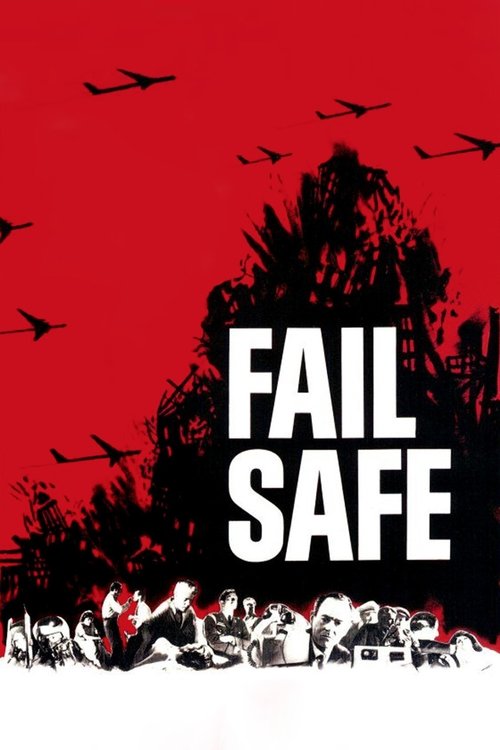
Fail Safe
1964 · Sidney Lumet
For when you want to be gripped by something deadly serious — a stark, adult thriller to watch in the dark and sit with afterward. Challenge, not comfort.
What it's about
A technical malfunction sends a group of American bombers, armed with hydrogen weapons, past their failsafe point toward Moscow — and no code, order, or plea can turn them back. In a Pentagon war room and a windowless bunker, the President of the United States gets on the phone with the Soviet Premier, through a single interpreter, and tries to stop the end of the world in real time.
The experience
Almost unbearably tense, and completely stripped of relief: no score, no jokes, no comforting distance — just men in fluorescent-lit rooms watching a catastrophe unfold on a board. It leaves you cold and shaken in a way few thrillers ever manage.
Performances
Henry Fonda, as a President negotiating for millions of lives over a telephone line, gives a masterclass in restraint — the whole apocalypse plays out on his face. Walter Matthau is chilling in a rare dramatic turn as a strategist who's made peace with megadeath.
The craft
Sidney Lumet directs it like a procedural tragedy: stark black-and-white photography, claustrophobic rooms, and — boldly — no music at all, so every silence hums with dread. The discipline of the filmmaking is the point; it refuses you a single escape hatch.
Why it matters
Released the same year as the era's famous nuclear satire and overshadowed at the box office, it has since been reclaimed as the deadly-serious counterpart — the definitive straight-faced portrait of Cold War annihilation by accident.
Snapshot
A bomber group carrying hydrogen weapons crosses the failsafe point toward Moscow due to a mechanical malfunction in the coded-order system. The President of the United States negotiates in real time with the Soviet Premier — through a single interpreter — while simultaneously directing his own aircraft to intercept the errant flight. When interception fails, he offers the Soviets an American city of equivalent value: New York. His wife is there. The film ends in silence, on photographs of ordinary people frozen at the moment of detonation.
Fail Safe is the coldest of Cold War films — a procedural tragedy conducted in fluorescent light, without a note of underscoring, stripped of irony, sentiment, and hope. Where Stanley Kubrick, working simultaneously from comparable source material, chose black comedy as his mode of confrontation, Sidney Lumet chose documentary dread. The result is a film that few other filmmakers could have made — not because its ideas are unique, but because its discipline is absolute.
Industry & production
The film's production history is inseparable from one of the more unusual legal and commercial disputes of postwar Hollywood. The 1962 novel Fail-Safe by Eugene Burdick and Harvey Wheeler became a bestseller and was acquired for film adaptation by producer Max Youngstein for Columbia Pictures. At the same time, Stanley Kubrick was preparing Dr. Strangelove or: How I Learned to Stop Worrying and Love the Bomb (1964) for Columbia, adapted from Peter George's novel Red Alert (1958). Peter George — and, more aggressively, Kubrick — pursued plagiarism claims against Burdick and Wheeler, arguing that Fail-Safe derived its central premise from Red Alert. The matter was settled out of court. What made the situation stranger still was that Columbia held both properties. The studio sequenced releases so that Kubrick's satire, shot at Shepperton Studios, opened first in January 1964; Fail Safe was withheld until October. By the time Lumet's film reached theaters, the premise of accidental nuclear war had already been metabolized through Kubrick's sardonic register, and audiences found it difficult to approach the same material a second time in an attitude of pure solemnity. This sequencing critically damaged the film's commercial prospects.
The production was shot almost entirely in New York, in keeping with Lumet's working practice and the film's ethos of institutional confinement. It was produced on a modest budget by the standards of the day. Walter Bernstein, who wrote the screenplay, had been blacklisted during the McCarthy period and worked under pseudonyms throughout the early 1950s; Fail Safe was among the first major studio assignments he received under his own name. His adaptation compresses the novel's structure and sharpens its tragic logic without sacrificing its systemic critique.
Technology
Fail Safe was shot in black and white — a choice that was already becoming commercially contrarian by 1964 but that Lumet treated as non-negotiable for tonal and thematic reasons. The black-and-white palette drains the material of any visual warmth, enforcing a visual grammar of abstraction and institutional sterility. The cockpit footage, the radar screens, the wall-sized display maps in the war rooms: all become diagrammatic rather than spectacular in monochrome, which is precisely the point. These are not dramatic images but administrative ones.
The technology the film depicts — the Vindicator bombers, the failsafe grid system, the hot-line communications between Washington and Moscow — was rendered with a high degree of operational plausibility, drawing on publicly available information and consultation. The credibility of the procedural detail was a deliberate production priority; the film needed to be believed as a possible scenario, not a fantasy, for its emotional argument to function.
Technique
Cinematography
Gerald Hirschfeld photographed the film with an approach that subordinates visual style to behavioral observation. The camera rarely calls attention to itself. Lighting is high-key and flat in the institutional spaces — the war room beneath the Pentagon, the Strategic Air Command bunker, the office where the President speaks by telephone — evacuating any atmospheric chiaroscuro and replacing it with the affectless glow of government fluorescence. Close-ups are used extensively in the telephone scenes, isolating faces and severing them from spatial context. The effect is to make the characters feel already entombed. There are no crane shots, no expressive wide angles for their own sake. The visual restraint is Lumet's primary instrument of tension: the frame never promises the audience relief that narrative events will not deliver.
Editing
Ralph Rosenblum edited the film, cutting between simultaneous locations — the SAC center in Omaha, the Pentagon war room, the presidential underground command post, the cockpit of the Vindicator — with a precision that maintains orientation without relaxing pressure. The intercutting is functional rather than rhetorical: it tracks the disintegrating lines of communication and command rather than building suspense in the conventional genre sense. Lumet and Rosenblum allow conversations to breathe, hold on silences longer than commercial editing norms would demand, and resist the impulse to cut away at moments of emotional extremity. The film's final montage — still photographs of Manhattan's population in the seconds before the American bomb strikes — is one of the most devastating editorial choices in American cinema of the period, a freeze-frame sequence that replaces catastrophe with its implication.
Mise-en-scène / staging
Lumet's theatrical instincts — shaped by years in live television and stage work — are everywhere in the staging. He frequently contains several characters within a single frame, orchestrating conversations as chamber encounters. The conference rooms and bunkers are blocked with actors at different distances and angles from the camera, creating a hierarchy of attention and complicity within the shot rather than through cutting. The film's most celebrated staging is the extended presidential telephone sequence with Henry Fonda and Larry Hagman: the President speaks, the interpreter renders his words into Russian and the Soviet Premier's responses back into English, and we never hear the Premier's voice or see his face. The entire geopolitical catastrophe is mediated, translated, secondhand. The staging makes this deferral of direct contact into formal argument.
Sound
The film has no original musical score. This was a deliberate and, at the time, highly unconventional decision. Lumet replaced the conventional emotional scaffolding of a film soundtrack with ambient sound, silence, and — in moments of extreme stress — a low-frequency electronic tone associated with the war room alert systems. The effect is disorienting in precisely the right way: audiences trained to receive emotional cues from music are left without that apparatus, forced to sit with the material unmediated. The absence of music is not emptiness but active pressure. Sound design, in a modern sense, does much of the work: the click of switches, the breathing of the cockpit crew, the static on long-distance telephone lines.
Performance
Lumet elicited a uniformly restrained ensemble, working against any tendency toward theatrical declaration. Henry Fonda brings to the President the same moral gravity and economy he had shown in Twelve Angry Men (1957), the quality of a man who thinks before he speaks and whose silences are consequential. Walter Matthau plays the civilian strategist Groeteschele — a figure in the Kissinger/Kahn mold, whose game-theory indifference to human death the film presents as the system's ideological pathology — with a controlled intelligence that avoids caricature. Dan O'Herlihy as General Black carries the film's moral horror in his body rather than his dialogue. Larry Hagman, as the presidential interpreter Buck, delivers a technically demanding performance of mounting anguish that works entirely through vocal texture and microexpression.
Narrative & dramatic mode
The film is a procedural tragedy, and its mode is resolutely classical in the Aristotelian sense: the catastrophe is already in motion at the opening, the characters discover they cannot stop it, and the final act is the working out of consequences. There is no villain and no sabotage; the system itself is the antagonist. The screenplay structures the action around three simultaneous narrative threads — the bomber crew executing their orders, the American command apparatus trying to countermand them, and the presidential diplomacy with the Soviets — and refuses to resolve any of them in the audience's favor. The ending is not a twist but an inexorable conclusion: if Moscow is destroyed, New York must be destroyed, because the logic of deterrence and equivalence has no exit.
The film operates in a mode closer to Greek tragedy than to the thriller it superficially resembles. The inevitability is built into the premise, and the dramatic question is not whether the catastrophe will occur but who the men are who preside over it and how they behave in the face of their own helplessness.
Genre & cycle
Fail Safe belongs to the cycle of nuclear anxiety films that ran from the mid-1950s through the mid-1960s, a cycle responding to the development of thermonuclear weapons, the missile gap panic, the Cuban Missile Crisis (October 1962), and the proliferating discourse of Mutual Assured Destruction and first-strike theory. Relevant companions in this cycle include On the Beach (1959, Stanley Kramer), Seven Days in May (1964, John Frankenheimer), and the competing Kubrick film. Within the cycle, Fail Safe occupies the most severe and literal position: it refuses comedy, romance, heroism, and survival. It is the cycle's most uncompromising specimen precisely because it eliminates every generic comfort.
More broadly, the film belongs to the tradition of the American institutional thriller — a mode in which the drama derives from the tension between procedural systems and human agency, and in which institutions themselves are the subject of critique. This tradition would continue through the 1970s in the conspiracy and system-failure films with which Lumet himself was deeply involved (Serpico, 1973; Network, 1976; Prince of the City, 1981).
Authorship & method
Sidney Lumet was by 1964 an established feature director with the reputation of a craftsman-humanist — attentive to performance, drawn to moral complexity, committed to New York as a production base, and professionally shaped by live television. His directorial debut, Twelve Angry Men (1957), prefigured Fail Safe in almost every formal respect: a single enclosed space, an ensemble of men under pressure, sustained dialogue, minimal music, deliberate pacing, and a narrative whose drama is entirely internal to its characters' choices. Lumet adapted literary and theatrical material throughout his career with the goal of discovering its inner theatrical logic rather than "opening up" the material for cinematic effect. Fail Safe is the logical extension of this approach applied to an end-of-the-world scenario.
Walter Bernstein's screenplay is a precise and loyal adaptation that tightens the novel's multi-character canvas. Bernstein had developed his craft writing for television and had the instinct for dialogue that drives scene rather than describes situation. Gerald Hirschfeld's cinematography is a study in subordination to directorial vision; the film does not display the cinematographer's individual sensibility but enacts Lumet's conception of the material. Ralph Rosenblum would collaborate with Lumet across several productions and develop a sensitivity to the long, dialogue-driven scene that Lumet's style required.
Movement / national cinema
The film is a product of the American cinema of the early-to-mid 1960s, a transitional moment between the studio classical system and the New Hollywood. Its aesthetic — black-and-white, location-based, performance-driven, formally austere — reflects the influence of European art cinema on American independent and studio work during the period, as well as the documentary impulse that had reshaped post-war cinematography. Lumet's specific lineage runs through live television drama, the social-problem film, and the theatrical adaptation, rather than through the genre traditions or the film-school formation of the directors who would dominate the next decade. He is in this sense a transitional figure: a studio professional whose aesthetic values were those of a theatrical realist.
Era / period
The film is a direct document of its Cold War moment. The Cuban Missile Crisis had occurred barely two years before production. The hotline between Washington and Moscow — a key plot device — had been established in 1963 following the crisis. The strategic doctrine of Mutual Assured Destruction and the RAND Corporation style of systems-theory thinking about nuclear war (personified in Groeteschele) were live, contested, and publicly debated. The Partial Nuclear Test Ban Treaty had been signed in 1963. Fail Safe participates in this specific historical moment not as allegory but as argument: the film is not "about" the Cold War in a displaced sense but is a direct intervention into a live cultural and political debate about nuclear policy.
Themes
The film's central concern is the relationship between systems and the humans who operate them. The failsafe mechanism exists to prevent accidental war; it is the failsafe mechanism's malfunction that causes the war. The logic is not ironic in the Strangelove mode but tragic: the more elaborate the safeguard, the more elaborate the potential failure. Technology promises to remove human error and instead introduces a new category of systemic error that human intervention cannot reliably correct.
Against the systemic critique, the film positions individual moral seriousness as both necessary and insufficient. The President's choices are scrupulously correct given the premises — he cannot stop the bombers, he cannot lie to the Soviets, he cannot allow a first-strike precedent to stand — and those correct choices lead to New York's incineration. The film refuses to blame him. The tragedy is structural.
The Groeteschele subplot introduces a second theme: the danger of a rationalism that has severed itself from emotional reality. His game-theory calculations — in which nuclear first-strike emerges as strategically logical — are presented as the ideology that the system has internalized, and the film suggests that the machine's indifference to human life is a projection of the intellectual frameworks used to design and manage it.
The film also meditates on translation and mediation. The presidential-Soviet dialogue passes through an interpreter; the strategic decision that destroys a city is encoded in a malfunctioning machine signal; the orders that kill the bomber crew will come from the President's own voice. Language, code, and chain of command are all shown as sites of fatal distortion.
Reception, canon & influence
Influences on the film: The novel by Burdick and Wheeler drew on a now-familiar cluster of Cold War anxieties and on Peter George's Red Alert (in ways that were legally contested). Lumet's formal approach reflects the live television drama tradition he came from, the social realism of postwar American theater, and the procedural authenticity of documentary cinema. The film's deliberate restriction to enclosed spaces and dialogue has precedents in the chamber plays of the American dramatic tradition as well as in the formal choices of European neorealism and the Nouvelle Vague's interest in long-take behavioral observation. The Manchurian Candidate (1962) had established a template for paranoid Cold War political cinema operating at a high level of narrative sophistication.
Critical reception: Upon release, the film received respectful if not rapturous reviews. Critics acknowledged its seriousness and formal control but frequently noted — sometimes with an air of unfairness — that it had arrived after Kubrick had already addressed the same premise with greater wit. The comparative framework proved difficult to escape: the two films were reviewed in relation to each other throughout 1964, and Kubrick's critical prestige and the commercial success of Dr. Strangelove set terms that were disadvantageous to Lumet's grimmer project. Commercially, the film underperformed. The critical consensus has, over decades, grown considerably warmer; it is now widely considered one of the essential American political films of its period.
Legacy: The most direct homage to Fail Safe is the 2000 live television broadcast directed by Stephen Frears for CBS, in black and white, with Richard Dreyfuss as the President and Don Cheadle as Buck. The live-broadcast format was an explicit tribute to Lumet's live-television origins and to the film's sense of unfolding crisis in real time. The film's influence on the procedural political thriller — the genre of the institutional system under catastrophic stress — is diffuse but traceable: its formal vocabulary of simultaneous intercutting between command centers, its focus on the interpreter-as-witness figure, its ending that refuses catharsis, all recur in subsequent political cinema. The absence of a film score as a deliberate ethical gesture — the refusal to tell the audience how to feel — has been cited by later filmmakers working in the mode of political documentary realism. Within Lumet's own career, Fail Safe is the film that most nakedly exposes the philosophical concerns — about institutions, individual conscience, and the limits of rationality — that would animate his major work through the following two decades.
A Deleuzian reading
The last thing Fail Safe shows you is a woman on a New York sidewalk, caught mid-stride, and then the frame freezes and the picture is over.
The full Deleuzian reading of Fail Safe →
Reception
Buried on release in 1964 after Dr. Strangelove beat it to theaters and turned its deadly-serious premise into a punchline, it flopped — but it's since been reappraised as one of the great Cold War thrillers, arguably the scarier of the two.
How Fail Safe was received, from release to now →
Influences: the films it descends from and the films it influenced
- Twelve Angry Men (1957) — Lumet developed his chamber-pressure grammar here — rehearsed ensemble blocked within institutional confinement, close-up surveillance of faces under procedural stress — and transposed it directly onto multiple simultaneous war rooms in Fail Safe, preserving the spatial logic of men who cannot leave the room where decisions are made.
- Marty (1955) — The live-television-to-theatrical-film pipeline establishes the flat high-key institutional lighting, unglamorous interiors, and behavioral performance-without-affect that Lumet, directing live TV concurrently, carries directly into Fail Safe's fluorescent war rooms and Pentagon corridors.
- Paths of Glory (1957) — Kubrick established the B&W military-procedural tragedy in which institutional logic executes its course despite individual moral objection; Lumet inherits the formal argument but strips Kubrick's expressionist tracking shots for static close-ups, replacing kinetic dread with affectless observational pressure.
- On the Beach (1959) — First major American studio film to stage nuclear apocalypse as a behavioral procedural stripped of melodrama and underscoring; Lumet inherits the restrained-ensemble-facing-extinction format but eliminates even Kramer's residual romantic subplot, achieving pure procedural tragedy.
- The Manchurian Candidate (1962) — Frankenheimer's B&W close-up-heavy intercutting during multi-party ensemble confrontations — cutting rhythm governed by psychological pressure rather than plot information — provides the visual syntax Lumet adapts for war-room telephone sequences where faces are severed from spatial context.
- La Jetée (1962) — Marker established nuclear-anxiety still photography as cinematic grammar — post-apocalyptic catastrophe rendered through frozen images of ordinary life — directly anticipating Fail Safe's climactic montage in which Manhattan citizens are frozen in still photographs at the moment of detonation.
- 12 Angry Men (1957) — Lumet strips the soundtrack to absolute silence — no underscore — confines his ensemble to three simultaneous sealed rooms, and applies real-time countdown pressure, radicalizing the score-minimalism and chamber constraints he first systematized in 12 Angry Men.
- Twelve O'Clock High (1949) — Transposes the confined-institutional-interior command drama and unbearable send-them-or-not decision onto SAC bombers, playing command pressure almost entirely in windowless war rooms.
- The Missiles of October (1974) — First television film to apply Fail Safe's procedural real-time chamber format directly to the Cuban Missile Crisis: institutional dialogue in spare interiors, parallel cutting between Washington and Soviet decision-makers, restrained ensemble performance, and a suppressed score — the Lumet formula repurposed for broadcast drama.
- Network (1976) — Lumet extends his institutional-confinement ensemble method into color, maintaining the same close-up-heavy staging and procedural critique of corporate systems that override individual moral agency; the boardroom sequences directly inherit Fail Safe's grammar of men in rooms unable to arrest the logic of an institutional machine.
- WarGames (1983) — Inherits Fail Safe's system-as-autonomous-antagonist architecture: the WOPR computer, like the Vindicator's coded-order malfunction, pursues procedural logic toward launch independent of human intent; Badham's parallel intercutting between NORAD command and the protagonist echoes Lumet's multi-location grammar of divided and failing command authority.
- The Day After (1983) — Consciously inherits Fail Safe's refusal of redemptive resolution; Meyer's deployment of freeze-frame and slow-motion to render the nuclear strike — denying spectacular catharsis — and the elimination of underscoring during the detonation sequence are direct formal citations of Lumet's still-image, no-score method.
- Crimson Tide (1995) — The divided-command nuclear-launch-authority standoff — two officers with legitimate procedural claims at opposite positions, neither able to prevail through personality alone — lifts Fail Safe's structural logic of bomber crew versus chain of command; Scott's parallel intercutting between submarine levels during the authority standoff is the direct formal heir of Lumet's multi-location grammar.
- Thirteen Days (2000) — Adopts Fail Safe's procedural real-time institutional drama format for the Cuban Missile Crisis: parallel intercutting between decision-making bodies, close-up behavioral ensemble performance in crisis-room staging, dialogue-driven tension without action sequences — applying the Lumet war-room grammar to the historical event Fail Safe fictionally mirrored.
- Dog Day Afternoon (1975) — Lumet's deliberate choice to release this Cold War crisis film without any musical score — letting dialogue and silence carry all tension — is the direct precedent for Dog Day Afternoon's score-free sound design; both films treat the absence of music as the authentic sound of dread.
- The Hunt for Red October (1990) — Lumet's patient intercutting between geographically isolated command centers — Pentagon, SAC, Moscow — each operating on incomplete information toward catastrophic misunderstanding, provides the editing template for Red October's multi-location dramatic irony structure.
- The Andromeda Strain (1971) — The institutional-systems-failure procedural with an ensemble of functional specialists replacing star heroes, editing driven by information exchange rather than emotional escalation, and containment-space blocking organized around the geometry of consoles and screens.
- Path to War (2003) — Lumet's closed-room executive crisis drama uses a restrained score, patient scene duration, and purely institutional blocking with no exterior relief, establishing the procedural template — men around tables enacting catastrophe through procedure — that Path to War inherits.
- A House of Dynamite (2025) — Established the nuclear command-chain procedural form: real-time compression of institutional decision-making with ensemble performance calibrated to professional function, and dread generated from the gap between correct procedure and catastrophic consequence rather than from physical action.
- The Sum of All Fears (2002) — Establishes the accidental-nuclear-catastrophe-by-system-error template, structured as cross-cut dramatic irony between sealed command rooms where the audience knows the misattribution that the principals cannot — the exact escalation machine Robinson inherits.
- Dr. Strangelove or: How I Learned to Stop Worrying and Love the Bomb (1964) — Both films share B&W cinematography, parallel intercutting between simultaneous command locations, and the system-as-autonomous-antagonist structural argument; where Kubrick deploys wide-angle distortion and satirical performance, Lumet uses flat-lit behavioral realism — identical war-room material, inverted formal registers, released by the same studio in the same year.
- Seven Days in May (1964) — Released the same year, Seven Days in May shares Fail Safe's institutional-military-thriller architecture: ensemble staging in bureaucratic interiors, procedural logic threatening civilian authority, B&W photography, and parallel cutting between command levels, evidence that Frankenheimer and Lumet were simultaneously developing the same political-confinement grammar.
- Judgment at Nuremberg (1961) — Shares Fail Safe's close-up-heavy behavioral grammar of institutional reckoning in B&W: faces isolated against sterile backgrounds during extended procedural confrontation, editing that holds on silence longer than commercial norms allow, performance restraint in the face of collective atrocity.
- The Best Man (1964) — B&W single-location political-institutional ensemble drama in which dialogue and procedural maneuvering — not action — determine outcome; Vidal's screenplay, like Bernstein's, foregrounds institutional logic over individual heroism, and Schaffner's flat-lit staging of men in hotel-room confinement mirrors Lumet's war-room blocking.
Similar films
- Dr. Strangelove or: How I Learned to Stop Worrying and Love the Bomb (1964) — influence & lineage
- Seven Days in May (1964) — influence & lineage
- Thirteen Days (2000) — influence & lineage
- Network (1976) — influence & lineage
- The Manchurian Candidate (1962) — influence & lineage
- Threads (1985) — same viewing thread
- The Hunt for Red October (1990) — same viewing thread
- A House of Dynamite (2025) — shared sensibility
All the films related to Fail Safe →
Watch it with: curated runs of related films
- The Shadow of the Bomb — Watch these when you want the Cold War's dread the way it actually landed — not in war rooms but at kitchen tables — the same annihilation refracted from pulp sci-fi to a submarine standoff to a retired couple brewing tea as the fallout arrives.