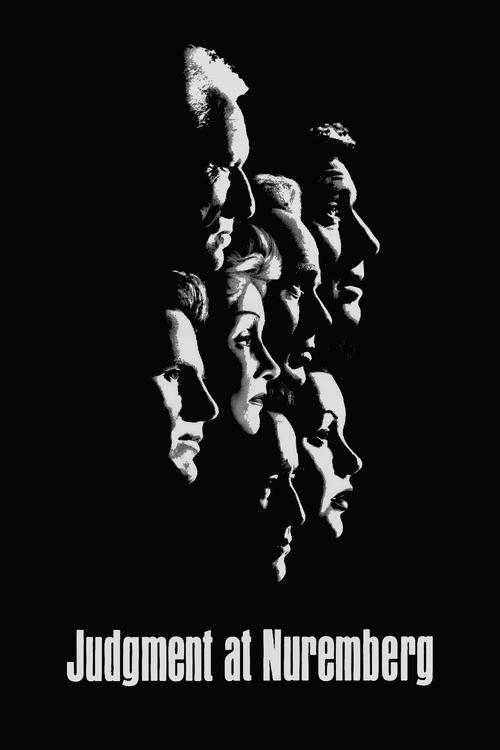
Judgment at Nuremberg
1961 · Stanley Kramer
For when you want a film to argue with — a big, absorbing courtroom drama for a thoughtful evening. It asks concentration and rewards it; this is the pick when you're in the mood to think, not to unwind.
What it's about
In occupied Germany in 1947, an unassuming American judge presides over the trial of four German jurists — men of learning and conscience who administered Nazi law from the bench. The courtroom becomes the arena for a harder question than guilt or innocence: how responsible is the respectable professional who lent the state's machinery its legitimacy? Around the trial, occupied Nuremberg itself — its widows, its survivors, its politics — keeps pressing in.
The experience
Talky, gripping, and morally serious — three hours of testimony and argument that play like a heavyweight bout, with speeches that land hard and a tension that comes from ideas rather than action. It leaves you turning the central question over long after the verdict.
Performances
Spencer Tracy anchors it with plainspoken decency, Maximilian Schell won an Oscar as the fierce young defense attorney, and Judy Garland and Montgomery Clift, in brief witness-stand appearances, are shattering. Burt Lancaster brings haunted gravity to the lead defendant.
The craft
Abby Mann's screenplay turns legal argument into genuine drama, giving the defense its strongest possible case rather than a straw man. The stark black-and-white photography and a camera that prowls the courtroom keep three hours of talk visually alive.
Why it matters
Arriving just months after the Eichmann trial made these questions front-page news, it became the definitive courtroom treatment of ordinary complicity in atrocity — a touchstone every trial film about historical guilt still answers to.
Snapshot
Judgment at Nuremberg is Stanley Kramer's three-hour courtroom drama about one of the lesser-known "subsequent" Nuremberg proceedings: the 1947 trial of German jurists who administered Nazi law from the bench. Rather than restage the prosecution of the regime's top political and military leaders, the film narrows its focus to four judges, and through them poses a harder, more reflexive question — what is the culpability of the ordinary professional, the man of conscience and learning, who lent the machinery of the state its legitimacy? Written by Abby Mann from his own television play and anchored by Spencer Tracy as the plain-spoken American jurist sent to preside, the film is a quintessential Kramer "message picture": earnest, talky, morally direct, and built for impact. It arrived at a charged moment — months after the capture and during the trial of Adolf Eichmann in Jerusalem — and it remains one of Hollywood's most ambitious mainstream reckonings with complicity, the rule of law, and the limits of "following orders."
Industry & production
The film was an independent production by Stanley Kramer, released through United Artists, the studio that had become the natural home for filmmaker-producers operating outside the old contract system. Kramer by 1961 was among the most prominent producer-directors in Hollywood, having built a brand on socially conscious, issue-driven pictures (The Defiant Ones, On the Beach, Inherit the Wind). Judgment at Nuremberg extended that brand to its most explicitly historical and didactic register.
Its origins lie in television. Abby Mann wrote Judgment at Nuremberg as an episode of Playhouse 90, broadcast in 1959, directed by George Roy Hill. Maximilian Schell appeared in that production as defense counsel and carried the role into the film — an unusual instance of a television player elevated to a major motion-picture lead. Kramer expanded Mann's compact teleplay into a roadshow-scale feature running roughly three hours, the kind of prestige length reserved for event releases.
The casting strategy was characteristic of Kramer's marquee-heavy productions: a constellation of stars in roles often smaller than their billing implied. Spencer Tracy plays the presiding judge; Burt Lancaster the lead defendant, the eminent jurist Ernst Janning; Richard Widmark the army prosecutor; Marlene Dietrich the widow of an executed German general; Judy Garland and Montgomery Clift appear in single, concentrated witness scenes. Garland's casting was notable as a dramatic comeback after years away from features, and Clift's brief, harrowing turn as a man sterilized under Nazi eugenics law is among the film's most discussed performances. A young William Shatner appears in a supporting role as an army aide.
The production reportedly included location work in Nuremberg and West Germany alongside studio shooting, lending the courtroom and the bombed-city exteriors a documentary texture; precise production-schedule details are not something I can confirm here without risking invention. The film was a significant awards success, nominated for eleven Academy Awards and winning two — Best Actor for Maximilian Schell and Best Adapted Screenplay for Abby Mann.
Technology
The film was shot in black-and-white 35mm at the standard widescreen aspect ratio of its era, a deliberately sober choice at a time when color and large-format roadshow spectacle were ascendant. Monochrome served both economy and meaning: it allied the film visually with newsreel and the documentary record, an effect made literal when actual concentration-camp liberation footage is screened within the narrative as evidence. That incorporation of archival atrocity footage into a fiction feature was, for a mainstream 1961 release, a bold technological and ethical gesture — the film's most disturbing "special effect" is unstaged historical fact.
Otherwise the production relied on conventional studio technology of the period: sound-stage interiors for the courtroom, optical work for transitions, and a post-synchronized approach to dialogue and the multilingual translation conceit (discussed under Sound). There is no technological novelty in the apparatus; the film's innovation is in deployment, not invention.
Technique
Cinematography
Ernest Laszlo's black-and-white photography is the film's principal formal achievement. Within the static givens of a courtroom drama, Laszlo and Kramer pursue an unusually mobile, expressive camera. The film is remembered above all for its sweeping dolly and crane movements that circle the witness stand and the bench — most famously a long traveling/encircling shot that closes in on a speaker during testimony, the camera prowling around the figure as emotion mounts. These moving-camera flourishes break the proscenium fixity that the dialogue might otherwise impose, converting talk into kinetic event. Laszlo also exploits deep, hard-edged lighting and the grain and contrast of monochrome to bridge the staged scenes and the documentary footage. His work earned one of the film's eleven Oscar nominations.
Editing
Frederick Knudtson, Kramer's regular editor, cut the film. The central editorial problem is sustaining a three-hour, dialogue-dominated trial without inertia. The solution is rhythm built on the reaction shot: the film cuts constantly among the bench, the dock, counsel, and gallery, so that testimony is dramatized through faces receiving it as much as through the speaker. The most charged editorial passage is the screening of the camp footage, where Knudtson intercuts the unbearable images with the courtroom's stricken witnesses — implicating the on-screen and off-screen audience in the same act of looking. The cutting earned a Best Editing nomination.
Mise-en-scène / staging
The dominant space is the tribunal: a deep, high-ceilinged courtroom organized around clear sightlines between bench, dock, and stand, with the gallery as an ever-present moral audience. Kramer stages the trial as a series of confrontations across this geometry, and the blocking does much of the dramatic work — who rises, who turns, who refuses to meet a gaze. Outside the courtroom, the bombed streets of Nuremberg and the quiet domestic scenes (Tracy's evenings, his encounters with Dietrich's widow) open the film to the texture of an occupied, defeated, and quietly unrepentant society. The contrast between the ordered courtroom and the ruined city carries the film's argument about justice imposed on rubble.
Sound
Sound design handles a genuine narrative challenge: the trial is bilingual. The film stages simultaneous translation with headphones and, in its most elegant device, lets the camera "follow" the act of comprehension — beginning a German speech in German and sliding into English to mark the audience's entry into understanding. Ernest Gold's score is used sparingly relative to the talk, reserving musical emphasis for transitions and the gravest passages rather than underscoring the testimony itself, which is allowed to play in something close to silence.
Performance
Performance is where the film lives, and its registers are deliberately varied. Tracy's Judge Haywood is the anchor of restraint — watchful, folksy, slowly hardening into resolve. Schell's defense attorney is the film's engine of motion: rapid, brilliant, aggressive, his Oscar-winning turn supplying the prosecutorial energy that a defense role rarely carries. Lancaster's Janning is mostly a study in monumental silence until a late, devastating courtroom confession. The film's two most celebrated set-pieces are the cameo testimonies: Montgomery Clift, playing a cognitively impaired man sterilized by the state, in a fractured, improvisatory-seeming breakdown; and Judy Garland as a woman once tried under the "racial defilement" laws, reliving her humiliation on the stand. Both compress the film's themes into a single body and voice.
Narrative & dramatic mode
Structurally the film is a courtroom drama in the classical sense — charge, evidence, testimony, summation, verdict — but its dramatic mode is dialectical rather than suspenseful. The outcome (a guilty verdict) is never seriously in doubt; the drama is argumentative, a sustained debate over the nature of guilt conducted through prosecution and defense. The defense's case is given real intellectual force — the arguments that the judges followed the law as it then stood, that they could not have foreseen the end, that the victorious powers are selectively self-righteous, that an entire nation cannot be indicted — and the film's seriousness depends on not making that case a straw man. The frame narrative is the moral education of Judge Haywood, the outsider who must decide; subplots (his relationship with the general's widow, the political pressure of the emerging Cold War to go easy on Germany) widen the question from law into geopolitics and conscience.
Genre & cycle
The film sits at the intersection of two genres: the courtroom drama and the postwar "Holocaust/war guilt" film. As courtroom drama it belongs to a rich late-1950s/early-1960s American cycle of trial pictures preoccupied with justice and conscience (12 Angry Men, Witness for the Prosecution, Kramer's own Inherit the Wind). As a reckoning with Nazism it belongs to a smaller, braver category of mainstream films willing to confront the genocide directly rather than as backdrop. It is also a defining instance of the "Stanley Kramer social-problem film" as its own recognizable cycle — the prestige issue-picture aimed at moral instruction of a mass audience.
Authorship & method
The film is doubly authored, by Kramer as producer-director and Mann as writer. Kramer's method was the message picture: take a pressing moral or social question, dramatize it through stars and confrontation, and deliver it to the widest possible audience with clarity and force. Critics have long debated the cost of that method — its tendency toward the explicit, the speech-driven, the morally underlined — but Judgment at Nuremberg is arguably its fullest justification, because its subject genuinely warrants direct statement.
Abby Mann's screenplay is the film's spine. Adapting his own teleplay, Mann retained the dialectical structure and the great summations while opening the material cinematically. His Oscar win acknowledged a script that gives the indefensible position real eloquence. Among collaborators, Ernest Laszlo (cinematography) supplied the mobile monochrome visual language; Frederick Knudtson (editing) the reaction-driven rhythm; and composer Ernest Gold the restrained score. This was a recurring Kramer unit — Laszlo, Knudtson, and Gold all worked repeatedly with him — and the film bears the marks of a settled creative team operating at full stretch.
Movement / national cinema
The film is firmly a product of American studio-era prestige filmmaking in its independent, post-studio phase — the producer-driven United Artists model. It is not affiliated with any aesthetic movement; its sensibility is the opposite of the contemporaneous European new waves, prizing legibility and moral statement over formal rupture. Yet its subject is transnational, and its multilingual staging and German locations register an awareness, rare in Hollywood, that this was not solely an American story to tell.
Era / period
1961 places the film at a hinge of historical memory. It appeared roughly a decade and a half after the actual trials, as the postwar consensus to rehabilitate West Germany as a Cold War ally was firmly established — a politics the film names directly through the pressure on Haywood to render a lenient verdict. It also coincided with the Eichmann trial in Jerusalem, which reopened the question of bureaucratic and "ordinary" complicity for a global public; the film's preoccupation with the desk-bound, law-abiding functionary speaks directly to that moment, even where it cannot have been a direct response. The film thus marks the period when the Holocaust began moving from suppressed aftermath to central moral subject of Western culture.
Themes
The film's governing theme is complicity — the guilt not of monsters but of educated, patriotic professionals who told themselves they were preserving order. Around it cluster: the conflict between law and justice (whether obedience to enacted law can excuse participation in atrocity); the "just following orders" defense and the question of individual moral responsibility under a criminal state; collective versus individual guilt, and whether a nation can be tried; the seductions of national survival and the cost of looking away; and the compromising of justice by political expedience. Janning's confession crystallizes the film's thesis — that the descent was incremental, that those who knew said nothing because the first victims were "only" a few. The film insists, finally, that knowing is itself a form of choosing.
Reception, canon & influence
Judgment at Nuremberg was received as a major, serious work and an awards heavyweight, drawing eleven Academy Award nominations and winning two (Schell, Best Actor; Mann, Best Adapted Screenplay). Critical response then and since has been admiring but divided along a familiar Kramer fault line: praise for its moral courage, its performances, and its willingness to give the defense genuine weight, set against the recurring charge that it is overlong, speechy, and inclined to underline what it might have implied. That tension — between power and didacticism — is the central critical fact of Kramer's career, and this film is the test case most often cited on both sides.
The influences on the film are clear: the documentary and newsreel record of the camps (incorporated literally); the actual transcripts and history of the Nuremberg "Justice Trial"; the live-television drama tradition of the 1950s, from which both Mann's teleplay and the film's intimate, performance-driven aesthetic descend; and the broader American courtroom-drama tradition.
Its legacy runs forward in several directions. It became a touchstone — for many viewers the defining popular image — of the Nuremberg trials and of the "I was only following orders" debate, a reference point invoked far beyond cinema in legal and ethical discussion. It helped legitimize the Holocaust and war-guilt as serious mainstream film subjects, part of a lineage extending toward later television and film treatments of the genocide and its trials (including, decades on, courtroom dramas of Holocaust memory and denial). And it stands as a model — and a cautionary example — of the star-driven, conscience-driven prestige picture, the kind of film that aims to make a mass audience deliberate. Its reputation has proved durable: it is regularly revived and taught, valued less as a perfect film than as an honorable and unusually intelligent one, willing to dramatize the strongest version of the argument it ultimately refuses.
A Deleuzian reading
An old judge from Maine sits and listens.
The full Deleuzian reading of Judgment at Nuremberg →
Reception
A prestige event in 1961 — 11 Oscar nominations and a pointed West Berlin premiere just months after the Wall went up — it later got dragged into the general critical backlash against Stanley Kramer's 'message pictures,' but has quietly won that argument: it now sits comfortably in the courtroom-drama canon and rates remarkably high with modern audiences.
How Judgment at Nuremberg was received, from release to now →
Influences: the films it descends from and the films it influenced
- Twelve Angry Men (1957) — Shares the live-television-to-film pedigree, building drama almost entirely from reaction-shot rhythm and the geometry of bodies confined in a single deliberative chamber.
- Witness for the Prosecution (1957) — Establishes the postwar prestige courtroom as a theater of staged cameo testimony, each witness a self-contained performance turn pivoting on a reveal.
- Paths of Glory (1957) — Models the military-tribunal-as-indictment, using mobile tracking through a rigid juridical space to expose 'following orders' as moral evasion.
- Nazi Concentration Camps (1945) — Supplies the literal liberation-camp atrocity footage entered as evidence at Nuremberg, the documentary record Kramer intercuts directly into the trial.
- Compulsion (1959) — Stakes the entire film on a single monumental closing summation (Welles) held in near-silence — the speech-as-climax structure Schell's defense inherits.
- Citizen Kane (1941) — Originates the deep-focus, low-ceiling mobile monochrome grammar that cinematographer Ernest Laszlo adapts for the gliding 360-degree courtroom camera.
- Mr. Smith Goes to Washington (1939) — Defines the American conscience-picture's faith in the oratorical set-piece, the lone voice swaying a deliberative body through sustained speech.
- The Ox-Bow Incident (1943) — Dramatizes law-versus-justice as procedural failure, the formal hearing that delivers an unjust verdict — the dialectic Mann's script weaponizes.
- 12 Angry Men (1957) — Kramer maps moral positions onto courtroom geography — witness stand, defense table, prosecution bench, gallery — and populates each zone with Method-trained actors (Tracy, Clift, Garland) in a direct expansion of 12 Angry Men's status-coding and ensemble template.
- The Stranger (1946) — Directly extends The Stranger's audacity of cutting real concentration-camp documentary footage into a fiction film to force the audience to bear witness to atrocity.
- The Caine Mutiny (1954) — Testimony-as-moral-reckoning courtroom drama whose climaxes are witnesses cracking under cross-examination, inheriting Caine's legal-vs-moral-truth structure.
- To Kill a Mockingbird (1962) — Extends the social-problem courtroom built around a monumental closing summation delivered into monumental silence as the film's moral fulcrum.
- JFK (1991) — Radicalizes the intercut-archival-footage technique, weaving documentary record into courtroom argument so the summation becomes a montage-driven dialectic.
- A Few Good Men (1992) — Stages the 'I was only following orders' defense as its central courtroom engine, climaxing in a cross-examination that breaks the chain-of-command alibi.
- Hannah Arendt (2012) — Intercuts the actual Eichmann-trial archival footage into the drama, continuing the post-Eichmann reckoning with complicity and the banality of obedience.
- Denial (2016) — Carries the lineage into the courtroom of Holocaust memory, again entering atrocity evidence into a tribunal where the strongest opposing argument is given real weight.
- The Reader (2008) — Re-stages the war-guilt tribunal around a defendant's complicity, dramatizing the gap between legal culpability and moral judgment that Mann's script opened.
- Downfall (2004) — Kramer established the legal-documentary framing device for Nazi perpetrators in Western cinema — extended scenes where war criminals speak in their own voices without narrative editorialising, the audience left to process discomfort without a cut to safety — a temporal and ethical precedent for Downfall's decision to hold inside Hitler's tirades at close-to-real conversational duration.
- Good Night, and Good Luck. (2005) — Kramer's decision to screen authentic concentration-camp documentary footage during the courtroom proceedings—cutting between audience reaction and unedited historical image—establishes the ethical and aesthetic grammar for integrating archival material into performed drama that Clooney adopts with the McCarthy kinescopes.
- Frost/Nixon (2008) — Kramer establishes the substitute tribunal as a narrative form — a formal legal proceeding that doubles as a moral reckoning conducted through dialogue — and uses sustained extreme close-up during testimony to externalize the psychological exposure of a witness who has something to confess, both strategies central to Frost/Nixon.
- Argentina 1985 (2022) — Stages the litigation of state atrocity through sustained witness close-ups and the in-court screening of actual archival footage of the crimes — the direct template for Argentina 1985's restrained-witness framing and archival-footage integration.
- Oppenheimer (2023) — Kramer's pressure-chamber courtroom staging — in which legal procedure forces defendants, witnesses, and audience to confront historical complicity in state-sanctioned atrocity — is the procedural template for Oppenheimer's 1954 security hearing as the film's moral crucible.
- The Trial of the Chicago 7 (2020) — The prestige issue-picture model of restaging a real historic trial as a moral referendum, climaxing in grandstanding speeches pitched past the bench toward the contemporary audience.
- Inherit the Wind (1960) — Immediate sibling from the same Kramer unit (Laszlo, Gold), built on dueling adversarial summations and a courtroom staged as a public dialectical arena.
- The Defiant Ones (1958) — Exemplifies Kramer's message-picture method — a pressing moral question dramatized through star confrontation and delivered to a mass audience with deliberate clarity.
- Anatomy of a Murder (1959) — Pursues the same procedural realism and sparse-scoring restraint, letting the rhythm of examination and cross-examination carry tension without underscoring.
- Fail Safe (1964) — Shares Fail Safe's close-up-heavy behavioral grammar of institutional reckoning in B&W: faces isolated against sterile backgrounds during extended procedural confrontation, editing that holds on silence longer than commercial norms allow, performance restraint in the face of collective atrocity.
Similar films
- Anatomy of a Murder (1959) — influence & lineage
- Paths of Glory (1957) — influence & lineage
- Witness for the Prosecution (1957) — influence & lineage
- To Kill a Mockingbird (1962) — influence & lineage
- A Few Good Men (1992) — influence & lineage
- Schindler's List (1993) — same viewing thread
- Shoah (1985) — same viewing thread
- Hitler: A Film from Germany (1978) — same viewing thread
All the films related to Judgment at Nuremberg →
Watch it with: curated runs of related films
- In the Shadow of the Reich — A run of films about ordinary people inside the Nazi era — surviving it, resisting it, or trying to reckon with how it happened — that rhyme on conscience, complicity, and who chooses to act.