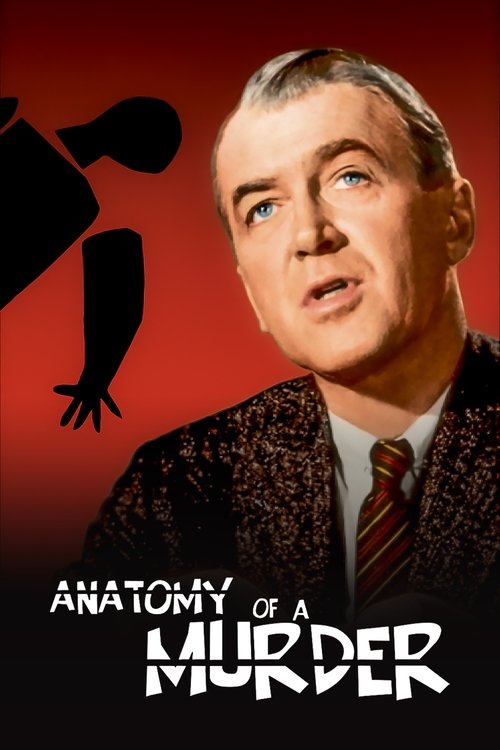
Anatomy of a Murder
1959 · Otto Preminger
For when you want a smart, grown-up drama to chew on — the kind where you're still debating the verdict at breakfast. An engrossing classic, not a stuffy one.
What it's about
A semi-retired small-town Michigan lawyer takes on the defense of an Army lieutenant who killed a local innkeeper — the man the lieutenant's wife says raped her. What follows is one long, meticulous trial: a chess match between a folksy defense attorney and a slick big-city prosecutor, where every witness complicates the question of who's telling the truth.
The experience
Talky, absorbing, and surprisingly playful for its era — the courtroom sparring crackles, and the film keeps you guessing without ever tipping its hand. It treats you like an adult juror and lets you sit with the doubt.
Performances
James Stewart is at his craftiest as the aw-shucks lawyer whose folksiness is a weapon, sparring memorably with George C. Scott's coiled prosecutor. Lee Remick brings unsettling ambiguity to the wife at the case's center.
The craft
Otto Preminger stages the trial with near-documentary fidelity to real courtroom procedure, shot in cool, unadorned black and white — and scores it, in a landmark move, with original Duke Ellington jazz. Its frank language shattered what studio films were allowed to say out loud.
Why it matters
It set the standard every courtroom drama since has been measured against, and its battles with censorship helped pry open American film for adult subject matter.
Snapshot
Anatomy of a Murder is the most rigorous and influential courtroom film Hollywood produced in the studio era, and one of the defining works of Otto Preminger's career as an independent producer-director. Across roughly two and a half hours, it follows the small-town Michigan lawyer Paul Biegler as he defends an Army lieutenant who has killed the man his wife says raped her — and it refuses, with unusual discipline, to tell us whether the client is innocent, whether the wife is honest, or whether justice is finally done. The film is at once a procedural of extraordinary technical fidelity to courtroom practice and a study in moral ambiguity, staged in the documentary-gray light of Michigan's Upper Peninsula and scored, in a landmark departure, by Duke Ellington. Its frank sexual vocabulary broke open the limits of what American films could say aloud, and its influence on the legal drama as a form is foundational.
Industry & production
By 1959 Preminger had spent the decade establishing himself as one of Hollywood's most determined challengers of institutional censorship. He had released The Moon Is Blue (1953) and The Man with the Golden Arm (1955) without Production Code seals, and his confrontations with the Code and with local censor boards were both a matter of conviction and a shrewd publicity instrument. Operating as his own producer through his independent company, with Columbia Pictures distributing, Preminger had the autonomy to pursue material that the major studios' in-house production would have softened or avoided.
The source was a best-selling 1958 novel, Anatomy of a Murder, published under the pen name Robert Traver by John D. Voelker, a Michigan lawyer who was at the time a sitting justice of the Michigan Supreme Court. The novel drew closely on a real 1952 case Voelker had defended in Big Bay, Michigan, in which a lieutenant shot and killed a tavern owner after his wife alleged a rape. The procedural authenticity that distinguishes the film flows directly from this origin: the author was a working trial lawyer writing what he knew. Wendell Mayes wrote the screenplay, preserving the novel's attention to legal mechanics and its refusal of tidy resolution.
Preminger's casting was both starry and conceptually pointed. James Stewart took the lead as Biegler, deepening the more ambivalent, ethically complicated persona he had been developing through the 1950s in his work with Anthony Mann and Alfred Hitchcock. Lee Remick played Laura Manion and Ben Gazzara her husband, Lt. Frederick Manion. The supporting ensemble proved a remarkable launching ground: George C. Scott, then largely unknown in film, played the steely out-of-town prosecutor Claude Dancer in a performance widely regarded as his breakthrough, while Arthur O'Connell played Biegler's alcoholic friend and colleague Parnell McCarthy and Eve Arden his dry secretary Maida. Most striking was Preminger's casting of Joseph N. Welch — the Boston attorney who had become a national figure as the Army's counsel during the 1954 Army–McCarthy hearings, famous for his rebuke "Have you no sense of decency?" — as the presiding Judge Weaver. A non-actor playing a judge lent the trial an unusual gravity and a real juridical bearing.
Preminger shot on location in the Upper Peninsula — in and around Ishpeming, Marquette, and Big Bay, near where the real events had occurred — rather than on studio sets, a choice central to the film's documentary texture.
Technology
Anatomy of a Murder was photographed in black and white in the standard 1.85:1 widescreen ratio of the period, eschewing both color and the anamorphic scope formats that Preminger had used elsewhere. The monochrome, location-based image was an aesthetic decision in keeping with the film's sober, observational realism. The film's most consequential technical-cultural innovation lay elsewhere: in its score. Preminger commissioned Duke Ellington to compose a full jazz score — one of the first occasions on which a major Hollywood feature was scored throughout by an African American composer working in an idiomatic jazz language rather than a symphonic one. Ellington also appears briefly on screen as a roadhouse pianist named "Pie Eye," playing alongside Stewart's character. The soundtrack album and the score were widely celebrated and honored in the years following release.
Technique
Cinematography
Sam Leavitt photographed the film in a restrained, lucid black-and-white style suited to its courtroom realism. The visual approach is observational rather than expressive: deep-focus compositions keep multiple figures legible within the trial space, long takes allow legal argument to unfold in continuous real time, and the camera tends to watch rather than editorialize. This relative austerity is purposeful — Preminger's long-take, deep-staging method (a hallmark of his direction across the 1950s) asks the viewer to weigh testimony and behavior as a juror might, without the guidance of emphatic close-ups or cutting that would tell us whom to believe. The Upper Peninsula locations give the non-courtroom scenes an unglamorous, lived-in physicality.
Editing
Louis R. Loeffler edited the film, sustaining its considerable length — well over two hours, much of it devoted to a single trial — through patient pacing rather than acceleration. The editing serves Preminger's preference for the extended take and the unbroken exchange: rather than fragmenting cross-examination into a rapid shot/reverse-shot rhythm, the film often holds on sustained two-shots and group stagings, letting the rhythm of legal questioning carry the scene. The result is a procedural that trusts its dialogue and performances to generate suspense.
Mise-en-scène / staging
Staging is the heart of Preminger's method here. He blocks the courtroom as a real, three-dimensional working space, choreographing lawyers, witnesses, judge, and jury in continuous movement so that the geometry of the trial — who approaches whom, who turns to the jury, who is cornered — becomes legible as drama. The deep, frontal staging keeps competing parties in the same frame, dramatizing the adversarial structure of the proceeding spatially. Outside the courtroom, Biegler's cluttered law office, the roadhouse, and the Michigan landscape are rendered with documentary concreteness. Preminger's refusal of expressionist distortion is itself a mise-en-scène strategy: the world is presented plainly, and judgment is left to us.
Sound
Beyond Ellington's score, the film's sound is organized around the spoken word — and specifically around words that American cinema had not previously been permitted to speak plainly. The trial turns on clinical and explicit language about the alleged rape, and the film's willingness to have its characters say "rape," "panties," "sperm," "penetration," and the like, in open court, was central to both its realism and its controversy. The frankness is dramatically functional: a rape trial conducted in euphemism would be a lie, and Preminger insisted on the vocabulary the subject required.
Performance
The performances are the film's most durable achievement. Stewart's Biegler is folksy, fishing-obsessed, and seemingly artless, yet the performance lets us see the calculating advocate beneath the country-lawyer manner — an ambiguity that mirrors the film's larger uncertainty about guilt and manipulation. Remick plays Laura Manion as flirtatious and unreadable, never resolving the question of how much of her account, or her self-presentation, to trust; Gazzara's Manion is cold and controlled, his Method-trained stillness withholding the sympathy a defendant usually solicits. George C. Scott's Claude Dancer is the revelation — incisive, aggressive, intellectually predatory — and his courtroom duels with Stewart give the film its sharpest electricity. Arthur O'Connell and Eve Arden supply texture and wit, and Welch's Judge Weaver presides with a dry, authentic authority no professional actor's "judge" could quite counterfeit.
Narrative & dramatic mode
The film operates as a procedural drama in a near-real-time investigative-then-trial structure: the first portion follows Biegler's preparation, his sizing-up of his evasive clients, and his discovery of a viable defense (the "irresistible impulse" variant of temporary insanity); the long central movement is the trial itself. Its defining formal choice is epistemological restraint. The film grants the viewer no privileged access to the truth of the killing or the alleged rape — we never see the events in flashback, and the testimony remains contradictory. Even the late revelation concerning the dead man's business partner deepens rather than dispels the ambiguity. The drama is thus not "did he do it" in the conventional sense but a study of how the adversarial system manufactures a verdict out of irreducibly uncertain facts, and of how an advocate shapes a story the jury can act on. The famously deflationary ending — Biegler arrives to find his clients have skipped town, leaving an unpaid bill and a note — refuses the moral closure the genre usually provides.
Genre & cycle
Anatomy of a Murder is the keystone of the American courtroom drama, a genre with a substantial prior history — 12 Angry Men (1957), Witness for the Prosecution (1957), and the long tradition of trial films before them — but which this film raised to a new standard of procedural fidelity and moral complexity. Where many trial films build toward a cathartic exposure of truth, Preminger's withholds it. The film belongs as well to the broader cycle of late-1950s "adult" pictures — works that pressed against the Production Code's limits on sexuality and frank speech — and to Preminger's own run of censorship-challenging independent productions. It is frequently cited by legal educators and practitioners as among the most accurate depictions of trial advocacy in fiction film.
Authorship & method
The film is a Preminger production in the fullest sense — he was its producer and director, and its independence from studio oversight enabled both its length and its frankness. His authorial signature is the long take, the deep ensemble staging, and above all an ethics of ambiguity: a refusal to instruct the audience whom to trust, realized through camera and staging that observe rather than judge. But the work is plainly collaborative. Voelker's lawyer's-eye source and Wendell Mayes's faithful adaptation supplied the procedural authenticity; Sam Leavitt's monochrome cinematography and Louis Loeffler's patient editing gave it its sober realism; Duke Ellington's score gave it a modern, jazz-inflected pulse that ran counter to symphonic convention; and Saul Bass contributed one of his signature title sequences — a stark graphic image of a dismembered, cut-out body whose fragmented figure announces the film's "anatomy" conceit before a word is spoken. Bass's design work is part of the film's authorship as surely as any department's.
Movement / national cinema
The film is a product of late-classical Hollywood in transition — specifically of the independent-producer model that was reshaping the American industry as the studio system declined. Preminger, an Austrian émigré who had become one of the most visible independent operators in American film, used that independence to expand the permissible content of mainstream cinema. The film's location shooting and observational manner connect loosely to the period's broader pull toward realism, though Preminger's polished long-take classicism is distinct from any documentary or neorealist movement proper. Ellington's involvement situates the film at a notable intersection of Hollywood and the African American jazz tradition.
Era / period
Released in 1959, the film sits at the threshold of the 1960s loosening of censorship. The Production Code's authority was visibly eroding, and Anatomy of a Murder became a test case: it was reportedly banned for a time in Chicago over its language, and its frank vocabulary drew both legal challenge and public debate. (By a widely repeated account, James Stewart's own father took out a newspaper notice discouraging people from seeing the picture he considered indecent.) The film's success despite — and partly because of — these controversies helped demonstrate that adult subject matter could be both commercially viable and critically esteemed, accelerating the changes that would culminate in the Code's replacement by the ratings system at the end of the 1960s.
Themes
The film's governing theme is the gap between truth and verdict — the recognition that a trial does not discover what happened but constructs a legally actionable account from contested evidence. Closely bound to this is the ambiguity of guilt and innocence: the film withholds certainty about the rape, the killing's justification, and the clients' honesty, leaving the viewer in the jury's position of deciding on insufficient knowledge. It is also a study of advocacy as performance and craft — Biegler's folksy manner is a tool, his discovery of the insanity defense an act of strategic storytelling — and of the moral cost of a system in which winning, not truth, is the lawyer's mandate. Sexuality, class, and small-town life run throughout, and the film's frankness about sex is inseparable from its larger insistence on looking at uncomfortable realities without euphemism.
Reception, canon & influence
Influences on the film: The film's most direct debts are to its lawyer-author's procedural knowledge and to the established courtroom-drama tradition that immediately preceded it, including the prestige trial pictures of 1957. Preminger's own prior censorship battles over The Moon Is Blue and The Man with the Golden Arm established both the method and the appetite for confronting the Code that this film extended. Ellington's score drew on his own decades-deep jazz idiom rather than on Hollywood scoring convention.
Initial reception: The film was a critical and commercial success and received numerous Academy Award nominations — including Best Picture, Best Actor for Stewart, Best Supporting Actor (with both Arthur O'Connell and George C. Scott recognized), Best Adapted Screenplay, Best Cinematography, and Best Film Editing — though it did not win in those categories. Stewart was honored at the Venice Film Festival. The controversy over its language amplified its visibility, and contemporary critics largely praised its intelligence, its performances, and its refusal of melodrama, even as some found its frankness provocative.
Canon and legacy: Anatomy of a Murder has become the benchmark courtroom film, routinely cited by lawyers, judges, and legal educators as the most procedurally faithful trial drama in American cinema and used in legal pedagogy for precisely that reason. Its forward influence is broad and persistent: the realistic, morally ambiguous legal drama — on screen and later on television, in the long lineage of trial-centered series and films — works in the template it established, privileging procedure and uncertainty over melodramatic revelation. Saul Bass's title sequence is a landmark in graphic film design, and Ellington's score is a foundational instance of jazz scoring in mainstream cinema, opening a path that later film composers would follow. Perhaps most consequentially, the film's victory over censorship — its insistence on saying plainly what its subject required — was a significant step in the dismantling of the Production Code and the broadening of what American films were permitted to depict. The film is preserved in the National Film Registry as a work of enduring cultural and historical significance.
A Deleuzian reading
You wait for the murder, and it never comes.
The full Deleuzian reading of Anatomy of a Murder →
Reception
A hit and a scandal in 1959 — its frank courtroom language ('panties' said in open court!) got it briefly banned in Chicago — and it earned seven Oscar nominations before losing everything to Ben-Hur; today it's routinely called the greatest and most legally accurate courtroom drama ever made.
How Anatomy of a Murder was received, from release to now →
Influences: the films it descends from and the films it influenced
- Fury (1936) — Lang's trial sequences introduce the courtroom as a machine for parsing physical evidence piece by piece — newsreel footage entered as exhibit, lawyers as technicians of proof — establishing the procedural grammar Preminger scales into a full two-hour narrative architecture.
- Young Mr. Lincoln (1939) — Ford's courtroom climax establishes the plainspoken lawyer-protagonist who controls the epistemological frame — withholding what he knows and releasing it strategically — the character template Preminger expands into the complete procedural figure of Paul Biegler.
- Citizen Kane (1941) — Welles and Toland's deep-focus compositions — staging figures at radically different depths without cutting — gave Hollywood its syntax for keeping multiple witnesses simultaneously legible in a single frame, the visual logic Preminger deploys in his courtroom group stagings.
- The Best Years of Our Lives (1946) — Wyler and Toland demonstrate that deep-focus long-take staging can sustain dramatic performance across wide social ensembles without editorial intervention — the compositional patience and temporal trust Preminger adopts for the trial's extended two-shots and group exchanges.
- Boomerang! (1947) — Kazan shoots a real Connecticut murder prosecution on location with semi-documentary available light and withholds the verdict from the audience, establishing the procedural-realist courtroom film as a vehicle for moral ambiguity rather than resolution — the structural precedent Preminger follows directly.
- A Streetcar Named Desire (1951) — Kazan's film gave Actors Studio method performance — the coiled physical stillness and sublimated aggression of Brando — its definitive screen vocabulary, the idiom Ben Gazzara and George C. Scott deploy in Anatomy's charged cross-examination sequences.
- The Moon Is Blue (1953) — Preminger releases this film without a Production Code seal for speaking the words 'virgin,' 'seduce,' and 'mistress' aloud — the legal-cultural precedent that lets him stage Anatomy's frank courtroom vocabulary about rape, penetration, and sexual conduct six years later.
- The Man with the Golden Arm (1955) — Preminger's second Code-defying independent production establishes the full production template for Anatomy: an idiomatic jazz score (Elmer Bernstein) replacing conventional orchestral underscoring, Saul Bass designing the title sequence, and Columbia distributing without a seal.
- Witness for the Prosecution (1957) — Wilder sustains courtroom mechanics across nearly the full running time and builds its entire climax on the epistemological question of whose testimony to credit — the same structural wager as Anatomy, resolved through narrative reversal rather than deflation.
- Laura (1944) — Preminger evolves Laura's staging method into the courtroom procedural: long takes with internal camera movement in which attorneys negotiate power within a single held shot, unhurried dialogue pacing as the primary tension generator, and no editorial intervention to guide the spectator's moral alignment — the same technique Laura uses to let McPherson and Lydecker circle each other without a cut to adjudicate.
- The Caine Mutiny (1954) — Builds its drama on the granular mechanics of cross-examination breaking a witness on the stand — the craft of Greenwald dismantling Queeg with the ball-bearings, extended to feature length.
- Inherit the Wind (1960) — Kramer inherits Anatomy's template for the two-star adversarial cross-examination — staged in wide two-shot with minimal cutting — applying the same courtroom-as-intellectual-arena compositional logic to the Scopes trial with Tracy and March in place of Stewart and Scott.
- To Kill a Mockingbird (1962) — Mulligan and Russell Harlan photograph Atticus Finch's courtroom defense in deep-focus black-and-white with sustained frontal group compositions — a direct inheritance of Anatomy's visual and moral architecture for the lawyer-as-protagonist film in which staging, not cutting, carries the epistemological weight.
- The Verdict (1982) — Lumet returns to the legal procedural Anatomy founded, preserving its ambiguity about client guilt and its refusal of cathartic resolution — extending Anatomy's deflationary-ending strategy and adding the corrupt-institution critique that Preminger's film only implies through Judge Weaver's dry tolerance.
- Presumed Innocent (1990) — Pakula builds a full courtroom procedural on Anatomy's central structural premise — the audience cannot determine the defendant's guilt from the evidence presented at trial — and sustains epistemological withholding through a deflationary ending that denies the legal system the power to produce truth.
- A Few Good Men (1992) — Reiner's military courtroom drama inherits Anatomy's template of cross-examination as theatrical performance — the lawyer using precise psychological pressure to extract an involuntary self-incrimination — staging its climactic interrogation sequence as a direct echo of Preminger's sustained pressure-exchange method.
- Primal Fear (1996) — Preminger establishes the courtroom-as-chess-game coverage grammar — wide gallery establishment, two-shots across counsel tables, close-ups calibrated to testimony's emotional temperature — that Hoblit's trial sequences replicate directly; Preminger also pioneers the attorney whose theatrical showmanship is indistinguishable from his professional method, the advocacy-as-performance theme Primal Fear inherits.
- Anatomy of a Fall (2023) — Preminger structures the courtroom as a machine that stages rather than recovers truth — the marital event that legal procedure can never reconstruct intact — establishing the formal premise Triet directly inherits, down to the title's echo.
- The Trial of the Chicago 7 (2020) — Establishes the procedural courtroom realism — objections, sidebars, the judge's rulings, and trial mechanics dramatized as suspense — that underlies the speeches and supplies the genre's working grammar.
- Catch Me If You Can (2002) — Pairs a Saul Bass animated graphic-cutout title sequence with a Duke Ellington jazz score — the exact two mid-century devices Spielberg's Kuntzel/Deygas credits and Williams's cool-jazz cues consciously revive.
- Midnight in the Garden of Good and Evil (1997) — A procedurally patient courtroom drama scored with Duke Ellington's jazz that withholds moral verdict on its principals — the direct template for Niehaus's jazz idiom and Midnight's unhurried, ambiguity-preserving trial structure.
- My Cousin Vinny (1992) — The founding template of a courtroom drama whose authority comes from the legal profession's endorsement of its procedural fidelity — foundation, expert qualification, and objection rhythm rendered accurately rather than dramatically faked.
- In Cold Blood (1967) — Scored a crime procedural with a continuous Duke Ellington jazz idiom rather than orchestral underscore, legitimizing jazz as the sound of American crime that Quincy Jones extends into rural subjective unease.
- 12 Angry Men (1957) — Lumet's debut applies long-take classicism to a single confined deliberation space — staging the entire film as sustained real-time group argument in unbroken shots — and refuses to confirm the defendant's guilt, the same formal-epistemological discipline Preminger practices simultaneously in a full trial format.
- Elevator to the Gallows (1958) — Malle commissions Miles Davis to improvise the score in a single overnight session directly to picture, replacing orchestral convention with an idiomatic jazz musician scoring a crime narrative — the closest European parallel to Preminger's Ellington commission the same production season.
- I Want to Live! (1958) — Wise shoots a criminal-justice procedural in documentary-realist black-and-white on location with a jazz score (Johnny Mandel), deploying the same combination of journalistic visual grammar and jazz underscoring Preminger uses, applied to capital punishment rather than cross-examination.
- Judgment at Nuremberg (1961) — Pursues the same procedural realism and sparse-scoring restraint, letting the rhythm of examination and cross-examination carry tension without underscoring.
- Sergeant Rutledge (1960) — A near-contemporary courtroom drama sustaining tension through withheld verdict and stark procedural staging, sharing Rutledge's expressionist trial-chamber theatricality.
Similar films
- Witness for the Prosecution (1957) — influence & lineage
- 12 Angry Men (1957) — influence & lineage
- To Kill a Mockingbird (1962) — influence & lineage
- The Verdict (1982) — influence & lineage
- The Man with the Golden Arm (1955) — influence & lineage
- Judgment at Nuremberg (1961) — shared sensibility
- Where the Sidewalk Ends (1950) — shared sensibility
- Laura (1944) — shared sensibility
All the films related to Anatomy of a Murder →