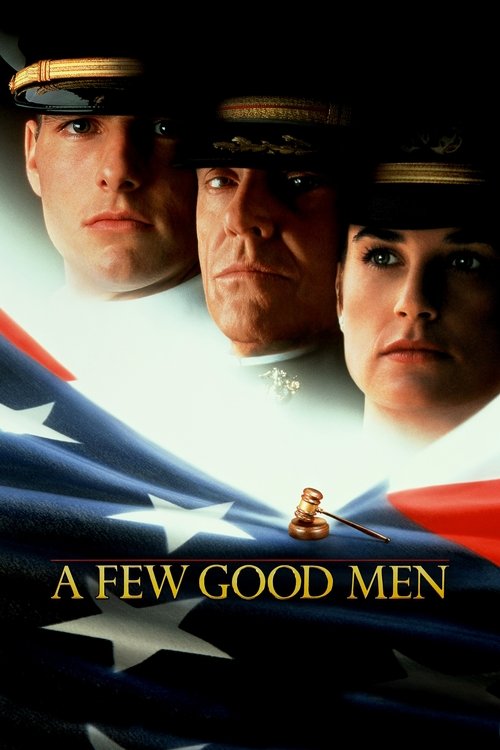
A Few Good Men
1992 · Rob Reiner
For when you want a crackling, grown-up drama that grabs you with words instead of action — reliable Friday-night comfort that still gives you an argument about duty and justice to chew on.
What it's about
Two U.S. Marines at Guantanamo Bay are charged with killing a fellow soldier in his bunk, and the case lands on Lt. Daniel Kaffee, a slick young Navy lawyer famous for plea-bargaining everything and trying nothing. Pushed by a dogged co-counsel who believes the Marines were following orders, Kaffee starts pulling at a thread that leads up the chain of command to the base's fearsome colonel. What begins as an open-and-shut case becomes a collision over honor, obedience, and who answers for the orders nobody will admit giving.
The experience
Pure courtroom electricity — talky in the best way, with dialogue that snaps and a slow tightening of pressure toward a confrontation you can feel coming for an hour. It's tense without being grim, and enormously satisfying.
Performances
Jack Nicholson, in limited screen time, delivers one of the most quoted performances in American movies — all coiled contempt and certainty — while Tom Cruise's arc from glib operator to a lawyer willing to risk everything gives the film its spine. Demi Moore and Kevin Bacon round out an unusually deep bench.
The craft
Aaron Sorkin adapted his own Broadway play, and the script is the engine: rapid-fire, quotable, structured so every scene raises the stakes on the next. Rob Reiner directs with clean, confident restraint, staging the climactic examination like a duel.
Why it matters
A massive hit that put Aaron Sorkin's name on the map and gave the culture lines people still quote thirty years on; it set the modern template for the military courtroom thriller.
Snapshot
A Few Good Men is the courtroom drama that turned a young playwright's stage success into one of the most quoted American films of its era and confirmed Rob Reiner's standing as a versatile, commercially reliable director of mainstream prestige pictures. Adapted by Aaron Sorkin from his own 1989 Broadway play, it dramatizes the court-martial of two U.S. Marines charged with the death of a fellow enlisted man at the Guantanamo Bay naval base in Cuba — a death that the defense comes to argue was the result of a "Code Red," an extrajudicial hazing punishment ordered up the chain of command and then disavowed by the officers who sanctioned it. The film pivots on a generational and moral contest between Tom Cruise's glib, conflict-avoidant Navy lawyer, Lt. Daniel Kaffee, and Jack Nicholson's imperious base commander, Col. Nathan Jessep, whose climactic witness-stand explosion — "You can't handle the truth!" — became an instant fixture of American popular speech. A four-time Academy Award nominee and a major box-office success, A Few Good Men is at once a polished entertainment in the classical Hollywood mode and the breakthrough that announced Sorkin's distinctive voice: morally earnest, verbally torrential, and fascinated by institutions, duty, and the performance of argument.
Industry & production
The film was produced by Castle Rock Entertainment, the company Reiner co-founded in 1987 with Martin Shafer, Andrew Scheinman, Glenn Padnick, and Alan Horn, and named for the fictional town in Stephen King's fiction that Reiner had adapted in Stand by Me. By 1992 Castle Rock had become a notably director-friendly mini-major, and A Few Good Men was among its most ambitious productions to date — a star-driven, mid-budget adult drama of exactly the kind the studio system still reliably mounted in the early 1990s. Reiner directed and produced alongside Scheinman and David Brown; Columbia Pictures handled distribution.
The property originated on the stage. Aaron Sorkin's play A Few Good Men premiered on Broadway in 1989; by widely repeated account Sorkin drafted much of it while working as a bartender, and the story drew on an incident his sister, a Navy JAG lawyer, had described — a Guantanamo Bay case involving Marines and a hazing. Sorkin adapted his own work for the screen, retaining its courtroom architecture while opening out the action that the stage had necessarily compressed.
Casting assembled an unusually deep ensemble around its three leads — Cruise, Nicholson, and Demi Moore. The supporting ranks included Kevin Bacon as the prosecutor, Kiefer Sutherland and J.T. Walsh as Jessep's subordinate officers, Kevin Pollak as Kaffee's co-counsel, James Marshall and Wolfgang Bodison as the accused Marines, plus Christopher Guest, J.A. Preston, and a young Cuba Gooding Jr. and Noah Wyle in smaller parts. Bodison's casting is the production's most often-told anecdote: he had been working on the production side and was cast as Lance Cpl. Dawson, one of the two defendants, despite minimal prior acting experience. The film was a substantial commercial success on release in the winter of 1992, ranking among the year's biggest hits; precise grosses should be checked against a reliable source rather than asserted from memory, but its status as a major studio earner is not in doubt.
Technology
A Few Good Men is a conventionally produced 35mm studio feature of the early 1990s, and it makes no claim to technological novelty; its resources are entirely conventional and entirely in service of performance and dialogue. There are no significant visual effects, and the film's craft lies in the orchestration of actors within designed and location interiors. What is worth noting is simply the high level of classical technical polish — the controlled, deliberately stylized lighting (discussed below), clean sound recording of dense dialogue, and the smooth coverage of long talk-driven scenes — characteristic of an A-list studio production of its moment. The record offers no indication of unusual technical apparatus, and it would be invention to claim otherwise.
Technique
Cinematography
The cinematography is by Robert Richardson, already by 1992 one of the most distinctive camera stylists in American film through his run of collaborations with Oliver Stone (Platoon, Born on the Fourth of July, JFK) and later a celebrated partner of Scorsese and Tarantino. Richardson's signature — a hard, often overhead "hot" light that blows out the top of the frame and isolates faces in pools of brightness — is present here in a restrained, institutional register suited to the material: the film's military offices, hearing rooms, and the courtroom are rendered with a crisp, slightly heightened clarity, the lighting lending an almost moral starkness to scenes of confrontation. Richardson and Reiner use the camera to build the courtroom climax architecturally, tightening framing and shortening the distance between Kaffee and Jessep as the interrogation escalates, so that the visual grammar itself ratchets the duel toward its eruption. The look is glossy and legible rather than expressionistic — the style of a prestige drama that wants its words and faces foregrounded.
Editing
The editing is by Robert Leighton, Reiner's regular cutter across much of his directing career, and it earned one of the film's Academy Award nominations. The central editorial achievement is the management of a dialogue-driven film so that talk generates momentum: scenes of legal procedure, investigation, and argument are paced to feel propulsive rather than static, and the long courtroom set pieces are cut to keep the rhythms of Sorkin's exchanges crackling. The film's structure is the classical investigation-and-trial arc — discovery of the case, reluctant assembly of a defense, and the climactic cross-examination — and Leighton's cutting builds the final Kaffee–Jessep confrontation as a sustained crescendo, alternating reaction and pressure until the colonel's outburst lands as the release the whole film has been engineering.
Mise-en-scène / staging
A Few Good Men descends from a stage play, and its staging retains a theatrical concentration on rooms, ritual, and the choreography of bodies in formal space. The mise-en-scène draws a sustained contrast between two worlds: the rigid, sun-bleached order of the Guantanamo base — uniforms, formations, the iconography of the Corps and its creed — and the more relaxed, paper-strewn civilian-military hybrid of Kaffee's Washington legal world. The courtroom is staged with attention to military protocol, the regimented seating and standing of a court-martial giving the climaxes their ceremonial charge. Costuming does much of the thematic work: the dress and undress uniforms encode rank, belonging, and the institutional values the film interrogates, while Kaffee's comparatively careless bearing marks his distance from the warrior culture he is prosecuting. The recurring visual emphasis on insignia, salutes, and the choreography of command keeps the question of hierarchy and obedience continuously in the frame.
Sound
The original score is by Marc Shaiman, a frequent Reiner collaborator (When Harry Met Sally..., Misery, City Slickers among the period's titles), and it deploys a robust, brass-forward orchestral idiom that leans into the material's martial setting and its register of duty and honor — swelling under the procedural beats and the moral turns rather than competing with the dialogue. The film's most important sonic dimension, however, is the dialogue itself: A Few Good Men is built to be listened to, and its sound work serves the clean, intelligible delivery of dense, rapid speech. The aural climax is verbal — Jessep's witness-stand tirade — and the sound mix, which received an Academy Award nomination, is calibrated to let language carry the film's peaks.
Performance
Performance is the film's principal attraction and its lasting legacy. Jack Nicholson, in a supporting role of limited screen time, dominates the picture as Col. Jessep, building through a register of coiled contempt to the explosive cross-examination monologue that became one of the most imitated pieces of screen acting of the 1990s; the part earned him an Academy Award nomination for Best Supporting Actor. Tom Cruise anchors the film as Kaffee, charting the character's arc from glib, plea-bargaining evasion to the nerve required to gamble everything on provoking a confession — a star turn that uses Cruise's charisma and his capacity for driven intensity. Demi Moore plays Lt. Cmdr. Galloway as the moral conscience pressing Kaffee toward the harder path. The deep supporting bench — Kevin Bacon's measured prosecutor, Kiefer Sutherland's chillingly committed Lt. Kendrick, J.T. Walsh's broken officer, Kevin Pollak's wry co-counsel, and Wolfgang Bodison's dignified Dawson — gives the ensemble unusual texture. The film is, fundamentally, an actors' showcase, and its enduring scenes are confrontations between performers.
Narrative & dramatic mode
The film's dramatic mode is the classical courtroom drama, a genre organized around the gradual disclosure of truth through testimony and cross-examination. Its structure follows the template precisely: a death, an investigation, the reluctant lawyer who would rather settle, the partner who insists on principle, the assembling of an unprovable theory, and the climactic trial in which the case turns on a single witness broken on the stand. Beneath the procedural machinery, however, the engine is a moral and generational confrontation — between Kaffee's instinct for the easy deal and the harder demand that someone be held accountable, and between two visions of duty embodied by the young lawyer and the old colonel. The narrative's central irony is that Jessep's defense is also his self-incrimination: his absolute conviction that men like him are necessary, and that civilians have no standing to question how order is kept, is exactly what Kaffee weaponizes to provoke the admission that wins the case. The film withholds its courtroom payoff with care, building suspense not around whether a "Code Red" occurred but around whether the truth can be made to surface within the rules of the court. It is melodrama in the serious sense — a drama of moral recognition — wrapped in the satisfactions of a tightly engineered legal thriller.
Genre & cycle
A Few Good Men is a courtroom drama and belongs to one of Hollywood's most durable genres, with antecedents reaching back through the trial pictures of the studio era. Its specifically military framing places it in the tradition of the court-martial film, alongside earlier examples that turn the machinery of military justice into an arena for examining obedience, honor, and conscience — Stanley Kubrick's Paths of Glory and the courtroom passages of The Caine Mutiny are the most obvious forebears in their concern with whether following orders excuses wrongdoing. Within the early-1990s cycle of glossy, star-driven adult dramas and legal thrillers — a moment when the legal thriller in particular was commercially ascendant — the film is a prime example of the studio prestige picture built on a strong literary or theatrical source, marquee casting, and a director associated with quality mainstream fare. Its theatrical origin also links it to the lineage of successful stage-to-screen adaptations whose power derives from concentrated language and confrontation rather than spectacle.
Authorship & method
The film is legible through two authorships in productive tension. The first is Aaron Sorkin's: A Few Good Men is the origin point of the style that would define his subsequent career in film and television — densely rhetorical dialogue, idealistic argument about institutions and their codes, characters who think and persuade out loud, and a recurring fascination with the ethics of professional duty. The themes and verbal rhythms here anticipate The American President (also a Reiner–Sorkin–Castle Rock collaboration) and, most consequentially, The West Wing. The second authorship is Rob Reiner's: by 1992 Reiner had assembled a remarkably varied directing record — the mockumentary This Is Spinal Tap, the coming-of-age Stand by Me, the fairy-tale The Princess Bride, the romantic comedy When Harry Met Sally..., and the thriller Misery — and his characteristic strengths, an unfussy classicism and a gift for shaping and trusting actors, are exactly what the material requires. Reiner's method here is essentially to serve the script and the cast: to stage the language cleanly, cast deeply, and build the picture toward its performed climaxes.
The key collaborators reinforce this. Cinematographer Robert Richardson supplied a glossy, morally legible visual surface; editor Robert Leighton, Reiner's longtime cutter, gave talk its momentum and the trial its crescendo; composer Marc Shaiman, another regular Reiner partner, set the martial-romantic tone. The creative center of gravity, though, remains the meeting of Sorkin's words and Nicholson's and Cruise's performances — the film is finally an instrument for delivering written argument through star acting.
Movement / national cinema
A Few Good Men is a thoroughly American studio film and belongs to no art-cinema movement; its significance to national cinema lies in what it represents about Hollywood practice in the early 1990s. It exemplifies the era's continued capacity to make adult, dialogue-driven dramas for a wide audience — the mid-budget prestige picture built on stars, a respected source, and craftsmanlike direction, a category that would come under increasing pressure in subsequent decades. As a Castle Rock production, it also reflects the period's ecosystem of director-led mini-majors operating within the larger studio distribution system. More lastingly, it stands at the headwaters of an American screenwriting sensibility — Sorkin's — that would become a recognizable strain of the national television and film culture in the years that followed.
Era / period
The film arrived in late 1992, in the immediate aftermath of the Cold War and the Persian Gulf War, at a moment when American attitudes toward the military were freshly charged and the question of what is owed to, and permitted of, those who "stand on that wall" carried particular resonance. Its setting at Guantanamo Bay locates it on the Cold War's literal frontier with Cuba, and its drama of institutional cover-up and accountability speaks to a recurrent American preoccupation with the gap between official rectitude and what is done in the name of security. The film's debate — Jessep's insistence that the nation's safety depends on hard men doing ugly things, against the claim that no code excuses the abuse of the weak — would acquire renewed and uncomfortable relevance in the post-2001 era, when Guantanamo Bay itself became the center of national arguments about detention and conduct; the film's prescience on this point is a matter of retrospective resonance rather than authorial intent.
Themes
The governing theme is the conflict between obedience and conscience — the question of whether following orders, and the loyalty and unit cohesion the military prizes, can justify cruelty, and where individual moral responsibility begins. The "Code Red" is the film's central device for this inquiry: a punishment that exists in the gap between official rules and actual practice, sanctioned by a culture that then refuses to own it. Around this orbit several related concerns. There is the theme of truth and its cost — the film's most famous line crystallizes Jessep's conviction that society wants the protection his methods provide but cannot bear to know what they entail. There is the theme of duty and honor, the creed of "Unit, Corps, God, Country," held up for examination as both a genuine virtue and a potential alibi for abuse. There is a generational and characterological drama of maturation, as Kaffee grows from a talented evader into someone willing to risk failure for principle. And running beneath it all is the question of accountability within hierarchies — how responsibility travels up a chain of command, and how institutions protect themselves by sacrificing those at the bottom.
Reception, canon & influence
A Few Good Men was both a critical and commercial success on release, praised in particular for its performances and for Sorkin's crackling dialogue, and it became one of the most popular films of its year. It received four Academy Award nominations — Best Picture, Best Supporting Actor for Jack Nicholson, Best Film Editing, and Best Sound — though it did not win in those categories. Its critical standing has remained high as an exemplary specimen of the courtroom drama, even as some later assessments note the conventionality of its genre architecture relative to the brilliance of its set-piece confrontations.
Influences on the film run backward to the courtroom and court-martial traditions of classical Hollywood — the trial picture as a stage for moral argument, and the military-justice drama's specific concern with obedience and conscience exemplified by Paths of Glory and The Caine Mutiny. The film's deepest debt is to its own theatrical source and to the long lineage of stage-to-screen adaptations whose power lies in concentrated language.
Its influence forward is felt most powerfully through Aaron Sorkin's subsequent career: the film inaugurated the style — idealistic, institution-focused, verbally virtuosic — that he would carry into The American President, The West Wing, The Social Network, and beyond, making A Few Good Men a foundational text for one of the most imitated screenwriting voices of the following decades. The Jessep cross-examination, and "You can't handle the truth!" in particular, passed into the common stock of American cultural reference, endlessly quoted and parodied — a rare instance of a single scene achieving an afterlife larger than the film around it. For its director, the picture stands as proof of Reiner's range across genres, and for its cast it remains a touchstone, especially as a late-career showcase for Nicholson's capacity to dominate a film in minutes of screen time. As a model of the star-driven, language-first prestige drama, it continues to be invoked as a benchmark for the courtroom genre.
A Deleuzian reading
Watch the last twenty minutes again and notice what the camera does to the space between two men.
The full Deleuzian reading of A Few Good Men →
Reception
A genuine event-movie hit in 1992 — huge box office, four Oscar nominations including Best Picture — it's since settled into 'peak they-don't-make-these-anymore' status: the mid-budget, star-stacked adult courtroom drama people now cite wistfully as a lost Hollywood genre.
How A Few Good Men was received, from release to now →
Influences: the films it descends from and the films it influenced
- The Caine Mutiny (1954) — Its court-martial climax — a commanding authority figure (Queeg) disintegrating into self-incrimination under relentless cross-examination — is the direct structural template for Jessep's witness-stand breakdown.
- Paths of Glory (1957) — Establishes the military court-martial as a stage for dramatizing obedience versus conscience, putting the chain of command itself on trial as A Few Good Men does.
- 12 Angry Men (1957) — Models the confined, talk-driven chamber drama that extracts suspense purely from escalating argument and cutting rhythm — the dialogue-momentum editing Leighton applies to the trial scenes.
- Witness for the Prosecution (1957) — A stage-to-screen courtroom built around a single explosive cross-examination reversal, the set-piece-confrontation architecture the film leans on.
- Anatomy of a Murder (1959) — Pioneers procedural courtroom realism in which the trial is depicted as professional craft and tactical gamesmanship between lawyers, the register Sorkin's legal maneuvering inherits.
- Judgment at Nuremberg (1961) — Centers the 'just following orders' defense as moral confrontation, making obedience to authority the very thing the courtroom must adjudicate.
- Inherit the Wind (1960) — Structures the courtroom as a rhetorical duel between two grandstanding adversaries, the two-titan set-piece confrontation Cruise and Nicholson reprise.
- A Streetcar Named Desire (1951) — The benchmark for faithful stage-to-screen adaptation that preserves concentrated theatrical language and delivers it through a dominating, contained star performance.
- The Verdict (1982) — Builds its dramatic payload on the studied climactic-summation rhetoric that The Verdict's closing argument standardized.
- The American President (1995) — The direct Reiner–Sorkin–Castle Rock–Shaiman continuation, carrying forward the idealistic institution-focused rhetoric and characters who persuade out loud.
- The West Wing (1999) — Extends the film's verbally virtuosic, institution-revering voice into the walk-and-talk method, treating professional duty and rhetoric as drama's engine.
- The Social Network (2010) — Opens with a deposition cross-examination and runs on Sorkin's overlapping, machine-gun rhetorical dialogue — verbal velocity as the primary craft, descended directly from the Jessep interrogation.
- Steve Jobs (2015) — Builds a three-act, stage-like structure entirely from confrontational dialogue duels backstage, the purest extension of Sorkin's talk-as-set-piece method.
- Molly's Game (2017) — Sorkin directing his own crescendo-built rhetorical voice, climaxing in a courtroom moral-argument confrontation modeled on his debut's template.
- A Time to Kill (1996) — A star-driven, language-first courtroom prestige drama engineered toward a single climactic summation, following the benchmark this film set for the genre.
- Charlie Wilson's War (2007) — Sorkin's earliest screen idiom—the climactic comic-rhetorical monologue and the belief that verbal facility is itself dramatic action—originates here and recurs in Wilson's and Avrakotos's set-piece speeches.
- The Trial of the Chicago 7 (2020) — Sorkin's own source play and screenplay established his signature courtroom climax — a cross-examination that breaks a witness through escalating rhetorical pressure toward a cathartic outburst — the set-piece grammar he reruns in the trial's confrontations.
- The Negotiator (1998) — Exposes an institutional cover-up through an evenly-matched verbal-duel two-hander, the antagonists battling on talk and wit rather than gunfire.
- Glengarry Glen Ross (1992) — A contemporaneous Mamet stage-to-screen adaptation that is likewise a language-first male ensemble where rhythmic, virtuosic dialogue is the action and acting the spectacle.
- JFK (1991) — Robert Richardson's glossy, morally-legible lighting and his architectural tightening toward a climactic verbal summation in court is the same cinematographic surface he supplies here.
- Primal Fear (1996) — Reiner's film operates on identical courtroom-as-performance-space grammar — the cross-examination as theatrical set-piece where the attorney's deliberate showmanship extracts confession — sharing Hoblit's advocacy-as-performance theme, the same spatial coverage conventions for trial sequences, and the protagonist attorney whose personal moral vanity is the engine of both his effectiveness and his exposure.
- My Cousin Vinny (1992) — Same-year companion built on the identical craft: the whole film engineered to drive an adversarial witness to break under escalating cross-examination on the stand.
Similar films
- The Caine Mutiny (1954) — influence & lineage
- JFK (1991) — influence & lineage
- 12 Angry Men (1957) — influence & lineage
- Paths of Glory (1957) — influence & lineage
- Judgment at Nuremberg (1961) — influence & lineage
- The Verdict (1982) — shared sensibility
- Crimson Tide (1995) — shared sensibility
- The Trial of the Chicago 7 (2020) — shared sensibility