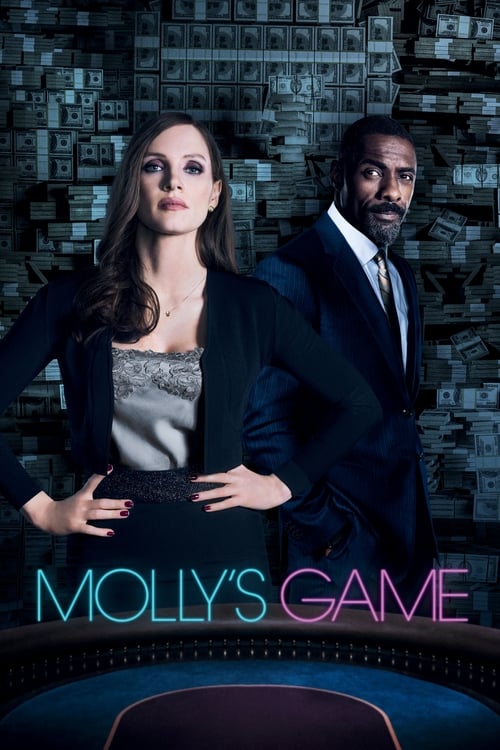
Molly's Game
2017 · Aaron Sorkin
For when you want to feel sharp — a talky, propulsive true-story drama that rewards your full attention and sends you out energized. More espresso than comfort food.
What it's about
Molly Bloom is an Olympic-class skier whose athletic career ends abruptly, so she reinvents herself — first as an assistant, then as the woman running the most exclusive underground poker games in Los Angeles and New York, dealing millions across the table from movie stars and, eventually, Russian mobsters. When the FBI comes for her, she has to convince a skeptical defense attorney that she's worth defending. It's a true story told from inside the deposition, the courtroom, and the memory of how it all got built.
The experience
Fast — the dialogue comes at you like a card shuffle, narrated with wit and fury, and the two hours-plus fly by. It's the pleasure of watching very smart people talk very fast, with a surprising emotional undertow about fathers, ambition, and integrity.
Performances
Jessica Chastain carries nearly every scene with steel and speed, making Bloom's intelligence the whole engine of the film. Idris Elba matches her as the attorney who can't decide whether she's a criminal or the most principled client he's ever had, and Kevin Costner lands the film's biggest emotional punch as her demanding father.
The craft
Aaron Sorkin's directorial debut is above all a writing showcase: dense, digressive, machine-gun dialogue that explains poker, celebrity, and federal law without ever slowing down. The three-editor cutting team keeps the timelines braided and the momentum constant, with Daniel Pemberton's score pushing it along.
Why it matters
It proved Sorkin could direct his own material, translating the voice of his screenplays into a career behind the camera, and gave Chastain one of her defining roles.
Snapshot
Aaron Sorkin's directorial debut is a propulsive adaptation of Molly Bloom's 2014 memoir about the former Olympic-hopeful skier who built and ran the most exclusive underground poker games in Los Angeles and New York before becoming the target of a federal investigation. The film stars Jessica Chastain as Bloom, Idris Elba as her reluctant defense attorney Charlie Jaffey, Kevin Costner as her demanding father Larry, and Michael Cera as a fictional composite celebrity player (identified in the script only as "Player X"). Shot by Charlotte Bruus Christensen and cut by a three-editor team led by Alan Baumgarten, with a score by Daniel Pemberton, the film is above all a showcase for Sorkin's mature command of his own signature voice — dense, digressive, intellectually proud dialogue deployed at a pace that demands the audience sprint to keep up. Released Christmas Day 2017 in the United States by STX Entertainment, it earned a single Academy Award nomination: Best Adapted Screenplay for Sorkin.
Industry & production
Sorkin acquired the rights to Bloom's memoir and wrote the screenplay himself, casting the project partly as a demonstration that the writer who had reshaped prestige drama for two decades — on television with The West Wing and The Newsroom, in film with A Few Good Men, The Social Network, Moneyball, and Steve Jobs — could command an entire production without a directing partner. His previous collaborators had been David Fincher, Bennett Miller, and Danny Boyle; each brought a strong visual sensibility against which Sorkin's language was a counterweight. Here there was no such negotiation.
The production was backed by Mark Gordon Productions and Amy Pascal's Pascal Pictures, with STX Entertainment distributing — a mid-budget, adult-skewing drama of exactly the kind that the major studios were progressively abandoning in the 2010s as tentpole franchises consumed theatrical marketing budgets. STX had been founded in 2014 specifically to occupy this vacated lane. The film's budget has been variously reported but sits comfortably in the mid-range prestige-feature bracket; specific figures have not been authoritatively confirmed, and this account declines to reproduce circulating estimates.
Principal photography took place across Los Angeles, New York, and Colorado, with the Colorado sequences covering Bloom's early skiing career and the pivotal injury that redirected her ambitions. The L.A. and New York poker-room sequences required production design of a particular texture: sumptuous hotel suites and private rooms that read simultaneously as glamorous and claustrophobic, the wealth on display always laced with menace.
The film was released into an industry and cultural moment freighted with significance it could not have entirely anticipated. December 2017 was the height of the initial phase of the #MeToo reckoning, and a film centered on a highly intelligent woman who built an empire in a male-dominated world, was exploited and betrayed by that world, and ultimately refused to cooperate with federal prosecutors who wanted her to name names — all while maintaining her own ethical code — carried an obvious resonance. Sorkin would later face some critical pushback suggesting his script did not fully reckon with Bloom's own exploitation of others in the poker-room economy, a debate that sharpened the film's afterlife.
Technology
Molly's Game was shot digitally on the ARRI Alexa, the dominant platform for prestige studio production in this period. Charlotte Bruus Christensen, a Danish cinematographer whose English-language work had included Far from the Madding Crowd (Thomas Vinterberg, 2015) and Fences (Denzel Washington, 2016), brought a controlled, elegant approach to the visual field — a sensibility formed partly in the Scandinavian tradition of restrained naturalism and partly sharpened by sustained collaboration with Vinterberg. The Alexa's latitude and color science suited Bruus Christensen's tendency toward refined mid-tones and clean shadow detail; the poker-room sequences demanded a specific quality of artificial light that could read as luxurious without tipping into garishness.
Technique
Cinematography
The central visual challenge of the film is the poker table itself, which is structurally inert: stationary players, a fixed geometry of felt and chips, faces partially obscured in thought. Bruus Christensen and Sorkin address this through aggressive intercutting rather than elaborate camera movement, relying on close-up work on hands, eyes, and the incremental theater of the face under pressure. The film does not attempt to aestheticize the card game in the manner of a casino film like Rounders (John Dahl, 1998), with its luminous overhead angles and mysticized chips. Instead, the poker table functions as a stage for performance, and the camera treats it accordingly — close, attentive to actorly nuance, uninterested in compositional spectacle for its own sake.
The Colorado sequences adopt a colder, wider visual register, the white landscape serving as contrast to the enclosing interiors of the poker world. Bloom's skiing injury is handled quickly; Sorkin has little patience for the sports-movie grammar that a different director might have dwelt in. The flashback structure allows Bruus Christensen to modulate the palette across timelines: the legal present carries a slightly more austere tone, the poker past a warmer, more seductive one.
Editing
Three editors are credited — Alan Baumgarten, Josh Schaeffer, and Elliot Graham — a configuration that sometimes signals a troubled post-production but in this case appears to reflect the scale and structural complexity of the assembly. Baumgarten had edited Steve Jobs (2015) for Boyle, where the challenge was similarly to make talky, dialogue-intensive material feel kinetic; his rhythm vocabulary was well-suited to Sorkin's cadence. The film's dual-timeline structure — the legal present intercut with extended flashback blocks covering the poker years — requires constant calibration so that neither strand loses momentum.
The editing is at its most demanding in the sequences where Sorkin cross-cuts between Molly's explanatory voice-over (delivered in the past tense as narration) and dramatized action — a technique that risks redundancy but which Sorkin and the editors use to layer information, withhold it selectively, and create irony between what Molly claims to understand and what the images show us she may have missed.
Mise-en-scène / staging
Sorkin's staging instinct is fundamentally theatrical, inherited from his origins in stage writing (A Few Good Men began as a stage play). The power dynamics he choreographs inside rooms — who stands, who sits, who crosses to a window — are a primary dramatic text. The film's most formally accomplished sequences are the two-hander scenes between Chastain and Elba, staged in Jaffey's office with an almost Mamet-like attention to the spatial grammar of negotiation. Sorkin positions both characters as intellectual equals who are also adversaries, and the staging keeps this equilibrium visible.
The poker rooms themselves are managed with an eye toward status hierarchies: how close to the table different characters position themselves, who circulates the room and who is fixed, how Molly moves through the space as both hostess and operator. The detail work in production design — the chips, the serving staff, the discrete monitors and security arrangements — reinforces the sense of an ecosystem that Molly has built from scratch and understands at a level her clients never fully do.
Sound
Daniel Pemberton's score is the third consecutive Sorkin film for which Pemberton has composed, following Steve Jobs (2015) — a collaboration that has produced a recognizable sonic idiom: propulsive, rhythmically complex, sympathetic to Sorkin's dialogue rather than competitive with it. Pemberton tends toward textured electronic elements layered beneath orchestral structures, giving the film a kinetic underpinning that accelerates the narration sequences without overwhelming them. The poker sequences carry a musical tension that is cumulative rather than sudden, suited to the slow-burn dramaturgy of the card game.
Sound design in the poker scenes foregrounds the acoustic texture of the world — chip sounds, the ambient murmur of side conversations, the near-silence of critical hands — in ways that give the viewer sensory grounding in an environment that might otherwise feel purely verbal.
Performance
Jessica Chastain's performance is the structural load-bearer of the film. She is present in almost every scene, and in the narration sequences she functions as a direct address performer in the tradition of the unreliable or semi-reliable first-person narrator: intelligent, self-aware, strategically selective in what she discloses. Chastain had spent the preceding years establishing a range that moved between contained intelligence (Zero Dark Thirty, 2012) and emotional extremity (Mama, 2013; A Most Violent Year, 2014); here she works in the former register, grounding Molly's formidable competence in physical stillness and precise diction that mirrors Sorkin's own prose rhythms.
Idris Elba provides the film with its warmest performance — Jaffey's initial cynicism ceding, across scenes, to genuine admiration and protectiveness toward Molly. Elba and Chastain's chemistry is the engine of the legal subplot, and their best scenes have the quality of intellectual sparring that Sorkin scripts better than almost anyone working in American film. Kevin Costner's role is smaller but carries substantial thematic weight, the father whose rigorous, coldly analytical parenting is both the source of Molly's formidable capability and, the film implies, a primary wound. The late scene between Chastain and Costner — a staged conversation in a park — is the film's emotional climax, and both actors honor its sudden vulnerability.
Narrative & dramatic mode
The film is structured as a retrospective account, Molly narrating her own story from the vantage of legal jeopardy. This positions the audience inside Molly's perspective from the outset, creating the epistemological condition typical of the noir-inflected biopic: we know the narrator survived, but we do not know what it cost her, and we gradually discover how selective her account has been.
Sorkin deploys voice-over narration with a density unusual even for the genre. Molly does not simply contextualize scenes; she interrupts them, corrects them, layers ironic commentary over dramatized moments. This is a mode with antecedents in Henry Hill's narration in GoodFellas (Martin Scorsese, 1990), but Sorkin's version is more intellectually aggressive — Molly explicitly positions herself as the most competent person in any room she enters, and the narration is partly an ongoing proof of that claim.
The film's climactic ethical question — whether Molly, who could have reduced her legal exposure by cooperating with federal prosecutors, was right not to betray her clients — is handled with characteristic Sorkin ambiguity. The film admires her choice without sentimentalizing it, and allows Jaffey (who represents legal pragmatism) to articulate the strongest case against it.
Genre & cycle
Molly's Game belongs to the prestige biopic cycle that dominated American awards-season filmmaking in the 2010s, alongside films like The Social Network, Moneyball, The Big Short (Adam McKay, 2015), and I, Tonya (Craig Gillespie, 2017). These films share a formal restlessness — non-linear structures, direct-address narration, a self-consciousness about mediation — that distinguishes them from the classical biopic tradition of seamless chronological cause-and-effect.
The film also participates in what critics have informally called the "competence porn" subgenre, films whose primary pleasure is watching an extraordinarily capable protagonist operate at the peak of their abilities. Sorkin is a foundational craftsman of this mode, which runs through The West Wing, The Social Network, and the Sorkin-created (though not directed) Moneyball. In Molly's Game, the protagonist's competence is specifically feminine and specifically unmarked as unusual within the film's world — Molly is simply better than everyone around her at what she does, and the film treats this as a given rather than a subject of wonder.
Authorship & method
The film is best understood as a writer-auteur's directorial self-assertion. Sorkin had long been a dominant creative voice in the productions he wrote for, but always mediated through a director who controlled the image. His direction here is not visually adventurous — critics noted that the film looks like what it is, a highly competent studio production by a first-time director — but it is controlled and intentional. Every technical decision serves the dialogue and the performance, which is consistent with Sorkin's hierarchy of values.
Charlotte Bruus Christensen's contribution is to provide a visual surface elegant enough not to distract from the verbal texture. Daniel Pemberton's score provides propulsive support. The editorial team, led by Baumgarten, keeps the pacing at the demanding clip that Sorkin's audience has come to expect. The film is, in this sense, an authored system in which every collaborator has calibrated their contribution toward an agreed-upon center.
Movement / national cinema
The film sits firmly within the tradition of American prestige drama, with no meaningful connection to any national film movement beyond that broad category. Its most direct cinematic genealogy runs through the Hollywood tradition of the legal thriller (Anatomy of a Murder, To Kill a Mockingbird, the Sidney Lumet courtroom drama) and the more recent cycle of true-crime narrative features. Sorkin's own television work is the more significant lineage; the film reads in many ways as a feature-length episode of a Sorkin dramatic series, which is not a criticism so much as a description of where his primary narrative fluency was formed.
Era / period
The film belongs to the mid-to-late 2010s moment in American cinema characterized by the retreat of mid-budget adult dramas from the major studio system and their partial relocation to independent distributors, streaming platforms, and specialty labels like STX. It was conceived and shot before the #MeToo moment but released into its opening weeks, a coincidence of timing that sharpened its critical reception and its cultural salience. As an artifact, it registers the anxieties of that moment — about male privilege, female autonomy, the ethics of complicity — without having been designed as a response to them.
Themes
The film's primary thematic architecture concerns female expertise operating inside male-controlled systems. Molly does not subvert the poker world; she masters its logic and deploys it more effectively than the men who created it. The film frames this as both an achievement and a trap — her mastery makes her indispensable to men who would eventually betray or exploit her, and her refusal to cooperate with prosecutors is itself an extension of the code of loyalty she absorbed from that world.
The father-daughter dynamic introduced through Kevin Costner's Larry Bloom functions as a psychological backstory for Molly's compulsive need to perform competence — the coldly analytic father who psychoanalyzes his daughter in a scene of surreal bluntness has produced a daughter who performs analysis as a mode of self-protection. This strand of the film is simultaneously its most schematic and its most emotionally affecting.
Running beneath both: the Sorkin preoccupation with the ethics of storytelling itself. Molly is narrating her own story under legal and personal duress; the film is alert to what she omits, what she shapes, and what she cannot see in herself.
Reception, canon & influence
Critical reception was positive to enthusiastic, with particular praise directed at Chastain's performance and Sorkin's screenplay. The consensus held that the film succeeded as a showcase for Sorkin's verbal gifts while confirming that his directorial debut, while competent, was not the work of a film director with strong visual instincts of his own. The comparison to his work with Fincher on The Social Network was inevitably drawn and found Molly's Game the lesser visual achievement.
The film received an Academy Award nomination for Best Adapted Screenplay (Sorkin), and Chastain received nominations at the Golden Globes and from SAG, among other bodies. The absence of a Best Actress Oscar nomination for Chastain was considered a significant omission by many critics.
The film's most substantial influence on Molly's Game runs backward: GoodFellas (1990) for the criminal-world narration structure; Sorkin's own The Social Network for the template of adapting recent events involving legal jeopardy and a highly intelligent protagonist whose ethics are genuinely ambiguous; the Lumet courtroom tradition for the legal drama sequences. Sidney Lumet's The Verdict (1982) and his general influence on American legal drama echo in the Chastain-Elba two-handers.
Its influence going forward is harder to trace with confidence, as is typically the case with well-reviewed mid-budget films that perform modestly at the box office. The film consolidated Sorkin's identity as a writer whose voice is strong enough to carry a film even in the absence of a visually dominant directorial collaborator — a demonstration with implications for subsequent projects. It also contributed to a cycle of films centered on women who operate with exceptional competence inside male-dominated illegal or quasi-legal economies, a genre that would develop in various forms across the following years of American prestige television and film.
A Deleuzian reading
Watch the face first.
The full Deleuzian reading of Molly's Game →
Reception
Landed in 2017 as a well-reviewed awards-season player (Sorkin got the Adapted Screenplay Oscar nod), then quietly settled into something warmer: a streaming-era comfort watch that Letterboxd keeps rediscovering as 'the most rewatchable Sorkin.'
How Molly's Game was received, from release to now →
Influences: the films it descends from and the films it influenced
- GoodFellas (1990) — The retrospective insider-narrator architecture — a criminally adjacent protagonist delivers rapid-fire competence-display directly to the audience while the image simultaneously illustrates and undercuts their account — which Sorkin has cited as the formal model for Molly's voiceover structure.
- Casino (1995) — Extended retrospective voiceover across multiple narrating perspectives tracking a protagonist's mastery of and expulsion from a male-dominated high-stakes underworld economy, with the operation's mechanics conveyed through insider fluency rather than external observation.
- The Verdict (1982) — Lumet's courtroom two-hander methodology: spatial antagonism between two characters in close proximity, power redistributed through blocking and eyeline cuts rather than camera movement, each line of dialogue reconfiguring the room's power geometry — the formal grammar of the Chastain/Elba interrogation sequences.
- Network (1976) — Theatrically staged verbal combat in which rhetoric constructs and dismantles institutional power relationships, with blocking serving argumentation rather than cinematic geometry — Lumet's template for writer-auteur cinema in which dialogue architecture overwhelms visual expression.
- The Social Network (2010) — Sorkin's own prior screenplay established the structural template Molly's Game inherits directly: a dual-timeline alternating between deposition/legal-jeopardy scenes and the events being reconstructed, with a morally ambiguous hyper-intelligent protagonist whose competence and ethics are simultaneously on trial.
- All About Eve (1950) — Mankiewicz's model of writer-auteur cinema in which verbal sophistication so thoroughly dominates the formal system that directorial style becomes transparent — the precedent for how Sorkin's debut organizes every technical collaborator (cinematographer, editor, composer) in service of screenplay architecture rather than visual invention.
- Broadcast News (1987) — Female professional superiority as central dramatic engine in a male-dominated industry, with fast verbal exchange as the primary cinematic vehicle and the female protagonist's exceptional competence made the object of simultaneous professional admiration and personal resentment — the lineage for Molly's feminine competence-porn structure.
- The Insider (1999) — Propulsive score driving a true story of individual intelligence and moral pressure against institutional force, with close-up performance work carrying documentary-weight emotional texture while Dante Spinotti's cinematography functions as elegant formal support rather than expressionist intervention — the template for Pemberton's function in Molly's Game.
- A Few Good Men (1992) — Sorkin directing his own crescendo-built rhetorical voice, climaxing in a courtroom moral-argument confrontation modeled on his debut's template.
- Steve Jobs (2015) — Sorkin's directorial extension of his own propulsive, monologue-driven architecture and a flawed protagonist narrated through verbal duels.
- Hustlers (2019) — Women deploying calculated competence inside a male-dominated illegal economy narrated retrospectively through GoodFellas-derived confessional structure, extending Molly's Game's feminine criminal-world competence-porn template while transposing it to a working-class register and adding a second unreliable narrator to destabilize the account further.
- Promising Young Woman (2020) — Extends the competence-porn formal vocabulary into genre territory, with a female protagonist whose calculated strategic intelligence is revealed gradually through unreliable-narrator withholding — developing the gap between what the narrative tells us and what the protagonist actually knows into a full genre mechanism rather than a character-study device.
- The Trial of the Chicago 7 (2020) — Sorkin's second directorial feature applies the same formal system established in Molly's Game: theatrical staging of verbal combat in institutional spaces, propulsive dialogue architecture organizing every editorial and performance decision, with ensemble legal drama structured so that the screenplay's rhythms override the cinematographer's visual preferences.
- Being the Ricardos (2021) — Sorkin's third directorial feature extends the writer-auteur model, using dual-timeline compression and retrospective framing of a female protagonist's professional genius in a male-controlled industry — directly inheriting Molly's Game's structure of collapsing years of legal and professional experience into a single concentrated timeframe.
- The Big Short (2015) — Voiceover-dense insider narration breaking the fourth wall to explain the mechanics of an opaque high-stakes world directly to an uninitiated audience, deploying direct address as both comedic device and structural scaffold — the sibling approach to translating insider competence into popular entertainment through narrator-as-guide.
- Miss Sloane (2016) — A female protagonist of exceptional strategic intelligence operating through calculated deception in a male-dominated institutional power structure, with a retrospective legal-jeopardy frame that reveals her ethical compromises alongside her mastery — the closest contemporaneous analog to Molly's Game's competence-and-ethics-on-trial formal structure.
- I, Tonya (2017) — Unreliable retrospective narration delivered through directly-addressed-camera confessional testimony, centering a female athlete's exceptional competence in a male-controlled world while inviting the audience to adjudicate competing accounts — both films use direct address as a mechanism for managing narrator credibility rather than resolving it.
- Spotlight (2015) — Awards-season prestige drama driven by procedural verbal density rather than visual ambition, in which a group's professional tenacity constitutes the primary dramatic subject — sharing with Molly's Game a position in the 2010s prestige cycle that values screenplay architecture and ensemble performance over directorial signature.
- Moneyball (2011) — Sorkin's voiceover-and-numbers procedural about a data-literate operator reverse-engineering and gaming a closed system — the Moneyball outsider-analyst posture in another arena.
Similar films
- The Trial of the Chicago 7 (2020) — influence & lineage · often watched together
- I, Tonya (2017) — influence & lineage · same viewing thread · often watched together
- The Social Network (2010) — influence & lineage
- Casino (1995) — influence & lineage
- Promising Young Woman (2020) — influence & lineage · often watched together
- Black Bag (2025) — often watched together
- Killing Them Softly (2012) — often watched together
- House of Games (1987) — shared sensibility
All the films related to Molly's Game →
Watch it with: curated runs of related films
- Beating a Rigged Game — A run of fact-based portraits of sharp outsiders who out-hustle the institutions built to keep them out — poker tables, front offices, corporate lawyers, and a class-obsessed sport.