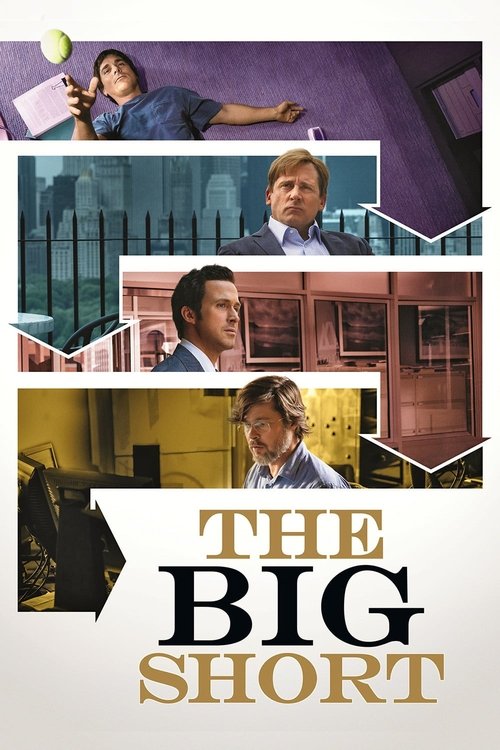
The Big Short
2015 · Adam McKay
When you want to feel smart and angry at the same time — a movie that explains something huge and infuriating without ever feeling like homework. Energizing rather than heavy, but it leaves a bruise.
What it's about
In the years before the 2008 crash, a handful of misfit investors — a socially awkward hedge-fund doctor, a furious money manager, a slick Wall Street trader, and two kids from a Colorado garage fund — each independently discover that the American housing market is a bomb waiting to go off. Nobody believes them, so they bet hundreds of millions against the banks and wait for the world to catch up. It's a true story about fraud so vast that seeing it clearly feels like madness.
The experience
Fast, funny, and quietly enraging — it moves like a caper, cracks jokes straight to camera, and then keeps reminding you that the punchline cost millions of people their homes. You come out entertained and a little sick, which is exactly the point.
Performances
Christian Bale is riveting as the glass-eyed, metal-blasting fund manager who saw it first, and Steve Carell burns off his comic persona entirely as a money man whose outrage keeps curdling into grief.
The craft
McKay tears up the rulebook: characters break the fourth wall, celebrities pop in to explain toxic financial instruments in plain English, and the editing jump-cuts through pop culture like a channel surf. The style isn't decoration — it's how the film makes credit default swaps genuinely gripping. It plays great anywhere, but the machine-gun cutting rewards full attention.
Why it matters
It proved a big studio comedy could tackle the financial crisis head-on and land Oscar nominations doing it, and it remade Adam McKay from comedy director into political satirist — spawning a whole wave of fourth-wall-breaking, explain-the-system filmmaking.
Snapshot
Adam McKay's adaptation of Michael Lewis's 2010 nonfiction book The Big Short: Inside the Doomsday Machine is a formally restless, satirically furious account of the handful of financial outsiders who identified the catastrophic instability of the American housing market before the 2008 global financial crisis and bet against it. Working from a screenplay he co-wrote with Charles Randolph, McKay renders arcane instruments — mortgage-backed securities, collateralized debt obligations, credit default swaps — legible through a battery of direct address, celebrity interpolations, archival footage, and Brechtian interruptions that refuse the consolations of conventional dramatic form. The result is simultaneously a heist film, a polemic, and a comedy of moral humiliation: the protagonists win, and that victory is presented as something close to a catastrophe.
Industry & production
The film was produced by Plan B Entertainment — Brad Pitt's production company, which had previously shepherded The Tree of Life (2011) and 12 Years a Slave (2013) — alongside Regency Enterprises, with Paramount Pictures handling distribution. Producers Dede Gardner, Jeremy Kleiner, and Arnon Milchan brought the project to McKay, who had recently concluded a long run of broad Will Ferrell comedies. The production was shot primarily in New York City, New Orleans (for the scenes depicting investor field research into Florida and adjacent housing markets), and Las Vegas during the period of the Financial Crisis Inquiry Commission's public hearings. The budget was modest for a film of this ensemble scale — reported in the range of $28 million — and the film performed substantially beyond expectations, earning approximately $133 million worldwide. Those figures should be treated as approximate; precise final accounting was not uniformly reported across sources.
The casting assembled an unusually dense collection of serious dramatic actors (Christian Bale, Steve Carell) alongside movie-star presences (Ryan Gosling, Brad Pitt) whose cultural familiarity McKay exploits structurally: their recognizability signals the film's awareness of itself as spectacle. The film also deployed a series of celebrity cameos — Margot Robbie, Anthony Bourdain, Selena Gomez, economist Richard Thaler — not as in-jokes but as didactic interruptions, directly explaining financial instruments that the narrative cannot convey through dialogue alone without losing its momentum.
Technology
McKay and cinematographer Barry Ackroyd shot on digital, consistent with Ackroyd's established practice on documentary-influenced projects. The film makes conspicuous use of consumer-grade and archival footage textures — news footage, home video, television broadcast material — intercutting these with the dramatic scenes to create a mosaic aesthetic that deliberately confuses the register of "real" and "constructed." There is no formal attempt to match the grain or color palette of archival material to the dramatic scenes; the discontinuity is the point. The camera moves freely and erratically through spaces, never settling into composed compositions for long. This is cinema that signals its own mediation at every frame.
Technique
Cinematography
Barry Ackroyd, whose earlier credits include Paul Greengrass's United 93 (2006) and Kathryn Bigelow's The Hurt Locker (2008), brings a handheld, observational vocabulary developed in documentary-adjacent practice. In The Big Short this manifests as restless reframing, a tendency to push into faces rather than hold on wide compositions, and a jittery alertness that reads simultaneously as urgency and anxiety. There is almost no still camera in the film. Interior scenes — boardrooms, trading floors, hotel rooms — are shot with the same relentless mobility as the street-level material. The effect is of a camera that cannot quite believe what it is seeing, a witness under stress. Ackroyd avoids the gleam of classical financial-thriller cinematography (the cool blues and grays of, say, Gordon Willis's work for Alan Pakula); nothing here signals mastery or control.
Editing
Hank Corwin, who had edited Terrence Malick's The Tree of Life (2011) and Oliver Stone's Natural Born Killers (1994), shapes the film's most formally radical decisions. The editing operates in a register between conventional dramatic cutting and essay-film montage: sequences are punctuated with sudden title cards, intercut with television commercials of the era, and interrupted by the explanatory celebrity cameos that arrive without warning and then cut back to the narrative. Corwin's work is elliptical and aggressive — a scene will be collapsing into emotional revelation when the film cuts away or crashes into a new register. The editing received an Academy Award nomination, and the nomination was warranted: this is a film whose argument is constructed in the cut as much as in the screenplay. The rhythm is not about propulsion toward a climax but about accumulation of evidence, a formal analog to the short-sellers' own process of building a case.
Mise-en-scène / staging
McKay's staging reflects his background in sketch comedy and improv: scenes are often allowed to run past their obvious structural endpoint, with performance outgrowing the space allotted. The physical spaces of the film — fluorescent-lit offices, crowded conference rooms, the loud anonymity of the American Securitization Forum in Las Vegas — are rendered without glamour, in deliberate contrast to the wealth being generated within them. McKay makes no use of the visual language of finance-as-power that dominates the genre (no panoramic city views from high floors, no lingering on luxury objects). The exception is the Las Vegas sequence, where the grotesquerie of the setting — strip clubs, casino floors, poolside debauchery — is used as an explicit illustration of the housing bubble as collective fantasy. The cameo interruptions (Robbie in a bubble bath, Bourdain in a kitchen) are staged with theatrical self-consciousness that makes visible the film's own artifice.
Sound
Nicholas Britell's score is used sparingly and strategically, largely displaced by a music-supervision-heavy soundtrack that draws on rock, pop, and hip-hop of the pre-crisis period. The deployment of this period music functions as ironic commentary — the cultural noise against which the crisis gestated, the soundtrack of collective distraction. Britell's original compositions tend toward a spare, percussive unease rather than conventional dramatic scoring. The film's sound design frequently incorporates the din of trading floors, television news, and crowd noise, creating an aural equivalent of the editorial montage: a world saturated with information that nonetheless communicates nothing useful.
Performance
The ensemble performs in registers that are deliberately mismatched — another Brechtian strategy. Christian Bale's Michael Burry is an almost autistic singularity, a performance of focused intensity and social dislocation that reads as genuine character study. Steve Carell's Mark Baum operates in a mode of barely suppressed fury, his performance the most conventionally emotional in the film. Ryan Gosling's Jared Vennett is all smirk and knowingness, a character who is transparently dishonest and whose narration the film explicitly characterizes as unreliable. Brad Pitt's Ben Rickert is written as a figure of moral weight — the one character who refuses to celebrate the profit being made — and Pitt plays him with a stillness that reads as guilt. The performances do not seek naturalistic coherence with one another; they exist in adjacent tonal registers, which is appropriate for a film about people who are all, in different ways, watching the same catastrophe and responding to it with irreconcilable mixtures of dread and exhilaration.
Narrative & dramatic mode
The film tracks three parallel narrative strands based on Lewis's reporting: Michael Burry (Christian Bale), the socially isolated hedge fund manager who first develops the thesis that the housing market is a fraud; Jared Vennett (Gosling), the Deutsche Bank trader who learns from Burry's trade and shops it to others; Mark Baum (Carell) and his team at a Morgan Stanley satellite fund, who are persuaded by Vennett to investigate and eventually participate; and Jamie Shipley and Charlie Geller (Finn Wittrock and John Magaro), small-time investors who find their way into the trade with the mentorship of former banker Ben Rickert. These strands are chronologically overlapping rather than strictly sequential, and McKay uses the editing to create rhymes and contrasts across them.
The film's dramatic mode is neither tragedy nor triumph. It is closer to what might be called catastrophic farce: a story in which the protagonists are proved right, profit enormously, and find no satisfaction in being right because being right meant the destruction of millions of ordinary people's financial lives. The final text cards — reporting that Wall Street was not meaningfully reformed, that the banks responsible were not prosecuted, that several of the same instruments are again in use — make explicit what the narrative leaves implicit: that the film has no real ending because the conditions that produced the crisis were not resolved by it.
Genre & cycle
The Big Short belongs to a cycle of post-2008 financial crisis cinema that includes J.C. Chandor's Margin Call (2011), the HBO film Too Big to Fail (2011), Ramin Bahrani's 99 Homes (2014), and, less directly, The Wolf of Wall Street (2013). Where Margin Call is chamber drama and The Wolf of Wall Street is black comedy of excess, The Big Short is perhaps the cycle's most formally experimental entry — the one most committed to using cinema's resources to explain the systemic rather than simply to dramatize the personal. The film is also part of a longer tradition of docudrama that blends documentary texture with dramatic reconstruction, though McKay's formal strategies (the cameos, the direct address, the title cards) push it significantly past the conventions of the genre toward the essay film.
Authorship & method
Adam McKay came to the film from a background as a writer and director of broad studio comedy — Anchorman (2004), Talladega Nights (2006), Step Brothers (2008) — and as a former head writer at Saturday Night Live. His move toward politically engaged satire with The Big Short was a significant authorial pivot, though in retrospect his comedy work was consistently interested in American masculinity, institutional absurdity, and the relationship between performance and power. His method on the film was research-intensive; he and Randolph drew on Lewis's book, additional financial journalism, and interviews with figures in the story. The screenplay was Oscar-winning for adapted screenplay (shared between McKay and Randolph).
Key collaborators: Ackroyd's documentary instincts gave McKay the visual grammar of a film that needs to feel like investigative journalism while moving with the speed of entertainment. Corwin's editing sensibility — cultivated across years of essay-film and experimental narrative work — enabled the associative structure that makes the film's argument through juxtaposition. Britell's score launched a collaboration that would continue across McKay's subsequent work.
Movement / national cinema
The film is American independent-leaning studio cinema operating in a tradition of politically engaged Hollywood filmmaking that includes the paranoid thrillers of the 1970s (Pakula, Lumet) and the New Hollywood generation's interest in institutional failure. McKay's formal strategies — particularly the direct address and the essay-film structure — have more obvious precedents in European cinema (Godard's work for Dziga Vertov Group, Marker's essay films) than in classical Hollywood, though he integrates them into a fundamentally entertainment-oriented framework. There is also a debt to the New Journalism of the 1970s and 1980s — Lewis's own literary practice, and the tradition of using literary technique to tell nonfiction stories — that McKay translates into cinematic terms.
Era / period
The Big Short was released a year before the 2016 American presidential election and arrives in retrospect as a diagnostic document of the political crisis that followed the economic one. Its argument that the financial system is operated by and for a class whose interests are incompatible with those of ordinary citizens — and that the institutions meant to regulate it are captured — registers differently depending on when it is viewed. As a period film about 2004–2008, it is a specific historical account. As a film about the structure of American capitalism, it is deliberately transhistorical.
Themes
The film's central concern is the relationship between information, belief, and power. The housing bubble persisted not because information about its instability was unavailable but because the people whose professional and financial interests depended on the bubble's continuation refused to process that information. McKay's formal strategies — explaining things directly to the audience, interrupting the drama to make sure the mechanisms are understood — are a rebuke to this epistemic failure: the film insists that its audience understand what happened, because not understanding is complicity.
Secondary themes include the moral ambiguity of profit derived from catastrophe (Rickert's anguished refusal to celebrate is the film's most ethically transparent moment), the corruption of rating agencies and regulatory bodies, and the invisibility of the poor and dispossessed within the financial system that destroyed their lives. The film's famous final sequence — showing the actual consequences of the crisis in foreclosed homes and unemployment statistics — insists on the human stakes that the preceding narrative of financial cleverness had necessarily bracketed.
Reception, canon & influence
Critical reception was strongly positive. The film earned five Academy Award nominations including Best Picture and Best Director, winning for Best Adapted Screenplay. It appeared on numerous year-end lists for 2015. Some critics raised legitimate questions about the film's tone — whether its energy and humor risked aestheticizing a human catastrophe, whether the pleasure of watching smart people figure things out overwhelmed the film's stated moral anger. These objections were part of a serious critical conversation rather than dismissals.
Looking backward, the film's influences are eclectic. Ackroyd's verité style acknowledges the Greengrass school of camera practice. The direct-address convention invokes Ferris Bueller and the Brechtian tradition. The rapid montage of archival and dramatic material draws on essay filmmakers from Marker to Michael Moore. The celebrity-cameo didactic interludes are formally novel and have not been convincingly traced to a specific precedent.
Looking forward, The Big Short established a template that McKay applied to Vice (2018) and Don't Look Up (2021), forming a loose trilogy of formally experimental political films. Its influence on subsequent filmmakers working in the docudrama or "explainer film" mode — using self-conscious technique to make systemic arguments accessible — is real but diffuse; it is one of several sources for a broader shift in how politically engaged American cinema understood its pedagogical responsibilities. It is also an early credit for Nicholas Britell, who would go on to score Moonlight (2016), If Beale Street Could Talk (2018), and the television series Succession — a collaboration interrupted with The Big Short is, in that context, the beginning of an important career.
A Deleuzian reading
Margot Robbie is in a bubble bath, sipping champagne, explaining to you what a subprime mortgage is.
The full Deleuzian reading of The Big Short →
Reception
A hit on arrival — Best Picture nominee and Adapted Screenplay Oscar winner, hailed as McKay's shock pivot from Anchorman to anger. Now it gets relitigated through the backlash to Vice and Don't Look Up, with defenders insisting this is the one film where the McKay style actually worked.
How The Big Short was received, from release to now →
Influences: the films it descends from and the films it influenced
- Goodfellas (1990) — Ironic period music supervision using pop songs at moments of peak moral horror to produce uncomfortable pleasure — the 'Layla' freeze-frame sequence is the direct template for Big Short's deployment of hip-hop and pop against financial carnage, making the audience complicit in enjoying what they should condemn.
- Network (1976) — Catastrophic farce as a mode for institutional critique: Howard Beale's breakdown is staged simultaneously as tragedy and entertainment spectacle, pioneering the mismatched tonal register in which moral horror and comedy coexist without resolving — the structural template for Big Short's treatment of the 2008 collapse.
- All the President's Men (1976) — Anti-glamour procedural aesthetic for institutional corruption — fluorescent-lit offices, unglamorous parallel investigation strands, and institutional distrust as the core dramatic engine; the dossier explicitly names the 1970s paranoid thriller as a direct influence on Big Short's visual grammar.
- Ferris Bueller's Day Off (1986) — The specific cinematic precedent for direct-address narration: Ferris speaking directly to camera to position the audience as confidants and explain his situation is the convention the dossier names by title as Big Short's immediate inheritance for its narrators breaking the fourth wall.
- JFK (1991) — Archival footage mosaic integrated with dramatic reconstruction — Stone's method of interweaving archival material, staged scenes, documentary-style inserts, and competing eyewitness testimonies to build a political argument through associative montage directly models Big Short's editing structure.
- Sans Soleil (1983) — Essay-film associative montage: Marker's practice of building argument through juxtaposition of archival images without explicit didacticism, allowing structural logic rather than narration to carry the claim, is the essay-film tradition the dossier names directly as one source for Big Short's editing method.
- United 93 (2006) — Barry Ackroyd, Big Short's cinematographer, carried his Greengrass collaboration directly into the film — the handheld documentary vérité style, anti-glamour digital image quality, and urgent handheld framing that Ackroyd developed across United 93 and Green Zone constitute the visual grammar he transposed to McKay's subject.
- The Informant! (2009) — Corporate fraud docudrama with deliberately mismatched score: Soderbergh and Marvin Hamlisch used bouncy, ironic comedy music against a story of systemic corporate crime, establishing the specific tonal device — moral weight undercut by musical incongruity — that Big Short inherits and intensifies through its period pop supervision.
- Fahrenheit 9/11 (2004) — Celebrity-confrontation as didactic device and essay-film montage combining archival footage with dramatized material for systemic political argument — Moore is named directly in the dossier as one of the essay-film lineage sources for Big Short's associative editing between archival and scripted material.
- Wall Street (1987) — McKay and editor Hank Corwin adapt Stone's percussive financial montage, adding Brechtian celebrity interpolations that descend from Stone's didactic strategy of making financial mechanics viscerally legible through editing; both films treat the cut itself as moral judgment on the transaction rather than merely connecting scenes.
- The Wolf of Wall Street (2013) — McKay explicitly credited Wolf's direct-address didactic comedy as his formal model; The Big Short transplants Wolf's fourth-wall narrator-as-explainer device into a non-fiction financial-crisis framework, including characters breaking frame mid-scene to define terms for the audience.
- Lord of War (2005) — Inherits the ironic narrator who decodes a lethal, opaque system for a complicit audience using montage, direct address and music — Niccol's didactic-yet-entertaining issue-film form turned toward finance.
- Vice (2018) — McKay's direct continuation of Big Short's Brechtian template applied to the Cheney biography: the same celebrity-cameo didactic interruptions, essay-film montage, and catastrophic farce framework, with formal escalation including a fake-out ending and a fly-fishing metaphor sequence that pushes the self-conscious didacticism further than the original.
- I, Tonya (2017) — Direct-address biographical docudrama with mismatched tonal registers: multiple characters break the fourth wall to dispute each other's accounts, inheriting Big Short's unreliable-narrator direct-address technique and foregrounding the form's epistemological self-consciousness as the film's explicit theme rather than its tonal flavor.
- Don't Look Up (2021) — Third film in McKay's formally experimental political trilogy completing the catastrophic farce mode: the same ironic period music supervision, mismatched tonal registers (comedy against existential horror), and parallel overlapping strands applied to climate crisis, with the satirical register pushed to a pitch where the form's limitations become the subject.
- Bombshell (2019) — Charlize Theron as Megyn Kelly opens the film by walking the audience through Fox News's corporate architecture while speaking directly to camera — a direct-address institutional explanation sequence that is formally legible as an inheritance of Big Short's celebrity-cameo didactic interludes, applied now to the protagonist rather than an interrupting outsider.
- Inside Job (2010) — Documentary essay film on the 2008 financial crisis using direct-address interview technique, archival footage mosaic, and pedagogical argument structure to make the same systemic claims about financial collapse, constituting the documentary pole of the same post-crisis genre cycle Big Short occupies as its docudrama counterpart.
- Margin Call (2011) — Post-financial crisis docudrama sharing the same investment bank milieu, anti-glamour corporate spaces, and multiple parallel character strands compressed into a single night — the same historical event and institutional setting treated with complementary formal discipline, real-time rather than retrospective.
- 24 Hour Party People (2002) — Docudrama with Brechtian direct-address self-consciousness: Steve Coogan as Tony Wilson breaks the fourth wall to correct his own account, acknowledge the film's artifice, and contextualize events for the audience — the same self-aware docudrama formal playfulness applied to cultural-institutional history that Big Short systematizes.
- Molly's Game (2017) — Voiceover-dense insider narration breaking the fourth wall to explain the mechanics of an opaque high-stakes world directly to an uninitiated audience, deploying direct address as both comedic device and structural scaffold — the sibling approach to translating insider competence into popular entertainment through narrator-as-guide.
- Brexit: The Uncivil War (2019) — Direct-address and on-screen data visualization deployed to dramatize an abstract system — Brexit applies the same explanatory device to micro-targeting and voter analytics.
- Crisis (2021) — Converts a systemic scandal into intercut character threads, the issue-mosaic repurposed to make an opaque institutional crime legible to a lay audience.
- Glengarry Glen Ross (1992) — Carries forward the dialogue-dense ensemble anatomy of financial predation, using overlapping rapid-fire jargon and direct address to expose the rot beneath the sales pitch, Mamet's central subject.
- Steve Jobs (2015) — A stylized, formally disruptive dramatization of recent capitalist history that breaks the biopic/explainer open rather than reenacting it.
Similar films
- Margin Call (2011) — influence & lineage
- Vice (2018) — influence & lineage
- Don't Look Up (2021) — influence & lineage
- The Wolf of Wall Street (2013) — shared sensibility
- Wall Street (1987) — shared sensibility
- American Psycho (2000) — shared sensibility
- Marty Supreme (2025) — shared sensibility
- American Hustle (2013) — shared sensibility
All the films related to The Big Short →