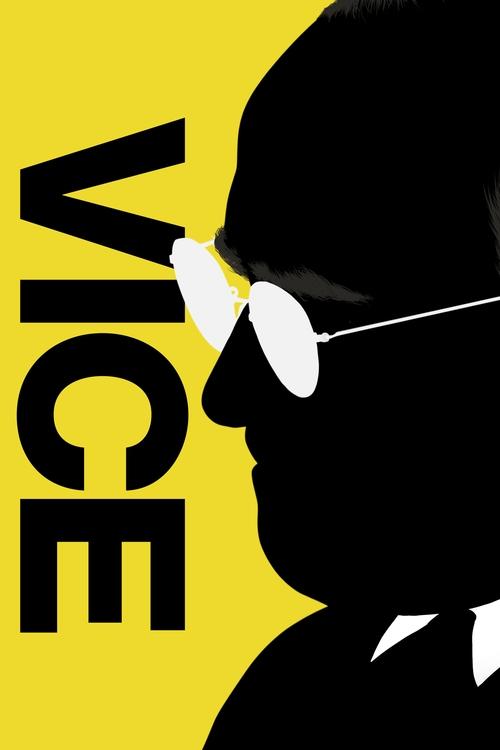
Vice
2018 · Adam McKay
For when you want politics as a bitter black comedy — something to yell at the screen with, not a soothing prestige drama. Best when you're in the mood to be provoked.
What it's about
The story of Dick Cheney: how a hard-drinking Wyoming washout remade himself into a Washington operator, rose through the Nixon and Ford White Houses under Donald Rumsfeld's wing, and then — as George W. Bush's vice president after 9/11 — quietly gathered more power than any VP in American history, steering the country toward surveillance, torture policy, and the Iraq War. It's a biography told as dark comedy, with his marriage to the formidable Lynne Cheney as its engine.
The experience
Fast, jagged, and furious under the jokes — it interrupts itself, breaks the fourth wall, fakes you out, and generally treats the biopic form as a piñata. Whether you find it exhilarating or exhausting, it never lets you settle, and its anger is the real aftertaste.
Performances
Christian Bale disappears into Cheney — the weight, the murmur, the crooked half-smile of a man who never raises his voice because he never has to. Amy Adams is his equal as Lynne, Sam Rockwell plays Bush as an eager junior partner, and Steve Carell makes Rumsfeld a grinning shark.
The craft
Adam McKay throws every formal trick he has at the material: a mystery narrator, nature-documentary cutaways, a scene delivered as Shakespearean verse, and Hank Corwin's whiplash editing stitching it all together. The transformation work on Bale is remarkable in itself — you stop seeing the actor within minutes.
Why it matters
It pushed McKay's collage-style political filmmaking to its limit, split critics right down the middle, and swept into awards season on the strength of Bale's transformation.
Snapshot
Adam McKay's Vice is a formally restless political satire-biography tracing Dick Cheney's ascent from Wyoming drifter to the most consequential—and, McKay argues, most dangerous—Vice President in American history. The film opens on Cheney's early life as a Yale dropout and heavy drinker, pivots through his apprenticeship under Donald Rumsfeld in the Ford White House, and culminates in the post-9/11 period when he used the Unitary Executive Theory to consolidate extraordinary executive power, authorize enhanced interrogation, and drive the case for the Iraq War. Formally, Vice refuses the conventions of the prestige biopic: it interrupts its own narrative with a fake ending, stages scenes as Shakespearean soliloquy, inserts nature-documentary footage as ironic commentary, and presents a narrator whose relationship to Cheney is only revealed as a plot twist. The film is simultaneously a character study of unnerving depth—anchored by Christian Bale's transformative performance—and a polemical essay on the mechanics of American political power.
Industry & production
Vice was produced by Plan B Entertainment (Brad Pitt's company, which had co-produced The Big Short), Annapurna Pictures, and McKay's own Gary Sanchez Productions, with Annapurna and Roadside Attractions handling distribution. The film's production history reflects the consolidation of prestige independent production around a small number of well-capitalized boutique companies willing to fund provocative political material at mid-budget scale. Annapurna, founded by Megan Ellison, had by 2018 established itself as the primary institutional home for ambitious, uncommercial filmmaking in Hollywood, backing work by Paul Thomas Anderson, Kathryn Bigelow, and Spike Jonze before partnering with McKay.
The budget, reported in the range of approximately $60 million, placed Vice in the upper tier of Annapurna's output and required Christian Bale's above-the-title commitment to secure financing. Bale gained approximately 45 pounds for the role—following his weight loss for The Machinist and his physical transformation for Batman Begins—making his casting both a performance and a marketing proposition. The film opened wide on Christmas Day 2018, a traditional prestige release slot, and earned approximately $76 million worldwide, a figure that represented a significant underperformance relative to studio hopes but was consistent with the limited commercial ceiling of politically contentious material. It collected eight Academy Award nominations, including Best Picture, Best Director, Best Actor, Best Supporting Actress (Amy Adams), Best Supporting Actor (Sam Rockwell), Best Original Screenplay, and Best Film Editing, ultimately winning only Best Makeup and Hairstyling.
Technology
Vice was shot by cinematographer Greig Fraser on a combination of film and digital formats, a deliberate choice that allowed the film to modulate texture in service of its shifting registers—from the glossy, over-exposed look of contemporary political imagery to grainier, news-reel-adjacent footage that approximates documentary authenticity. Fraser's team also worked extensively with archival television footage, integrating it into the film's visual vocabulary in a way that blurs the boundary between reconstruction and document. The prosthetic and makeup work—recognized by the Academy—was conducted by Kazu Hiro (credited as Kazuhiro Tsuji), who had previously created transformative prosthetic applications for Darkest Hour (2017). The degree of physical alteration required for Bale's Cheney, Sam Rockwell's Bush, and Steve Carell's Rumsfeld involved extensive prosthetic construction, making Vice one of the more technically ambitious makeup projects of its era.
Technique
Cinematography
Greig Fraser's work on Vice is deliberately unstable—a visual strategy that matches McKay's refusal of documentary authority. The film moves between formats and aspect ratios with rhetorical intent: the contemporary political sequences often have the flat, broadcast-television overexposure of cable news, while the 1970s Ford-era passages carry a warmer, filmic grain. Fraser employs handheld camera during moments of political crisis and chaotic decision-making, and a more composed, almost classical framing when staging the Cheneys in domestic spaces—a visual binary that sets public turbulence against private legibility. The film also draws on the grammar of the nature documentary, with insert shots of predatory animals that operate as visual editorializing. Fraser's career at the time of Vice—he had shot Zero Dark Thirty (2012), Foxcatcher (2014), and Lion (2016)—was marked by an ability to move between austere realism and more expressive registers, a range fully exploited here.
Editing
Hank Corwin, who had previously worked with McKay on The Big Short and before that spent decades as Oliver Stone's primary editor (including JFK, Natural Born Killers, and Nixon), brings to Vice an associative, maximalist montage practice. The editing is the film's most formally aggressive element. Corwin cuts freely between dramatic reconstruction, archival news footage, political speech recordings, nature-documentary inserts, and title cards in a mode that owes something to Stone's essay-montage but pushes further into self-conscious absurdism. The film's most audacious editorial gesture is the false ending: approximately halfway through, when Cheney chooses not to run for president in 2000, a closing-credits sequence begins—only for the narrative to resume when George W. Bush recruits Cheney as his running mate. The choice reads simultaneously as a joke about genre expectations and a thesis statement about contingency, implying that the Cheney-as-VP story was not inevitable, and that the subsequent catastrophes flowed from a single decision.
Mise-en-scène / staging
McKay's staging alternates between two poles. The first is a kind of exaggerated naturalism—particularly in the domestic scenes between Dick and Lynne Cheney, staged with an intimacy that grants them interiority the film simultaneously undermines through ironic framing. The second is explicitly theatrical: the most celebrated staging choice is a scene in which Dick and Lynne speak to each other in blank verse, parodying Shakespeare's history plays, specifically the collusion scenes from Macbeth. The sequence is played deadpan by Bale and Adams and functions as a Brechtian Verfremdungseffekt—a deliberate rupture in illusionism that signals the film's consciousness of its own constructedness. This Brechtian impulse runs throughout: the narrator addresses the camera directly; title cards explain legal and political concepts; the machinery of representation is never fully concealed.
Sound
Nicholas Britell's score for Vice draws on his established practice of what he has called "broken music"—melodic and harmonic material subjected to distortion, tempo manipulation, and tonal ambiguity. Having scored Moonlight (2016) and If Beale Street Could Talk (2018), Britell brought to Vice a sensibility attuned to the gap between surface emotion and underlying dread. The score oscillates between grandiloquent, almost pompous orchestral passages—mimicking the self-congratulatory aesthetics of political power—and more dissonant, destabilizing undercurrents. The film also uses source music strategically, including country music and period-appropriate radio and television audio to anchor its historical passages.
Performance
Christian Bale's performance is the film's commercial and critical center of gravity. Beyond the obvious physical transformation, Bale constructs Cheney from the inside out: the voice, flattened to a near-expressionless register; the stillness, which reads as either self-containment or vacancy; the moments of genuine warmth toward his daughter Mary, which the film uses to establish that Cheney is not a cartoon but a person who chose. Amy Adams as Lynne Cheney delivers what many critics considered the film's most quietly devastating performance—Lynne is cast as the Lady Macbeth figure, the ambition-driver behind Dick's rise, and Adams plays the role with a controlled, chilling resolve. Sam Rockwell's George W. Bush is broadly performed but intentionally so; he is a study in incuriosity and manipulation, not a rounded character. Steve Carell's Rumsfeld is played as a kind of manic id, an older model of Washington cynicism who initiates the young Cheney into the logic of power for its own sake. Jesse Plemons as the narrator Kurt gives the film its most overtly fictional and emotionally strange anchor.
Narrative & dramatic mode
Vice is a satirical biopic organized around a revisionist historical thesis: that Dick Cheney, not George W. Bush, was the operational center of the post-9/11 executive, and that the expansion of presidential power during that period was deliberate, legally architected, and personally driven. The film's narrative mode is essayistic—it does not trust its dramatic scenes to carry argument without supplemental editorializing through title cards, direct address, and montage. This is a formally honest position: McKay is not pretending to offer a balanced portrait or a fully documented account, but an argument with a point of view, staged in the grammar of cinema rather than journalism. The narrator conceit—in which the narrator eventually reveals himself to be a man who received Cheney's discarded heart in a transplant—is the film's most overtly absurdist gesture, rendering the entire preceding narrative as retrospectively colored by an impossible relationship of literal bodily connection between narrator and subject.
Genre & cycle
Vice belongs to a cycle of politically engaged American docudramas that intensified in the mid-2010s, including Spotlight (2015), The Big Short (2015), The Post (2017), and Dark Waters (2019). Within that cycle, Vice and The Big Short occupy a specific sub-category: the polemical essay-film masquerading as entertainment, in which formal experimentation is in the service of explicit political argument. The lineage behind this mode reaches back to Oliver Stone's conspiracy biopics—JFK (1991) and Nixon (1995)—and further to the New Hollywood tradition of formally adventurous political filmmaking. McKay's distinctly contemporary contribution is to graft the reflexive energy of late-network television satire (specifically, the sensibility of Saturday Night Live and its alumni) onto the political biopic, producing something that feels simultaneously more populist and more aggressively constructed than its predecessors. The film is also part of a broader cultural moment of Trump-era documentary and docudrama production in which the formal limits of traditional journalism seemed inadequate to the scale of the events being described.
Authorship & method
Adam McKay began his career as a writer and director at Saturday Night Live before transitioning to broad studio comedies (Anchorman, Step Brothers, The Other Guys). His pivot to politically charged docudrama with The Big Short (2015) marked a decisive authorial shift. McKay has spoken extensively about his political radicalization in the years after the 2008 financial crisis as the animating impulse behind this shift. His method is collaborative and fast-moving: he writes his own scripts, works closely with his editors (Corwin on both The Big Short and Vice), and tends to use a large ensemble cast whose performances he shapes through improvisation and multiple takes. Greig Fraser, as cinematographer, was a crucial collaborator in establishing Vice's visual grammar; Fraser's background in both genre and documentary-inflected work made him well suited to the film's tonal range. Nicholas Britell, whose scoring work had become identified with emotionally complex, formally adventurous American films of the period, brought a musical intelligence that complemented McKay's tendency toward ironic juxtaposition.
Movement / national cinema
Vice is firmly situated in American prestige independent cinema of the late 2010s, a category defined less by low budgets than by a particular institutional ecology: production through boutique companies (Annapurna, A24, Plan B), distribution through specialty arms or indie labels, and a target audience defined by cultural capital rather than demographic. Within that movement, the film is notable for its explicit political ambition—most prestige independent cinema of the period exercised political caution even when addressing political subjects. Vice is unabashedly partisan, and was received as such, which accounts for both its awards success with certain branches of the Academy and its polarized critical and audience reception.
Era / period
The film spans approximately 1963 to the late 2000s, with primary focus on the period 1968–2008, encompassing Cheney's apprenticeship in the Nixon-Ford era, his years as a Wyoming congressman, his tenure as Secretary of Defense under George H.W. Bush during the Gulf War, his decade in the private sector at Halliburton, and his Vice Presidency under George W. Bush. The film was produced and released in 2018, during the Trump presidency, a context that saturates its reception: audiences and critics inevitably read Vice as a prehistory of the current moment, tracing the intellectual and legal architecture of executive overreach to the Cheney years. McKay has confirmed in interviews that the film is intended in part as an autopsy of how the American right arrived at Trumpism, though Trump does not appear in the film.
Themes
Power and its concealment are Vice's central preoccupations: the film is fascinated by how power is accumulated through procedural and legal means rather than dramatic confrontation, and how its most effective practitioners are those who appear, like Cheney, to want nothing for themselves. The Unitary Executive Theory—the legal doctrine holding that the President (and by extension the Vice President) has nearly unlimited authority over the executive branch—is presented as the ideological key to understanding the Cheney era: a theory that existed in conservative legal circles for decades before being operationalized in the post-9/11 emergency. The film also engages the theme of marriage as political partnership, rendering the Cheney relationship as a genuine bond that is also a collaboration in the pursuit of power. A third theme, handled with some ambiguity, concerns Cheney's relationship to his lesbian daughter Mary and his eventual public support of same-sex marriage—a humanizing strand that the film simultaneously credits and contextualizes against the political damage his administration's anti-gay positions caused.
Reception, canon & influence
Backward influences. The film draws extensively from Oliver Stone's political biopics, particularly Nixon (1995), which established the template for a psychologically revisionist portrait of a right-wing president that is simultaneously a critique of institutional power and an exercise in dramatic sympathy. The Brechtian theatrical devices—direct address, interpolated commentary, the visible machinery of production—connect Vice to a longer tradition of political theater, including the work of Joan Littlewood and the Living Newspaper tradition of the 1930s Federal Theatre Project. McKay's specific blend of comedy and political argument owes something to the satirical documentary tradition of Michael Moore, though McKay disavows the first-person mode and prefers formal experimentation to polemical confrontation. The Big Short is the most immediate formal precursor, establishing the specific grammar—narrator as explainer, celebrity cameos as pedagogical devices, genre ruptures—that Vice extends.
Critical reception. The film was one of the more divisively received prestige productions of 2018. Admirers argued that McKay had found the only formally adequate response to the Cheney story—that a conventional biopic would have domesticated its subject and rendered him pitiable rather than dangerous. Critics of the film, including several prominent reviewers, argued that the formal pyrotechnics served as a substitute for genuine psychological investigation, that the film's Cheney was a cartoon rather than a person, and that the political thesis was too simple to justify the satirical apparatus. The film received a notably low audience score on Rotten Tomatoes relative to its critical score, a pattern that reflected the partisan nature of its reception: audiences with sympathetic views of Cheney or the Bush administration largely rejected it as propaganda.
Forward influence. Vice is a significant reference point for the subsequent development of politically engaged American docudrama, particularly McKay's own Don't Look Up (2021), which pushed the satirical essay-film form further toward explicit allegory. The film also contributed to a broader conversation about the limits of liberal political cinema—whether formal sophistication can substitute for political analysis, and whether films can produce political effects in a fragmented media environment. Greig Fraser's work on Vice contributed to his rising stature as one of the defining cinematographers of his generation; he subsequently shot Dune (2021) and The Batman (2022), winning the Academy Award for Dune. Christian Bale's performance extended his reputation as one of the most technically committed actors of his era, though the role did not produce the Oscar recognition that Bale and McKay anticipated. The film remains, in the early 2020s, a contested object: a genuine formal experiment whose political argument has become, for some viewers, more rather than less pertinent as the Cheney-era legal architecture has continued to shape American executive power.
A Deleuzian reading
About halfway through *Vice*, the credits roll.
The full Deleuzian reading of Vice →
Reception
Landed in 2018 as a genuine critical split — eight Oscar nominations on one hand, some of the year's harshest reviews on the other — and time hasn't healed it: it's still the McKay film people point to when arguing about where his post-Big Short style tipped over.
How Vice was received, from release to now →
Influences: the films it descends from and the films it influenced
- JFK (1991) — Pioneered the political essay-montage—rapid intercutting of newsreel, 8mm, 16mm, 35mm, and re-enacted footage as argumentative structure rather than narrative continuity—establishing the grammar of mixed-stock historical collage that McKay and Greig Fraser deploy as Vice's visual rhetoric.
- Nixon (1995) — Established the psychologically revisionist portrait of a right-wing president using expressionistic flash-cuts and interior-monologue structure that renders institutional power as simultaneously pitiable and monstrous, the direct formal template Vice extends to Cheney.
- Natural Born Killers (1994) — Stone's radical mixed-media collage—Super-8, 16mm, 35mm, video, and animation cut together in rapid ironic juxtaposition—established the grammar of multi-stock satirical critique that McKay and Fraser absorb into Vice's visual language.
- The Big Short (2015) — McKay's direct formal precursor invented the specific grammar Vice extends: celebrity cameo asides as pedagogical interruptions, a narrator who breaks the fourth wall to explain institutional mechanisms, and mid-scene genre ruptures as Brechtian alienation devices.
- Bob Roberts (1992) — The first American fiction film to use Brechtian mockumentary format as a vehicle for satirizing right-wing political demagoguery, using the film's own visible production machinery as ideological commentary on political image-making.
- Citizen Kane (1941) — Established the fragmented, multi-perspective biopic structure in which no single narrator is authoritative and the subject remains deliberately opaque—the formal precedent for Vice's construction of Cheney as an unknowable cipher.
- Fahrenheit 9/11 (2004) — The most prominent political docudrama collage specifically targeting the Bush-Cheney administration, using ironic juxtaposition of archival footage with dramatic reconstruction in a populist mode that McKay absorbs and formally sophisticates through fiction-film conventions.
- Network (1976) — Chayefsky's model of characters who declaim directly at the audience with satirical-prophetic rhetoric about institutional power—performed theatrically rather than naturalistically—establishes the register that Vice's narration and direct-address sequences inhabit.
- All the President's Men (1976) — Established political docudrama's grammar of institutional legitimacy—handheld camera, naturalistic shadow-heavy lighting, procedural narrative structure—that McKay and Fraser consciously cite and distort through their own mixed-stock, high-contrast satirical visual approach.
- The Death of Stalin (2017) — Uses dark comedy, theatrical staging, and historical reconstruction as Brechtian critique of executive power as grotesque farce—the closest European parallel to Vice's treatment of the Cheney apparatus, with cabinet proceedings rendered as slapstick procedural.
- Frost/Nixon (2008) — McKay inherits Frost/Nixon's mockumentary scaffolding — here through an unreliable narrator and direct-address breaks — and applies it to another prestige political docudrama about Republican executive power, using historical impersonation and the substitute tribunal form (Congressional testimony staged as confessional chamber) as the film's structural armature.
- Path to War (2003) — McKay extends Path to War's archival-footage punctuation into outright satirical montage; the willed-ignorance acting demanded of Bale's Cheney is the same internal technique — a powerful figure performing incuriosity — placed in an aggressively ironic rather than tragic frame.
- Don't Look Up (2021) — McKay's direct extension of Vice's essay-film grammar, pushing Brechtian satire toward explicit allegory and political signposting, using the same ensemble-satire structure and fourth-wall narration to address climate denial as Vice applied to the Cheney executive apparatus.
- W. (2008) — Shares the satirical biopic form targeting Bush-era executive overreach and the revisionist psychological portrait of a sitting president, but opts for conventional dramatic structure rather than Brechtian formal interruption, making it Vice's more restrained generic counterpart.
- I, Tonya (2017) — Employs competing unreliable testimonies presented as contradictory direct-address narration and on-screen title cards, and uses mockumentary aesthetics to satirize an American media figure through a biopic that openly interrogates its own construction of truth.
- Bombshell (2019) — Uses heavy prosthetic transformation of name actors to play Fox News political figures in the same Trump-era prestige-docudrama space, deploying similar direct-address asides and satirical framing of institutional events from the same American political milieu.
- The Eyes of Tammy Faye (2021) — Employs prosthetic-heavy physical transformation of a name actor to render a religiously inflected American figure adjacent to Bush-era political power, inhabiting the same prestige-biopic conventions and transformation-as-craft ethos that Vice established in the same award cycle.
- Brexit: The Uncivil War (2019) — Full-body transformation into a real backroom operator combined with the system-dramatizing, fourth-wall explanatory mode about still-contested recent history.
- The Report (2019) — Shares the post-9/11 reckoning on the Cheney-era security state and the theme of euphemism-and-classification — how policy crimes are renamed into administrative procedure.
Similar films
- The Big Short (2015) — influence & lineage
- Nixon (1995) — influence & lineage
- Darkest Hour (2017) — often watched together
- Being John Malkovich (1999) — often watched together
- American Sniper (2014) — often watched together
- American Fiction (2023) — often watched together
- American Psycho (2000) — shared sensibility
- Burn After Reading (2008) — shared sensibility