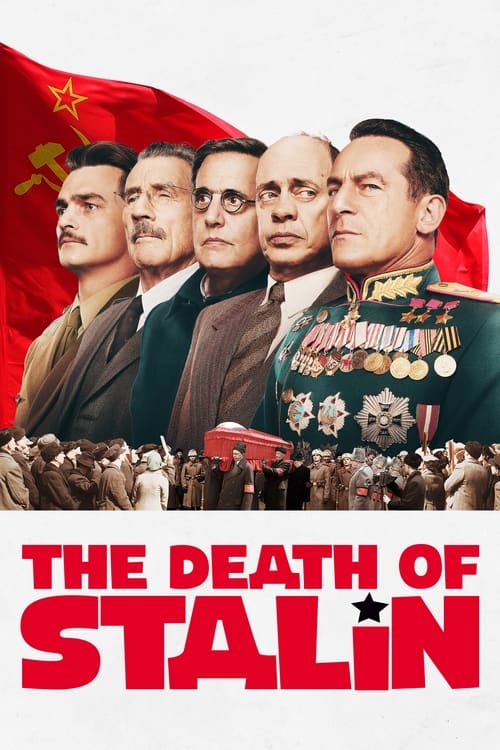
The Death of Stalin
2017 · Armando Iannucci
When you want to laugh at power — the darkest comedy you can reach for, ideal when the news has you cynical and you'd rather cackle than despair. A challenge for the squeamish, catnip for anyone who likes their satire with teeth.
What it's about
Moscow, 1953: the dictator drops dead of a brain hemorrhage, and the terrified, scheming men of his inner circle scramble to seize power before one of the others has them shot. What follows is a week of funeral arrangements, alliance-swapping, and back-stabbing played as farce — a comedy where the punchline to every joke could be an execution. Based on real events, absurd as they seem.
The experience
Savagely funny and genuinely chilling, often in the same breath — you laugh at the bumbling and then remember people are being dragged off in the background. It moves at a sprint, dialogue overlapping and panic escalating, and it leaves a bracing aftertaste.
Performances
Simon Russell Beale is terrifying and hilarious as secret-police chief Beria, Steve Buscemi's fast-talking Khrushchev is a marvel of nervous calculation, and Jason Isaacs storms in as a war-hero general who steals every scene he's in.
The craft
Iannucci lets his cast keep their own accents — Brooklyn, Yorkshire, wherever — a brilliant choice that strips away period-drama stuffiness and makes these apparatchiks feel like office schemers you know. The script is machine-gun quick, and the film's boldest trick is tonal: it keeps real terror humming under the slapstick without ever letting either cancel the other out.
Why it matters
It confirmed Iannucci as the sharpest political satirist working, translating the style he honed on television to lethal historical stakes — and it was banned in Russia, which rather proved its point.
Snapshot
The Death of Stalin is a political farce that stages the chaotic week following Joseph Stalin's fatal cerebral hemorrhage in March 1953 as a sweating, back-stabbing scramble among the men of his inner circle. Adapted from the French graphic novel La mort de Staline by Fabien Nury and Thierry Robin, it was Armando Iannucci's second feature after In the Loop (2009) and the first to take him out of the modern Anglo-American corridors of power that defined The Thick of It and Veep. The film translates Iannucci's signature register — overlapping, profane, panic-driven dialogue among venal functionaries — onto the lethal stakes of high Stalinism, where a misjudged sentence can mean a bullet. Its great formal wager is tonal: it plays mass terror, torture, and summary execution as the background hum to a comedy of cowardice and committee procedure. The result is one of the more discomfiting political comedies of its decade, and one whose release became a minor geopolitical event when Russia revoked its distribution certificate.
Industry & production
The film was a European co-production, structured chiefly through French and British partners — Quad and Main Journey on the French side, with Gaumont involved, alongside British and Belgian co-financing — a configuration that reflects both the graphic novel's French origin and the cross-border financing typical of mid-budget specialty cinema in the 2010s. Iannucci developed the script with longtime collaborators David Schneider and Ian Martin, with additional material credited to Peter Fellows, working from the Nury–Robin source. The budget was modest by the standards of period spectacle; the production economized by shooting largely in and around London, with British heritage interiors standing in for the Kremlin and Moscow's institutional spaces, supplemented by location work that lends the film its gray, marbled, fluorescent-lit institutional texture.
Distribution split along the usual specialty lines: Entertainment One handled the United Kingdom, where the film opened in October 2017, while IFC Films released it in the United States in early 2018. It performed as a respectable arthouse and crossover success rather than a blockbuster, earning strong reviews and awards-season attention in Britain — including BAFTA and British Independent Film Award recognition — without breaking into wide commercial territory. The most consequential industrial fact of its release was political rather than financial: in January 2018 Russia's Ministry of Culture withdrew the film's distribution license shortly before its scheduled Russian opening, and screenings were effectively halted, an act of state censorship that became inseparable from the film's public identity and, predictably, amplified its visibility abroad.
Technology
The Death of Stalin is a conventionally produced digital-era feature; its technological interest lies less in novel apparatus than in disciplined craft applied to a period reconstruction on a controlled budget. The production leaned on practical interiors and art-directed dressing rather than extensive digital set extension, using real architecture to supply scale. Where the film is most "technological" thematically is in its preoccupation with the machinery of the Soviet state — the radio broadcast apparatus of the opening sequence, the telephones and switchboards through which power is transmitted, the lists and dossiers that function as instruments of death. The film treats bureaucratic and broadcast technology as the period's true weaponry, but its own production technology remains transparent in the service of performance.
Technique
Cinematography
Zac Nicholson's photography keeps faith with the loose, observational handheld grammar Iannucci favors, but tempers it with a more composed, period-appropriate palette than the run-and-gun look of Veep. The camera tends to float and reframe restlessly around groups of men, catching reactions and the small physical tells of fear — a calibrated tracking of who is closest to power at any given second. Color skews toward institutional drabness: cold marble, deep reds, the sickly green-gray of corridors and offices, lit to feel airless and surveilled. The handheld instability becomes meaningful rather than merely stylish; it renders a world in which no footing is secure and the ground of authority shifts hour by hour.
Editing
Peter Lambert's cutting is the film's metronome. The comedy depends on rhythm — on the precise beat at which a character recalculates, retreats, or seizes an opening — and the editing privileges reaction over action, holding on faces a fraction longer than expected to let dread and opportunism register. The film accelerates markedly in its back half, as the funeral and the move against Beria compress events into a tightening sequence of corridors, cars, and rooms. The cut between farce and atrocity is handled without editorial cushioning: the film declines to signal when to laugh and when to recoil, and that refusal is largely an editorial decision.
Mise-en-scène / staging
The staging is the film's most theatrical dimension. Iannucci blocks the Central Committee and the inner circle as ensembles in constant micro-negotiation — who sits where, who moves toward the body, who is permitted to speak. The opening at Radio Moscow, in which a live Mozart concert must be hastily re-performed and re-recorded to satisfy Stalin's request for a disc that was never cut, establishes the film's central image of power: an entire apparatus mobilized in terror to fabricate a record after the fact. The recurring tableau of men gathered around Stalin's prone, soiled body — afraid to touch it, afraid to summon doctors who have mostly been purged — is staged as grotesque comedy and political allegory at once.
Sound
Sound design foregrounds the overlapping, interruptive speech that is Iannucci's hallmark: dialogue is layered, talked-over, and dense with insult, demanding the audience track multiple simultaneous calculations. Crucially, the cast performs in their own native accents — Steve Buscemi's American, the various British registers of Simon Russell Beale, Michael Palin, and Jason Isaacs — rather than affecting Russian inflection. This is a deliberate distancing strategy: it refuses the costume-drama convention of "Russian-accented English" and instead maps Soviet power onto familiar regional class voices, making the cronies sound like recognizable modern operators.
Performance
The ensemble is the film's engine. Simon Russell Beale's Lavrentiy Beria is its dark center — oily, intelligent, sexually predatory, and genuinely menacing — a performance that supplies the threat against which the comedy is measured. Buscemi plays Nikita Khrushchev as a wary, calculating survivor; Jeffrey Tambor's Georgy Malenkov is a study in vain, pliable insecurity; Michael Palin's Molotov embodies the true believer whose ideology has hollowed into reflex. Jason Isaacs arrives late as a swaggering, medal-clanking Marshal Zhukov and tilts the film's balance of power with sheer bravado. Andrea Riseborough and Rupert Friend, as Stalin's children, supply notes of hysteria and grief at the edges. The acting style is high-velocity ensemble comedy played absolutely straight — no one signals that any of it is funny.
Narrative & dramatic mode
The film operates in the mode of historical farce structured as a political thriller. Its narrative engine is succession: with the autocrat suddenly removed, the question "who is running the government?" drives a sequence of maneuvers, alliances, and betrayals compressed into a few frantic days. The dramatic irony is total — the audience knows the broad historical outcome (Khrushchev prevails; Beria is destroyed) while the characters improvise blindly. The structure moves from the inciting collapse, through the paralysis around the body and the funeral arrangements, to the decisive coup against Beria, giving the farce an underlying thriller spine that pulls the comedy toward genuine dread. The mode is satirical realism warped into nightmare: the events are largely grounded in the historical record even as the film telescopes timelines and heightens behavior for comic effect.
Genre & cycle
The Death of Stalin sits at the intersection of political satire, dark comedy, and the period film, and it belongs most clearly to the lineage of the totalitarian black comedy. Its closest ancestor is the Kubrickian Cold War farce, and it shares DNA with the broader British tradition of institutional satire. Within Iannucci's own cycle, it extends the Thick of It / In the Loop / Veep project — the comedy of cowardly functionaries managing crises beyond their competence — but raises the stakes from career humiliation to literal liquidation, which is the film's defining generic move. It also participates in a smaller 2010s cycle of comic-grotesque historical reckonings with twentieth-century tyranny, treating dictatorship not as solemn tragedy but as absurd, bureaucratic, and survivable only through abjection.
Authorship & method
The film is unmistakably Iannucci's. His method — building scripts as scaffolds for layered, improvisation-inflected ensemble performance; prizing the rhythms of panic and the poetry of profane insult; staging power as a perpetual scramble among the second-rate — is fully present, transposed into a deadlier key. He worked, as is his practice, with a writing room (David Schneider, Ian Martin, Peter Fellows) rather than as a solitary author, and Ian Martin's contribution as the "swearing consultant" of the Iannucci universe registers in the dialogue's verbal violence. Key collaborators shape the film's distinct identity: cinematographer Zac Nicholson supplies the cold institutional look; editor Peter Lambert calibrates the comic and dramatic rhythm; and composer Christopher Willis provides a score steeped in Soviet-era classical idiom — pastiching the brass-heavy, ominously triumphal mode associated with Shostakovich and Prokofiev — that lends the farce an authentic, foreboding period gravity and underscores the gap between the regime's monumental self-image and its squalid reality. The source authorship of Nury and Robin's graphic novel remains the film's foundation, supplying both the premise and much of the structural compression.
Movement / national cinema
The film resists neat national placement. It is a British-authored, French-financed European co-production about Soviet history, performed by a transatlantic cast in their native accents. It belongs to a tradition of British screen satire and to the cosmopolitan, festival-and-specialty stream of European art cinema rather than to any single national movement. Its treatment of Soviet material from outside — the deliberate refusal of Russian accents, the mapping of Stalinist power onto recognizably Anglo-American comic types — marks it as an outsider's satire, which is precisely the quality that provoked official Russian rejection. It is, in the most useful sense, a work of European political cinema about the shared memory of twentieth-century totalitarianism.
Era / period
Set in March 1953, the film reconstructs the immediate aftermath of Stalin's death — the moment when the Soviet system's dependence on a single terrifying figure was suddenly exposed. Its historical canvas includes the Doctors' Plot and the depletion of competent physicians by purge, the omnipresence of the NKVD/MVD under Beria, the rituals of the personality cult, and the looming question of de-Stalinization that Khrushchev's eventual ascent would inaugurate. The film compresses and rearranges the documented chronology for dramatic economy — a liberty it takes openly — but its texture of fear, denunciation lists, and arbitrary death is grounded in the well-established historiography of late Stalinism. Made in the 2010s, it also reads, unavoidably, as a film of its own era: a meditation on strongman rule, sycophancy, and institutional collapse with contemporary resonance.
Themes
The film's governing theme is the cowardice and self-interest that authoritarianism breeds in those who serve it — the way absolute power degrades its functionaries into terrified opportunists incapable of acting until the threat is removed, and barely then. Closely bound to this is the theme of fear as the organizing principle of a state: the comedy is generated almost entirely by men calculating, in real time, how to survive. The film also examines the bureaucratization of atrocity — death administered by list, quota, and committee — and the absurd theater of the personality cult, in which truth is whatever the leader last said. Finally, it dwells on the contingency of history: that the succession of a global superpower was settled by a few panicked men in rooms, improvising, is the film's most unsettling and most resonant claim.
Reception, canon & influence
Critically, the film was widely praised on release, particularly in Britain, for the audacity of its tonal balance and the strength of its ensemble — Simon Russell Beale's Beria drawing especially strong notice — and it featured in British awards conversations through BAFTA and British Independent Film Award nominations. Reviews recurrently grappled with the central question of whether comedy is an adequate or ethical response to mass terror, and the strongest defenses argued that the film's refusal of solemnity is itself a moral position: that ridicule deflates the tyrant's monumentality more effectively than reverence. The Russian government's revocation of its distribution license, with officials denouncing it as an insult, paradoxically confirmed the film's thesis about thin-skinned authority and became central to its reception narrative.
The influences on the film are legible: the Nury–Robin graphic novel as direct source; the Kubrickian tradition of Cold War black comedy; the British heritage of institutional satire; and, most directly, Iannucci's own corpus of crisis-comedy (The Thick of It, In the Loop, Veep), whose grammar this film inherits and darkens. The opening Yudina concert anecdote draws on a widely circulated story associated with the disputed Shostakovich memoir Testimony, a provenance the film treats as legend rather than documented fact.
Assessing the film's forward influence requires honesty about how recent it is: a 2017 release has not yet had time to generate a clearly attributable lineage, and any claim of specific descendants would be speculative. What can be said is that it strengthened the contemporary case for historical farce as a serious mode for confronting twentieth-century tyranny, demonstrated the commercial and critical viability of period political satire performed in deliberately non-naturalistic accents, and consolidated Iannucci's standing as the leading screen anatomist of institutional cowardice. Its durable contribution to the canon is likely to be exactly that tonal proof of concept — the demonstration that the machinery of terror can be most damningly exposed by being played as farce.
A Deleuzian reading
Start with the record that doesn't exist.
The full Deleuzian reading of The Death of Stalin →
Reception
Acclaimed on release in 2017 — though some found laughing at the Terror queasy — it has only climbed since, now routinely called the best political comedy of the 2010s and quoted whenever real-world authoritarian succession drama hits the news.
How The Death of Stalin was received, from release to now →
Influences: the films it descends from and the films it influenced
- Dr. Strangelove or: How I Learned to Stop Worrying and Love the Bomb (1964) — Establishes the Cold War black-comedy grammar this film inherits — rendering the apparatus of catastrophe as a squabble among incompetent men confined to institutional rooms, with annihilation played absolutely straight rather than for jokes.
- In the Loop (2009) — The director's own immediate precursor: scripts built as scaffolds for improvisation-inflected ensemble panic, where power is staged as profane verbal violence and the poetry of insult does the work of plot.
- The Thick of It (2005) — Supplies the inherited grammar — handheld coverage of crisis-comedy, reaction-over-action cutting, and Ian Martin's 'swearing consultant' register — that this film transposes into a deadlier key.
- The Great Dictator (1940) — Originates the moral wager the film stakes its tone on: that ridicule deflates a tyrant's monumentality more effectively than reverence, mocking the dictator's self-image to diminish him.
- To Be or Not to Be (1942) — Pioneers farce staged inside live terror, using precise comic timing to expose the squalid pettiness behind authoritarian pageantry without softening the threat.
- M*A*S*H (1970) — Source of the overlapping-dialogue technique — layered, colliding, half-audible ensemble speech and loose blocking — that the film deploys to make a politburo sound like a panicking crowd.
- Catch-22 (1970) — Dramatizes the bureaucratization of atrocity as the film's core theme — institutional logic that processes mass death through absurd paperwork and self-protective procedure.
- Burn After Reading (2008) — Shares the engine of second-rate operators whose vanity and cowardice escalate into lethal farce, cut for reaction-over-action so consequences land on faces rather than deeds.
- The Lion in Winter (1968) — Iannucci films a succession struggle as anachronistic-voiced, vicious comedy among rivals jockeying in rooms — Lion's mordant treatment of power as family bloodsport transposed into a Soviet key.
- Conspiracy (2001) — Inverts Conspiracy into farce but keeps its engine intact — a committee-room reconstruction where mass murder is negotiated through bureaucratic euphemism and status maneuvering among functionaries around a table.
- The Firemen's Ball (1967) — Political satire of collective moral cowardice played as ensemble comedy of officials managing a botched public occasion, critique carried by petty behavior rather than didactic speech.
- Vice (2018) — Extends the tonal-juxtaposition editing — splicing comic rhythm against historical atrocity — into political biography, indicting the same institutional cowardice the film anatomizes.
- Jojo Rabbit (2019) — Builds on the film's tonal proof-of-concept that twentieth-century fascism can be confronted through farce, deflating the tyrant by rendering authoritarianism absurd.
- The Personal History of David Copperfield (2019) — Carries forward the director's commitment to deliberately non-naturalistic, accent-blind ensemble casting as a formal choice rather than naturalist illusion.
- Four Lions (2010) — Parallel British black comedy that plays terror straight through incompetent conspirators, using native-accent naturalism against horrific stakes for tonal juxtaposition.
- The Lives of Others (2006) — Shares the cold institutional-drab palette — muted grays and bureaucratic interiors — that visualizes the surveillance state as a machinery of dread, here repurposed as the backdrop to farce.
- The Favourite (2018) — A period court rendered as a venom-soaked succession scramble, with a caustic ensemble jockeying for proximity to power in an anachronistic, non-reverent register.
- Wag the Dog (1997) — Backstage political satire where image-managing cynics stage-manage reality, dramatizing the gap between a regime's monumental self-presentation and its squalid improvisation.
- Don't Look Up (2021) — Iannucci's ensemble political dark comedy operates through comedy-of-manners staging in which figures of institutional power negotiate catastrophe via comic misunderstanding, achieving simultaneously the absurdity and genuine horror of institutional failure that is Don't Look Up's central tonal problem — and its shared solution.
- Napoleon (2023) — Sibling in the revisionist deflation of tyranny: it strips the grandeur from an absolute ruler by playing power as petty, bodily and absurd — the same anti-hagiographic deflation Phoenix's unmagnetic Napoleon performs.
- Good Bye, Lenin! (2003) — Tragicomic treatment of a collapsing communist apparatus keyed to bureaucratic and material detail, extending the use of comedy to anatomize the dissolution of a state.
- De Gaulle: Liberté (2026) — A sibling in summit-room dramaturgy that dramatizes power as backroom maneuver and jockeying for recognition, the negotiation-as-theater mode Liberté plays straight rather than satirically.
- Herod's Law (1999) — Names a real regime's actual actors and stages institutional terror as farce, deploying the same specificity-as-danger satirical method against a historical apparatus.
- The Kingdom of Diamonds (1980) — Satirizes the pomp and terror of an autocrat's inner court through comic verbal grotesque and choreographed ceremony — extending the court-ritual-as-farce staging that animates Hirak's throne room.
Similar films
- The Great Dictator (1940) — influence & lineage · same viewing thread
- To Be or Not to Be (1942) — influence & lineage · same viewing thread
- Dr. Strangelove or: How I Learned to Stop Worrying and Love the Bomb (1964) — influence & lineage
- The Favourite (2018) — influence & lineage
- Duck Soup (1933) — same viewing thread
- Repentance (1987) — shared sensibility
- Ivan Vasilyevich Changes His Profession (1973) — shared sensibility
- Two Prosecutors (2025) — shared sensibility
All the films related to The Death of Stalin →
Watch it with: curated runs of related films
- Comedy Declares War on Fascism — A run of satires and cabaret turns that meet tyranny with ridicule — watch these together to see performers puncture dictators and expose the void behind the uniform.