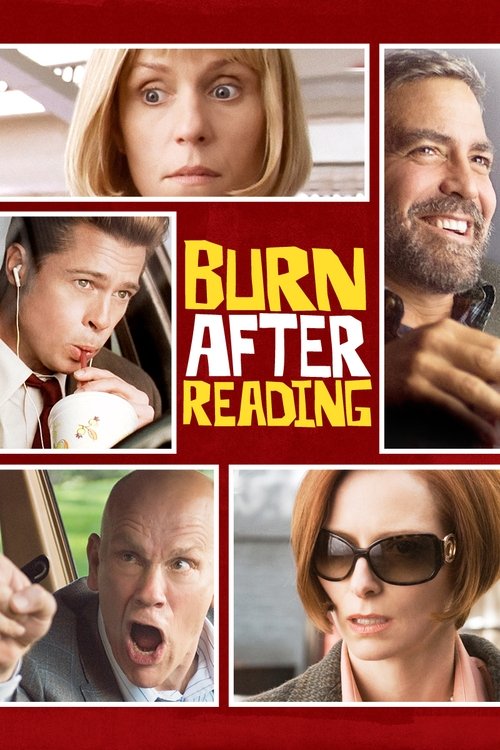
Burn After Reading
2008 · Ethan Coen
When you want to laugh at human idiocy with zero sentimentality — great with friends, great when you're feeling cynical about institutions. Comfort viewing for people with a dark streak.
What it's about
A demoted CIA analyst starts writing his memoirs, and the disc they're on ends up on a locker-room floor at a Washington gym. Two employees there — a woman saving up for cosmetic surgery and her cheerfully dim coworker — decide they've found a sellable state secret. Around them orbit the analyst's icy wife and her philandering lover, a federal marshal, and soon everyone is blackmailing, tailing, or sleeping with everyone else over a disc that contains almost nothing.
The experience
Fast, mean, and very funny — a farce that keeps escalating in ways you don't see coming, with sudden jolts of violence that make you laugh and gasp in the same breath. It leaves you delightedly shaking your head at how stupid everyone was.
Performances
Brad Pitt's dim, ponytailed gym trainer is one of the great comic performances by a movie star sending up his own image, and Frances McDormand matches him with desperate, sunny obliviousness. John Malkovich's profane meltdown and Tilda Swinton's arctic contempt round out a cast having visible fun.
The craft
The Coens run the script like a Swiss watch built to produce chaos: every subplot collides on schedule, and the thriller-movie style — ominous score, surveillance shots, urgent briefings — is played dead straight against material that is pure nonsense. The joke is in the filmmaking itself.
Why it matters
Arriving right after the Coens swept the Oscars with their darkest film, it reasserted their comic register and has aged into one of the most quoted spy spoofs of its era — the definitive comedy about intelligence agencies that have no idea what's going on.
Snapshot
Burn After Reading is a black comedy of espionage and idiocy, arriving as the Coen brothers' deliberate palate-cleanser after the austere dread of No Country for Old Men. Where that film had just swept the major Academy Awards, this one answers with farce: a Washington spy caper in which nobody spies competently, nobody understands what they have, and the machinery of national intelligence grinds itself into bafflement over a disc full of nothing in particular. The plot threads a demoted CIA analyst (John Malkovich), his cold cardiologist wife (Tilda Swinton), her philandering federal-marshal lover (George Clooney), and two gym employees (Frances McDormand and Brad Pitt) who find the analyst's "memoirs" on a misplaced CD and convince themselves it is a sellable secret. The film's governing joke is the gap between the characters' conviction that they are inside a thriller and the reality that they are inside a sequence of accidents. It is minor Coen by design and ambition, but it is among their most precisely engineered comedies of human folly, bracketed by two CIA superiors who narrate the wreckage and conclude, memorably, that there is nothing to be learned from it.
Industry & production
The film was produced through the Coens' long-standing relationship with Working Title Films, the British company headed by Tim Bevan and Eric Fellner, and released in the United States by Focus Features, with StudioCanal involved on the international side. This placed it within the same producing infrastructure that had supported The Big Lebowski and Intolerable Cruelty, and gave the brothers the autonomy they had come to expect: their own script, their own cut, and casting latitude built around actors they had worked with or courted.
The production's most significant industrial fact is its timing. Burn After Reading was shot and assembled in the immediate wake of No Country for Old Men, and the brothers were candid that the two films functioned as opposites — one a tightening of suspense, the other a loosening into absurdity. The film opened the Venice Film Festival in the late summer of 2008 before its theatrical release, a prestige launch that confirmed the Coens' standing post-Oscar even as the film itself courted no awards seriousness.
Casting was a coup of star wattage deployed against type. George Clooney took his third role in what he and the Coens jokingly framed as a trilogy of imbeciles, following O Brother, Where Art Thou? and Intolerable Cruelty. Brad Pitt, against his leading-man image, played the guileless gym trainer Chad. Frances McDormand — Joel Coen's wife and a fixture of the brothers' cinema since Blood Simple — anchored the film as Linda Litzke, the woman whose vanity sets the catastrophe in motion. Malkovich, Swinton, Richard Jenkins, J.K. Simmons, and David Rasche filled out an ensemble of considerable pedigree. I do not have reliable budget or box-office figures to cite precisely; the film is generally understood to have performed respectably for a star-driven adult comedy, but I will not invent numbers.
Technology
Burn After Reading was made on the cusp of the industry's transition to digital capture, and it sits firmly on the photochemical side of that line: it was shot on 35mm film, the format the Coens favored throughout this period. The film's technological subject matter, by contrast, is contemporary and pointed — CD-ROMs, internet dating, financial-data security, online banking transfers, and the surveillance apparatus of a post-9/11 intelligence state. The McGuffin itself is a consumer storage disc, and much of the comedy turns on the characters' misreading of ordinary digital ephemera as classified material. The film thus uses no especially novel production technology while making the anxieties of everyday digital life — what is stored, what is exposed, what is worth selling — its running joke. The CIA's omniscient-seeming capacity to track and observe is rendered as both real and useless: the agency sees everything and comprehends nothing.
Technique
Cinematography
The cinematographer is Emmanuel Lubezki, a notable departure from the Coens' near-permanent collaboration with Roger Deakins. Lubezki — already celebrated and later a multiple Oscar winner — brings a clean, bright, faintly glossy surface to the film that suits its satirical register. The Washington of Burn After Reading is shot in cool, corporate light: glassy office interiors, antiseptic gym spaces, suburban kitchens, and the bland affluence of Georgetown. The camera is frequently mobile in a manner that mimics the conventions of the spy thriller — sweeping establishing shots, surveillance-style framings, and ominous push-ins on doorways and basements — and the disjunction between this self-serious visual grammar and the foolishness it documents is itself the joke. Lubezki's compositions lend the characters a gravity they have not earned, which is precisely the film's comic strategy.
Editing
The film is edited, as the Coens' films invariably are, by the brothers themselves under their shared pseudonym Roderick Jaynes. The cutting is brisk and architectural: Burn After Reading is a farce of interlocking plot lines, and its editing manages a large ensemble of characters who keep colliding without ever quite understanding one another. The rhythm favors hard, slightly abrupt transitions and a withholding structure — information the audience needs is doled out late, and several of the film's biggest shocks (its sudden bursts of violence in particular) are timed to detonate against the comic flow. The framing device of the CIA superiors' debriefings punctuates the narrative, allowing the editing to step back periodically from the chaos to a position of bemused overview.
Mise-en-scène / staging
Production design renders a Washington of surfaces: Osbourne Cox's wood-paneled study, the fluorescent banality of the Hardbodies gym, Harry Pfarrer's basement workshop and its absurd homemade contraption, Katie Cox's chilly modernist home. The film stages its characters within environments that signal status, control, or aspiration — and then exposes the emptiness behind them. Costume and grooming carry comic weight: Chad's frosted-tip hair and gum-chewing alertness, Linda's anxious self-presentation organized entirely around the cosmetic surgeries she craves, Harry's running-and-fitness vanity. The staging repeatedly places characters in spaces of supposed privacy — bedrooms, offices, cars — that turn out to be sites of exposure and intrusion.
Sound
Carter Burwell, the Coens' composer since their debut, supplies a score that is one of the film's sharpest instruments. Burwell scores the film as though it were a genuine geopolitical thriller — propulsive, thunderous, percussive, freighted with manufactured suspense — and the music's grandiosity, set against the pettiness of the plot, generates a sustained ironic friction. The score insists on stakes the story refuses to provide. Beyond the music, the film's sound design exploits ordinary domestic and office acoustics, and its few moments of violence land with a deliberately shocking, unscored abruptness that ruptures the comic tone.
Performance
Performance is the film's richest layer. Brad Pitt's Chad Feldheimer is the standout — a wide-eyed, dim, relentlessly cheerful physical creation, all bouncing energy and earbud-driven obliviousness, played with a fearless commitment that subverts Pitt's stardom. Frances McDormand grounds Linda in genuine, almost touching need: her pursuit of cosmetic surgery is vain and ruinous, but McDormand plays the longing beneath it as real. Malkovich's Osbourne Cox is a study in self-important rage, his profanity escalating into operatic indignation. Clooney commits fully to Harry Pfarrer's jittery, paranoid, compulsively unfaithful narcissism. Tilda Swinton plays Katie as a figure of glacial contempt, and Richard Jenkins, as the gym manager quietly in love with Linda, supplies the film's one note of unguarded human feeling — which the plot duly destroys. J.K. Simmons, in two short scenes as the CIA superior, delivers the film's thesis through sheer exasperated incomprehension.
Narrative & dramatic mode
The film operates as a farce of cross-purposes, an ensemble machine in which each character pursues a private agenda — money, sex, revenge, a new body — in total ignorance of the others' aims, and the collisions among these agendas produce escalating disaster. Structurally it deploys a frame: scenes of CIA officers attempting, and failing, to make sense of the events function as a Greek-chorus-by-bureaucracy, externalizing the audience's own bafflement. The dramatic mode is comic until it abruptly is not; the Coens fold sudden, real violence into the farce, refusing the genre's usual assurance that nothing truly bad will befall comic characters. The narrative's deepest device is dramatic irony pushed to the level of philosophy: the audience sees the full picture of meaningless accident while every character constructs a false narrative of conspiracy, espionage, and significance.
Genre & cycle
Burn After Reading belongs to two overlapping lineages. Within the Coens' own filmography it is one of their "numbskull" comedies — the strain of their work, alongside Raising Arizona, The Big Lebowski, and Intolerable Cruelty, that catalogs human stupidity with affectionate cruelty. More broadly it is a spy parody, a satirical inversion of the Cold War and post-9/11 espionage thriller, draining the genre of competence and consequence while retaining its visual and musical apparatus. It also carries the DNA of screwball comedy in its mismatched couplings, mistaken assumptions, and accelerating chaos, and of the ensemble crime-caper film in which a botched scheme metastasizes.
Authorship & method
Though the title block here credits Ethan Coen, Burn After Reading is, like nearly all of the brothers' films from this period onward, a joint Joel-and-Ethan Coen work — co-written, co-directed, and co-edited (under the Roderick Jaynes pseudonym), with the brothers also serving among the producers. By 2008 the Coens had formalized the shared directing credit that they had long withheld in favor of listing Joel alone. Their method is famously total authorship: they write a tightly controlled screenplay, storyboard and shoot with minimal improvisation, and cut the film themselves, which gives their work its characteristic unity of tone and its refusal of sentimentality.
The film is a node in a dense web of recurring collaborators. Carter Burwell's scoring relationship with the brothers reaches back to Blood Simple (1984), and his ironic-thriller score here is a textbook instance of the Coens using music against image. Frances McDormand's presence likewise links the film to the beginning of their careers. The conspicuous variable is the cinematography: by hiring Emmanuel Lubezki rather than Roger Deakins, the Coens swapped their signature image-maker for a different sensibility, and the film's brighter, glossier surface reflects that choice. The casting method — taking major stars and weaponizing their images against type — is itself an authorial strategy the brothers had refined across their comedies.
Movement / national cinema
The film is firmly within American independent-minded studio cinema: a Coen production financed through Anglo-American channels (Working Title/Focus/StudioCanal) but rooted in the brothers' particular American vernacular. It is a Washington film, engaged with a specifically American institutional landscape — the CIA, federal law enforcement, the security state — and with American types: the self-made man, the striving consumer, the fitness-obsessed bureaucrat. The Coens belong to no school but their own, an authorial pocket of American filmmaking defined by genre revisionism, regional specificity, and a coolly ironic moral vision.
Era / period
Burn After Reading is a product and portrait of the late-2000s United States: the tail end of the Bush era, a post-9/11 culture saturated with surveillance anxiety and security theater, and a consumer landscape organized around self-improvement, cosmetic enhancement, and online life. Its satire of an intelligence apparatus that monitors everything yet understands nothing reads as a comment on the bloated, post-9/11 security state. The film's preoccupation with cosmetic surgery, internet dating, and identity-as-performance situates it precisely in its moment. Coming directly after No Country for Old Men, it also marks a particular phase in the Coens' own career — a confident, post-Oscar interval in which they could follow a prestige triumph with a deliberately unserious entertainment.
Themes
The film's central theme is stupidity as a tragic force — the way self-deception, vanity, and incuriosity drive ordinary people toward ruin. Each character is captive to an idée fixe: Linda to her body, Harry to his appetites, Osbourne to his wounded pride, Chad to the thrill of a secret. Paranoia is a second register: the characters and the agency alike read conspiracy into accident, manufacturing meaning where there is none. Surveillance and exposure run throughout — the comedy of a world in which everyone is watched and nothing is understood. Vanity and the commodification of the self link the cosmetic-surgery plot to the broader theme of identity as a thing to be improved, sold, or stolen. Above all the film is about meaninglessness: the CIA superiors' closing exchange, in which they tally the bodies and damage and conclude they have learned nothing except, vaguely, not to do it again, is the Coens' most explicit statement of their long-running insistence that human striving unfolds against an indifferent and absurd universe.
Reception, canon & influence
Critical reception was generally favorable if appropriately calibrated to the film's modest aims — most reviewers received it as a sharp, enjoyable, deliberately lesser Coen entertainment rather than a major work, and a recurring point of praise was the cast, with Brad Pitt's performance frequently singled out as a comic high point. Some critics found the film's misanthropy chilly or its construction more clever than affecting; others embraced exactly that coldness as the point. I do not have precise aggregate scores or award tallies to cite and will not fabricate them.
Looking backward, the film draws on a deep well of espionage cinema and fiction, parodying the conventions of the spy thriller and the Cold War paranoia film while inverting their competence and gravity; it also extends the screwball and caper traditions and, most directly, the Coens' own prior comedies of folly. Looking forward, Burn After Reading has settled into the Coen canon as a sharp, much-quoted entry in their comic mode — its CIA-debriefing bookends and its bleak punchline have become touchstones for the brothers' philosophy of absurdity. Its most durable legacy may be as a demonstration piece: proof that the spy genre could be hollowed out and played as a comedy of human idiocy, and an enduring example of casting marquee stars against their images. It is rarely placed among the brothers' masterworks, but it is securely regarded as one of their most distilled statements of the worldview that runs through all their cinema — that beneath the machinery of plot and institution lies only accident, vanity, and the refusal to learn.
A Deleuzian reading
Start at the end, in a featureless office, where two CIA men try to file the story you've just watched.
The full Deleuzian reading of Burn After Reading →
Reception
In 2008 it landed as a shrug — a 'minor Coens' palate-cleanser arriving right after the Oscar sweep of No Country for Old Men, with critics calling it slight. It's since been reappraised as one of their sharpest, most quotable comedies, a movie people now rank shockingly high in Coen tier-lists.
How Burn After Reading was received, from release to now →
Influences: the films it descends from and the films it influenced
- Dr. Strangelove (1964) — Establishes the Cold War institutional satire whose control-room/war-room framing and gravely-intoned debriefings Burn parodies, treating the apparatus of national security as a theater of self-important idiocy.
- The Conversation (1974) — Source of the surveillance-framing grammar — figures isolated in long-lens watchfulness and the dread of being recorded — which Burn quotes glossily but empties of genuine menace.
- Three Days of the Condor (1975) — The competent, paranoid CIA-betrayal thriller whose tone of grave institutional conspiracy Burn directly inverts, replacing the savvy analyst-hero with venal incompetents.
- North by Northwest (1959) — The template of an ordinary innocent swept into espionage machinery via mistaken identity, a structure Burn hollows out so the 'intelligence' driving the plot is literally worthless.
- The President's Analyst (1967) — Earlier spy-paranoia-as-absurdist-farce that plays intelligence agencies for laughs, prefiguring Burn's tactic of dramatizing espionage as a comedy of bureaucratic cross-purposes.
- A Fish Called Wanda (1988) — Black-comedy caper built on cross-purposes and double-crosses among greedy fools, casting marquee actors as preening incompetents — the same against-type star weaponization Burn uses on Pitt and Clooney.
- Bringing Up Baby (1938) — The screwball engine of escalating farce-of-cross-purposes — characters acting confidently on total misapprehension — that Burn retools into a lethal rather than romantic key.
- Blood Simple (1984) — Origin of the Coen–Burwell scoring partnership and of their signature dramatic irony, in which characters kill and scheme while the audience sees the fatal misreadings they cannot.
- Fargo (1996) — The Coens' fullest prior statement of stupidity-as-tragic-force, where petty vanity and a small lie cascade into deadpan, abrupt violence — the exact moral architecture Burn miniaturizes.
- The Big Lebowski (1998) — Ensemble of confident incompetents stumbling through a blackmail/mistaken-identity plot they never understand, with a framing-narrator chorus — the comic structure Burn distills into the CIA-debrief bookends.
- The Ladykillers (1955) — Reworks the closed-system caper as a chain of incompetent conspirators picked off one by one by the very scheme they devised.
- A Serious Man (2009) — Extends Burn's worldview of an ordinary man crushed by forces he cannot decode, ending on the same bleak punchline that the universe offers accident and silence, never explanation.
- Hail, Caesar! (2016) — Continues the brothers' method of stacking against-type star cameos and staging Cold War institutional intrigue as farce, with characters earnestly chasing a plot of comic insignificance.
- The Death of Stalin (2017) — Carries forward the institutional-power-as-idiot-farce mode, where apparatchiks who project competence are revealed, through cross-purposes and self-preservation, as panicked fools.
- Knives Out (2019) — Deploys an all-star ensemble cast against type within a withholding, dramatic-irony structure where the audience holds knowledge the scheming characters lack — Burn's narrative game played as whodunit.
- No Country for Old Men (2007) — Made in the same period and editing sensibility, it shares Burn's withholding structure and refusal of catharsis — key deaths dispatched abruptly and offscreen, denying genre payoff.
- In Bruges (2008) — Contemporary hitman black comedy that, like Burn, casts stars against image and punctures its genre with sudden, unfunny violence that exposes the characters' fatal stupidity.
- Three Billboards Outside Ebbing, Missouri (2017) — The Coens' use of pop and period music cues as Brechtian ironic commentary on characters too self-absorbed to perceive their own absurdity is the precise technique Three Billboards inherits for its pop intrusions — the Abba needle-drop, the tonal whiplash of Burwell's score shifts — deployed as destabilizers rather than emotional underscores.
- Bridge of Spies (2015) — The Coens' deadpan verbal compression and ironic view of intelligence bureaucracy—the same authorial diction they brought to rewriting Donovan's exchanges in Bridge of Spies.
- Eddington (2025) — The escalating-idiot-feud satire in which mutual incomprehension spirals to lethal absurdity with no moral center — the comic-nihilist mechanics behind Eddington's town war.
- Get Shorty (1995) — Multi-party cross-cut crime comedy of incompetent operators and ironic reversals, sharing Get Shorty's structural braid of converging schemers and deadpan tonal control.
Similar films
- Fargo (1996) — influence & lineage · often watched together
- The Big Lebowski (1998) — influence & lineage
- No Country for Old Men (2007) — influence & lineage
- Synecdoche, New York (2008) — often watched together
- Argo (2012) — often watched together
- Fight Club (1999) — shared sensibility
- Killing Them Softly (2012) — shared sensibility
- Headhunters (2011) — shared sensibility