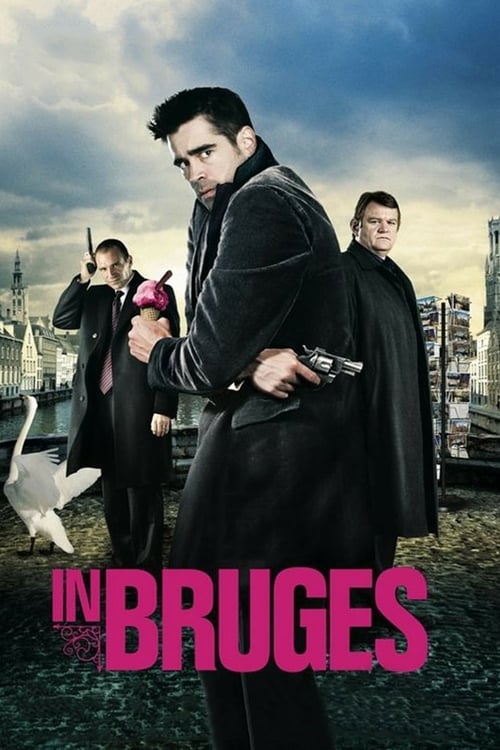
In Bruges
2008 · Martin McDonagh
For when you want to laugh at things you probably shouldn't and still feel something real by the end. Perfect for a night when straight comedy feels too light and straight drama feels too heavy.
What it's about
Two Irish hitmen, Ray and Ken, are ordered by their volatile London boss to lie low in Bruges, Belgium, after a job goes horribly wrong. Ken wants to sightsee; Ray wants to drink, sulk, and escape the guilt eating him alive. Then the phone rings with new instructions, and the picture-postcard medieval town turns into a moral trap.
The experience
Riotously funny and genuinely sad, often in the same breath — the profane banter keeps you laughing right up until the film sucker-punches you with real grief. It's a comedy with a conscience, and the tension of waiting for that phone call never lets up.
Performances
Colin Farrell is a revelation — childish, wounded, and hilarious, the performance that reintroduced him as a serious actor. Brendan Gleeson gives the film its soul as the patient, decent Ken, and Ralph Fiennes is terrifyingly funny as their principled psychopath of a boss.
The craft
Martin McDonagh's debut script is a machine of setups and echoes where every joke turns out to be load-bearing, and the dialogue crackles like the stage plays he came from. Bruges itself — canals, spires, Christmas lights — is shot as both fairy tale and purgatory, gorgeous and suffocating at once.
Why it matters
It became an instant cult favorite and launched McDonagh's film career, proving a crime comedy could carry real moral and theological weight.
Snapshot
A pair of Irish hitmen, Ray and Ken, are dispatched by their London-based employer Harry Waters to wait in Bruges, Belgium, after a job goes catastrophically wrong. What unfolds is less a conventional crime film than an elegiac black comedy about guilt, purgatory, and whether the irredeemably damned can earn grace. Set against the perfectly preserved medieval architecture of the Flemish city, the film uses its location as a moral diagram: Bruges as the afterlife's waiting room, picturesque and oppressive in equal measure. Martin McDonagh's feature debut fused theatrical language with cinematic grammar, delivering a film that operates simultaneously as genre entertainment and as a serious, if darkly comic, inquiry into Catholic conscience and the ethics of violence.
Industry & production
In Bruges was produced by Film4 and Blueprint Pictures, with co-financing and distribution handled by Focus Features in North America and Universal Pictures internationally. Blueprint Pictures, the production company founded by Graham Broadbent and Pete Czernin, had been developing McDonagh's screenplay for several years before the project assembled its cast. The involvement of Film4 situates the film within a tradition of British independent co-production that has, since the 1980s, underwritten literary and auteur-adjacent projects unlikely to find purely commercial backing.
McDonagh had established his reputation as a playwright of international standing before In Bruges. His 2004 short film Six Shooter, also starring Brendan Gleeson, won the Academy Award for Best Live Action Short Film, giving him the leverage to mount a feature on his own terms. The screenplay had been written some years prior and drew directly on McDonagh's own experience visiting Bruges, which he reportedly found simultaneously beautiful and suffocating — an ambivalence the film wears openly.
Casting centered on Brendan Gleeson and Colin Farrell, both Irish, which gave the project a transatlantic Irish-British identity that complicated its national cinema categorization. Ralph Fiennes, cast as the volcanic London gangster Harry Waters, came aboard relatively late and transformed a functional antagonist into one of the film's most arresting performances. The shoot took place on location in Bruges across winter months, a decision that shaped the film's color palette and its sense of a city emptied out and held in suspension. Some interiors and London scenes were filmed separately in the UK.
Technology
In Bruges was shot on 35mm film using anamorphic lenses by cinematographer Eigil Bryld. The choice of the anamorphic format was deliberate: the wide aspect ratio allowed Bryld to frame Bruges's medieval streetscapes and canal vistas with panoramic depth while still isolating characters in close-up. The format lent the image a certain weight and optical character — a slight softness at the edges of the frame, lens flares that read as natural rather than manufactured — that distinguished the film from the shallow-depth digital aesthetic beginning to dominate low-budget crime films in the same period.
The production did not rely heavily on visual effects; the practical locations provided nearly everything the film required. Post-production included a digital intermediate, allowing for the controlled color grade that gives the film its desaturated, autumnal look — muted greens and grays relieved by the warm gold of the Markt's café awnings and the red-brick facades of the Bruges canal houses. The DI process also enabled the precision grading of day-for-night sequences and the film's few expressionistic inserts.
Technique
Cinematography
Bryld's approach consistently treats Bruges as a character with its own psychological register. Wide establishing shots emphasize the city's formal, almost artificial perfection — the Belfry rising over the Markt, the Rozenhoedkaai canal bend that has become the film's most reproduced image — while medium shots of Ray and Ken moving through those spaces underline their dislocation. The two men are visually swallowed by Bruges rather than inhabiting it; compositions frequently place them small within larger architectural frames, dwarfed by centuries of stone. Handheld work is used sparingly and purposefully, appearing when the film's violence erupts rather than as a stylistic default, which makes those moments land harder against the prevailing stillness.
Editing
The editing maintains a measured, theatrical rhythm consistent with McDonagh's stage background. Scenes are allowed to breathe; conversations run to their natural conclusions rather than being truncated for pace. The film's comic timing, which depends on the management of delay and surprise, is served by a willingness to hold on actors' faces after punchlines rather than cutting away. The structure does accelerate in the final act as Harry's arrival triggers a conventional chase-and-confrontation pattern, but even here the editing avoids the hyperkinetic fragmentation common to the genre. The transitions between Bruges's exterior spaces and interior rooms are handled cleanly, reinforcing the sense of the city as a bounded, enclosed world.
Mise-en-scène / staging
McDonagh's theatrical instincts are most visible in staging. Many of the film's central exchanges — Ray and Ken on the canal walk, Ken's phone calls to Harry, the restaurant confrontation — are essentially two-handers blocked for maximum eye-line tension, closer to proscenium staging than to classically cinematic coverage. The recurring motif of the Belfry tower, which both Ray and Ken climb at different moments of the film, functions as a visual emblem of Purgatory's vertical moral axis: where one stands on the tower corresponds to one's proximity to judgment. The canal scenes employ reflective surfaces throughout, doubling the characters and suggesting the film's preoccupation with doubled selves, conscience, and the watched life.
The production design replicates period-accurate Bruges with minimal intervention; the city itself does the work. The film's most deliberately artificial space is the film-within-a-film shoot that Ray stumbles upon — a midget actor, a drug sequence, a Hieronymus Bosch-inflected tableau — which functions as a kind of dream logic embedded in the otherwise realist texture.
Sound
Carter Burwell's score is among the more distinctive elements of the film's sound design. Burwell, known for his long collaboration with the Coen Brothers and his ability to write music that inhabits moral ambiguity without sentimentalizing it, produced a score built around solo piano and string arrangements that are elegiac without being maudlin. The score avoids the brassy crime-film conventions of the genre and instead signals the film's kinship with European art cinema. Diegetic sound — church bells, the ambient noise of a tourist city in low season, the flat echoes of a medieval square — is given unusual prominence, reinforcing the film's almost hallucinatory stillness. The absence of underscore in the film's violence is notable; the killing scenes are scored only by their practical sound, which gives them an unadorned, procedural horror.
Performance
Colin Farrell's performance as Ray is the film's tonal center and its greatest achievement. Farrell plays a man of enormous violence and comparable remorse, calibrating Ray's adolescent humor and his private devastation so that each illuminates the other without canceling it out. The performance won Farrell the Golden Globe for Best Actor in a Comedy or Musical in 2009, and many critics argued it represented a recalibration of expectations for what Farrell could do when given material of sufficient depth. Brendan Gleeson brings a weary, specifically Irish Catholic gravity to Ken; his scenes atop the Belfry, alone with his decision, are among the film's most quietly devastating. Ralph Fiennes's Harry Waters operates in a different register — operatic, practically Jacobean — and the film wisely keeps him off-screen until the moral stakes have been fully established. When Fiennes arrives, he functions less as a character than as an externalized force of judgment.
Narrative & dramatic mode
The film's dramatic architecture is essentially Aristotelian in the classical tragic sense, but routed through a specifically Irish-Catholic moral theology. Ray's accidental killing of a child during an assassination functions as the film's originating wound: an irremediable act that cannot be undone, only atoned for or escaped. The narrative becomes a study in how guilt operates in the absence of any institutional mechanism for resolution — the hitman cannot confess to a priest in any meaningful way; there is no legal recourse. McDonagh structures the film as a series of delaying tactics around an inevitable moral reckoning, which is what gives the comedy its strange, aching undertow.
The film's tonal mode — irreverent, even farcical on the surface, genuinely grief-stricken beneath — owes much to Irish dramatic tradition. The capacity to hold comedy and mourning in the same gesture, without forcing a resolution, is a recognizable feature of the Irish dramatic literary tradition from Synge through O'Casey to the contemporary moment.
Genre & cycle
In Bruges belongs to a cycle of post-Tarantino crime films that use the apparatus of the hitman genre as a vehicle for philosophical and ethical inquiry. The cycle, which includes Grosse Pointe Blank (1997), The Matador (2005), and in a British-inflected mode the work of Guy Ritchie and Edgar Wright, takes the professional killer as a figure whose occupational detachment from ordinary moral life makes him a useful probe for questions about conscience and redemption.
The film's more specific antecedent, however, is European: it owes a visible debt to the mid-century tradition of existentialist crime drama, and particularly to films in which location functions as a kind of psychological projection. Nicolas Roeg's Don't Look Now (1973), set in a similarly canal-laced, death-haunted city, is a notable formal and thematic precursor — both films use their Flemish/Venetian settings as Gothic traps in which characters confront mortality and guilt. The hitman-waiting-for-instructions structure also echoes Jean-Pierre Melville's work, particularly Le Samouraï (1967), though McDonagh's tone is less austere.
Authorship & method
McDonagh came to cinema from theater, where he had achieved an extraordinary early reputation with the Leenane Trilogy (beginning with The Beauty Queen of Leenane, 1996) and The Pillowman (2003). His plays are characterized by a highly literary use of dialect, a structural sophistication disguised by apparent simplicity, and a willingness to explore extreme violence within broadly comedic frameworks. These qualities translate directly into In Bruges: the screenplay is dense with verbal patterning, callbacks, and what might be called theological wit — jokes that are also serious arguments.
McDonagh's method as a filmmaker in In Bruges was to prioritize the script as a complete document and to assemble collaborators who would serve rather than transform it. His later films — Seven Psychopaths (2012), Three Billboards Outside Ebbing, Missouri (2017), and The Banshees of Inisherin (2022) — confirm a consistent authorial sensibility: morally serious, formally controlled, alert to the farcical dimensions of violence and grief. Carter Burwell's score and Eigil Bryld's cinematography represent collaborations of unusual coherence; the film does not feel like a debut in any under-controlled sense.
Movement / national cinema
The film's national identity is genuinely hybrid. It is a British-financed production, set in Belgium, made by an Irish-British writer-director, starring two Irish actors and one English one, with an Irish-American composer and a Danish cinematographer. This transnational character is not incidental; it mirrors the film's thematic concern with characters who are displaced, stateless, and operating outside the frameworks of any particular community. It can be usefully placed within a tradition of Irish-inflected British cinema that has consistently engaged with questions of violence, guilt, and national identity — a tradition that includes works by Neil Jordan, Jim Sheridan, and Sheridan's contemporary Kirsten Sheridan, though McDonagh's sensibility is more formally theatrical and more explicitly influenced by absurdist European drama than most of his peers.
Era / period
In Bruges arrives in 2008 at the tail end of a decade in which the post-Tarantino crime film had matured into a recognizable mode, absorbing its initial shock and developing its conventions. The mid-2000s also saw a renewed interest in European location filmmaking and in films that deliberately courted a transnational audience while retaining specific cultural identities. The film's production year also coincides with a period of significant transition in exhibition and distribution: In Bruges was a theatrical film made for theatrical audiences, but its subsequent life on DVD and streaming platforms — where its word-of-mouth reputation grew considerably — reflects the shifting ecology of mid-budget cinema in the late 2000s.
Themes
Guilt and the possibility of redemption constitute the film's central theological inquiry. McDonagh frames Bruges explicitly as Purgatory through Ray's dialogue — the medieval city becomes a literalized in-between space, neither heaven nor hell, where the fate of a soul is still to be determined. The film is genuinely Catholic in its structure, not merely in its imagery; it takes seriously the question of whether certain actions are beyond forgiveness and whether self-destruction can constitute a form of moral seriousness.
Alongside this runs a sustained engagement with the aesthetics of violence: who has the right to kill, what distinguishes murder from execution, and whether the professional's emotional detachment is more or less honest than the civilian's. The film refuses to sentimentalize its hitmen while also refusing to dehumanize them; Ray's grief over the child he killed is the engine of the entire narrative.
Tourism and the alienation it produces — the sense of moving through a space perfectly arranged for contemplation while remaining constitutionally unable to contemplate — runs as a comic counterpoint to the tragic register. Ray's hostility to Bruges is funny precisely because it is sincere; the city's beauty is real, but beauty is not available to those who have recently done what Ray has done.
Reception, canon & influence
Critical reception was strongly positive on release, with particular praise directed at Farrell's performance and McDonagh's screenplay, which received an Academy Award nomination for Best Original Screenplay. The film performed modestly at the box office on initial release — it opened in limited theatrical release in the United States before gradually expanding — but built a substantial reputation through subsequent home video circulation. It is now routinely cited as one of the stronger crime films of its decade and as a benchmark of its specific tonal mode: the philosophically ambitious black comedy.
The film's backward influences include Beckett's Waiting for Godot (two characters in an existential holding pattern, filling time with argument and digression), Harold Pinter's menace-beneath-comedy dramaturgy, and the tradition of the European art cinema canal city — Roeg's Venice, Vigo's L'Atalante — repurposed as moral landscape. McDonagh's theatrical work, and specifically his engagement with the Irish grotesque tradition, is the most direct formal antecedent.
Its forward influence is harder to trace precisely, as is typically the case with films absorbed into a broader cultural conversation rather than spawning explicit imitators. McDonagh's own subsequent career is the most visible legacy: Three Billboards and The Banshees of Inisherin both extend the formal and thematic concerns first fully realized here. The film contributed to a rehabilitation of Colin Farrell's critical reputation that would accelerate with subsequent career choices and reach a kind of apotheosis with The Banshees of Inisherin in 2022. Within the crime-comedy subgenre, it stands as evidence that the mode can sustain genuine moral seriousness without abandoning its comic contract — a balance few films in the cycle have managed as cleanly.
A Deleuzian reading
Two men in long coats stand in the middle of the Markt, and the square is too big for them.
The full Deleuzian reading of In Bruges →
Reception
A modest box-office performer in early 2008 (it opened Sundance to warm but not rapturous notices), it snowballed via word of mouth and DVD into one of the most beloved dark comedies of its decade — now routinely cited as an all-timer of the hitman genre and re-boosted when Farrell, Gleeson and McDonagh reunited for The Banshees of Inisherin.
How In Bruges was received, from release to now →
Influences: the films it descends from and the films it influenced
- Don't Look Now (1973) — Roeg composes Venice's canal labyrinth as a psychic trap—reflective waterways, soaring stone, narrow alleys—establishing the formal grammar Bryld adopts for Bruges: architectural wide shots that swallow protagonists rather than anchor them, the city functioning as an inescapable moral enclosure rather than a neutral backdrop.
- The Third Man (1949) — Postwar Vienna's bombed vertical geography becomes a moral purgatory for a naïf sent into a foreign city who discovers ethical catastrophe instead of profit; Reed's use of tilted framings and the Prater Ferris wheel as an aerial site of moral reckoning directly precedes Bruges's Belfry as the film's vertical judgment-axis.
- The Servant (1963) — Harold Pinter's screenplay established cinema's model for two-hander power-play staging in confined interiors—precise blocking, subtext-saturated pauses, psychic dominance enacted through physical positioning—the compositional grammar McDonagh's theatrically-staged dialogue scenes inherit.
- Withnail and I (1987) — The founding British text of two incompatible men stranded in a picturesque-oppressive location, using sustained theatrical two-hander dialogue as the film's primary engine; its structure of confined waiting, mutual exasperation, and failed escape directly precedes Ray and Ken's Bruges entrapment.
- The Long Good Friday (1980) — Bob Hoskins's Harry Shand established the British crime film's operatic antagonist type—voluble, class-conscious, alternating between charm and lethal fury within a single speech—that Ralph Fiennes's Harry Waters inherits precisely in verbal register and eruptive physical delivery.
- Miller's Crossing (1990) — The literary gangster film organized around a single ethical question—the right to kill a man who deserves death—with Carter Burwell's inaugural Coen partnership establishing sparse, emotionally ambivalent orchestral scoring played against violence rather than underlining it, the template In Bruges adopts in both moral architecture and musical method.
- Pulp Fiction (1994) — Established the hitman-as-philosophical-conversationalist template: two professionals debating ethics and aesthetics in extended dialogue scenes structured around the assignment's aftermath rather than its action, with genre violence deliberately deferred so that conversation becomes the film's primary spectacle.
- Fargo (1996) — Carter Burwell composed both scores using the same compositional strategy—sparse folk-melodic themes played in ironic counterpoint to violent material rather than underscoring it—producing the sardonic emotional detachment that both films use to hold tragedy and black comedy in suspension.
- Sexy Beast (2000) — A retired hitman in an idyllic European location disrupted by a volcanic, rhetoric-dense antagonist (Ben Kingsley) staged in proscenium-style confrontations; Glazer established the British crime film's grammar for theatrical two-hander staging in purgatorial location settings immediately before In Bruges adopted the same structure.
- The Ladykillers (1955) — Continues the British black-comic register that yokes lethal violence to genteel diction and moral fastidiousness, the comedy arising from killers' incongruous propriety.
- Intermission (2003) — Carries forward the playwright-penned Irish crime comedy — theatrical, foul-mouthed dialogue and tonal whiplash between farce and pathos, with Farrell again cast against type as a soulful thug.
- Withnail & I (1987) — A dialogue-driven two-hander tragicomedy whose quotable, sculpted script carries genuine melancholy beneath the farce, extending Withnail's literate-comedy-that-refuses-to-soften template.
- Seven Psychopaths (2012) — McDonagh's second feature extends the playwright-to-cinema method—meta-fictional hitman structure, proscenium-staged dialogues, theatrical editing rhythm, operatic antagonist—while inverting the purgatorial geography: LA's sprawl replacing Bruges's medieval compression as the moral enclosure.
- Three Billboards Outside Ebbing, Missouri (2017) — Carter Burwell returns; McDonagh again structures an Aristotelian arc around hamartia and the question of whether the irredeemably compromised can achieve grace, retaining theatrical dialogue pacing and an operatic antagonist, with the editing's sustained holds on faces after punchlines reprising In Bruges's comic timing method.
- The Banshees of Inisherin (2022) — Most direct formal descendant: anamorphic wide photography frames an Irish island as purgatorial enclosure, Aristotelian tragic structure governs the arc from solidarity to destruction, theatrical two-handers dominate staging, and the purgatory-as-beautiful-trap framework is reprised with the same visual grammar Bryld established for Bruges.
- Soodhu Kavvum (2013) — Demonstrated sustaining deadpan comedy across genuinely dark, violent material without collapsing into grimness or slapstick — the precise tonal-control problem Nalan Kumarasamy solves.
- No Country for Old Men (2007) — Carter Burwell deploys the same compositional silence—long passages without music, ambient diegetic sound foregrounded—while the operatic philosophical killer (Javier Bardem) and extended unscored violence sequences share In Bruges's diegetic-prominence approach to sound design in a hitman film structured around an ethical absolute.
- The Guard (2011) — John Michael McDonagh deploys Brendan Gleeson in the same character register within the same transnational British-Irish movement—Irish provincial setting as morally claustrophobic enclosure, theatrical dialogue pacing privileged over cinematic momentum, black comedy layered over genuine lethal violence without tonal apology.
- Killing Them Softly (2012) — Post-Tarantino hitman film extending In Bruges's formal strategy: extended philosophical hitman dialogue in lieu of action sequences, diegetic sound prominent over musical scoring across long ambient-only passages, and a desaturated digital-intermediate color grade that deliberately drains the American crime landscape of generic glamour.
- Calvary (2014) — Brendan Gleeson anchors an Aristotelian tragic arc—a good man condemned by collective sin—in a purgatorial Irish coastal landscape, with confessional two-handers in precise theatrical blocking and a sustained purgatory-as-beautiful-trap framework; the most formally allied film to In Bruges's moral architecture.
- Snatch (2000) — McDonagh shares Ritchie's framework of dialect-rich British/Irish criminal characters placed in morally absurd situations with a licensed soundtrack as emotional counterpoint, but replaces Ritchie's hyperkinetic jump-cut editing with long-take theatrical staging — a divergent aesthetic solution to the same genre problem of making violent criminals funny.
- Lock, Stock and Two Smoking Barrels (1998) — Extends the British-Isles crime-comedy ensemble built on profane vernacular dialogue and comic dramatic irony among bungling criminals.
- Burn After Reading (2008) — Contemporary hitman black comedy that, like Burn, casts stars against image and punctures its genre with sudden, unfunny violence that exposes the characters' fatal stupidity.
- On the Count of Three (2022) — Nearly the same machine: two men, one actively suicidal, guns and guilt between them, achieving comedy and grief in the same breath through banter that keeps detonating into real stakes.
- Riders of Justice (2020) — The benchmark for tonal gearshifting between farce and sudden lethal violence among hitmen paralyzed by guilt — the exact black-comic-grief register and whiplash editing rhythm Riders sustains.
- The Ballad of Wallis Island (2025) — A two-hander comic double act stranded together in a single confined place, using rapid banter as a surface over unspoken grief.
- The Last Viking (2025) — The post-job waiting room as a genre in itself — two mismatched criminals stranded in a picturesque provincial town with nothing to do but talk — and the hard tonal cut as its signature edit: a comic exchange severed mid-beat by sudden, unscored violence with no shift in visual register to prepare it.
Similar films
- The Banshees of Inisherin (2022) — influence & lineage
- Killing Them Softly (2012) — influence & lineage
- Three Billboards Outside Ebbing, Missouri (2017) — influence & lineage
- Miller's Crossing (1990) — influence & lineage
- Intermission (2003) — shared sensibility
- Man Bites Dog (1992) — shared sensibility
- Henry V (1989) — shared sensibility
- The Departed (2006) — shared sensibility
All the films related to In Bruges →