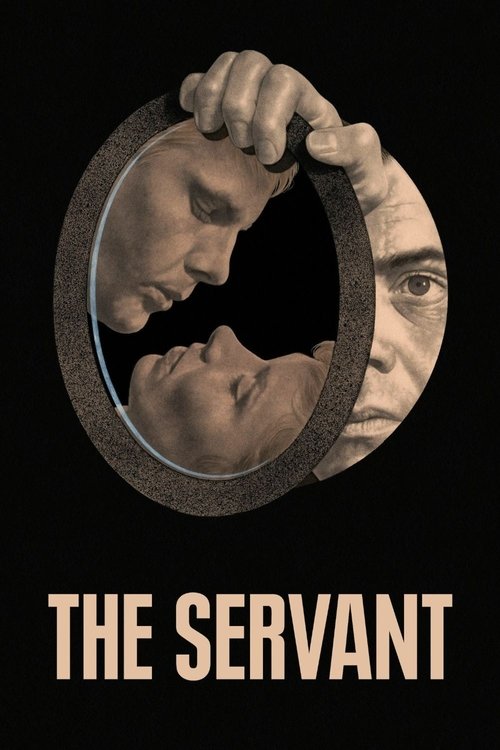
The Servant
1963 · Joseph Losey
For when you want something wicked and adult — a slow-burn power game to watch with full attention, ideally with someone to argue about it with afterward. Challenge, not comfort.
What it's about
Tony, a lazy young London aristocrat, hires the impeccably competent Barrett as his live-in manservant, and at first the arrangement suits them both. Then Barrett suggests his sister move in as a maid, and the careful order of the Chelsea townhouse begins to tilt — a slow campaign of manipulation in which it becomes harder and harder to say who serves whom.
The experience
Coolly gripping and increasingly claustrophobic — a battle of wills fought through good manners, where every polite exchange carries a blade. It curdles from drawing-room comedy into something genuinely unnerving.
Performances
Dirk Bogarde is mesmerizing as Barrett, insinuating and unreadable, deference and menace in the same breath — one of the great screen performances of British cinema.
The craft
Harold Pinter's screenplay weaponizes small talk, saying everything by saying almost nothing, while Joseph Losey turns a single townhouse into a trap — mirrors, staircases, and shifting camera positions charting exactly who holds power in each scene. The chilly black-and-white photography and late-night jazz score give it a seductive rot.
Why it matters
A landmark of 1960s British cinema and the opening statement of the celebrated Losey–Pinter partnership, it set the standard for films that dissect the English class system from inside a single house.
Snapshot
The Servant is a chamber drama of class inversion in which a manservant patiently dismantles the master who hired him. Adapted by Harold Pinter from Robin Maugham's 1948 novella, directed by the American exile Joseph Losey, and anchored by Dirk Bogarde's performance as the insinuating valet Hugo Barrett, the film converts a single Chelsea townhouse into an arena of psychological siege. Its surface is the brittle good manners of early-1960s upper-class England; beneath that surface runs a study of power, dependency, sexual humiliation and the rot Losey diagnosed at the heart of the British establishment. Shot in cold black-and-white by Douglas Slocombe and scored with John Dankworth's nocturnal jazz, the film is now regarded as one of the key British films of its decade and as the opening statement of the Losey–Pinter partnership that would continue through Accident (1967) and The Go-Between (1971).
Industry & production
The Servant was an independent British production made outside the major studio system, produced by Losey with Norman Priggen through the company Springbok Films, and released in 1963 (it screened at the Venice Film Festival that year). Its financing was modest and its making depended heavily on Dirk Bogarde, then one of Britain's most bankable stars, who championed the long-gestating project and accepted deferred or reduced terms to get it made; this commitment was decisive in moving the picture from years of development into production. The exact budget and box-office returns are not reliably documented in the public record, and I will not invent figures; what is clear is that the film was conceived and executed as a comparatively low-cost, single-principal-location production, with most of the drama confined to one house.
The property had a tangled history. Robin Maugham's novella had circulated as a potential film for years, and Pinter's screenplay had been written some time before the cameras finally rolled, with other directors previously attached at various points. Losey, blacklisted in Hollywood, had rebuilt a career in Britain through the 1950s, sometimes under pseudonyms, and The Servant arrived as the film that consolidated his critical standing there. The picture was a critical success and a defining credit for nearly everyone involved: it announced James Fox as a leading man, confirmed Bogarde's reinvention from matinee idol into a serious dramatic actor, and cemented the Losey–Pinter axis as a recognizable brand in European art cinema.
Technology
Technologically the film is conservative in apparatus and radical in deployment. It was shot on 35mm black-and-white stock at the Academy ratio, with synchronized sound recorded in the conventional manner of British studio practice. There is no novel hardware to report; the film's distinction lies entirely in how standard tools were used. Most significant is the choice of black-and-white in a period when color was increasingly the prestige norm — a decision that reads as deliberately austere and that serves the film's interest in tonal gradation, shadow and reflective surfaces. The other consequential choice is lens selection: Slocombe and Losey favoured wide-angle optics that deepen the apparent space of the house and subtly distort figures and rooms, lending the confined sets an unstable, expanding geometry. Where the record on specific lenses or stocks is thin, I won't manufacture detail; the point is conceptual rather than technical novelty.
Technique
Cinematography
Douglas Slocombe's photography is the film's most celebrated craft element, and it won him the BAFTA for black-and-white cinematography. The visual scheme is built on deep focus, low and oblique angles, and an obsessive use of reflective and divisive surfaces. A convex mirror in the hall recurs as a motif, warping the room and the people in it into a single distorted field; staircases, banisters, doorframes and windows repeatedly slice the frame into compartments that fix characters in zones of dominance and subordination. As Barrett's power grows, the camera increasingly finds Tony enclosed, reflected, or pinned at the bottom of compositions while the servant commands the heights of the staircase. Slocombe modulates from the crisp, well-lit order of the early scenes to a murkier, more shadowed palette as the household decays, so that lighting itself charts the moral descent.
Editing
The cutting, by Reginald Mills (a frequent Losey collaborator), is patient and architectural rather than kinetic. Scenes are allowed to run on sustained takes that let power shift within a single composition, so that the editing's job is often to withhold the cut and force the viewer to sit inside an uncomfortable duration. The film's late passages, as the house dissolves into a fevered, almost hallucinatory disorder, loosen this control deliberately, the rhythm fragmenting in step with the collapse of social form. The discipline of the earlier reels makes that final unmooring legible as decline.
Mise-en-scène / staging
The single townhouse is the film's true subject as much as any character. Losey stages the drama as a slow colonization of domestic space: rooms are redecorated, territories are claimed, and the staircase becomes the literal and symbolic axis of authority — to be above on the stairs is to command, to be below is to serve, and the film tracks the steady reversal of who stands where. Props carry weight (the bell that summons the servant, the kitchen as Barrett's true seat of power, the dinner table as a stage for ritualized control). The blocking is choreographic, with characters circling one another through doorways and around furniture in patterns that map the shifting balance of dominance. Few British films of the era make architecture work this hard as dramaturgy.
Sound
John Dankworth's jazz score gives the film a cool, insinuating modernity that cuts against the period-drawing-room setting. The recurring song "All Gone," sung by Cleo Laine to Dankworth's music, threads a melancholy, decadent refrain through the picture and underscores its mood of dissolution. Beyond the score, Losey exploits the acoustics of the house — footsteps on the stairs, the bell, the amplified intimacies and silences of a near-empty home — so that sound design participates in the atmosphere of surveillance and entrapment.
Performance
Dirk Bogarde's Barrett is one of the great performances of British cinema, a study in controlled servility that lets contempt, calculation and desire flicker beneath an immaculate professional mask; the role won him the BAFTA for Best British Actor and remade his screen identity. James Fox, as the weak, idle aristocrat Tony, plays the harder and less showy part — passivity, suggestibility and dissolution — and won the BAFTA's Most Promising Newcomer award. Sarah Miles as Vera, the supposed sister installed as maid and used as bait, brings an earthy sexual provocation that detonates the household's pretenses, while Wendy Craig as Tony's fiancée Susan embodies the class propriety the film is dismantling. The four-hander is calibrated so that authority visibly migrates from Fox to Bogarde over the course of the picture.
Narrative & dramatic mode
The narrative is a slow-build psychological drama structured as a campaign rather than a plot of incident. Tony, an indolent young gentleman, hires the competent Barrett to run his new house; Barrett makes himself indispensable, then introduces Vera as a maid, ostensibly his sister, in fact his lover and an instrument of seduction. Once Tony is compromised and his engagement to Susan strained, the relationship between master and servant curdles, breaks, and reforms on inverted terms, ending in a near-total reversal in which the aristocrat is reduced to dependency within his own home. Pinter's dramaturgy favours menace conveyed through banal surfaces — the loaded pause, the social courtesy that conceals aggression, the gap between what is said and what is meant. The mode is allegorical without ever abandoning the texture of behavioral realism; the film invites a reading of class war and moral corruption while remaining grounded in the specific, watchable cruelty between two men.
Genre & cycle
The film sits at the intersection of the psychological drama and the British social-realist moment, yet it deliberately stands apart from the kitchen-sink cycle then dominant. Where the British New Wave of the late 1950s and early 1960s trained its lens on working-class life in the industrial north, The Servant turns the same critical, class-conscious gaze upward, onto the decadent metropolitan upper class — a counter-current within the same broad impulse to interrogate the English class system. It belongs equally to a more European art-cinema lineage of chamber dramas about power and humiliation, and it can be read as a forerunner of a strain of British film concerned with class as psychosexual pathology rather than economic condition.
Authorship & method
The film is a director's work and a writer's work in roughly equal measure. Joseph Losey brought a Brechtian sensibility, a taste for spatial allegory, and the perspective of an outsider — an American Marxist exiled by the Hollywood blacklist — who could see the codes of English class society with an anthropologist's detachment. His method here is to let meaning accrete through staging and décor, trusting composition to carry the politics. Harold Pinter, in the first of his three screenplays for Losey, supplied a script of elliptical menace that translated Maugham's novella into his own idiom of veiled aggression and social unease; the collaboration was so productive that it defined a phase of both careers. Douglas Slocombe (cinematographer) furnished the mirror-and-staircase visual grammar; Reginald Mills (editor) gave the film its patient architecture; John Dankworth (composer), with vocalist Cleo Laine, supplied its cool jazz melancholy. Dirk Bogarde functions almost as a fourth author, both as the performance at the film's center and as the star whose advocacy enabled its production.
Movement / national cinema
The Servant is a landmark of British cinema of the early 1960s, contemporaneous with the New Wave but tilted toward art-house modernism rather than documentary realism. It is also, paradoxically, a work of émigré cinema: its most penetrating insights into Englishness come from an American director shaped by Continental and Brechtian influences. The film thus belongs to two national stories at once — a high point of British filmmaking and an artifact of the Cold War cultural diaspora that the Hollywood blacklist scattered across Europe. Within Britain it helped open space for a more stylized, psychologically charged art cinema alongside the prevailing social realism.
Era / period
The film is saturated with the specific atmosphere of England on the cusp of the mid-1960s — a society whose rigid class hierarchies were beginning to be questioned, satirized and, in some accounts, to erode. Released in 1963, the same cultural moment that produced the satire boom and the Profumo scandal's exposure of establishment hypocrisy, The Servant reads as a barometer of a ruling order losing confidence in its own authority. Its portrait of a useless young gentleman undone by the servant who actually runs his life resonates with a period anxiety about who, in fact, held power as deference began to crack.
Themes
The governing theme is the instability of power and the reversibility of the master–servant relation: dependency, the film argues, is a form of control, and the one who serves can come to rule. Around this core cluster several others — class and its corruptions, with the aristocracy depicted as decadent, idle and ripe for collapse; sexuality as a weapon, Vera's body deployed to compromise and subjugate; and a strong current of homoeroticism in the charged, possessive intimacy between Barrett and Tony, never made fully explicit but unmistakable in its tension. Surveillance, entrapment and the house-as-prison run throughout, as does a Pinteresque concern with the violence concealed beneath good manners. The film can be read as a political allegory of class war, a moral fable of corruption, or a psychosexual two-hander — and its richness lies in sustaining all three at once.
Reception, canon & influence
The Servant was a critical success on release and swept the principal British honors of its year: at the BAFTA Awards it won Best British Actor for Bogarde, Best British Cinematography (black-and-white) for Slocombe, and Most Promising Newcomer for James Fox, and it figured among the year's most acclaimed British films. It established Losey, after years of blacklisted obscurity, as a major figure in European art cinema and confirmed Bogarde's transformation into a serious actor.
The influences on the film run backward to Robin Maugham's 1948 source novella; to Pinter's theatrical idiom of menace, then newly ascendant on the British stage; and to Losey's own grounding in Brecht and in a European tradition of allegorical, politically charged cinema. The blacklist experience that drove Losey to Britain is itself a shaping force, lending the film its outsider's clarity about class.
Looking forward, the film's legacy is substantial. It anchored the Losey–Pinter collaboration that produced Accident and The Go-Between, two further essays on English class and repression. Its visual rhetoric of mirrors, staircases and divided frames, and its treatment of class as psychosexual entrapment, fed a durable strain of British and international art cinema concerned with servitude, power and domestic claustrophobia; later filmmakers working on master–servant dynamics and the perversities of the English country house and townhouse owe something to its template. Bogarde's Barrett, in particular, remains a touchstone for performances of menacing servility. The film endures as a fixture of the British canon and a frequent reference point in critical writing on class, Pinter, and Losey alike.
A Deleuzian reading
There's a convex mirror in the hall of Tony's house, and Losey keeps coming back to it.
The full Deleuzian reading of The Servant →
Reception
A hit with British critics from the start — it swept the 1964 BAFTAs conversation and made blacklist exile Joseph Losey's name in Britain — and its stock has only risen since, with restorations and re-releases cementing it as the definitive British class-warfare film.
How The Servant was received, from release to now →
Influences: the films it descends from and the films it influenced
- La Règle du jeu (1939) — Renoir's deep-focus choreography of masters and servants moving through the strata of a single great house — class observed with anthropological detachment via staging rather than dialogue — is the template Losey adapts to the townhouse.
- Citizen Kane (1941) — Slocombe's deep-focus, wide-angle distortion and low-angle compositions that let foreground and background contest the frame descend directly from Gregg Toland's lensing for Welles.
- The Magnificent Ambersons (1942) — Welles makes the grand staircase the stage on which a household's power shifts are played out, and turns decaying domestic architecture into a register of social decline — exactly Losey's staircase-axis grammar.
- Sunset Boulevard (1950) — The servant Max, who quietly governs the master inside a decayed mansion, is the prototype for Barrett's inversion of the master–servant hierarchy through indispensability.
- The Prowler (1951) — Losey's own earlier study of a covetous interloper who insinuates himself into a household and usurps it — class envy as predation — rehearses the usurper-from-below dynamic of Barrett.
- Eva (1962) — The immediately preceding Losey film, with its cool jazz-scored melancholy and a destroyer who dismantles a man through psychosexual domination, sets the tonal and musical idiom Dankworth and Laine extend in The Servant.
- The Fallen Idol (1948) — The townhouse staircase and its mirror made the principal dramatic instrument of a master–servant inversion, with Slocombe's wide-angle depth staging keeping the balustrade between camera and subject exactly as Reed's does.
- Cul-de-sac (1966) — Polanski plays the same single-location power games with Pinteresque menace, an intruder progressively inverting the authority of his hosts inside a sealed domestic space.
- Accident (1967) — The second Losey–Pinter screenplay extends the elliptical idiom of veiled aggression and class repression, with sustained takes and charged decor carrying meaning the dialogue withholds.
- The Go-Between (1971) — The third Losey–Pinter collaboration completes the trilogy on English class and repression, again using a servant/outsider figure and the architecture of the great house as the field of power.
- Performance (1970) — Roeg and Cammell stage a reversal of dominant and servile identities inside a single London house, saturated with mirrors and fractured reflections that literalize the merging Losey suggests.
- The Night Porter (1974) — Cavani recruits Bogarde to reprise his register of menacing servility, building a whole film on the sexualized inversion of master and subordinate that his Barrett pioneered.
- The Remains of the Day (1993) — Ivory's study of a butler's self-erasing performance of servitude within the English house develops Bogarde's touchstone of repressed, controlled servility into a feature-length character.
- Gosford Park (2001) — Altman choreographs the upstairs/downstairs spatial divisions of the English country house — the servant's-eye view of class — as explicit architecture, the same deployment of domestic space as social map.
- The Handmaiden (2016) — Park stages a servant infiltrating and inverting power over her mistress, using mirrors and reflective surfaces and an erotic charge to dissolve the hierarchy — Losey's mirror-and-class grammar transposed.
- Parasite (2019) — Bong builds class inversion on a literal staircase-axis architecture and on infiltrators who make themselves indispensable to a household before usurping it — the Barrett strategy as structural blueprint.
- Saltburn (2023) — Fennell fuses homoerotic class envy with an outsider who insinuates himself into an English great house and supplants its heir — the psychosexual servitude-and-usurpation template in contemporary dress.
- Pillion (2025) — Stages dominance and submission as choreographed power-inversion within charged domestic interiors, the blocking grammar underlying Pillion's leather/suburban-chintz mise-en-scène.
- The Swimming Pool (1969) — Losey encodes class and sexual rivalry entirely through the spatial choreography of a single domestic space — who occupies which room, how bodies approach and retreat through architecture — and Deray transplants this grammar of proximity-as-threat directly from the London townhouse to the Riviera villa.
- Persona (1966) — Bergman's two-hander of identities dissolving into one another, built on mirror motifs and the merging of servile and dominant roles, parallels the psychological fusion of Tony and Barrett.
- Teorema (1968) — Pasolini sends an enigmatic outsider into a bourgeois household to dismantle it through sexual magnetism — class and homoeroticism deployed as solvent, the same allegorical mechanism Losey uses.
- This Sporting Life (1963) — Losey's contemporaneous British monochrome uses deep-focus staging and spatial blocking within domestic interiors to externalize psychological power dynamics — the same technique Anderson employs to show Machin's alienation from the middle-class spaces he has purchased entry to.
- The Exterminating Angel (1962) — Class inversion within a confined domestic space where behavioral codes erode and social roles reverse — Exterminating Angel's surrealist conceit recast in naturalist terms, with the same impartial observation of bourgeois ritual collapsing.
- The Bitter Tears of Petra von Kant (1972) — A single-house chamber drama of sadomasochistic master/servant inversion (Pinter's script), staging power as a slow domestic reversal exactly as Petra and her silent assistant Marlene do.
- Diary of a Chambermaid (1964) — Contemporaneous master/servant power inversion charged with eros and class resentment, the household's hierarchy quietly corroded from below.
- Lolita (1962) — Contemporaneous Pinter-scripted chamber piece of erotic psychological manipulation and role-reversal in expressive monochrome—the same year's British exercise in obsession-as-power-game that mirrors Quilty's gamesmanship with Humbert.
Similar films
- Theorem (1968) — influence & lineage · same viewing thread · often watched together
- The Remains of the Day (1993) — influence & lineage
- The Go-Between (1971) — influence & lineage
- The Handmaiden (2016) — influence & lineage
- The Rules of the Game (1939) — influence & lineage
- Gosford Park (2001) — influence & lineage
- Saltburn (2023) — influence & lineage
- Parasite (2019) — influence & lineage
All the films related to The Servant →
Watch it with: curated runs of related films
- Buñuel and the Bourgeoisie — A run of surrealist provocations where every dinner, prayer, and marriage bed hides an appetite polite society can't admit — watch them together for the way Buñuel (and Pasolini's Theorem) keep pulling the tablecloth out from under the well-heeled.