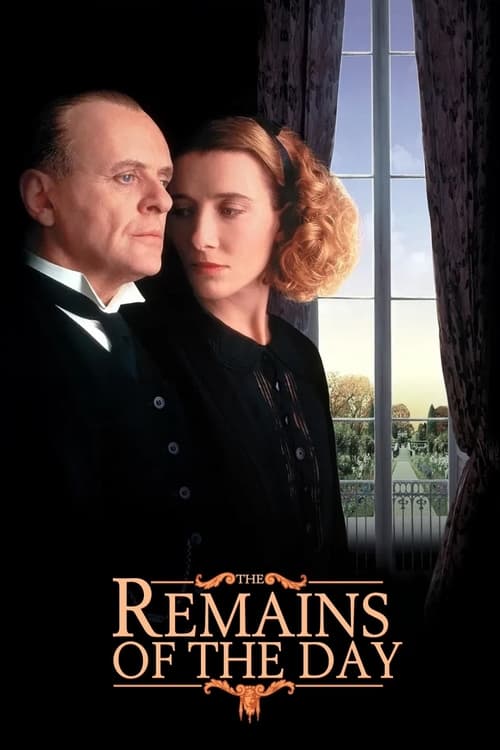
The Remains of the Day
1993 · James Ivory
For when you want a grown-up heartbreaker — a film about regret to watch when you're in the mood to feel something deep and don't need it loud. Bring patience; it repays every minute.
What it's about
Stevens, the impeccable head butler of a great English country house, has built his entire life around service, dignity, and never letting feeling show. Between the wars, two things test that armor: Miss Kenton, the spirited housekeeper who comes to care for him, and his master Lord Darlington's deepening entanglement with Nazi sympathizers. Years later, a road trip through 1950s England forces Stevens to look back at what his loyalty cost him.
The experience
Quiet, exquisitely restrained, and ultimately shattering — the drama lives in pauses, glances, and everything two people can't bring themselves to say. It builds a slow ache that stays with you for days.
Performances
Anthony Hopkins gives one of the great screen performances of repression, letting entire emotional collapses register in a flicker behind the eyes, and Emma Thompson matches him beat for beat as the woman trying to reach him.
The craft
James Ivory solves an 'unfilmable' first-person novel by trusting faces, framing, and silence to carry what Ishiguro's prose confided — the camera watches Stevens not-say things and makes it riveting. The country-house world is rendered with immaculate period detail, all below-stairs choreography and hushed corridors.
Why it matters
The crown jewel of the Merchant Ivory partnership at its peak, an eight-time Oscar nominee that became the benchmark for literary adaptation done through performance rather than narration.
Snapshot
The Remains of the Day is the Merchant Ivory partnership at the peak of its prestige and its craft: an adaptation of Kazuo Ishiguro's 1989 Booker Prize–winning novel, made the year after the team's Howards End (1992) had won three Academy Awards. It is a film about a man who cannot say what he feels, and it solves the central problem of adapting a first-person interior novel — Stevens narrates his own evasions — by trusting performance, framing, and withholding to do the work that prose did on the page. Anthony Hopkins plays Stevens, the head butler of Darlington Hall, whose devotion to "dignity" and service becomes a lifelong alibi for emotional and moral abdication; Emma Thompson plays Miss Kenton, the housekeeper whose feeling for him goes unanswered. Around their thwarted intimacy runs a political tragedy: their employer, Lord Darlington (James Fox), is an English aristocrat drawn into appeasement and sympathy for Nazi Germany in the 1930s. The film holds the private and public failures in a single frame — a love unspoken and a country sleepwalking — and refuses to let either resolve. It is restrained to the point of austerity, and its restraint is its subject.
Industry & production
The project reached Merchant Ivory by an unusually circuitous route. Film rights to Ishiguro's novel were initially developed by Mike Nichols and the executive John Calley, and the playwright Harold Pinter was engaged to write a screenplay. When the production passed to Merchant Ivory Productions, Ruth Prawer Jhabvala — Ivory's longtime screenwriter — wrote the shooting script, and Pinter, per the terms common to his contracts, had his name removed from the credits. Nichols and Calley remained on board as producers alongside Ismail Merchant, an arrangement that gave the modestly budgeted, art-house-pedigreed company unusual studio backing. Columbia Pictures distributed.
The timing was decisive. Howards End had just established Merchant Ivory as a commercially viable purveyor of high-end literary adaptation, and the same creative nucleus — Ivory directing, Merchant producing, Jhabvala adapting — reassembled with much of the Howards End cast and crew, including Anthony Hopkins and Emma Thompson, who had played opposite each other in the earlier film. That continuity is part of why the production feels so assured: it is a company executing a house style it had refined over three decades.
Production used a composite of English country houses to build the fictional Darlington Hall, drawing on properties including Dyrham Park, Powderham Castle, Corsham Court, and Badminton House. The strategy is itself meaningful: Darlington Hall is an idea of England assembled from real estates, just as the film is about an idea of service and nationhood that does not survive contact with history. The film was released in the United States in November 1993 and went on to receive eight Academy Award nominations — Picture, Director, Actor (Hopkins), Actress (Thompson), Adapted Screenplay, Art Direction, Costume Design, and Original Score — winning none, in a season dominated by Schindler's List. I do not have reliable box-office figures to cite and will not invent them; contemporaneous reporting treated it as a strong performer for a film of its kind without the breakout numbers of a wide commercial release.
Technology
Technologically the film is conservative by design — shot photochemically on 35mm with naturalistic lighting and anamorphic-era classical coverage rather than any innovation of apparatus. The relevant "technology" is the country-house infrastructure the camera documents: the below-stairs machinery of bells, dumbwaiters, silver-polishing, and the household's hydraulic social order. The production's investment went into period verisimilitude — interiors, decorative arts, livery, motorcars — rather than into optical or post-production novelty. This is a film whose technical ambition is concealment: it wants its means to be invisible so that the surfaces of the 1930s appear simply, unanswerably present.
Technique
Cinematography
Tony Pierce-Roberts, who had shot A Room with a View and Howards End, photographs The Remains of the Day with a controlled, low-key naturalism that resists the picturesque even as it renders beautiful rooms. Light tends to come from windows and lamps, leaving the corridors and service areas in warm gloom; the great house is grand but also dim, enclosing, a place of long passages and closed doors. The framing is patient and frequently architectural, using doorways, thresholds, and the geometry of rooms to box characters in or hold them apart. The recurring visual figure is the barrier — a doorframe between Stevens and Miss Kenton, a closed door she stands behind, the glass of a conservatory or a car window — so that the camera states physically what the characters will not say. The film's most famous beats are built on this proximity-without-contact: Miss Kenton trying to pry a sentimental book from Stevens's hands, the two of them inches apart and immovable.
Editing
Andrew Marcus's editing manages a double time scheme: a 1950s frame, with Stevens motoring across the West Country to see the former Miss Kenton (now Mrs. Benn), wraps an extended return to the 1920s and 1930s of the house in its political and emotional prime. The cutting is unhurried, favoring duration over momentum, letting scenes breathe to the rhythm of decorum. Transitions between the two periods are smooth rather than jolting, so that memory seems to seep into the present, which is precisely Stevens's condition — a man living among the residues, the "remains," of a past he cannot reread honestly. The pacing has been called slow; it is more accurately deliberate, an editorial argument that suppression has its own tempo.
Mise-en-scène / staging
Luciana Arrighi's production design and the costume work of Jenny Beavan and John Bright are central to the film's meaning, not merely its look. Darlington Hall is dressed as a self-sufficient world with its own strict topography — the front-of-house of statesmen and the back-of-house of servants — and the staging continually marks the line between them. Stevens is most often shown in motion through the house on errands of service, the body kept busy so the self stays unexamined. Blocking does the emotional bookkeeping: characters are arranged at formal distances, on opposite sides of tables, separated by furniture and rank. Costume functions as carapace — Stevens's livery is the uniform of a self he has surrendered to a role — and the few moments his dress or posture relaxes register as near-nakedness.
Sound
Richard Robbins, Merchant Ivory's resident composer, supplies a score of restrained, elegiac strings and piano that underscores loss without melodrama; it tends to enter at the edges of scenes rather than swelling over them, in keeping with the film's discipline. Equally important is the film's use of quiet — the ticking, footstep, and clink of a working house, the silences in which conversations stall. Dialogue is delivered in lowered, courteous registers; the drama frequently lives in what a voice will not raise itself to say. Robbins's score received one of the film's eight Oscar nominations.
Performance
The film is a monument to acting under constraint. Anthony Hopkins gives one of his defining performances precisely by giving almost nothing away: Stevens is a study in micro-expression and held composure, the feeling legible only in a tightened jaw, a swallowed sentence, a hand that does not reach out. The performance's great achievement is to make repression visibly costly. Emma Thompson's Miss Kenton supplies the warmth and the wit that Stevens cannot, and the unrequited charge between them is the film's engine. James Fox plays Lord Darlington as a decent, vain man whose breeding leaves him fatally unequipped to recognize evil — not a villain but a dupe, which is more damning. The supporting cast is deep: Peter Vaughan as Stevens's aged father, himself a butler, dying in service; Christopher Reeve as the American Lewis, the plain-speaking outsider; Hugh Grant as Darlington's godson; Michael Lonsdale, Tim Pigott-Smith, and a young Lena Headey and Ben Chaplin among the household and guests.
Narrative & dramatic mode
The dramatic mode is tragic irony sustained at low temperature. The novel's unreliable first-person narration — Stevens telling us a story whose meaning he keeps misreading — becomes, in film, a structure of dramatic irony in which the audience understands more than the protagonist permits himself to know. The framing journey is a quest that the hero does not realize is too late; the flashbacks are the evidence he cannot bring himself to weigh. There is no catharsis, no confrontation that clears the air. The climactic meeting between Stevens and Mrs. Benn delivers the recognition without the reversal: she names what might have been, he registers it, and the order of his life closes back over the wound. The film's power comes from withholding the scene every romance and every political reckoning trains us to expect.
Genre & cycle
The film sits at the intersection of the literary period drama, the thwarted-romance melodrama, and the political-historical film, and it belongs to the specific cycle of late-1980s and early-1990s prestige British heritage cinema — adaptations of canonical or acclaimed novels, lavishly mounted, exported as a vision of Englishness. Within the Merchant Ivory filmography it is the companion piece to A Room with a View (1985) and Howards End, sharing personnel and an interest in English social codes. But The Remains of the Day is also a critique from inside the cycle: where "heritage film" was sometimes charged with nostalgically fetishizing the country house and its hierarchies, this film makes that very nostalgia — Stevens's reverence for a vanished order — the object of its tragic scrutiny.
Authorship & method
The dossier's central authorial question is collaborative authorship. Merchant Ivory was a genuine triumvirate: James Ivory's unobtrusive, actor-trusting direction; Ismail Merchant's producing, which conjured high production values from limited means; and Ruth Prawer Jhabvala's screenwriting, which here performs the delicate surgery of externalizing an interior novel — converting Stevens's self-deceiving narration into scenes, glances, and structural irony without bolting on voiceover to explain him. Pierce-Roberts's camera, Robbins's score, Arrighi's design, Beavan and Bright's costumes, and Marcus's editing are not decoration but the means by which subtext is made visible in a film whose text is studiously evasive. Ishiguro is the originating author whose theme — service as both virtue and self-erasure, dignity as a mask for moral surrender — the film honors with notable fidelity. The method throughout is subtraction: the artistry lies in what each department declines to do.
Movement / national cinema
The film is a flagship of British heritage cinema, even as its principal authors were cosmopolitan outsiders — Ivory an American, Merchant Indian, Jhabvala German-born and of Polish-Jewish descent, Ishiguro Japanese-born and British-raised. That outsider vantage matters: the film's England is observed rather than simply inhabited, which sharpens its critique of class deference and national self-image. It belongs to a moment when British literary adaptation became a reliable transatlantic export and a recurring presence at the Academy Awards, and it both exemplifies and interrogates that tradition's romance with the great house.
Era / period
The film operates across two historical registers. Its dramatic past is the interwar period — the 1920s and especially the 1930s of appeasement, when sympathetic English elites pursued accommodation with Nazi Germany; an unofficial conference at Darlington Hall dramatizes this milieu, with Darlington as the well-meaning amateur diplomat manipulated by it. Its frame is the mid-1950s, after Darlington's posthumous disgrace and the sale of the house to an American, with the Suez era's twilight of British imperial confidence hanging over Stevens's journey. The film was made in the early 1990s, and its diagnosis of how decent people accommodate themselves to indecent power has an unmistakable resonance beyond its period setting.
Themes
The governing theme is the cost of self-suppression in the name of duty: Stevens's "dignity" is a discipline that hollows him, and the film asks whether a life of perfect service is a life at all. Bound to this is the politics of deference — the way a servant's refusal to think above his station shades into complicity, dramatized in the episode of the dismissal of Jewish maids, which Stevens carries out on Darlington's order and only later, dimly, regrets. Other strands: the unlived life and the irrecoverability of lost chances (the "remains" of the title); the relation between private repression and public catastrophe; the death of one social order and the arrival of another (American, democratic, plain-spoken) it cannot comprehend; and inheritance, embodied in Stevens succeeding his own father in a vocation of self-effacement. Above all the film studies the seductions of role — how a self can be wholly subsumed into a function, and how that surrender can feel like virtue.
Reception, canon & influence
Critically the film was received as a high accomplishment of its kind, singled out especially for the Hopkins–Thompson pairing and for the intelligence of Jhabvala's adaptation; its eight Oscar nominations registered the industry's esteem, even as it won none against Schindler's List in a formidable year. Its influences run backward to Ishiguro's novel — the indispensable source, whose unreliable narrator and themes the film transposes — and to the Merchant Ivory house style honed across A Room with a View and Howards End, as well as to the longer tradition of British literary cinema and the country-house drama. Its standing has risen with time: it is now widely regarded as among the finest Merchant Ivory films and one of Hopkins's and Thompson's signature works, and a recurring point of reference in debates over the heritage film's politics — whether such films indulge or interrogate nostalgia, with The Remains of the Day most often cited for the latter. Its forward influence is felt in the prestige adaptation generally and, more specifically, in screen treatments of the English servant class and the upstairs-downstairs world — a lineage that runs to later television such as Downton Abbey, though that genealogy is broad and the film is one node within it rather than a sole origin. As a model of how to film interiority through restraint rather than voiceover, it remains a touchstone for adapting first-person fiction. Where the precise lines of influence are diffuse, they should be named as such; what is not in doubt is the film's durable place in the canon of literary cinema.
A Deleuzian reading
Watch the scene where Miss Kenton tries to take the book from his hands.
The full Deleuzian reading of The Remains of the Day →
Reception
A prestige hit on arrival — eight Oscar nominations, zero wins in the year Schindler's List swept — it then spent years filed under 'stuffy heritage cinema' before a full reappraisal: it's now widely held up as Merchant Ivory's masterpiece and one of the great films about emotional repression.
How The Remains of the Day was received, from release to now →
Influences: the films it descends from and the films it influenced
- Howards End (1992) — The immediate Merchant Ivory precursor that perfected Jhabvala's method of externalizing a novel's interiority into staged glances and Pierce-Roberts's architectural framing of the country house as a moral diagram rather than scenery.
- A Room with a View (1985) — Where the house style was forged — Ivory's actor-trusting, unobtrusive direction paired with Jhabvala's surgical literary adaptation, the template of subtraction the seed inherits.
- The Servant (1963) — Maps master-servant power onto below-stairs topography and barrier-blocking — staircases, thresholds and doorframes choreographed so architecture enacts the inversion of class authority.
- The Go-Between (1971) — Harold Pinter's frame-flashback structure and the device of a class-subordinate observer carrying the unspeakable secrets of the gentry, withholding emotional resolution across time.
- Brief Encounter (1945) — The foundational British grammar of repression-under-constraint: love and grief conveyed entirely through performance held in check, restrained scoring and expressive silence rather than declaration.
- The Heiress (1949) — Externalizes emotional imprisonment through architectural framing — the staircase as instrument of confinement — in a fastidious adaptation of first-person literary interiority.
- The Rules of the Game (1939) — Establishes the upstairs/downstairs topography in which the servants' hall mirrors and comments on the masters' intrigues, the structural template for below-stairs drama.
- The Innocents (1961) — Low-key naturalist photography and a governess's repressed propriety inside an English country house, subtext made visible through what the camera and performance decline to state.
- Maurice (1987) — A Merchant Ivory companion in which desire is suppressed by English class codes and rank, conveyed through barrier-blocking and the silences of deference.
- The Leopard (1963) — Ivory extends The Leopard's literary-adaptation method for aristocratic decline: theatrical-tableau staging in authenticated period interiors, ambient sound privileged over underscore in emotionally critical sequences, and Hopkins' deliberately constrained stillness-as-interiority — a conscious extension of the Lancaster method of registering historical extinction through bodily stillness.
- Ikiru (1952) — Ishiguro's screenplay and Ivory's direction extend Ikiru's institutional-self-erasure argument: Stevens, a butler whose entire identity is the professional role he performs, is revealed retrospectively through fragmentary memory, with Hopkins's physical economy of repressed expression directly descending from Shimura's method of containment as emotional argument.
- The Dead (1987) — Builds the film on what a face declines to show, using doorframes and half-closed doors to occlude the instant of feeling — the doorframe-occlusion grammar of Gretta on the stairs.
- Sense and Sensibility (1995) — Emma Thompson again renders feeling dammed behind social decorum, the heritage-adaptation performance of repression-under-constraint extended into Austen.
- Gosford Park (2001) — Expands the below-stairs topography into a full architecture of service, the servants positioned as moral observers whose vantage indicts the country house above.
- Atonement (2007) — Inherits the frame-flashback structure with a withheld, unreliable resolution, plus architectural framing of English class and a love undone by deference and self-deception.
- Never Let Me Go (2010) — From Ishiguro again — deference-as-self-erasure rendered in expressive silence and restraint, adapting first-person fiction through suppressed performance rather than voiceover.
- Carol (2015) — Repression under social constraint staged through barrier-blocking and glance — longing communicated by what propriety forbids being said aloud.
- Phantom Thread (2017) — Couples repression-under-constraint with craft obsession, the household ordered by ritual and self-denial, emotional subtext carried by silence and a restrained, near-continuous score.
- Downton Abbey (2010) — Carries the upstairs-downstairs/below-stairs topography into long-form television, the servant class rendered with the same architectural separation of worlds the seed maps within one house.
- Far from the Madding Crowd (2015) — Tony Pierce-Roberts' interior/exterior contrast cinematography — high-key windows against shadow-heavy rooms — and the staging of all dramatic weight through physical restraint rather than dialogue are the direct heritage-mode antecedents for FFTMC's lighting philosophy and performance register.
- Darkest Hour (2017) — Ivory's amber-lit, compression-framed British institutional interiors — corridors, studies, drawing rooms as arenas of repression — established the visual and tonal grammar of British heritage prestige cinema that Wright's War Cabinet rooms directly inherit.
- Conclave (2024) — Hopkins's performance mode of interior stillness — institutional loyalty rationalized as virtue while suppressing moral judgment, repression performed as dignity — establishes the register Fiennes inhabits as Lawrence, within a comparably hierarchical architectural space where rank is encoded in who occupies which rooms.
- The Gathering Storm (2002) — Merchant-Ivory's use of the English country house as a near-character — rooms, grounds and household routine carrying emotional weight — directly informs Chartwell's staging as the film's 'third lead.'
- The Cider House Rules (1999) — The template for codified-rules-versus-lived-authority drama, rendering duty and restraint through understated ensemble performance — the formal mode the film's posted 'cider house rules' literalizes.
- The Age of Innocence (1993) — Released the same year, it films the interiority of forbidden love through period detail as constraint and withheld resolution — desire registered in micro-gesture, never consummated in plot.
- Mr. & Mrs. Bridge (1990) — The same triumvirate's study of emotional self-erasure, marital repression dramatized purely by subtraction — restrained performance and what each scene withholds.
- The Last Emperor (1987) — Ivory's Stevens is TLE's Pu Yi in an English country house: physical reticence encoding political complicity, a retrospective self-narration that only partly comprehends its own subject, and architecture — Darlington Hall's formal rooms — functioning as the ideological prison its occupant mistakes for vocation.
- Murder on the Orient Express (2017) — Merchant-Ivory's British heritage register — period-luxury production design and restrained ensemble interiority — supplies the prestige-adaptation grammar Branagh works within.
- Gods and Monsters (1998) — The Merchant-Ivory mode of restrained, performance-forward English chamber drama in which repressed desire is rendered through gesture and decorum within an enclosed household — the literate, dialogue-driven prestige register Condon works in, transposed to Whale's Pacific Palisades home.
- The Proposition (1998) — Merchant-Ivory restraint-under-pressure that achieves emotional clarity through suppression and meticulous period decorum.
- Shadowlands (1993) — Same-year Hopkins masterclass in withholding-restraint, where the entire drama is built from emotion conveyed through repression and the unspoken — the twin of his C. S. Lewis.
- The Bridges of Madison County (1995) — Emotion withheld beneath composed surfaces — contained interiority as the whole subject, love foreclosed by an ethic of duty rather than spoken.
Similar films
- Howards End (1992) — influence & lineage
- Maurice (1987) — influence & lineage
- The Age of Innocence (1993) — influence & lineage
- The Servant (1963) — influence & lineage
- Atonement (2007) — influence & lineage
- The Go-Between (1971) — influence & lineage
- Schindler's List (1993) — same viewing thread
- The Pianist (2002) — same viewing thread
All the films related to The Remains of the Day →
Watch it with: curated runs of related films
- In the Shadow of the Reich — A run of films about ordinary people inside the Nazi era — surviving it, resisting it, or trying to reckon with how it happened — that rhyme on conscience, complicity, and who chooses to act.