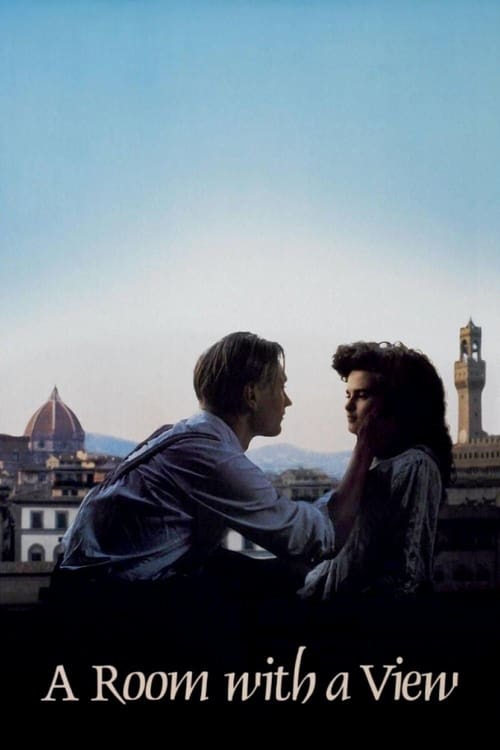
A Room with a View
1986 · James Ivory
For a cozy night in when you want to fall in love — romance, beautiful places, sharp social comedy, and not a single ugly frame. Pure comfort with a real brain.
What it's about
Lucy Honeychurch, a proper young Englishwoman touring Florence with a fretful spinster chaperone, is given a room without a view — until the unconventional Mr. Emerson and his brooding son George offer to swap. An impulsive kiss in a Tuscan field follows her home to Surrey, where she settles into an engagement with Cecil, a fastidious aesthete who treats her like an acquisition. The film watches her caught between the life that's expected of her and the one that briefly flared open in Italy.
The experience
Sun-warmed, witty, and gently swooning — a comedy of manners that pokes affectionate fun at Edwardian propriety while taking the ache of first passion completely seriously. It's paced like a leisurely holiday and leaves you glowing.
Performances
A young Helena Bonham Carter makes Lucy's confusion luminous, Daniel Day-Lewis is hilariously, precisely insufferable as Cecil, and Maggie Smith and Denholm Elliott steal scenes on opposite ends of the propriety spectrum.
The craft
Ruth Prawer Jhabvala's screenplay carries Forster's wit intact, and Merchant Ivory's production dresses it in ravishing Florentine vistas, English gardens, and period detail so lovingly rendered the film practically invented a genre's look. The photography of Tuscany alone justifies the biggest screen you can find.
Why it matters
The film that made Merchant Ivory a brand name and defined what critics came to call the British heritage film; it won three Oscars, including for its screenplay, and set the visual template for decades of literary adaptations.
Snapshot
A Room with a View is the film that turned Merchant Ivory Productions from a respected art-house concern into a brand name, and that crystallized what British critics would soon label the "heritage film." Adapted by Ruth Prawer Jhabvala from E. M. Forster's 1908 novel, directed by James Ivory and produced by Ismail Merchant, it follows Lucy Honeychurch (Helena Bonham Carter), a young Edwardian Englishwoman whose Florentine holiday — and an impulsive kiss from the déclassé George Emerson (Julian Sands) — disturbs the careful arrangement of her life, including her engagement to the chilly aesthete Cecil Vyse (Daniel Day-Lewis). Made on a modest budget, it became an unexpectedly large international success and won three Academy Awards (Adapted Screenplay, Art Direction, Costume Design) from eight nominations. More than any single Merchant Ivory title before it, the film defined a house style — literate, sunlit, performance-driven, scrupulous about period surface — and set the template for the team's subsequent Forster adaptations, Maurice (1987) and Howards End (1992).
Industry & production
The picture sits at the center of one of cinema's longest creative partnerships: the producer Ismail Merchant, the director James Ivory, and the screenwriter Ruth Prawer Jhabvala had been working together since The Householder (1963). By the mid-1980s their reputation rested on tasteful, undercapitalised literary films that earned prestige more reliably than profit. A Room with a View changed that calculus. It was financed substantially through Britain's Goldcrest Films and the National Film Finance Corporation, with the kind of patched-together budget — reported in the low millions of dollars — that Merchant was famous for stretching through charm, deferral, and improvisation. (Merchant's resourcefulness as a producer who could conjure aristocratic locations and full period dress on minimal money is among the best-documented features of the production, though precise budget and gross figures vary across sources and should be treated with caution.)
What is certain is that the film returned many times its cost and became one of the most commercially successful independent/art-house releases of its decade, particularly in the United States, where it ran for months in specialty cinemas. Its success demonstrated to distributors that a literate period adaptation could be a durable, even lucrative, theatrical proposition — a lesson that helped underwrite the British heritage-film cycle and, later, the Anglo-American prestige-adaptation economy of the 1990s (Miramax, Merchant Ivory's own Howards End and The Remains of the Day, and the wave of Austen films). The eight Oscar nominations, including Best Picture and Best Director, confirmed the team's arrival as awards-season fixtures.
Technology
Technically the film is conservative by design. It was shot on 35mm color stock with largely naturalistic means: available and augmented daylight in the Tuscan exteriors, practical and motivated lighting in interiors. There is no reliance on optical spectacle, and the film's "technology" is essentially the classical apparatus of location shooting plus carefully dressed sets. The production's real technical achievement is logistical rather than mechanical — securing and photographing actual Florentine locations (the Piazza della Signoria, the Santa Croce environs, the hills above the city) and English country settings, then matching them seamlessly with constructed or redressed interiors. The recorded score and the use of pre-existing operatic recordings (discussed below) represent the most deliberate technological choice: sound as an emotional amplifier laid over otherwise restrained image-making.
Technique
Cinematography
Tony Pierce-Roberts photographed the film, and his work earned one of the eight Oscar nominations. The visual scheme draws a pointed contrast between Italy and England. The Florentine passages are warm, golden, and slightly intoxicated — the famous barley-field sequence outside the city, where George kisses Lucy amid waist-high grain, is staged and lit as a near-pastoral swoon, the camera finding sun-saturated color and open space. The English scenes at Windy Corner are cooler, greener, more enclosed and ordered, their compositions hemmed by hedges, tennis nets, and drawing-room furniture. Pierce-Roberts favours a relatively still camera, classical framing, and compositions that read clearly in deep space, trusting architecture and landscape to carry meaning. The look is "painterly" in the sense the heritage genre would make notorious: the image is offered as something to be admired, and the period surface becomes part of the spectacle.
Editing
Humphrey Dixon edited the film. The cutting is measured and unobtrusive, built to let performance and dialogue breathe rather than to generate momentum through montage. Forster's novel is structured around social comedy and sudden ruptures, and the editing honors that rhythm — long enough to register manners and hesitation, sharp enough to land the comic reversals and the shocks (the murder Lucy witnesses in the piazza; the sudden kiss). Ivory's preference, here as elsewhere, is for scenes that play in sustained takes and clean reverse-angle conversation rather than aggressive coverage.
Mise-en-scène / staging
This is the film's signal strength and the basis of its two Oscars (Art Direction, won by Gianni Quaranta and Brian Ackland-Snow with set decoration by Brian Savegar and Elio Altramura; Costume Design, won by Jenny Beavan and John Bright). The Edwardian world is rendered with fastidious specificity — clothing, table settings, the pension's furnishings, the codes of who sits where and who may speak. Crucially, staging is dramatized rather than merely displayed: the comedy of constraint is built into blocking, as characters are hemmed by doorways, chaperones, and the choreography of propriety. The recurring motif of windows, doors, and views — Forster's central metaphor for the difference between seeing life and being shut out of it — is given concrete spatial form, from the swapped rooms in Florence to the framed English vistas. The film's most exuberant set-piece, the nude bathing scene at the "Sacred Lake" with George, Freddy (Rupert Graves), and Mr Beebe (Simon Callow), uses staging to puncture period decorum with sudden physical freedom.
Sound
The soundscape is dominated by music. The original score is by Richard Robbins, Merchant Ivory's regular composer, but the film's most memorable aural gesture is its use of Puccini — soprano arias, notably "O mio babbino caro" from Gianni Schicchi and "Chi il bel sogno di Doretta" from La Rondine, in recordings by Kiri Te Kanawa. The operatic voice functions as the expression of Lucy's suppressed inner life: what manners forbid her to say, the soprano sings. Beyond music, the sound design is naturalistic — birdsong and open air in Italy, the domestic hush of the English interiors — reinforcing the geographic and emotional contrast the cinematography establishes.
Performance
The film is an ensemble showcase and a launching pad. Helena Bonham Carter, then largely unknown, plays Lucy with a watchful stillness that the surrounding eccentrics throw into relief; the role typecast her for years as the "corseted English rose," a label she later worked hard to escape. Maggie Smith's Charlotte Bartlett — fluttering, self-abnegating, quietly manipulative — is a masterclass in comic precision and earned a Best Supporting Actress nomination. Denholm Elliott, as the warm, unfashionable freethinker Mr Emerson, was nominated for Best Supporting Actor and gives the film its moral center. Daniel Day-Lewis's Cecil Vyse is a brilliant comic-grotesque of priggish aestheticism — pince-nez, stiff spine, fatal incapacity for feeling — and the performance is routinely cited alongside his contemporaneous, utterly opposite turn in My Beautiful Laundrette (1985) as proof of his range. Judi Dench (the novelist Eleanor Lavish), Simon Callow, Rupert Graves, and Rosemary Leach round out a cast deep in British stage talent.
Narrative & dramatic mode
The dramatic mode is social comedy in the high English tradition, shading into romance and Bildungsroman. Forster's plot is a comedy of manners about the gap between convention and authenticity: Lucy must choose between Cecil (society, propriety, the closed room) and George (passion, honesty, the open view). Jhabvala's screenplay preserves Forster's structure, including his chapter-heading irony, by deploying intertitles drawn from the novel ("In Santa Croce with No Baedeker," "Lying to George," and so on), which lend the film a knowing, literary, faintly comic framing. The narration is largely classical and external — we watch manners and misreadings accumulate — but the music supplies the interiority that Edwardian reticence withholds. The witnessed murder in the piazza serves as the novel's hinge: an eruption of the real (violence, mortality, the body) into the tourist's curated experience, the moment that first binds Lucy and George.
Genre & cycle
A Room with a View is the foundational text of the 1980s British "heritage film," a cycle that critic Andrew Higson influentially analyzed and named. These are period adaptations of canonical English literature, characterized by lavish production design, prestige casting, painterly cinematography, and a tendency to present the national past as a beautiful, consumable surface. The cycle includes Merchant Ivory's own Maurice and Howards End, the later Austen adaptations of the mid-1990s, and television antecedents like Brideshead Revisited (1981). Within that cycle this film is the commercially decisive one — the proof of concept. It also belongs to the longer lineage of the literary-adaptation prestige picture and the comedy of manners on screen.
Authorship & method
Authorship here is genuinely collaborative and best understood as the Merchant Ivory–Jhabvala "trinity." James Ivory directs with restraint and trust in actors, favouring clarity over flourish; his method is to let well-cast performers play scrupulously researched scenes in beautifully realized spaces. Ruth Prawer Jhabvala — a novelist of distinction in her own right — is the structural intelligence of the adaptation, and her screenplay won the Academy Award; her great skill is compression that preserves authorial irony. Ismail Merchant, though credited as producer, is inseparable from the films' aesthetic: his ability to finance and physically mount these productions made the house style possible. Among the key craft collaborators, Tony Pierce-Roberts (cinematography), Richard Robbins (music), Humphrey Dixon (editing), and the design teams of Quaranta/Ackland-Snow and Beavan/Bright are essential authors of the film's texture. The result is a body of work where "directed by James Ivory" reliably signals a specific, recognizable sensibility produced by a stable team.
Movement / national cinema
The film is a landmark of 1980s British cinema, arriving in a decade when British film was culturally vital but commercially precarious. It represents one pole of that era's national cinema — the literate, export-oriented, heritage prestige picture — set implicitly against the other pole of socially engaged, contemporary, often abrasive work (the Channel 4–backed films, My Beautiful Laundrette, the cinema of Mike Leigh and Stephen Frears). That Daniel Day-Lewis bridged both in 1985–86 is the period's neatest emblem. Merchant Ivory's transnational character — an Indian producer, an American director, a European-and-Indian-experienced novelist-screenwriter, filming English literature on Italian and English locations for a largely Anglo-American audience — complicates any simple national label, but the films were received, and critiqued, as quintessentially "English."
Era / period
Set in the Edwardian moment (Forster's novel is from 1908), the film looks back from the Thatcherite 1980s to a pre-war England on the cusp of change. Much of the heritage-film debate turns on this double temporality: critics argued that such films offered Reagan-and-Thatcher-era audiences a consoling, depoliticised nostalgia — England as heritage property, the past as a National Trust garden. Defenders counter that Forster's source, and the film, are quietly critical of that very world, satirizing its snobbery, its sexual repression, and its class cruelty. The film's sympathies clearly lie with rupture and openness over preservation, which complicates the charge of mere nostalgia even as the gorgeous surfaces invite it.
Themes
The governing theme is the conflict between social convention and authentic feeling — the "room" (enclosure, propriety, the inherited self) versus the "view" (openness, desire, the chosen life). Around it cluster Forster's characteristic concerns: the English fear of passion and the body; class and its policing of intimacy; the contrast between Mediterranean spontaneity and English reserve; tourism and the difference between consuming a place and being changed by it. The film is also, gently, about female self-determination — Lucy's drama is the achievement of honesty about her own desire — and about the moral superiority of unfashionable sincerity (the Emersons) over cultivated taste (Cecil). Forster's humanist credo, "only connect," is unspoken here but everywhere implied.
Reception, canon & influence
Critical reception was strongly favourable, particularly in the United States, where the film found a large and loyal art-house audience and ran for an extended release. The eight Academy Award nominations and three wins certified its prestige, and it has remained a fixture of the Merchant Ivory canon and of period-cinema curricula. Looking backward, its influences are literary and theatrical above all — Forster's novel and the broader English comedy-of-manners tradition — refracted through Merchant Ivory's own prior decades of literary adaptation; the use of Puccini situates it in a tradition of opera-as-emotional-subtext.
Looking forward, its legacy is large and double-edged. Commercially, it proved the viability of the literate period adaptation and helped launch the 1990s prestige-adaptation boom, from the team's own Howards End and The Remains of the Day to the Austen cycle and the Miramax model of the awards-season literary film. Stylistically, it codified the heritage look — sunlit landscapes, immaculate costume, classical framing — that countless subsequent productions imitated or reacted against. Critically, it became the central exhibit in the "heritage cinema" debate that shaped British film studies for a generation, a debate about whether such films sell a conservative, museumised vision of the national past. And it launched or elevated careers — Bonham Carter, Sands, Graves, and the consolidation of Day-Lewis as a major screen actor. Few films of the 1980s have proved so generative of both an industry trend and an academic argument.
A Deleuzian reading
Two women arrive at a Florentine pension and find their rooms look onto a courtyard.
The full Deleuzian reading of A Room with a View →
Reception
A sleeper smash in 1986 — eight Oscar nominations, three wins, and the film that made 'Merchant Ivory' a household brand — it later got dismissed as tasteful 'heritage cinema' before a full rehabilitation: viewers now insist it's far funnier, hornier, and more subversive than its Laura Ashley reputation suggests.
How A Room with a View was received, from release to now →
Influences: the films it descends from and the films it influenced
- The Bostonians (1984) — The immediately prior Merchant-Ivory–Jhabvala literary adaptation that fixed the working method carried into Room: Jhabvala compressing a canonical novel while preserving its authorial irony, Ivory directing for performance in researched period interiors.
- Heat and Dust (1983) — Jhabvala adapting her own novel taught the team the dual-register narration and ironic distance that Room reproduces in its literary intertitles and its detached comedy-of-manners framing.
- A Passage to India (1984) — The other major 1980s Forster adaptation, modeling the use of a foreign landscape (India / Italy) as the destabilizing 'view' that loosens English repression — the same place-as-emotional-catalyst structure Room builds around Florence.
- Senso (1954) — Visconti's deployment of opera as the emotional subtext a repressed surface cannot voice anticipates Room's use of Puccini ('O mio babbino caro,' 'Chi il bel sogno') to carry feeling the characters suppress.
- The Leopard (1963) — The benchmark for painterly period mise-en-scène — composing scenes as Old Master tableaux in real historic interiors — that Pierce-Roberts and the design teams translate into Room's classical framing and immaculate Edwardian surface.
- Tom Jones (1963) — Richardson's adaptation of a comic English novel using chapter-card intertitles and an arch literary voice is the direct precedent for Room's caption cards ('In Santa Croce with No Baedeker') and its ironic novelistic structure.
- The Go-Between (1971) — Pinter and Losey's sunlit Edwardian country-house adaptation, organized around a watching outsider and class-bound desire, prefigures the heritage look and the window/view motif of observed yearning.
- The French Lieutenant's Woman (1981) — Takes the proof-of-concept: a senior British craft team applied to a canonical novel, shot in real period locations with source-motivated light, as the house style of the 1980s adaptation boom.
- Maurice (1987) — The team's very next Forster film, reusing the identical apparatus — Jhabvala-school compression, painterly framing, Cambridge/country-house period design — to push the convention-versus-feeling theme into forbidden desire.
- Howards End (1992) — The fullest extension of the same trinity method and Forster source, refining Room's restrained ensemble staging and class-coded domestic spaces into the canonical heritage-film template.
- The Remains of the Day (1993) — Carries forward Ivory's directing-for-restraint and Jhabvala's irony-preserving adaptation, applying Room's grammar of suppressed feeling and the unspoken to an English country house.
- Sense and Sensibility (1995) — A flagship of the 1990s prestige-adaptation boom Room enabled, inheriting the literate screenplay (Thompson), the heritage sunlit-landscape look, and the British-stage ensemble it codified.
- Pride & Prejudice (2005) — Reacts against the museumised heritage surface Room standardized — handheld camera and naturalist grime — while still depending on its window/view framing and comedy-of-manners adaptation grammar.
- Atonement (2007) — Extends Room's painterly English-house heritage cinematography and its motif of a fatefully observed scene glimpsed through windows, now weaponized as the engine of the plot.
- Shakespeare in Love (1998) — The apotheosis of the Miramax awards-season literary film that Room's American art-house success and Oscar haul made commercially viable.
- Call Me by Your Name (2017) — James Ivory's own Oscar-winning screenplay closes the lineage, transposing Room's Italian sun, window-and-view framing, and desire-against-restraint to a 1980s Lombardy villa.
- The Cider House Rules (1999) — Sets the Merchant-Ivory prestige-adaptation grammar — pastoral natural-light cinematography wedded to literary fidelity and ensemble decorum — that defines the genre Cider House operates within.
- The Merchant of Venice (2004) — The Merchant-Ivory heritage template — fidelity to a canonical literary text, meticulously tangible period design, and ensemble restraint over star spectacle — is the production-aesthetic Radford inherits wholesale.
- The Portrait of a Lady (1996) — The decorous Merchant-Ivory heritage grammar of sunlit literary good taste that Campion deliberately inverts; her coldness and refusal of consolation only legible against this house style.
- Shadowlands (1993) — Establishes the Merchant-Ivory heritage house style — literary source, painterly English light, tasteful period restraint, concealed craft — the mode Shadowlands operates squarely within.
- Enchanted April (1992) — Repeats Room's exact Italy-versus-England contrast — repressed Edwardian Englishwomen liberated by Mediterranean light and a 'room with a view' — as an explicit structural and tonal echo.
- Gosford Park (2001) — A deliberate counter-reading of the heritage country-house picture Room helped define — overlapping sound and below-stairs satire deployed against the conservative period-prestige surface.
- Manon of the Spring (1986) — The reigning international model of the tasteful literary adaptation — prestige mounting, landscape, period fidelity — that Berri consciously matched in scale and finish.
Similar films
- Howards End (1992) — influence & lineage
- The Remains of the Day (1993) — influence & lineage
- Maurice (1987) — influence & lineage
- Sense and Sensibility (1995) — influence & lineage
- Pride & Prejudice (2005) — influence & lineage
- Call Me by Your Name (2017) — influence & lineage
- Atonement (2007) — influence & lineage
- The Portrait of a Lady (1996) — shared sensibility