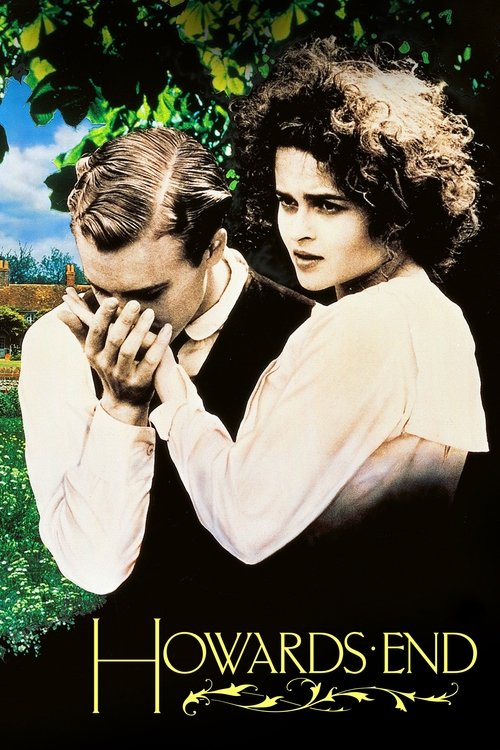
Howards End
1992 · James Ivory
When you want to sink into something sumptuous and literate on a long evening — tea-and-blanket viewing that still gives your brain and heart plenty to do.
What it's about
In Edwardian England, two idealistic, intellectual sisters — Margaret and Helen Schlegel — get entangled with the wealthy, ruthlessly practical Wilcox family and with Leonard Bast, a poor young clerk hungry for culture and a better life. At the center sits Howards End, a country house that comes to stand for the question of who England really belongs to. Friendships, a marriage, and a series of well-meaning interventions bind the three families together with consequences none of them can control.
The experience
Elegant and unhurried on the surface, but underneath it simmers with class anger, romantic tension, and moral stakes that keep tightening. It's the rare costume drama that feels alive — witty in one scene, quietly devastating in the next.
Performances
Emma Thompson won the Oscar for her warm, intelligent Margaret, and she's magnetic — reasonable and radical at once. Anthony Hopkins makes Henry Wilcox's emotional blindness fascinating rather than cartoonish, and Vanessa Redgrave is haunting in limited screen time.
The craft
This is Merchant Ivory at the summit of their powers: Ruth Prawer Jhabvala's adaptation compresses E. M. Forster's novel without losing its bite, and every interior, garden, and London street is composed like a painting. It's gorgeous on a big screen — the period detail isn't decoration, it's the argument.
Why it matters
It swept up nine Oscar nominations, made Emma Thompson a star, and became the film that defines the literary period drama — the standard every Forster and Austen adaptation since has been measured against.
Snapshot
Howards End is the crowning achievement of the Merchant Ivory partnership and the third of the company's adaptations of E. M. Forster, following A Room with a View (1985) and Maurice (1987). Drawn from Forster's 1910 novel, it dramatizes the collision of three social strata in Edwardian England — the cultured, half-German intellectualism of the Schlegel sisters; the moneyed, pragmatic commercialism of the Wilcoxes; and the precarious lower-middle-class aspiration of Leonard Bast — and asks whether England's future belongs to the poets or the businessmen. Forster's famous epigraph, "Only connect," supplies both the moral thesis and the narrative engine. Adapted by Ruth Prawer Jhabvala, photographed by Tony Pierce-Roberts, and anchored by Emma Thompson's Academy Award–winning performance as Margaret Schlegel, the film became the most commercially successful and critically decorated work in the trio's long career, and stands as a defining text in the debate over British "heritage cinema."
Industry & production
The film was produced by Ismail Merchant under the Merchant Ivory banner, the independent production company Merchant and director James Ivory had run since 1961. By 1992 the partnership had a distinctive working method: modest budgets, international financing, literary source material, and a stable repertory of craftspeople. Howards End was financed in part through Japanese investment (the Sumitomo Corporation and Imagica are commonly cited among its backers) together with Film Four International, reflecting the era's reliance on patchwork co-financing for prestige literary adaptation. By the standards of the company it was relatively well-funded, though still inexpensive against Hollywood norms.
Principal photography took place in England. The house standing in for Howards End itself was Peppard Cottage in Oxfordshire, chosen for its wisteria-clad domesticity rather than grandeur — a deliberate counter to the stately-home spectacle the film is sometimes accused of trading in. Production design was by Luciana Arrighi with set decoration by Ian Whittaker; costumes were by the long-serving team of Jenny Beavan and John Bright. The shoot drew on London locations and period interiors to register the social geography that the story depends upon — the contrast between the Schlegels' bohemian Wickham Place, the Wilcoxes' urban wealth, and Bast's cramped lodgings.
Commercially, the film was a substantial success for an art-house release, performing strongly in specialty distribution in the United States (through Sony Pictures Classics) and internationally, and it became one of Merchant Ivory's biggest earners. Exact box-office figures vary across sources, so they are best left uncited here; what is securely established is that the film outperformed expectations for a literary period piece and helped sustain the company's subsequent productions.
Technology
Howards End was shot photochemically on 35mm color stock and finished for conventional theatrical projection; it predates the digital intermediate and is in every technical respect a film of the analog era. The technological interest of the production lies less in any innovation than in the disciplined orthodoxy of its craft. The film uses available and motivated lighting schemes, naturalistic color timing, and a restrained camera package suited to period interiors. There is no recourse to optical spectacle or visual-effects work; the "effect" the film pursues is the persuasive reconstruction of 1910 through art direction, costume, and lighting rather than through any technological apparatus. In this sense the production exemplifies a craft tradition — the careful marshaling of design and photography to produce historical verisimilitude — that the heritage cycle inherited from earlier British costume drama and from the company's own house style.
Technique
Cinematography
Tony Pierce-Roberts, who had shot A Room with a View, gives Howards End a luminous but disciplined look built on soft natural light, deep interiors, and an attentiveness to the textures of Edwardian domestic life — glass, foliage, lamplight, fabric. The camera tends toward stillness and measured movement; compositions frequently frame characters through doorways, windows, and the lattice of the house, visually arguing that these people are defined by the spaces and the property they inhabit. Recurrent motifs — the wisteria and the great wych-elm at Howards End, the window onto a garden — are photographed to carry the novel's symbolic freight of rootedness and English continuity. The cinematography earned an Academy Award nomination.
Editing
Andrew Marcus edited in the unhurried, classical register characteristic of the company's adaptations: scenes are allowed to play, performances are given room, and transitions favor clarity of social and chronological progression over rhythmic aggression. The cutting serves Forster's structure of episodes and ironic juxtapositions — the abrupt reversals of fortune that throw Schlegel, Wilcox, and Bast against one another — rather than imposing a montage-driven tempo. The pacing has been both praised as stately and faulted as genteel, depending on the critic's disposition toward the heritage mode.
Mise-en-scène / staging
This is the film's most celebrated dimension and the one the Academy honored with its Art Direction award (Luciana Arrighi and Ian Whittaker). The production design constructs a richly legible social world in which objects and rooms carry meaning: the Schlegels' cluttered, book-lined cultivation; the Wilcoxes' solid, upholstered wealth; the bare anxiety of Bast's flat. The plot itself turns on objects and property — an inherited house, a bequeathed scrap of paper, a borrowed umbrella, a stolen library book — and Ivory's staging keeps these material tokens in view as the instruments through which class is negotiated. The famous bookcase sequence, in which Leonard Bast is crushed beneath a toppling shelf of the very volumes that represented his striving toward culture, is the film's most concentrated emblem of staging as argument.
Sound
Richard Robbins, the company's resident composer since the 1970s, supplied an original score whose lyrical, Romantic idiom underlines the elegiac strain in the material without overwhelming it. The sound design otherwise favors period realism — the ambient texture of Edwardian streets, interiors, and the countryside. Music is used to bind the film's emotional movements and to lend the English landscape its mythic, valedictory weight, in keeping with the film's preoccupation with what is being lost as the motor-car age arrives.
Performance
The acting is the film's living center. Emma Thompson's Margaret Schlegel — intelligent, morally serious, generous to the point of self-erasure — won the Academy Award for Best Actress and remains the performance by which the film is remembered; she renders Forster's most difficult feat, a heroine whose virtue is active rather than passive. Anthony Hopkins plays Henry Wilcox as a study in unexamined privilege and emotional incapacity, the man who cannot "connect" the compartments of his own conduct. Helena Bonham Carter's Helen is impulsive, ardent, and politically combustible, the sister who acts on principle where Margaret accommodates. Vanessa Redgrave, in the relatively brief but pivotal role of Ruth Wilcox, establishes the spiritual claim on Howards End that drives the plot, and earned wide praise. Samuel West's Leonard Bast and the supporting playing (including Prunella Scales and Jemma Redgrave) fill out a precisely calibrated social ensemble.
Narrative & dramatic mode
The film is a realist social drama organized around Forster's ironic plot of crossings between classes. Its mode is novelistic adaptation in the fullest sense: it preserves the source's episodic structure, its omniscient sympathy distributed across antagonistic worlds, and its reliance on coincidence and inheritance as engines of meaning. The dramatic question is moral and social rather than suspenseful — who shall inherit England, literally and figuratively — and the narrative advances through encounters that test the possibility of connection across the barriers of money, sex, and culture. Jhabvala's screenplay compresses and clarifies without modernizing; it trusts dialogue and situation, and lets the symbolic architecture of the novel (the house as contested inheritance) do structural work.
Genre & cycle
Howards End is a touchstone of the British "heritage film," the cycle of literary-historical adaptations — frequently of Forster, Austen, Waugh, and James — that flourished from the mid-1980s through the 1990s. The critic Andrew Higson influentially theorized this body of work, arguing that its lavish reconstruction of the national past could function conservatively, offering spectacle and nostalgia even when the source texts were socially critical. Howards End sits squarely within, and to some degree above, this cycle: it is at once a prestige costume drama and a film explicitly about class injustice and the violence of property. The tension between its sumptuous surfaces and its critical content is precisely what makes it the central case study in the heritage-cinema debate.
Authorship & method
The film is the product of the most durable collaboration in postwar independent cinema: producer Ismail Merchant, director James Ivory, and screenwriter Ruth Prawer Jhabvala, working together as they had since the early 1960s. Ivory's direction is characteristically self-effacing, prioritizing performance, design, and literary fidelity over assertive visual signature — an authorship of taste and restraint. Jhabvala, a novelist herself, was the company's indispensable adapter; her screenplay for Howards End won the Academy Award for Best Adapted Screenplay and exemplifies her gift for distilling dense narrative prose into dramatic clarity while keeping the author's irony intact. The key technical collaborators — Pierce-Roberts (camera), Robbins (music), Marcus (editing), Arrighi (design), Beavan and Bright (costume) — constituted a stable repertory whose continuity across films gave Merchant Ivory its recognizable house style. The film thus represents collaborative authorship in a strong sense: no single hand, but a method.
Movement / national cinema
The film belongs to British national cinema of the Thatcher and immediate post-Thatcher era, a period in which the heritage adaptation became one of the most internationally visible forms of British filmmaking. Its concerns — class, property, the meaning of "England," and who has a right to it — resonated against contemporary debates about national identity and social division, even as the film displaced them safely into 1910. Yet Merchant Ivory was always a transnational enterprise: an Indian producer, an American director, a European-born writer, and international financing, making "national cinema" an imperfect label. The film is best understood as British heritage cinema produced by a cosmopolitan, independent company operating across the Atlantic and beyond.
Era / period
The story is set in Edwardian England, roughly 1910, on the threshold of modernity — the age of the motor-car, suburban expansion, and the erosion of the older agrarian order that Howards End the house represents. Forster wrote on the eve of the Great War, and the novel carries a premonitory sense of an England about to be transformed. The film, made eighty years later, reconstructs that moment with archaeological care while inviting reflection on the social questions it raises. The doubled temporality — 1910 imagined from 1992 — is essential to its meaning and to the heritage-cinema critique.
Themes
The governing theme is Forster's imperative to "only connect" — to reconcile the prose and the passion, the inner life and the outer life, the seen and the unseen. The film dramatizes the failure and the partial achievement of such connection across the chasms of class and temperament. Property and inheritance are its concrete preoccupation: the house is a spiritual and material legacy fought over by those who feel they belong to it and those who legally own it. Adjacent themes include the social cost of capitalism (embodied in Leonard Bast's destruction), the limits of liberal good intention, the position and agency of women, and the question of who shall inherit England. The film refuses easy resolution; the ending grants the house to Margaret but leaves the costs — Bast's death, Helen's ostracism, Henry's diminishment — fully visible.
Reception, canon & influence
Howards End was met with strong critical acclaim and became the most honored film of Merchant Ivory's career. It received nine Academy Award nominations, winning three: Best Actress (Emma Thompson), Best Adapted Screenplay (Ruth Prawer Jhabvala), and Best Art Direction (Luciana Arrighi and Ian Whittaker). It was a notable presence at Cannes in 1992 and gathered numerous further awards and nominations across the British and American awards season. Critically, it was widely received as the apex of the heritage adaptation, admired for its performances, design, and intelligence; some commentators, following Andrew Higson's argument, simultaneously interrogated whether its beauty softened its social critique.
The influences on the film are clear and acknowledged: above all Forster's 1910 novel, and behind it the tradition of the English social-realist and condition-of-England novel; within cinema, the company's own prior Forster adaptations established the template that Howards End perfected. Its legacy forward is considerable. The film consolidated the commercial and critical viability of the literary heritage adaptation and helped propel the 1990s wave of Austen and Forster screen versions; it elevated Emma Thompson to international stature on the eve of her own screenwriting triumph with Sense and Sensibility (1995); and it remains the standard reference point — admired and contested in equal measure — in academic accounts of British heritage cinema. A restored re-release and continued home-video circulation have kept it in view, and it endures as the work by which the Merchant Ivory name is most securely defined.
A Deleuzian reading
Start with an object almost too small to see: a scrap of paper.
The full Deleuzian reading of Howards End →
Reception
A critical and box-office triumph in 1992 (nine Oscar nominations, three wins), it later got lumped into the 'stuffy Merchant Ivory heritage film' backlash of the '90s — before a 2016 4K restoration and the post-Call Me by Your Name Ivory revival turned it back into a beloved classic for a new generation.
How Howards End was received, from release to now →
Influences: the films it descends from and the films it influenced
- A Room with a View (1985) — The first Merchant Ivory Forster adaptation to fix the house template Howards End perfects: Jhabvala's irony-preserving compression of the novel, Tony Pierce-Roberts' soft window-light interiors, and the framing of romantic tension across thresholds and through doorways.
- Maurice (1987) — Refined the same Forster-to-screen method — Edwardian repression staged through restrained blocking and architectural framing, with the stable Ivory/Jhabvala repertory rehearsing the country-house-versus-city geography Howards End reuses.
- The Go-Between (1971) — Pinter's screenplay and Losey's framing of English class through the country house — doorways, windows, and servants glimpsed at the edge of frame — established the cinematic grammar of inheritance and trespass Howards End inherits.
- The Remains of the Day (1993) — The immediate descendant made by the identical repertory (Ivory, Jhabvala-credited team, Thompson, Pierce-Roberts), extending Howards End's grammar of class served through architectural framing and emotion withheld behind decorum.
- Sense and Sensibility (1995) — Directly propelled by Howards End: Emma Thompson parlays her Margaret into her own Oscar-winning adapted screenplay, applying the same Jhabvala-style fidelity-with-clarity to launch the 1990s Austen heritage wave.
- Atonement (2007) — Carries forward heritage staging of class and inheritance through the English country house, with objects (the letter, the fountain) as markers and threshold framing — while breaking the classical edit with self-conscious devices.
- The Gathering Storm (2002) — Establishes the heritage-drama visual grammar of low-key naturalistic interiors and country-house iconography that The Gathering Storm inherits wholesale.
- The English Patient (1996) — The heritage-film faith in canonical literature as the guarantor of cinematic seriousness — meticulous period design (Stuart Craig–style) serving a prestige adaptation — is the immediate tradition the film both joins and eclipses.
- Shadowlands (1993) — The heritage boom's immediate peak: theatrical ensemble blocking in period interiors and a muted, weather-bound palette that is Shadowlands' direct genre context.
- The Bostonians (1984) — Jhabvala's earlier adaptation of a dense social novel (Henry James) into dramatic clarity, with ensemble period performance and objects/parlors as class signifiers — the prototype for her Oscar-winning Howards End distillation.
- A Passage to India (1984) — The other major Forster adaptation of the decade, modeling the heritage register of measured pacing, landscape-as-meaning, and faithful literary scaffolding that Howards End consolidated commercially.
- The Rules of the Game (1939) — Renoir's deep-staged ensemble at a country estate, with class strata choreographed through thresholds and overlapping doorways, is the ancestor of Howards End's threshold-framing and upstairs/downstairs ensemble geometry.
- The Shooting Party (1985) — Edwardian country-house drama using the weekend gathering to anatomize a doomed class order through props, costume and decorum — the same condition-of-England staging Howards End deploys.
- Barry Lyndon (1975) — Kubrick's commitment to natural and available-light period interiors and painterly composition set the visual benchmark for the soft, unforced naturalism of Pierce-Roberts' lighting in Howards End.
- The Age of Innocence (1993) — Scorsese's literary adaptation makes material culture — silver, fabric, place settings — the engine of social meaning, the same 'objects as class markers' technique Howards End uses to read character through possessions.
- Persuasion (1995) — Part of the heritage adaptation wave Howards End made viable, restating period restraint and natural-light interiors but pushing toward a grittier social-realist surface.
- The Wings of the Dove (1997) — A post-Howards End Henry James heritage adaptation that inherits the threshold framing and design-driven storytelling while sexualizing the surface the Merchant Ivory model kept chaste.
- Gosford Park (2001) — Extends the country-house ensemble and upstairs/downstairs class anatomy, but inverts Howards End's classical unhurried editing with overlapping sound and roving camera to foreground the servants the heritage frame keeps marginal.
- The Golden Bowl (2000) — The late Merchant Ivory Henry James adaptation that reapplies the house method one more time — Jhabvala script, repertory crew, objects (the flawed bowl) literalizing class and moral compromise.
- Howards End (2017) — Kenneth Lonergan's miniseries openly answers Ivory's film, retaining the threshold-and-object grammar and 'only connect' architecture while expanding Jhabvala's compression back toward the novel's full social detail.
- The Madness of King George (1994) — The early-1990s British heritage aesthetic — literate adaptation plus meticulous period design and natural light — that King George extended into the historical-chronicle mode.
Similar films
- The Remains of the Day (1993) — influence & lineage
- Sense and Sensibility (1995) — influence & lineage
- The Age of Innocence (1993) — influence & lineage
- Maurice (1987) — influence & lineage
- The Go-Between (1971) — influence & lineage
- Gosford Park (2001) — influence & lineage
- Atonement (2007) — influence & lineage
- A Room with a View (1986) — shared sensibility