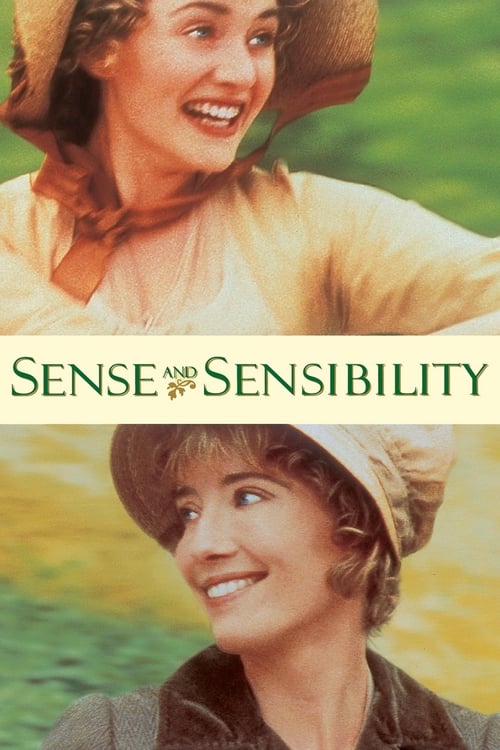
Sense and Sensibility
1995 · Ang Lee
For a cozy night in when you want to fall in love — with characters, with landscapes, with the sheer pleasure of well-made romance. It's a comfort watch with a real ache inside it: tears likely, but the good kind.
What it's about
When their father dies, the Dashwood sisters and their mother lose their home and most of their money overnight — by law, everything passes to a son from an earlier marriage. Practical, self-contained Elinor and headlong, romantic Marianne must now navigate love in Regency England, where a woman's heart and her financial survival are tangled in the same question. Suitors appear, promises hang unspoken, and both sisters learn how much feeling can cost.
The experience
Warm, witty, and quietly devastating — it glides along on Austen's social comedy, then catches you off guard with real heartbreak. The pleasure is watching restraint and passion pull against each other until something has to give.
Performances
Emma Thompson is superb as Elinor, holding oceans of feeling behind perfect composure — and she wrote the screenplay too. A very young Kate Winslet burns as Marianne, and the supporting cast of English character actors is a feast.
The craft
Emma Thompson's script is a masterclass in adaptation, keeping Austen's wit while sharpening the sisters' emotional arc, and Ang Lee directs with an outsider's fresh eye — rain-lashed landscapes and candlelit rooms that make Regency England feel physical rather than decorative. Gorgeous on a big screen, but it plays beautifully at home too.
Why it matters
It proved Ang Lee could master any genre and any culture — the launchpad for one of the most versatile directing careers in modern cinema — and it set the standard for the wave of Austen adaptations that followed in the 1990s.
Snapshot
Ang Lee's adaptation of Jane Austen's 1811 novel is at once a rigorous costume drama and a quiet provocation: a Taiwanese-American director, working from a script by its English star, refracting British literary heritage through a sensibility formed far outside that tradition. The film follows the Dashwood sisters — restrained, duty-bound Elinor and romantically volcanic Marianne — as they negotiate love and economic precarity in Regency England after their father's death strips them of financial security. Formally measured, emotionally precise, and unusually attentive to the novel's comedy of social performance, Sense and Sensibility remains among the most accomplished literary adaptations of its decade and the film that established Ang Lee as a major international director capable of inhabiting genres not his own.
Industry & production
The project originated with producer Lindsay Doran at Mirage Enterprises, who had long wanted to bring Austen to screen and approached Emma Thompson to write the adaptation. Thompson worked on the screenplay for approximately five years, producing numerous drafts; she has described the process as among the most demanding of her career. The script went through extensive revision before Columbia Pictures came aboard as distributor. Doran's decision to hire Ang Lee, whose English-language experience was then limited to the "Father Knows Best" trilogy — Pushing Hands (1991), The Wedding Banquet (1993), and Eat Drink Man Woman (1994) — was widely seen as unconventional, and Lee himself has spoken candidly about initially feeling daunted by the material's cultural specificity. His outsider status, however, ultimately proved productive: Lee approached Austen's social rituals with an anthropologist's curiosity rather than an inheritor's familiarity, which gave the film a freshness alongside its evident respect for the source.
The production was a co-venture between Mirage Enterprises and Columbia. Casting assembled a notably strong ensemble: Hugh Grant as Edward Ferrars, Alan Rickman as Colonel Brandon, Greg Wise as Willoughby, and in a breakout role, Kate Winslet as Marianne. Thompson took the role of Elinor herself, playing a character a decade younger than her actual age — a decision that generated some comment at the time but which ultimately served the film's thematic emphasis on repression and endurance. Principal photography took place on location across Devon and Somerset, using period country houses and the English landscape to ground the film in material rather than merely decorative authenticity.
The film performed strongly at the box office for a prestige literary adaptation, earning far beyond its modest production budget in worldwide release, and demonstrated commercial appetite for Austen adaptations at precisely the moment a broader cultural revival of the novelist was taking shape.
Technology
Sense and Sensibility was shot on 35mm film with conventional photochemical methods; no significant digital intervention marks the production. Cinematographer Michael Coulter worked with a largely naturalistic palette, favoring soft diffused light for interiors and the gray-green tones of the English countryside in autumn and winter rather than the golden nostalgia common to the heritage-film tradition. The period is one of transition in post-production — digital intermediate processes were just beginning to enter industry use — but the film's look is emphatically analog: texture, grain, and the qualities of natural or candlelit interior light are preserved rather than corrected.
Practical locations demanded that the camera adapt to real spaces with authentic period proportions, which meant tighter rooms, lower ceilings, and more constrained framing than studio-built sets would have allowed. This constraint, whether fully intended or partly circumstantial, reinforces the film's thematic attention to confinement: characters are often filmed in relation to doorways, windows, and thresholds that literalize social permission and inhibition.
Technique
Cinematography
Michael Coulter's work here sits in deliberate contrast to the lush, richly saturated cinematography associated with Merchant-Ivory productions of the preceding decade. The color palette is relatively desaturated, skewing toward cool greens and grays outdoors, ochres and candlelit amber indoors. Coulter avoids the sweeping golden-hour vistas that might sentimentalize the landscape and instead gives the exteriors a certain melancholy openness — particularly in the sequences on the Somerset moors, where Marianne's emotional excess finds spatial room denied her in the drawing room. Interiors are often slightly underlit by the standards of glossy period production, emphasizing the modest circumstances of the Dashwoods' reduced life at Barton Cottage. Close-ups are deployed sparingly and purposefully; the film trusts actors' faces but does not fetishize them, keeping the camera at a register that reads as socially observed rather than melodramatically intimate.
Editing
Tim Squyres — who would go on to collaborate with Lee on The Ice Storm, Crouching Tiger Hidden Dragon, Brokeback Mountain, and much of his subsequent career — edits with a restraint that mirrors Elinor's own temperament. Cuts tend toward classical invisibility; the film does not use editing as expressive commentary in the way some prestige adaptations of the era did. The pacing is deliberate without being sluggish: scenes are given time to breathe and characters time to withhold, which is essential for a film in which the gap between feeling and expression is the primary dramatic subject. The editing becomes most pointed in sequences where the audience is kept aligned with Elinor's knowledge — information managed across scenes to sustain irony and suspense simultaneously.
Mise-en-scène / staging
Lee's staging reveals his theatrical background and his interest in social choreography. He directs the ensemble in a manner that makes group scenes feel genuinely social — people positioned according to relationship, allegiance, and unspoken desire rather than simply for visual composition. The domestic spaces of Barton Cottage are staged to suggest physical intimacy and reduced circumstance, while the grander houses the sisters visit register as spaces of performance and surveillance. Lee pays close attention to what bodies do in these rooms: how they approach or retreat, when they speak across a room versus in proximity, who controls entrances. The famous scene of Elinor finally collapsing in grief after Edward's revelation — the full release of long-suppressed emotion — is shot and staged with particular restraint, making Winslet's continuous Marianne-style weeping in the background a kind of ironic counterpoint, and Thompson's breakdown the more devastating for its compressed suddenness.
Sound
Patrick Doyle's score is understated relative to the lush orchestral confections typical of the sub-genre. Doyle — who had worked with Kenneth Branagh on Henry V (1989) and Much Ado About Nothing (1993) and brought a similar respect for dramatic pacing to his scoring — uses strings and piano with some restraint, allowing diegetic music to carry significant emotional weight. Marianne's singing and piano playing, presented as entirely natural domestic activity, functions as characterization and emotional register simultaneously: her musical expressiveness is part of what marks her as a sensibility type, and Winslet performed her own singing for these sequences. The sound design otherwise leans on the natural ambient texture of the English countryside and period buildings, using silence and environmental sound — rain, wind across open landscape — in support of the emotional arcs.
Performance
Thompson's Elinor is arguably the central achievement of the film's performance register: the actress conveys the effort of containment continuously, so that the audience inhabits a character's interior at precisely the moment the character is refusing to display it. This is technically demanding and not always credited in discussions of technically showy acting. Winslet's Marianne provides the emotional spectacle the film otherwise withholds — she is operatic where Thompson is sotto voce — and the contrast between the two modes is itself the film's dramatic argument about modes of feeling and their social costs. Rickman's Brandon is a study in quietly suppressed longing; his stillness carries the weight of a history the character cannot speak. Grant's casting as Edward Ferrars was considered against type — Grant had been primarily associated with romantic comedy and the Four Weddings and a Funeral persona — but the role in fact extends that persona toward its melancholy underside: the charming, decent man imprisoned by his own obligations.
Narrative & dramatic mode
The film inherits Austen's primary narrative technique — free indirect discourse, the alignment of narration with a character's perspective and ironic distance simultaneously — and translates it into cinema primarily through performance and point-of-view management rather than voice-over or literary device. Elinor functions as the film's internal narrator even without narrating: her knowledge, her withholding, and her eventual release structure the audience's experience. The narrative mode is comedy in the classical sense — movement from disorder toward social reintegration through marriage — but inflected with a degree of genuine suffering that the film does not resolve cheaply. The double-plot structure (Elinor's Edward / Marianne's Willoughby-then-Brandon) allows contrasts in romantic temperament to generate the film's argument rather than merely its entertainment.
Genre & cycle
The film belongs squarely to the British heritage drama, a genre consolidated in the 1980s and early 1990s by Merchant-Ivory productions (A Room with a View, 1985; Howard's End, 1992; The Remains of the Day, 1993) and distinguished by its investment in period authenticity, literary source material, theatrical performance traditions, and landscape as cultural signifier. Lee's film participates in these conventions while modifying them, trading the Merchant-Ivory tendency toward a certain elegiac visual richness for something colder and more ironic.
More specifically, Sense and Sensibility arrives at the center of a discrete mid-1990s Austen cycle that constitutes one of the more striking cultural phenomena of the decade: the BBC's six-part Pride and Prejudice (1995, dir. Simon Langton) premiered in the same year; Amy Heckerling's Clueless (1995) transposed Emma to contemporary Beverly Hills in the same year; Emma (dir. Douglas McGrath, 1996) followed, as did Roger Michell's film of Persuasion (1995, for BBC/cinema release). The cycle reflected a broader cultural appetite — variously attributed to nostalgia, the appeal of narrative order amid postmodern anxiety, and the era's renewed interest in social manners — that the Lee film both shaped and benefited from.
Authorship & method
Ang Lee came to the project with a distinctive approach developed across his first three features: a mode of ethnographic observation applied to family structures under social pressure, a directorial restraint that refuses overt emotional instruction, and a fascination with the gap between what cultures perform and what they feel. These preoccupations translate naturally to Austen. Lee has spoken in interviews about his process of extensive preparation — detailed script analysis, long rehearsal periods with his cast, storyboarding key sequences — and about his tendency to work quietly and collaboratively on set rather than through directorial display. His outsider position relative to Regency England he treated as a resource rather than a handicap, approaching the social codes with the attention of someone learning a language rather than speaking a mother tongue.
Emma Thompson's screenplay is a significant document of adaptation craft. She preserved Austen's structural logic and ironic register while necessarily externalizing what the novel accomplishes through free indirect narration, adding scenes and dialogue not in the novel to dramatize what Austen leaves in summary. Her decision to make Elinor more actively aware of, and more pained by, her own suppression is a creative choice that shifts the novel's balance somewhat; her script gives the eldest sister a warmer emotional presence than purely Austenian irony might warrant, without betraying the character's function. Thompson won the Academy Award for Best Adapted Screenplay for the film.
Michael Coulter and Tim Squyres constitute the core technical collaborators; Squyres in particular would become one of Lee's most important long-term creative partners. Patrick Doyle's score belongs to a tradition of literary-adapted period drama scoring that he helped define through his Branagh collaborations, here applied with somewhat greater restraint than his noisier scores.
Movement / national cinema
The film complicates simple national cinema categories productively. It is a British literary adaptation financed in part by American money, directed by a Taiwanese filmmaker, written and co-led by a British actress, photographed in England, and released as an American studio prestige picture. The "British heritage film" designation fits it as genre, but Lee's authorship cannot be accommodated within that tradition's usual national-cultural terms. His film is in some respects more Austen than many British productions — more attentive to social comedy and ironic distance, less inclined to pictorialize the period into reassuring nostalgia — because he approached it as a foreign culture rather than a national inheritance. This speaks to a broader phenomenon in 1990s international cinema in which non-European directors were regularly bringing new perspectives to European literary canons.
Era / period
The film belongs to a specific moment in mid-1990s cinema characterized by the prestige literary adaptation as a commercially and awards-viable product. The decade saw a concentration of such films across English-language production — from The Age of Innocence (Scorsese, 1993) and The Remains of the Day (Ivory, 1993) through the Austen cycle and onward to The English Patient (Minghella, 1996) — and Sense and Sensibility sits near the peak of this wave in quality and cultural impact. It is also the film in which Ang Lee crossed definitively from international art-cinema visibility to mainstream Hollywood legitimacy, positioning him for the more commercially ambitious projects that followed.
Themes
The film's governing tension is the one Austen's title announces: the opposition between sense (rationality, social performance, the management of feeling for strategic ends) and sensibility (emotional authenticity, romantic expressiveness, the refusal of social mask). The film treats these not as a simple binary in which one wins but as a dialectic in which each mode has costs — Elinor's sense nearly destroys her capacity for joy; Marianne's sensibility nearly destroys her literally. The resolution asks both sisters to incorporate something of the other's mode, though the film is careful not to suggest Marianne's education in sense is without loss.
Beneath this, the film is acutely attentive to the material conditions of women's lives: the Dashwood sisters' situation is not merely a romantic comedy but a consequence of specific legal and economic structures (the entail, inheritance law, the marriage market as labor market) that the film neither obscures nor sensationalizes. The question of money is never far from any romantic scene, and this ground-level economic realism keeps the film from floating into mere period fantasy. The theme of social performance — of the enormous gap between what Regency society allows to be said and what is felt — connects to Ang Lee's broader career-long interest in the cost of cultural codes and the pressure they exert on interior life.
Reception, canon & influence
Backward influences: Austen's novel (1811) is the primary source and the standard against which adaptations are inevitably measured; Thompson's fidelity to its structure while adapting its technique is central to the film's achievement. The Merchant-Ivory heritage drama provides the genre template that Lee both inhabits and modifies; Howard's End (1992) and The Remains of the Day (1993) are the immediate generic predecessors, notable particularly for their integration of literary adaptation with performance-centered direction. Ang Lee's own Father Trilogy — especially Eat Drink Man Woman (1994) — provides the direct precursor to his method: family dynamics under social and generational pressure observed with anthropological coolness.
Critical reception: The film was greeted with wide critical enthusiasm upon release, praised for the quality of Thompson's script, the ensemble acting, and Lee's restrained direction. It received seven Academy Award nominations — including Best Picture, Best Actress (Thompson), Best Supporting Actress (Winslet), Best Adapted Screenplay, Best Cinematography, Best Original Score, and Best Costume Design — winning Best Adapted Screenplay. It won the Golden Bear at the Berlin International Film Festival in 1996, a rare honor for an English-language studio production and one that underscored Lee's standing within international art cinema as well as mainstream Hollywood. Kate Winslet's nomination, for a performance in her first major film role, proved an accurate forecast: she appeared in Titanic (1997) two years later.
Forward influence: The film's most immediate legacy is its role in accelerating and validating the mid-1990s Austen cycle; its commercial success demonstrated that faithful, intelligent Austen adaptation could reach mainstream audiences. It contributed to a broader reassessment of period drama as a commercially serious form rather than a niche prestige product. For Ang Lee personally, it was the decisive entry into the Hollywood mainstream, enabling The Ice Storm (1997), Ride with the Devil (1999), Crouching Tiger Hidden Dragon (2000), and the more commercially scaled productions that followed. The film's model of casting against expectation — particularly the use of Hugh Grant in a role that revised rather than simply exploited his persona — influenced the casting logic of subsequent prestige adaptations. It remains on university curricula for adaptation studies, for its integration of literary and cinematic irony, and as a case study in how directorial outsider status can productively estrange familiar material.
A Deleuzian reading
Near the end, Elinor is told that Edward is free after all, and the thing she has held shut for two hours gives way.
The full Deleuzian reading of Sense and Sensibility →
Reception
A hit in 1995 — seven Oscar nominations, the Golden Bear at Berlin — and its stock has only risen since: it's now routinely called the best Austen film ever made, and looks even more remarkable in hindsight as the movie that launched Ang Lee's genre-hopping English-language career.
How Sense and Sensibility was received, from release to now →
Influences: the films it descends from and the films it influenced
- A Room with a View (1985) — Tony Pierce-Roberts's warm, richly saturated Tuscan and English interiors define the golden Merchant-Ivory palette that Michael Coulter and Lee systematically inverted: the desaturation and gray-green coolness of Sense and Sensibility is partly a formal argument against this specific predecessor.
- Barry Lyndon (1975) — Kubrick's f/0.7 candlelit cinematography established the precedent of practical interior light as period authenticity rather than glamour; Coulter's underlit candlelit interiors at Barton Cottage work in this tradition rather than the bright, even illumination of most heritage productions.
- Howards End (1992) — Ivory's systematic staging of class permission through doorways and threshold crossings—who enters which room, who waits outside—is the formal ancestor Lee inherits and psychologizes into threshold-framing that literalizes Elinor's social and emotional containment.
- The Piano (1993) — Campion's structuring of Ada's piano-playing as the site of interiority that speech is prohibited from expressing directly precedes the function of Marianne's singing and piano in Lee's film: diegetic music as the permitted channel for feeling that social convention refuses.
- The Age of Innocence (1993) — Scorsese's use of selective literary voiceover to externalize a character's partial knowledge—privileging Newland's POV to generate irony about what he cannot see—directly precedes Lee and Thompson's POV-information management across Elinor's plot, sustaining irony and suspense simultaneously.
- The Remains of the Day (1993) — Hopkins's technique of performing emotional suppression through bodily rigidity and involuntary microexpression established the template for contained interiority that Thompson and Rickman both draw on explicitly—repression rendered as physical posture rather than psychological statement.
- The Wedding Banquet (1993) — Lee's earlier film established his outsider-ethnographic gaze: observing social ritual from bemused external curiosity rather than insider familiarity, letting the comedy of performance emerge without directorial commentary—the identical stance he applies to Austen's drawing rooms.
- Eat Drink Man Woman (1994) — The international credibility Eat Drink Man Woman built recruited Lee for Austen, where he carries the identical method — emotional restraint and comedy-of-manners tension between social ritual and unspoken feeling — into English.
- The Ice Storm (1997) — Tim Squyres again edits with classical invisibility; Lee transplants the double-plot structure—two siblings navigating incompatible romantic codes simultaneously—and withheld emotional declaration into a 1970s Connecticut setting, using the same POV-management rhythm to delay the convergence of the two plots.
- Gosford Park (2001) — Altman's multi-figure social choreography in British country-house settings extends Lee's threshold-framing into a fully orchestrated system: characters move through spaces whose architectural hierarchies are as psychologically loaded as Lee's doorways, with overlapping sound tracks now doing the work Lee's editing performs.
- Pride & Prejudice (2005) — Roman Osin's desaturated-but-luminous palette, Dario Marianelli's restrained score, and Wright's practical location shooting in actual English country houses constitute the direct craft inheritance of Lee's counter-Merchant-Ivory approach to Austen—same author, same visual program.
- Brokeback Mountain (2005) — Squyres's editing again operates on classical-invisibility principles while managing prolonged information asymmetry across a temporal structure measured in years; Lee refines the technique of withheld emotional release—across decades rather than seasons—that he first developed with Squyres here.
- Atonement (2007) — Wright and Seamus McGarvey extend Lee's threshold-framing into a sustained formal metaphor: observation through windows, gaps in hedges, and hallway views structures knowledge asymmetrically, staging repressed desire and misread intention through blocked sightlines in inherited period spaces.
- Crouching Tiger, Hidden Dragon (2000) — Lee and Schamus developed their method of using literary genre adaptation to generate structural repression—emotion withheld, expressed through constraint rather than declaration—as the film's primary dramatic engine, transferred wholesale into CTHD's martial register.
- Materialists (2025) — Ang Lee foregrounds the Austen arithmetic of courtship — literal pounds-per-year sums determining who may love whom — the marriage-as-economics tradition Materialists updates into matchmaker checklists and dealbreakers.
- Lust, Caution (2007) — Within Lee/Schamus's own practice, the study of social masks and repressed feeling rendered through cool control of surfaces, where the gap between decorous social role and inner life is the entire subject.
- Ride with the Devil (1999) — Lee's manners grammar — held two-shots in which feeling can only be stated through forms of address, and costume deployed to mark faction and rank — transposed intact onto Missouri clan society, where the same rules exact the same cost.
- Persuasion (1995) — Michell's raw-stock naturalistic cinematography and practical-location shooting in the same production year constitute the aesthetic road not taken: where Lee pursues classical formal control, Michell achieves documentary roughness in identical heritage source material, framing the range of the Austen-cycle's formal options.
- Carrington (1995) — Hampton's restraint in staging non-normative desire through social performance and withheld declaration rather than direct statement matches Lee's method: both films construct repression as dramatic form rather than merely dramatic subject, letting what is never said structure narrative tension.
- Portrait of a Lady (1996) — Stuart Dryburgh's desaturated silver-toned palette and Campion's restrained deployment of Wojciech Kilar's score represent the sibling approach to literary-adaptation mode: visual and acoustic understatement preserving the interiority of a protagonist whose primary action is perception rather than event.
- Little Women (2019) — A sisterhood-ensemble period adaptation that foregrounds the economics of marriage as plot engine — Marmee/Aunt March's 'marry rich' pragmatism descends from Emma Thompson's script.
Similar films
- Pride & Prejudice (2005) — influence & lineage
- Howards End (1992) — influence & lineage
- Atonement (2007) — influence & lineage
- The Remains of the Day (1993) — influence & lineage
- Brokeback Mountain (2005) — influence & lineage
- The Piano (1993) — influence & lineage
- The Age of Innocence (1993) — influence & lineage
- Emma. (2020) — shared sensibility