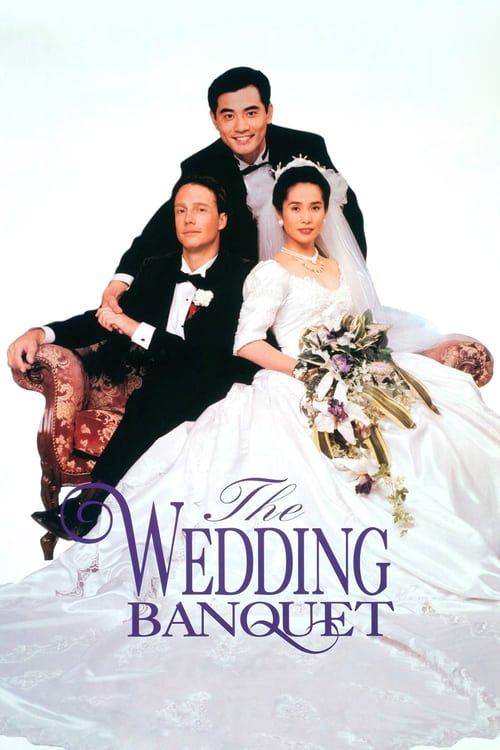
The Wedding Banquet
1993 · Ang Lee
For a night when you want to laugh at a family scrambling to keep up appearances and come away a little misty — comfort viewing that still has something honest to say. Great with company, especially anyone who's ever managed their parents' expectations.
What it's about
Wai-Tung, a Taiwanese-American landlord, lives happily in New York with his boyfriend Simon — a fact he's kept from his parents in Taipei. To silence their matchmaking and help a tenant from mainland China get her green card, he stages a marriage of convenience. Then his aging parents fly in for the wedding, demand a proper banquet, and settle in for a long stay, and the whole careful arrangement starts to wobble.
The experience
A true farce with a warm heart — doors nearly opened, stories nearly slipped, escalating from cringe comedy into something genuinely moving about what parents and children hide from each other out of love. It's brisk and funny, then sneaks up on you with real tenderness.
Performances
Sihung Lung is quietly magnificent as the father, saying volumes with a glance, and Ah-Lei Gua matches him as the mother whose wedding dreams steamroll everyone's plans.
The craft
Ang Lee directs the mounting deceptions with clockwork timing but keeps the camera patient enough to catch what characters can't say out loud. The banquet itself is a marvel of staged chaos — a raucous, detailed portrait of a Chinese wedding that's worth the ticket on its own. Made on a shoestring, it proves how far sharp writing and an exact sense of behavior can go.
Why it matters
It shared the Golden Bear at Berlin, earned an Oscar nomination for Best Foreign Language Film, and launched Ang Lee onto the international stage — an early-90s landmark for gay stories told with mainstream warmth.
Snapshot
The Wedding Banquet (喜宴, Xǐyàn) is Ang Lee's second feature and the pivot on which his international career turned. A Taiwan–United States co-production shot largely in New York, it stages a comedy of concealment: Wai-Tung, a Taiwanese-American landlord living contentedly with his American partner Simon, agrees to a sham marriage with Wei-Wei, a mainland Chinese tenant needing a green card, chiefly to placate his aging parents in Taipei. The scheme collapses into farce when his mother and father fly in for the wedding, insist on a lavish banquet, and settle in for an extended stay. The film shared the Golden Bear at the 1993 Berlin International Film Festival and earned a nomination for the Academy Award for Best Foreign Language Film as Taiwan's submission. Made cheaply through the fledgling independent shop Good Machine, it became, by wide report, one of the most profitable releases of its year relative to cost, and it announced the humane, tonally supple sensibility Lee would carry into a remarkably varied career.
Industry & production
The film sits at the intersection of two production cultures. On the Taiwan side, it was backed by the state-linked Central Motion Picture Corporation (CMPC), whose script-development support had already enabled Lee's debut, Pushing Hands (1992). On the American side, it was produced by Good Machine, the New York outfit founded by Ted Hope and James Schamus, then building a reputation for making features on shoestring budgets through what they half-jokingly branded a "no-budget" model. Schamus became Lee's indispensable creative partner here, co-writing the screenplay with Lee and Neil Peng and beginning a producer-writer collaboration that would run through most of Lee's subsequent films.
The production was modest and fast, shot on location in New York with a compact crew. Precise budget and gross figures vary across sources, so they are best treated with caution; what is not in dispute is that the picture returned many times its cost and was celebrated as an exemplary case of lean independent filmmaking yielding outsized commercial and critical results. Its success, arriving on the heels of Pushing Hands, gave Lee the leverage to complete his loose "Father Knows Best" trilogy with Eat Drink Man Woman (1994) and then to make the leap to English-language literary adaptation with Sense and Sensibility (1995).
Technology
There is little to claim here, and it would be a distortion to inflate it. The Wedding Banquet is a conventionally photographed 35mm film of the early 1990s, made without recourse to novel optical, digital, or effects technology. Its resources went into performance, location, and script rather than apparatus. The honest observation is that the film's achievement is entirely one of craft and dramaturgy rather than of technical innovation; any account claiming otherwise would be inventing significance the record does not support.
Technique
Cinematography
Cinematographer Jong Lin, who shot all three films of Lee's early trilogy, works in a warm, unobtrusive naturalism keyed to domestic interiors — the apartment Wai-Tung and Simon share, the hotel rooms, the restaurant. Compositions are largely classical and legible, favoring the clear staging of relationships within the frame over stylistic display. The camera observes rather than editorializes, a restraint that lets the comedy of misunderstanding play in the space between characters. The visual register shifts noticeably for the banquet sequence, where the previously composed, contained framing gives way to a looser, more crowded and kinetic coverage appropriate to the chaos of the celebration.
Editing
The film marks the beginning of Lee's long partnership with editor Tim Squyres, who would go on to cut the great majority of Lee's subsequent work. The editing here serves the screenplay's farce architecture: it sustains the rhythm of concealment and near-exposure, times comic reversals cleanly, and manages the tonal migration from social comedy toward familial melodrama in the final act without a jarring seam. The banquet set piece is the showcase for the cutting — an accelerating montage of toasts, games, and drunken ritual that builds communal energy before the film contracts again into intimate, quieter scenes.
Mise-en-scène / staging
Lee's staging is organized around the theme of performance: characters are constantly arranging themselves for an audience — the parents, the wedding guests, the immigration officer. The banquet is the film's central mise-en-scène achievement, a densely populated recreation of Chinese wedding custom, including the boisterous nao dongfang tradition of teasing and goading the newlyweds toward the marriage bed. The production dresses the ritual with specificity and lets its excess become both comic and quietly coercive, the social machinery that finally pushes the fake couple into a real (and consequential) sexual encounter. Domestic spaces are staged to register the awkward choreography of a household pretending to be something it is not.
Sound
The film is bilingual, moving between Mandarin and English, and much of its comedy and pathos lives in that linguistic divide — in what the parents are not told, in what can be said only in a language the other party does not understand. The score by the composer Mader is light and supportive, coloring the comedy without underlining it. Sound design is functional and realist; the banquet again provides the fullest soundscape, a wash of overlapping voices, toasts, and celebration.
Performance
The ensemble is the film's engine. Sihung Lung, who plays the patriarch Mr. Gao, appeared as the father figure across all three trilogy films and anchors this one with a gravity that the late revelations deepen; his final gesture at the airport security check — arms raised in what reads at once as surrender and benediction — has become the film's most discussed image. Ah-Leh Gua plays Mrs. Gao with a tender, wounded warmth. Winston Chao, in an early screen role, gives Wai-Tung a plausible exhaustion beneath the deception; May Chin brings restless vitality to Wei-Wei; and Mitchell Lichtenstein makes Simon the film's aggrieved moral center, the partner asked to erase himself so the performance can proceed. Lee himself takes a brief cameo as a banquet guest, delivering the film's most quoted line — a wry remark to the effect that the raucous wedding games are the product of "five thousand years of sexual repression."
Narrative & dramatic mode
Structurally the film is a farce built on a single sustained deception, with the classic farce mechanism of a lie that must be defended by ever more elaborate improvisation as unexpected parties arrive. It observes the conventions of the comedy of manners — social ritual, mismatched expectations, the gap between public face and private truth — and layers on the specific engine of bedroom farce when the wedding night produces an unplanned pregnancy. What distinguishes it is the way it lets the comedy curdle into melodrama in the third act, as the human costs of the charade come due and the film pauses to take its characters' pain seriously. The resolution is notably unsentimental in its compromise: rather than a clean restoration of order, it arrives at an improvised, three-cornered family arrangement in which everyone gives something up. The father's quiet, late acknowledgment that he has understood more than he let on reframes the whole comedy in retrospect as a negotiated, mutually protective silence.
Genre & cycle
The film belongs to several cycles at once. It is a romantic comedy and an "ethnic family comedy," working the well-worn material of parents descending on adult children; it is an immigrant-cinema story turning on the green-card marriage; and it is a landmark of gay cinema arriving in the early-1990s independent boom. It reads across these traditions rather than committing wholly to any, and part of its historical interest is its accessibility — a queer story told in a broadly humane, mainstream comic idiom at a moment when much explicitly gay filmmaking was more confrontational.
Authorship & method
The film is a genuine collaboration between a small, stable creative team, most of whom would remain with Lee for years. Ang Lee directs and co-writes; James Schamus co-writes and produces, initiating the partnership that shaped Lee's whole subsequent output; Neil Peng shares screenplay credit. Jong Lin photographs, Tim Squyres edits (the start of a career-long relationship), and Mader composes. Lee's method, already visible here, is one of tonal control and empathy distributed across an ensemble rather than concentrated in a single protagonist — a refusal to make villains of any of the parties in a conflict. His biography informs the work without over-determining it: Taiwan-born, trained at the University of Illinois and then NYU's film program, he spent years without a directing career while his wife's income supported the household, and the trilogy's preoccupation with fathers, duty, and the immigrant's divided loyalties clearly draws on that experience — though one should be careful not to reduce the films to autobiography.
Movement / national cinema
The film is best understood as transnational and diasporic rather than as a product of any single national movement. It is often bracketed with Taiwanese cinema of its era, but Lee stands somewhat apart from the Taiwan New Cinema of Hou Hsiao-hsien and Edward Yang, both in sensibility and in his New York base; his early films are more accurately positioned at the meeting point of Taiwanese production support and American independent filmmaking. That hybrid location is itself the subject: the film dramatizes the negotiation between a Taipei household and a New York life, and its very financing embodied the same East–West traffic its plot describes.
Era / period
The Wedding Banquet is a document of the early 1990s. It emerged alongside the phenomenon that critic B. Ruby Rich named New Queer Cinema, and within the larger surge of American independent film centered on festivals like Sundance. It is also, pointedly, a film made during the AIDS crisis that largely declines to foreground AIDS — a choice that has drawn both criticism and interest, and that aligns it with a strain of early-1990s gay storytelling more concerned with family, visibility, and ordinary domestic life than with illness. Its green-card plot lands in a period of active public debate over immigration, and its comedy of a Chinese family reunited across the Taiwan Strait carries the charge of a specific historical moment in cross-strait mobility.
Themes
The film's governing theme is filial piety and its collision with individual desire — the Confucian obligation to marry and continue the family line set against Wai-Tung's settled gay life. Around that runs a sustained meditation on performance and the theatricality of social ritual: the wedding as a show staged for an audience, identity as something managed and concealed. It explores the closet not as private psychology alone but as a family system, a mutual arrangement of silences. It weighs biological against chosen family, and resolves toward an expanded, negotiated household rather than a simple triumph of one over the other. And it treats immigration, language, and belonging as inseparable from all of this — who can speak, who is understood, and what a green card, a pregnancy, or a banquet is really being asked to secure. Beneath the comedy lies a persistent tenderness toward compromise: nearly everyone in the film sacrifices a version of the truth so that the people they love can keep their dignity.
Reception, canon & influence
Critically, the film was warmly received and widely praised for balancing broad comedy with emotional honesty; its Golden Bear at Berlin (shared that year) and its Academy Award nomination for Best Foreign Language Film gave it international standing well beyond its budget. It is the film that made Ang Lee's name abroad and set up the extraordinary breadth of his subsequent career — from Eat Drink Man Woman and Sense and Sensibility to Crouching Tiger, Hidden Dragon and Brokeback Mountain, the last of which returns, in a very different register, to the story of gay love constrained by family and social expectation.
Looking backward, the film's influences are less a matter of specific cited models than of traditions Lee synthesizes: the domestic comedy of manners, Chinese family melodrama, and the deception-farce lineage of the stage. Looking forward, its legacy is substantial and specific. It became a touchstone for Asian American cinema and for queer representation on screen, cited repeatedly as a foundational text in discussions of both. Its afterlife extended into the present with Andrew Ahn's 2025 reimagining of The Wedding Banquet, co-written with James Schamus, which transposes the premise to a contemporary American setting — a direct measure of the original's durability. Where the historical record is thin — on exact financials, and on any formal preservation status — this dossier leaves the question open rather than filling it with invention; the film's standing rests securely enough on its influence, its awards, and its place at the origin of one of contemporary cinema's most wide-ranging directorial careers.
A Deleuzian reading
An old man raises his arms in an airport security line so a stranger can search him, and holds them a beat longer than the search requires.
The full Deleuzian reading of The Wedding Banquet →
Reception
A Golden Bear winner at Berlin and a surprise arthouse smash in 1993, it's since settled in as a foundational text of queer Asian diaspora cinema — affection renewed (and re-litigated) when Andrew Ahn's 2025 remake with Bowen Yang and Lily Gladstone sent people back to the original.
How The Wedding Banquet was received, from release to now →
How to watch The Wedding Banquet: what to notice on a first viewing
- Watch how plainly and clearly the camera stages every room. Jong Lin shoots in a warm, classical, legible style that observes rather than editorializes, letting the comedy of misunderstanding play out in the space between characters. The plainness puts the whole joke in what you notice, not in how the camera comments.
- Listen for scenes that shift between Mandarin and English. Much of the comedy and pain lives in what the parents are not told, in what gets said only in a language the other side does not follow. Which language a line is spoken in tells you who is allowed to understand it.
- Notice characters arranging themselves whenever the parents watch. Lee stages the apartment, the hotel, and the immigration interview as scenes performed for an audience, the household visibly rearranging itself to look like something it is not. You keep catching people mid-performance, adjusting themselves for whoever just walked in.
- Watch the banquet grow louder and more chaotic as it goes. The wedding banquet recreates Chinese custom with dense specificity, including boisterous games that goad the newlyweds toward the marriage bed in front of the whole crowd. The celebration is both genuinely joyful and quietly coercive at the very same time.
- Watch Sihung Lung's face give away almost nothing at the table. Lung plays the father with a quiet gravity and an unreadable stillness, speaking little and watching everything. You are watching a man whose face holds back everything he thinks.
The whole guide to watching The Wedding Banquet, with the keys for a rewatch →
Influences: the films it descends from and the films it influenced
- Late Spring (1949) — The template for Lee's domestic naturalism — patient, low, static framing of family interiors organized around a marriage the parent wants and the child resists, filial duty dramatized through the arrangement of bodies in a room rather than confrontation.
- Tokyo Story (1953) — Establishes the generational-obligation melodrama staged at the shared meal, where the family table becomes the arena for unspoken disappointment — the staging grammar Lee inherits for his banquet and dinner scenes.
- La Cage aux Folles (1978) — The direct deception-farce ancestor: a gay couple frantically restaging their home and selves as heterosexually respectable for a formal visit from disapproving parents, the same concealment engine that drives Wai-Tung's sham wedding.
- The Palm Beach Story (1942) — Source of the farce-rhythm editing Tim Squyres deploys — comedic escalation built by cutting on entrances, near-exposures, and overlapping cross-purposes among characters who each know a different part of the lie.
- Guess Who's Coming to Dinner (1967) — Models the parental-approval drama that refuses villains, distributing sympathy across every party at the table — the empathetic, no-antagonists ensemble stance the dossier identifies as Lee's method.
- Crossing Delancey (1988) — Builds its farce on the same engine — an immigrant family deploying formal matchmaking against a child's own romantic choice — and sustains it through Lee's patient, largely static framings that let the parents' broad comic playing coexist with the lovers' realism.
- The Birdcage (1996) — American extension of the same performing-straightness-for-the-parents farce, structured around a single dinner where set-dressing and role-play conceal a gay household — the Banquet's concealment set-piece transposed.
- Saving Face (2004) — Inherits the exact machinery — a closeted Chinese American child, an anxious parent, and a wedding-banquet frame — running the same comedy-to-melodrama modulation over concealment and eventual filial reconciliation.
- Brokeback Mountain (2005) — Lee and Schamus return to gay love constrained by family and social expectation, applying the Banquet's method of distributed empathy and refusal to make villains of the wives or the men.
- Crazy Rich Asians (2018) — Builds its climax on the elaborate Chinese wedding-banquet set piece as a test of an outsider partner under family scrutiny — the ritual social-performance staging the Banquet foregrounded, scaled to spectacle.
- The Farewell (2019) — Directly extends the family-wide benevolent deception staged around a wedding banquet to preserve face, in the same bilingual Mandarin-English register and comedy-sliding-to-melodrama tone.
- Fire Island (2022) — Ahn's queer Asian American ensemble comedy that rehearses the social-performance-and-chosen-family concerns he would then bring to his direct remake, favoring warmth over villainy in the Lee mode.
- The Wedding Banquet (2025) — The explicit reimagining co-written by James Schamus himself, transposing the sham-marriage premise to a contemporary American queer setting — the most literal possible inheritance of the original's craft and script DNA.
- Sense and Sensibility (1995) — Lee's earlier film established his outsider-ethnographic gaze: observing social ritual from bemused external curiosity rather than insider familiarity, letting the comedy of performance emerge without directorial commentary—the identical stance he applies to Austen's drawing rooms.
- Your Name Engraved Herein (2020) — The film's own faceting names this as its lodestar: it fixes the Taiwanese template of coding gay desire as a negotiation with familial/institutional duty, where longing surfaces through withheld gesture and social performance rather than declaration.
- Lust, Caution (2007) — Lee's early study of a false social self performed at a communal table, where the banquet becomes the arena of concealment — the direct forerunner of the mahjong table as staging of the masked self.
- Dear Ex (2018) — Establishes the template of staging a gay son's rupture with his family as a warm reconciliation comedy that grants the wounded traditional parent a dignified, defensible interior rather than a villain.
- Pushing Hands (1991) — First panel of Lee's 'Father Knows Best' trilogy with the same Schamus partnership and Sihung Lung as the displaced patriarch — the immigrant-father-in-America conflict and quiet domestic blocking carried directly into the Banquet.
- Eat Drink Man Woman (1994) — Closing trilogy panel that perfects the banquet montage — food preparation cross-cut as the family's displaced language of love and control, again with Sihung Lung, Jong Lin's camera, and Squyres's meal-scene cutting.
- The Joy Luck Club (1993) — Concurrent Asian American touchstone using the bilingual Mandarin/English register and comedy-to-melodrama tonal shift to dramatize the immigrant's divided loyalty between generations.
- Poison (1991) — Foundational New Queer Cinema text of the same moment and AIDS-crisis context, sharing the movement's project of centering gay lives without apology that the Banquet joins from a comedic angle.
- Happy Together (1997) — Chinese-language gay cinema of the same decade that extends the Banquet's placement of a queer relationship inside diasporic displacement, though trading farce for durational mood.
Similar films
- Eat Drink Man Woman (1994) — influence & lineage · same viewing thread
- Saving Face (2004) — influence & lineage · same viewing thread
- Happy Together (1997) — influence & lineage · same viewing thread
- The Farewell (2019) — influence & lineage
- The Joy Luck Club (1993) — influence & lineage
- Brokeback Mountain (2005) — influence & lineage
- Farewell My Concubine (1993) — same viewing thread
- In the Mood for Love (2000) — same viewing thread
All the films related to The Wedding Banquet →
Watch it with: curated runs of related films
- Love Against the Grain — A run of films where desire refuses the shape its world demands — opera stages, drought-struck Taipei, an honor-bound Lahore household, drenched Buenos Aires — and burns brighter, and more dangerously, for the refusal.