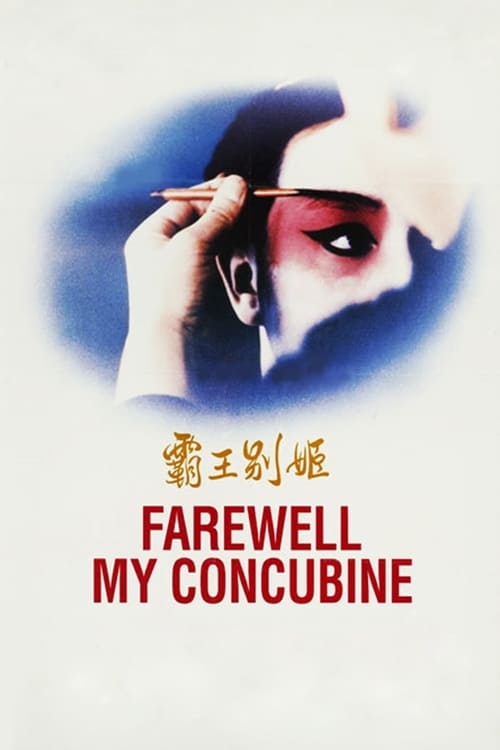
Farewell My Concubine
1993 · Chen Kaige
For a night when you want to be swept away completely — grand passion, grand history, real heartbreak. This is challenge-and-reward viewing, not comfort food; save it for when you can give it your full attention.
What it's about
Two boys are raised inside the brutal discipline of a Peking opera training school and grow into stage partners famous for one opera: the tragedy of a warlord and the concubine who stays loyal to the end. One of them, trained since childhood to play the female role, cannot separate the opera from his own life and love; the other marries a former courtesan, setting up a triangle that plays out across fifty years of Chinese upheaval — warlords, Japanese occupation, revolution, and the Cultural Revolution.
The experience
A full-blooded epic that moves like a great novel: sumptuous, wrenching, and increasingly devastating as history closes in on people who only ever wanted to perform. It's long and it earns every minute — the kind of film that leaves you sitting quietly through the credits.
Performances
Leslie Cheung is extraordinary as Dieyi, the performer who lives inside his stage role — one of the most celebrated performances in Chinese-language cinema — and Gong Li matches him as the fiercely pragmatic woman caught between the two men.
The craft
Chen Kaige stages the operas themselves in blazing color and ritual precision, then lets that theatrical beauty collide with the drab machinery of history; the film's sweep across five decades is handled with remarkable clarity. The costumes, makeup, and backstage world are rendered in obsessive, gorgeous detail.
Why it matters
The first Chinese-language film to win the Palme d'Or at Cannes, a landmark of China's Fifth Generation filmmakers, and a milestone of queer representation in Chinese cinema — its frankness made it as controversial at home as it was celebrated abroad.
Snapshot
Farewell My Concubine (Bawang Bie Ji, 霸王别姬) is Chen Kaige's epic chronicle of two Peking opera performers whose bond is tested across more than fifty years of Chinese history, from the warlord era of the 1920s through the Japanese occupation, the Nationalist and Communist transitions, and the devastations of the Cultural Revolution. Adapted from Hong Kong novelist Lilian Lee's book, it braids the ancient opera it takes its name from — the tragedy of the Chu hegemon Xiang Yu and his loyal concubine Yu Ji — into the lives of the men who perform it. The film is at once a backstage melodrama, a study of gender and performed identity, and a national allegory of loyalty and betrayal under successive regimes. It became the first Chinese-language film to win the Palme d'Or at Cannes (shared, in 1993, with Jane Campion's The Piano), and it remains the signal international achievement of the mainland "Fifth Generation" and a landmark of pan-Chinese cinema, anchored by Leslie Cheung's celebrated performance as the dan (female-role) actor Cheng Dieyi.
Industry & production
The film sits at a revealing crossroads of Chinese-language film industries. It was directed by a mainland Fifth Generation filmmaker, adapted from a Hong Kong novel, produced by the Taiwan-based (Hong Kong-registered) company Tomson Films under producer Hsu Feng, and it drew its principal star from Hong Kong. Hsu Feng — herself a former actress who had appeared in King Hu's wuxia classics, including A Touch of Zen — was the driving force behind the production, having secured the rights to Lilian Lee's novel and pursued Chen Kaige to direct. This tri-territorial arrangement was characteristic of the early 1990s, when Hong Kong and Taiwan capital increasingly financed ambitious mainland productions that domestic studios could not, or would not, fully underwrite.
The film's relationship to mainland authorities was fraught. After its Cannes triumph it faced censorship at home; it was temporarily banned and subsequently released in mainland China only in an edited version, with cuts affecting its treatment of homosexuality, suicide, and the Cultural Revolution. The precise sequence and extent of the cuts are widely reported but details vary across accounts, so specifics should be treated with caution. What is clear is that the film's frank engagement with the Cultural Revolution — still a politically sensitive subject — and with same-sex desire made it a flashpoint in debates over what the reform-era Chinese cinema could depict for both foreign festival audiences and domestic viewers.
For the international market, the film was distributed by Miramax in the United States, part of that company's early-1990s strategy of importing prestige world cinema. It performed strongly on the arthouse circuit and accumulated major awards; beyond the Palme d'Or it took the Golden Globe for Best Foreign Language Film and the BAFTA for Best Film Not in the English Language, and it received two Academy Award nominations, including Best Cinematography. Because it was submitted to the Oscars as a Hong Kong entry, the film also became a case study in the complicated national labeling of transnational co-productions.
Technology
Farewell My Concubine was a conventionally photographed 35mm production of its era, and its technological interest lies less in innovation than in scale and craft: the recreation of period Beijing across five decades demanded extensive sets, costumes, and crowd staging rather than novel apparatus. The film predates the digital-effects turn in Chinese cinema; its spectacle is analog — painted opera faces, elaborate stage costumes, practical crowds for the struggle-session and street sequences. I do not have reliable, specific documentation of the exact camera and lens packages used, so I will not assert particulars. What can be said with confidence is that the production belongs to the last generation of major Chinese films made entirely on photochemical film with practical staging, and that its visual ambition was realized through art direction and lighting rather than post-production manipulation.
Technique
Cinematography
The cinematography is by Gu Changwei, one of the most accomplished camera artists of the Fifth Generation, and it earned the film its Academy Award nomination in that category. Gu's work here is richly saturated and painterly, exploiting the reds and golds of the opera stage and the warm interiors of the theatrical milieu, then modulating toward colder, grayer registers as the film moves into the Communist period and the Cultural Revolution. The camera treats the opera performances with reverence — framing the transformed faces of the actors, the layered costumes, the choreographed gesture — while reserving a more mobile, observational style for the historical street scenes. Gu's palette and control of light are central to the film's operatic emotional pitch, lending the melodrama a visual grandeur that critics widely singled out.
Editing
The editing, credited to Pei Xiaonan, must manage an unusually demanding structure: a decades-spanning narrative that repeatedly returns to the same central relationship across radically different political settings. The film uses a framing device — the two performers reunited in the late 1970s — and then unfolds in long chronological movement, so the editorial task is one of maintaining emotional continuity across large ellipses of time while the world around the characters is transformed. The cutting favors sustained scenes and performance-length duration over rapid montage, in keeping with the film's operatic and theatrical sensibility.
Mise-en-scène / staging
Mise-en-scène is arguably the film's greatest achievement. The production reconstructs successive eras of Beijing with meticulous period detail — the training compound where boys are brutally drilled into opera performers, the teahouses and theaters of the Republican years, the changed public spaces of the People's Republic. The opera stage itself functions as a recurring, charged space, and Chen repeatedly stages the boundary between the theatrical and the real: makeup and costume become the visible apparatus of transformed identity, and the film insists on the labor and violence that produce the illusion. The struggle-session sequence during the Cultural Revolution, in which the performers denounce one another before a mob, is a masterpiece of staging that converts political spectacle into personal catastrophe.
Sound
Peking opera is the film's sonic center — its singing, percussion, and stylized vocal delivery structure entire sequences and provide the recurring musical motif of the title opera. The score is by Zhao Jiping, Chen Kaige's frequent collaborator and one of the leading film composers of the Fifth Generation, whose music interweaves with the diegetic opera to bind the personal drama to its theatrical source. The soundscape moves between the ritualized world of the stage and the noise of history — crowds, slogans, upheaval — using the contrast to dramatize how little refuge the performers find outside their art.
Performance
Performance is the film's beating heart, and Leslie Cheung's turn as Cheng Dieyi — the dan actor who cannot separate himself from the concubine role he plays, and who loves his stage partner as Yu Ji loves her king — is among the most acclaimed screen performances in Chinese-language cinema. Cheung, a major Hong Kong pop star and actor, brings a controlled intensity and physical delicacy to a role that demands he embody a lifetime of unrequited devotion and self-erasure. Zhang Fengyi plays Duan Xiaolou, the more worldly "king," with a bluff warmth that curdles under political pressure, and Gong Li — by then internationally known through her work with Zhang Yimou — plays Juxian, the courtesan whose marriage to Duan sets off the central triangle. The child actors who play the young performers in the brutal training sequences are essential to the film's foundation, though I do not have their credits reliably at hand.
Narrative & dramatic mode
The film's dramatic mode is operatic melodrama in the fullest sense: it uses the story of the classical opera as both structuring metaphor and emotional template, so that the fate of the fictional performers rhymes with the tragedy of Xiang Yu and Yu Ji. The narrative is a long-form historical chronicle organized around a single triangular relationship, framed by a reunion in the late 1970s that casts the whole story as retrospective. Its rhetoric is heightened and symbolic rather than naturalistic; recurring motifs — the opera itself, the act of performance, betrayal under duress — accumulate meaning across the decades. The mode is also allegorical: the loyalty and treachery among the characters map onto the shifting demands of successive regimes, so that private passion is inseparable from public history.
Genre & cycle
The film belongs to several overlapping categories. It is a backstage or theatrical melodrama, a genre with deep roots in both Chinese and world cinema; it is a national historical epic, tracing individual lives across the great ruptures of twentieth-century China; and it participates in the internationally circulating "prestige East Asian epic" of the early-to-mid 1990s. It sits naturally alongside other Fifth Generation historical films of the period — Zhang Yimou's To Live (1994) and Raise the Red Lantern (1991), and Tian Zhuangzhuang's The Blue Kite (1993) — that used the family or the individual as a lens on the traumas of the Mao era. Within Chen Kaige's own filmography it marked a turn toward larger-scale, more emotionally accessible storytelling after the austere formalism of his earlier work.
Authorship & method
Chen Kaige is a central figure of the Fifth Generation, the cohort that graduated from the Beijing Film Academy in 1982 and remade Chinese cinema. His debut, Yellow Earth (1984), photographed by Zhang Yimou, is often cited as the movement's founding work. Farewell My Concubine is frequently read as Chen's most personal film despite its adaptation from a novel: his own father, the director Chen Huaikai, was persecuted during the Cultural Revolution, and Chen has spoken of having denounced his father as a youth — a biographical wound that resonates powerfully with the film's theme of betrayal under political coercion. This personal charge is widely noted in criticism of the film.
The key collaborators form a roster of Fifth Generation and pan-Chinese talent. The screenplay was adapted by Lu Wei together with the novelist Lilian Lee (Lee Bik-wah); Lu Wei would go on to script Zhang Yimou's To Live. Cinematographer Gu Changwei and composer Zhao Jiping were both major creative forces of the era, and Zhao's collaborations extended across the movement's principal directors. Producer Hsu Feng's role was decisive in shaping the project from acquisition through its festival campaign. The editing was handled by Pei Xiaonan. Together this team produced a film of unusual craft integration, in which score, image, and performance are calibrated to the operatic register.
Movement / national cinema
The film is a defining statement of the mainland Fifth Generation, the first generation of filmmakers trained after the Cultural Revolution, whose work combined bold visual style with critical engagement with Chinese history and tradition. Yet it is also a transnational Chinese-language film, financed and cast across the mainland–Hong Kong–Taiwan triangle, and it exemplifies how "Chinese national cinema" in the 1990s exceeded the borders of any single polity. Its international success, alongside contemporaneous work by Zhang Yimou, brought the Fifth Generation to the peak of its global visibility and helped establish Chinese cinema as a fixture of the major European festivals.
Era / period
The film's diegetic span — roughly the 1920s to the late 1970s — encompasses nearly every major convulsion of modern Chinese history: warlordism, Japanese invasion and occupation, the civil war and Communist victory of 1949, and the Cultural Revolution of 1966–76, with a coda of tentative reunion afterward. As a production, it belongs to the early-1990s moment of reform-era opening, when mainland filmmakers, backed by Hong Kong and Taiwan capital, could make historically ambitious films for a world audience even as domestic censorship constrained what could be shown at home. That tension between international acclaim and domestic restriction defines the film's place in its era.
Themes
The film's central themes are the instability of identity and the cost of devotion. Cheng Dieyi's inability to separate himself from the concubine role — "I am by nature a girl, not a boy," in the opera's formulation he is trained to internalize — dramatizes gender and sexuality as things performed, imposed, and finally lived. Loyalty and betrayal run through every register: personal (the triangle of the two men and Juxian), theatrical (fidelity to the art of Peking opera), and political (the demand that individuals denounce one another to survive successive regimes). The film mourns the destruction of traditional Chinese art under modernization and revolution, and it treats history as an engine that grinds down private passion. Its treatment of homosexual desire — largely tragic, tied to suffering and self-negation — has been both praised for its rarity in Chinese cinema of the period and critiqued in later scholarship, a debate worth acknowledging rather than resolving here.
Reception, canon & influence
Critical reception was rapturous. The Palme d'Or made the film an international sensation and, as the first Chinese-language winner of that prize, a historic milestone; its Golden Globe and BAFTA wins and its two Oscar nominations confirmed its standing with Western critics and industry bodies alike. Reviewers singled out Leslie Cheung's performance, Gu Changwei's cinematography, and the sheer sweep of the storytelling. At home the reception was more complicated, shaped by the censorship controversy that shadowed its release.
Looking backward, the film draws on Lilian Lee's novel, on the deep tradition of Peking opera and the specific classical opera of its title, and on the Fifth Generation's project of reckoning with Chinese history through richly stylized image-making — a lineage that runs back through Chen's own Yellow Earth. Looking forward, it became a touchstone: a high-water mark for the Fifth Generation and, alongside Zhang Yimou's films, part of the wave that secured Chinese cinema's place in the international canon. It is regularly cited in scholarship on Chinese national cinema, gender and performance, and film melodrama, and it is central to the critical and popular legacy of Leslie Cheung, whose 2003 death intensified the film's resonance for later audiences. Its precise influence on subsequent filmmakers is harder to quantify than its canonical stature, but its standing as one of the essential Chinese-language films of the twentieth century is not in dispute.
A Deleuzian reading
A boy's face being painted.
The full Deleuzian reading of Farewell My Concubine →
Reception
Acclaimed instantly abroad — it shared the 1993 Palme d'Or — while briefly banned at home in China; today it's settled into place as the towering peak of Fifth Generation cinema and, by near-universal agreement, of Chen Kaige's career.
How Farewell My Concubine was received, from release to now →
How to watch Farewell My Concubine: what to notice on a first viewing
- Watch the opera makeup go on: white ground first, then red. Chen returns to this application again and again across the film, shooting the paint and the layered costume with the same reverence he gives the finished performance. Watching the labor behind the transformation is watching what the finished performance actually costs someone.
- Watch the color of the opera scenes shift over the film's decades. Gu Changwei's palette starts in reds and golds on the opera stage, then modulates toward colder, grayer registers as the film moves through Chinese history. The color itself is telling you how much of the old world is still left before anyone says a word about it.
- Watch how differently the city looks in each period. The production reconstructs successive eras of Beijing with meticulous detail, from the training compound to Republican teahouses to the changed public spaces after 1949. The physical world keeps changing around these two men, which tells you a whole history is passing without a single caption.
- Listen for the opera's singing and percussion structuring a whole scene. Peking opera's stylized vocal delivery provides the recurring musical motif of the title story, interwoven with Zhao Jiping's score across the film. The same opera keeps returning across the decades, so you start to hear it as a clock as much as a performance.
- Notice how rarely the film breaks a scene into quick cuts. Pei Xiaonan's editing favors sustained, performance-length scenes over rapid montage, letting a piece of stage business play out at its own length. Cutting a performance down to its meaning would falsify the labor that actually produced it, so the film doesn't.
The whole guide to watching Farewell My Concubine, with the keys for a rewatch →
Influences: the films it descends from and the films it influenced
- Yellow Earth (1984) — Chen's own founding Fifth Generation work established the grammar Concubine extends — monumental static widescreen compositions and diegetic folk/opera performance used to interrogate Chinese history rather than merely illustrate it.
- Red Sorghum (1987) — Introduced the Gu Changwei/Zhao Jiping partnership of drenching a scene in a single expressionist primary (blood-red) as an emotional key, the color-modulation logic Gu carries into Concubine's stage reds and fire.
- Ju Dou (1990) — Gu Changwei's dye-vat cinematography treats saturated fabric color as a psychological pressure gauge, the same technique of chromatic staging that codes Concubine's opera costumes and interiors.
- Raise the Red Lantern (1991) — Zhao Jiping's percussive opera-inflected scoring plus rigidly symmetrical framing of an enclosed period compound model the way ritualized space and music entrap performers across seasons.
- Two Stage Sisters (1964) — The direct template: a backstage-opera melodrama that charts two stage performers' bond and rupture across decades of Chinese political upheaval, exactly the structure Concubine inherits and darkens.
- Hibiscus Town (1986) — Perfected the Cultural Revolution 'struggle-session' set piece and the melodramatic accounting of Maoist coercion forcing intimates to denounce one another — the staging Chen restages in the film's climactic public denunciation.
- The Last Emperor (1987) — A transnational co-production that spans 20th-century Chinese history via a single figure's memory under political re-education, using a framing/flashback device and lavish period reconstruction that Concubine's bookended structure echoes.
- Ran (1985) — Chen Kaige integrates Peking opera's performance conventions — stylized physical vocabulary, the requirement that actors shift between theatrical formalism and emotional naturalism within a single scene — into cinematic drama, extending Ran's model of the Noh-naturalistic performance fusion to a different East Asian theatrical tradition and its attendant register-control demands.
- To Live (1994) — Scripted by the same writer, Lu Wei, using his signature method of tracing a couple across the Republican-through-Maoist decades with a folk-performance art (shadow puppetry) as the surviving through-line.
- Temptress Moon (1996) — Chen and Gu Changwei reunite Leslie Cheung with the same lush, decadent period reconstruction and theme of performed/masked identity, extending Concubine's craft integration into Republican-era Shanghai.
- Lust, Caution (2007) — Reworks 'performed identity' by having a wartime theater troupe's stagecraft bleed into lethal political masquerade, where playing a role for the audience becomes indistinguishable from playing one for survival.
- Forever Enthralled (2008) — Chen returns explicitly to the Peking opera dan, biographizing Mei Lanfang and re-staging the male-female-role performer's discipline and public persecution that Concubine mythologized.
- Platform (2000) — Transposes the performing-troupe-through-history structure into a realist register, using a state-then-privatized song-and-dance ensemble as the lens on the reform era — the performer-as-historical-barometer device stripped of operatic melodrama.
- Infernal Affairs II (2003) — Chen Kaige's technique of mapping political catastrophe directly onto personal betrayal within an intimate partnership — using formal ceremony and historical upheaval as structural counterpoint to private collapse — establishes the method IA2 applies to the Handover as both setting and moral-dramatic metaphor.
- Your Name Engraved Herein (2020) — Threads unspoken same-sex devotion through decades of political upheaval, using the sweep of national history as the pressure that thwarts the lovers — the elegiac 'liberation came too late' architecture.
- Soulmate (2023) — Performance-anchored melodrama in which doomed devotion between two intimates is staged through doubling and role-exchange sustained across a sweeping historical span.
- Devils on the Doorstep (2001) — Gu Changwei's operatic staging of bodies-in-crowds here supplies the choreographic template for Jiang Wen's threshold-and-throng compositions.
- Xiu Xiu: The Sent-Down Girl (1998) — Stages the political machine crushing the individual performer on an epic scale, treating the body as a site the Cultural Revolution violates — the theme Xiu Xiu miniaturizes to a single girl in a tent.
- In the Heat of the Sun (1994) — Gu Changwei's immediately preceding work, whose lush golden period-image supplies the exact tonal palette carried over to Jiang Wen's debut.
- So Long, My Son (2019) — Sustains a decades-long sweep of intimate lives across successive political ruptures, modeling the ambition of treating recent Chinese history as the very substance of private biography.
- The Blue Kite (1993) — A Fifth Generation episodic historical chronicle marking off the Anti-Rightist and Cultural Revolution campaigns through accumulating domestic detail, the same decade-by-decade political-catastrophe architecture rendered from a family's ground level.
- Center Stage (1991) — Builds a nested framing device around a performer (silent star Ruan Lingyu) so that acting, historical trauma, and identity blur — the meta-performance interrogation of a stage/screen icon Concubine pursues through Dieyi.
- M. Butterfly (1993) — Released the same year, it dramatizes the Peking opera dan precisely as a site of gender performance and deception, sharing Concubine's premise that the male performer of female roles dissolves the boundary between role and self.
- Happy Together (1997) — Carries forward Leslie Cheung's dan-inflected performance register — the self-abnegating, doomed queer desire and mercurial cruelty — into a new formal context, extending the actor's specific tragic vocabulary.
- Hero (2002) — Pushes Fifth Generation expressionist color-modulation to its limit, assigning each narrative chapter a dominant hue so color itself carries story information — the logical extension of the movement's chromatic staging.
Similar films
- Lust, Caution (2007) — influence & lineage · same viewing thread
- Happy Together (1997) — influence & lineage · same viewing thread
- Raise the Red Lantern (1991) — influence & lineage · often watched together
- To Live (1994) — influence & lineage
- The Last Emperor (1987) — influence & lineage
- In the Mood for Love (2000) — same viewing thread · often watched together
- Comrades, Almost a Love Story (1996) — same viewing thread
- The Wedding Banquet (1993) — same viewing thread
All the films related to Farewell My Concubine →
Watch it with: curated runs of related films
- Love Against the Grain — A run of films where desire refuses the shape its world demands — opera stages, drought-struck Taipei, an honor-bound Lahore household, drenched Buenos Aires — and burns brighter, and more dangerously, for the refusal.