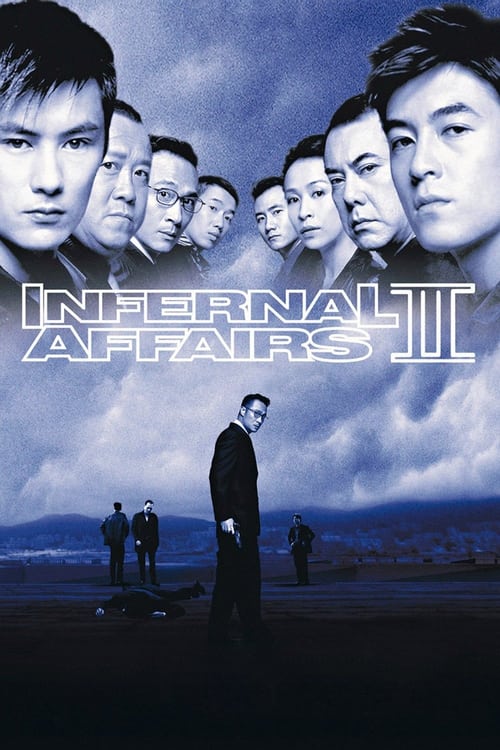
Infernal Affairs II
2003 · Alan Mak Siu-Fai
For when you want to sink into a sprawling, operatic crime epic — family, power, succession — rather than a quick adrenaline hit. Best when you're ready to commit to something dense.
What it's about
A prequel that rewinds the double-agent story to its roots: how a young cop went undercover in the Triads, how a young gangster was seeded inside the police, and the bloody succession war inside a crime family that made both plants necessary. It all unfolds against the 1997 handover of Hong Kong, with the city's own uncertain future bleeding into everyone's loyalties.
The experience
Slower-burning and more novelistic than a straight thriller — a brooding crime saga where betrayals accumulate across years rather than minutes, and the violence lands with dynastic weight.
Performances
Eric Tsang, usually cast for comedy, is quietly chilling as the mid-level boss clawing his way up, and Edison Chen and Shawn Yue give the younger moles a rawness that makes their older selves make sense.
The craft
The script's ambition is the star: it braids gang succession, police politics, and the handover itself into one moral climate, so history and crime story comment on each other. Moody, rain-slicked Hong Kong photography gives it a genuine period melancholy.
Why it matters
It transformed a taut two-hander into a generational saga and stands as the most overtly political chapter of one of Hong Kong cinema's landmark trilogies — for many critics the trilogy's secret heart.
Snapshot
Released just twelve months after the original Infernal Affairs (2002) reshaped Hong Kong's commercial and critical landscape, Infernal Affairs II is an ambitious prequel that reframes the double-agent story as a dynastic crime saga. Where the first film operated as a taut two-hander compressed into near real-time, this follow-up expands the canvas backward into the late 1990s, using the 1997 Handover of Hong Kong to Mainland China as both historical setting and moral climate. The film traces the origin stories of both Yan and Ming—here played by Edison Chen and Shawn Yue in their younger incarnations—while centering on the generational power struggle within the Triad organization led by Sam (Eric Tsang). It is the most overtly political entry in the trilogy and, for a certain strand of Hong Kong film criticism, the richest, precisely because it refuses to separate personal betrayal from colonial aftermath.
Industry & production
Infernal Affairs II was produced by Media Asia Films, the production house that bankrolled all three installments of the trilogy in rapid succession. The decision to mount a prequel while the first film was still circulating in regional cinemas reflected both commercial opportunism and genuine creative momentum: writers Alan Mak and Felix Chong had conceived of the story as a larger universe from an early stage, and the success of the original gave them the leverage to execute that vision.
The production cycle was aggressive. All three Infernal Affairs films were in various stages of development and pre-production simultaneously, and the trilogy was completed within roughly eighteen months. This compressed timeline is visible in the production design ambition required to recreate late-1990s Hong Kong on a Hong Kong commercial film budget—a task that involved period costuming, location dressing, and the careful management of anachronistic architecture. The ensemble cast, which brought back Anthony Wong and Eric Tsang from the first film while introducing Carina Lau as the morally complex Mary and Francis Ng in a career-defining performance as the Triad patriarch Ngai Wing-Hau, suggests that the budget, while not lavish by Hollywood standards, was sufficient to attract talent of the first rank. Specific production cost and box-office figures are not cited here, as reliable sourced numbers are not readily available in the scholarly record.
Technology
The visual infrastructure of Infernal Affairs II continues the approach established in the original: high-definition digital acquisition was a component of the production pipeline in keeping with the broader Hong Kong industry's rapid adoption of digital tools in the early 2000s, though the films were released theatrically in 35mm. Andrew Lau Wai-Keung, who co-directed the film alongside Alan Mak, had built his reputation as one of Hong Kong's most technically accomplished cinematographers—his credits as DP stretch back through the Young and Dangerous series—and retained a working involvement in the image-making even as his directorial responsibilities expanded. The specific division of on-set labor between Lau and Mak across the trilogy is not exhaustively documented in English-language scholarship, and claims about precise camera choices should be approached cautiously, but the visual continuity across the three films is sufficiently coherent to suggest Lau's cinematographic sensibility remained the dominant force behind the frame.
Technique
Cinematography
Where the first Infernal Affairs favored sleek, clean compositions in cool metallic registers—offices, rooftops, surveillance equipment rendered with an almost fetishistic precision—Infernal Affairs II introduces a warmer, more amber-tinted palette appropriate to its period setting and its more explicitly elegiac tone. The film makes frequent use of shallow depth of field to isolate characters against the bokeh of period-dressed Hong Kong streets, embedding the personal drama within a city that is visually present but soft, uncertain, transitional. Widescreen compositions often place characters at the margins of the frame, their centrality undermined by architecture and crowd. The 1997 Handover ceremonies are rendered with a documentary sobriety that contrasts with the stylized violence elsewhere, as if the film is marking the real event as something the visual grammar of genre cannot quite contain.
Editing
The editing of Infernal Affairs II is more expansive and less percussive than the first film's—a consequence of the shift from thriller mechanics to something closer to melodrama and chronicle. Where the original cut between its two protagonists with metronomic, almost musical precision, the prequel allows scenes to breathe, particularly in the sequences built around Carina Lau's Mary and Francis Ng's Ngai Wing-Hau. The intercutting of the Triad political intrigue with the younger characters' initiation into their respective undercover roles is managed through parallel editing that gradually draws the two narrative strands into the tragic alignment that viewers of the original will recognize as inevitable. The film's willingness to hold on faces—to let a reaction shot extend past the point where a thriller would cut away—signals the genre ambitions of its writers more clearly than any other formal element.
Mise-en-scène / staging
The staging in Infernal Affairs II is markedly more operatic than its predecessor's. Scenes of Triad ceremony, oath-taking, and ritual violence are composed and lit with an attention to symbolic weight—candlelit interiors, formally arranged bodies, the spatial grammar of hierarchy made legible through blocking—that draws on the long tradition of Hong Kong Triad cinema while inflecting it with a period consciousness. The 1997 setting enables a particular kind of nostalgic mise-en-scène: pagers instead of smartphones, specific street signage, the physical texture of pre-SAR Hong Kong. The film's most striking staging choices involve the juxtaposition of intimate domestic spaces—Sam's household, the informal family structures of Triad membership—against the bureaucratic and institutional spaces of the police force, a spatial argument about the mirrored structures that the trilogy has always been making.
Sound
The sound design extends the first film's practice of using ambient urban texture—traffic, crowd noise, the acoustic signature of elevators and car parks—as a kind of atmospheric constant beneath the music. Chan Kwong-Wing, who composed the trilogy's score, supplies Infernal Affairs II with music that is more mournful and less propulsive than the original's, leaning into low strings and spare piano figures where the first film often used electronic pulse. The use of source music and period Cantopop is restrained; the score largely avoids period pastiche, preferring to establish emotional register over historical atmosphere. The result is a sound world that reinforces the film's elegiac register, in which even moments of violence carry the weight of loss.
Performance
The most discussed performance in the film is Francis Ng's Ngai Wing-Hau, a Triad leader whose combination of paternal warmth, decisive brutality, and philosophical fatalism makes him one of the more memorable antagonists in Hong Kong crime cinema of the period. Ng works in a register that owes something to the charismatic gangster archetypes of the heroic bloodshed tradition but is tempered by a psychological interiority that the film's screenplay actively supports. Carina Lau as Mary occupies an equally complex position—a woman navigating a male criminal world through intelligence and controlled affect—and Lau finds the precise emotional frequency where calculation and genuine feeling become indistinguishable. Edison Chen and Shawn Yue as the younger versions of the series' protagonists face the structural challenge of inhabiting roles already defined by Tony Leung and Andy Lau in the original, and the general critical consensus is that they acquit themselves with credibility, if not the depth their predecessors brought, a reflection as much of their relative experience at the time as of the screenplay's priorities.
Narrative & dramatic mode
Infernal Affairs II operates in a mode that sits somewhere between prequel mechanics and dynastic melodrama. Its narrative task is explanatory—it must account for how two young men came to be embedded on opposite sides of the law—but it consistently subordinates that exposition to character study and historical allegory. The Triad power struggle at the film's center has the shape of a classical tragedy: a patriarch whose empire is fated to be consumed by internal rivalries, a woman of intelligence and ambition whose agency is ultimately circumscribed by the structures around her, and a generation of younger men whose destinies are already determined by the choices being made above them. The 1997 Handover functions not merely as backdrop but as structural metaphor: the transfer of sovereignty over Hong Kong becomes a figure for the transfer of criminal authority within Sam's organization, and both transfers mark an ending that is also an inheritance. The film uses dramatic irony more extensively than the original—viewers who have seen the first film already know how each of these characters will meet their end—and this foreknowledge shapes the emotional register into something closer to tragedy than thriller.
Genre & cycle
Infernal Affairs II belongs to the triad/crime film cycle that runs through Hong Kong cinema from at least the 1970s, through the heroic bloodshed films of John Woo and Ringo Lam in the late 1980s, through the Young and Dangerous franchise of the 1990s (for which Andrew Lau served as cinematographer and later director), and into the prestige crime cinema of the early 2000s. The trilogy as a whole marks a shift in how Hong Kong crime films address their Triad material: where earlier cycles often aestheticized brotherhood and loyalty as ends in themselves, the Infernal Affairs films are interested in the corrosion of identity under sustained deception. Part II in particular uses the period setting to introduce a more explicitly sociological dimension: the film is interested in how institutions—criminal and police alike—reproduce themselves across generations, and in what is lost and what is transferred in that reproduction. The influence of the American prestige crime television cycle (particularly The Sopranos, which began in 1999 and had been circulating widely in Asia by the time the Infernal Affairs trilogy was being developed) on the narrative ambitions of the series has been noted in passing in the critical literature, though direct evidence of influence is not well documented.
Authorship & method
The Infernal Affairs trilogy is a genuine co-authorship between Andrew Lau Wai-Keung and Alan Mak Siu-Fai, with Felix Chong Man-Keung as the third crucial voice as co-writer. Lau brought the visual infrastructure and a genre craftsman's instinct for pace and action; Mak brought a literary sensibility and an interest in character psychology and thematic density; Chong brought structural ingenuity and an ability to construct dialogue that carries philosophical weight without tipping into pretension. The division of directorial labor between Lau and Mak across the trilogy is not exhaustively documented in published sources, but accounts of the production suggest a collaborative model in which Mak took primary responsibility for directing performances while Lau oversaw the camera. Composer Chan Kwong-Wing's contribution to the emotional texture of all three films should not be understated: the score's ability to hold together the trilogy's tonal range—from thriller efficiency to romantic tragedy to historical elegy—is a significant part of what gives the films their coherence as a cycle.
Movement / national cinema
The Infernal Affairs trilogy arrived at a moment when Hong Kong cinema was negotiating its post-Handover identity with some urgency. The first years following 1997 had seen significant disruption to the Hong Kong film industry: the Asian financial crisis of 1997–98 had contracted the regional market, mainland co-production arrangements were altering the economics and the content of local filmmaking, and the emigration of major talent (including John Woo, Chow Yun-fat, Jackie Chan, and others) to Hollywood had diminished the commercial profile of Hong Kong cinema internationally. Infernal Affairs and its sequels represent a kind of consolidation—a demonstration that Hong Kong genre filmmaking could produce work of sufficient quality to reclaim critical prestige without abandoning its genre roots. Infernal Affairs II's explicit engagement with 1997 as a historical rupture places it within the tradition of Hong Kong films that process the Handover through generic displacement, a tradition that includes films as different as Wong Kar-wai's Happy Together (1997) and Fruit Chan's Handover trilogy.
Era / period
The film's production in 2003 coincides with the SARS outbreak, which severely disrupted Hong Kong public life and, along with the broader contraction of the regional film market, created conditions of economic and social anxiety that inflect the trilogy's elegiac tone, though no direct documented connection between the epidemic and the films' thematic content has been established in the scholarship. More broadly, 2003 marks the peak of the Infernal Affairs moment: the first film had already been remade in South Korea (Muui, 2005) and its reputation was traveling internationally at the speed of DVD and internet circulation, setting up the conditions for Martin Scorsese's The Departed (2006).
Themes
The film's thematic concerns are those of the trilogy as a whole, rendered in a more historical and generational key. Identity under sustained deception is the trilogy's central preoccupation, and Part II stages it as a problem of inheritance: who are you when the institution that shaped you is itself based on deception? The Handover provides a political correlative—Hong Kong's identity after 1997 was precisely the question of what was transferred, what was preserved, and what was lost in the change of sovereignty. Loyalty, the supreme value of both the Triads and the police force as depicted here, is shown to be structurally incompatible with the double lives both Yan and Ming are forced to live; the tragedy is that neither they nor the institutions they serve can acknowledge this incompatibility. The film is also unusually interested in feminine agency within patriarchal criminal structures: Mary's arc is among the more complex in the trilogy, and the film treats her intelligence and her constraints with equal seriousness.
Reception, canon & influence
Influences on the film: The Infernal Affairs trilogy draws on a range of precursors. The heroic bloodshed films of John Woo—particularly A Better Tomorrow (1986) and The Killer (1989)—established the template of the morally compromised man caught between institutional loyalty and personal integrity in a Hong Kong crime setting. The Japanese yakuza films of Kinji Fukasaku, particularly the Battles Without Honor and Humanity cycle (1973–76), provide a model for the dynastic crime saga with strong historical consciousness. The Young and Dangerous series, in which Andrew Lau had deep involvement, supplied a more proximate template for serialized Triad storytelling in Hong Kong popular cinema. For the prequel's more tragic and operatic register, the influence of Hong Kong melodrama—the school of filmmaking associated with directors like Patrick Tam—has been cited in passing in critical writing, though this connection is less systematically developed in the scholarship.
Critical reception: Infernal Affairs II was received warmly within Hong Kong and the regional critical circuit, though it did not match the first film's awards sweep. Francis Ng's performance was widely praised as one of the highlights of the trilogy. Some critics found the expansion of scope and the shift toward political allegory a dilution of the original's lean formal construction; others considered it a deepening. The film's relationship to its successors within the trilogy is complicated by the simultaneous release of Infernal Affairs III later in 2003, and the critical tendency has been to assess the three films together as a unified work rather than evaluate the prequel in isolation.
Legacy and forward influence: The trilogy's most consequential legacy is The Departed (2006), Martin Scorsese's Academy Award–winning remake of the first Infernal Affairs, which introduced the double-agent premise to a global multiplex audience and retrospectively raised the international profile of all three originals. Within Hong Kong and East Asian cinema, the trilogy's success helped establish the viability of prestige crime filmmaking and contributed to the ongoing negotiations between local genre traditions and mainland co-production priorities that would reshape Hong Kong cinema across the following decade. Edison Chen and Shawn Yue went on to significant careers in Hong Kong and mainland Chinese entertainment, and the prequel is frequently cited as an early showcase for both. The trilogy as a whole occupies a canonical position in any account of Hong Kong cinema in the decade following the Handover, and Infernal Affairs II's willingness to make that Handover explicit subject matter rather than mere background ensures its place in the political cinema of the period as well.
A Deleuzian reading
The candles are lit, the men kneel in rows, and a young face swears an oath it can never take back.
The full Deleuzian reading of Infernal Affairs II →
Reception
Released just a year after the original, it was inevitably received as 'the prequel' — but its stock has steadily risen, and the Godfather Part II comparisons critics reached for in 2003 have hardened into a genuine 'it might be the best of the trilogy' reputation.
How Infernal Affairs II was received, from release to now →
Influences: the films it descends from and the films it influenced
- A Better Tomorrow (1986) — Woo's origination of heroic bloodshed's ceremony-as-opera — Triad oath rituals staged with candlelit chiaroscuro, hierarchically arranged bodies, and slow-motion consecration — gives IA2 its blocking grammar for Ngai Wing-Hau's ritual authority over the Sam organization.
- The Killer (1989) — Woo's scoring practice of layering swelling, grief-saturated orchestral music over moments of criminal male sacrifice — converting melodrama into tragic dignity — is the direct sound template IA2 applies to Ngai Wing-Hau's decline and its elegiac closing sequences.
- City on Fire (1987) — Lam's structural invention of the undercover cop embedded long-term in a criminal organization whose divided loyalty is legible to the audience before either institution — the foundational dramatic irony device that IA2 elaborates retroactively as origin myth for both moles.
- Young and Dangerous (1996) — Andrew Lau's visual vocabulary for Hong Kong Triad hierarchy — oath ceremonies staged in candlelit interiors with formally arranged principals, criminal seniority rendered through spatial blocking rather than exposition — migrates directly into IA2, where Lau applies it with greater period precision to the 1997 setting.
- Beast Cops (1998) — Francis Ng's HKFA Best Actor performance as a Triad-adjacent cop whose paternalistic authority masks chronic moral compromise — physically still, vocally precise, capable of sudden violence — establishes the specific performative register IA2 deploys as Ngai Wing-Hau, the patriarch whose gravitational pull organizes the film's tragedy.
- The Godfather Part II (1974) — Coppola's invention of the prequel-as-dynastic-tragedy — where younger versions of established figures are watched through audience foreknowledge of their fates, and crime family succession staged through formal patriarch-centered ritual compositions — is IA2's structural template transposed wholesale to the Triad milieu.
- Once Upon a Time in America (1984) — Leone's amber-gold period palette for criminal nostalgia — warm, suffused with loss — combined with Morricone's elegiac orchestral scoring of criminal memory across historical time, provides IA2's tonal and chromatic blueprint for reconstructing late-1990s Hong Kong as a mourned, irretrievable space.
- In the Mood for Love (2000) — WKW's amber-tinted shallow-focus compositions — protagonists isolated against warm bokeh in widescreen frames where they occupy margins rather than centers — established the post-handover visual idiom for Hong Kong period nostalgia that IA2 adapts to crime cinema's staging of the 1997 moment.
- Farewell My Concubine (1993) — Chen Kaige's technique of mapping political catastrophe directly onto personal betrayal within an intimate partnership — using formal ceremony and historical upheaval as structural counterpoint to private collapse — establishes the method IA2 applies to the Handover as both setting and moral-dramatic metaphor.
- Infernal Affairs (2002) — IA1's cinematographic infrastructure — shallow depth of field isolating protagonists against urban bokeh, parallel editing cross-cutting between undercover identities with near-metronomic rhythm — is the inherited template IA2 transforms by shifting the palette from cool surveillance-blue to warm amber and the genre register from compressed thriller to dynastic chronicle.
- Infernal Affairs III (2003) — IA3 inherits and extends IA2's extended reaction shot grammar — holding on a face past the thriller's conventional cut point to let moral weight accumulate — applying this practice to a non-linear temporal architecture where faces bear the burden of events the audience has already witnessed but the character has not yet survived.
- Election (2005) — To's formal codification of Triad succession ritual — succession candidates blocked around the contested wooden baton, ceremony staged with explicit symbolic spatial grammar — extends and systematizes the operatic Triad ceremony staging IA2 had applied to Ngai Wing-Hau's period-precise 1997 power transfer.
- The Departed (2006) — Scorsese adopts IA2's parallel editing rhythm between criminal and institutional worlds, specifically its technique of letting audience foreknowledge transform ordinary workplace conversations into tragic foreshadowing — an ironic register IA2 produces precisely because viewers arrive already knowing who survives the original film.
- Election 2 (2006) — To deploys mainland political pressure as a structural force reshaping Hong Kong criminal organizations from without — extending IA2's formal device of embedding the Handover as an environmental determinant within every scene of institutional transition, scaling the metaphor from Triad succession to transnational capital.
- Overheard (2009) — Mak and Chong's continued authorial collaboration transfers the IA trilogy's ambient institutional surveillance texture — the acoustic and spatial presence of recording equipment woven into the editing rhythm of monitored space — to a financial thriller context, confirming it as a signature of their shared craft rather than a genre accident.
- PTU (2003) — To's method of building Hong Kong's nighttime ambient urban texture — wet pavement, institutional machinery, layered acoustic presences — into a structurally active element of the crime narrative is the contemporaneous formal practice IA2 shares for embedding personal drama in the sensory grain of the post-handover city.
Similar films
- Infernal Affairs (2002) — influence & lineage · same viewing thread
- The Departed (2006) — influence & lineage · same viewing thread
- A Better Tomorrow (1986) — influence & lineage
- The Godfather Part II (1974) — influence & lineage
- City on Fire (1987) — influence & lineage
- In the Mood for Love (2000) — influence & lineage
- The Killer (1989) — influence & lineage
- Exiled (2006) — shared sensibility
All the films related to Infernal Affairs II →
Watch it with: curated runs of related films
- Undercover and Underworld — A run of cops, criminals, and the moles planted between them — watch these back-to-back for how loyalty curdles into betrayal across one corrupt city after another, from the Boston docks to Hong Kong to Marseille-by-way-of-New-York.