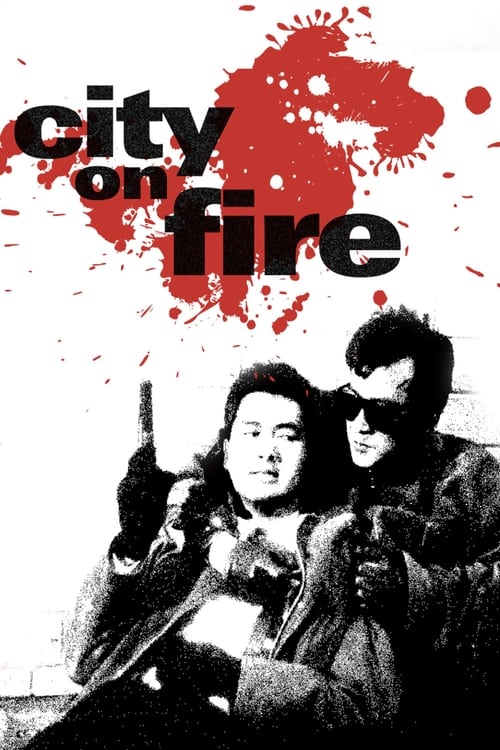
City on Fire
1987 · Ringo Lam Ling-Tung
For when you want a hard-edged crime picture with a heavy heart — adrenaline plus moral weight. Great for a gritty late-night double feature, not for when you need things to end tidily.
What it's about
Ko Chow is an undercover cop who wants out. His handler is forcing him to infiltrate one more crew — ruthless jewel robbers planning a big score — his girlfriend is giving him an ultimatum, and other cops who don't know he's one of them are hunting him. The longer he stays inside, the more the thieves feel like brothers and the badge feels like the betrayal.
The experience
Sweaty, fast, and fatalistic — Hong Kong at night, all neon and dread, with action that hurts rather than thrills. The real tension isn't the heist; it's watching a decent man get squeezed until something has to give.
Performances
Chow Yun-fat is magnetic as Ko Chow — exhausted, guilty, charming despite himself — a star turn built on weariness instead of swagger.
The craft
Ringo Lam strips the gloss off Hong Kong action: handheld urgency, real streets, gunfights staged for chaos and consequence rather than ballet. The mounting claustrophobia is the craft — every scene tightens the vise on its hero.
Why it matters
The film that made Ringo Lam the dark conscience of Hong Kong crime cinema — and, famously, the acknowledged blueprint for Quentin Tarantino's Reservoir Dogs, which reworked its undercover-man-among-thieves setup for American independent film.
Snapshot
City on Fire (龍虎風雲, literally "Dragon Tiger Wind Cloud") is Ringo Lam's breakthrough crime thriller and the film that established his reputation as the grittiest, most pessimistic voice of late-1980s Hong Kong action cinema. Built around Chow Yun-fat's performance as Ko Chow, an exhausted undercover cop sent to infiltrate a gang of armed jewel robbers, it transposes the genre's familiar heroics into a register of fatigue, guilt and moral exhaustion. Where John Woo's roughly contemporaneous A Better Tomorrow (1986) lent the gunfight an operatic, almost devotional grandeur, Lam pulled in the opposite direction toward sweat, betrayal and dread. The film is now doubly canonical: as a high point of the Cinema City era's tougher, more realist crime output, and — outside Asia — as the unmistakable template for Quentin Tarantino's Reservoir Dogs (1992), a debt that turned City on Fire into one of the most-discussed cases of cross-cultural borrowing in modern film culture. It is, first, a study of a man who can no longer tell which of his loyalties is real.
Industry & production
City on Fire was produced under the banner of Cinema City & Films Co., the studio that had reshaped Hong Kong commercial cinema across the early-to-mid 1980s with slick, fast comedies and the Aces Go Places franchise. By 1987 Cinema City was diversifying into harder-edged material, and Lam — who had returned from film study in Canada and worked his way up through television and lower-profile features — was given the latitude to make something bleaker than the studio's house style. The film belongs to the extraordinarily compressed, high-output Hong Kong industry of the period, in which shooting schedules were short, scripts often evolved on set, and stars cycled through multiple productions a year. Chow Yun-fat in particular was at the center of an astonishing run in 1986–1987, moving between Woo's "heroic bloodshed" pictures, romantic dramas such as An Autumn's Tale, and Lam's crime films, frequently overlapping. Precise budget and box-office figures for City on Fire are not securely documented in English-language sources, so claims about its commercial scale should be treated cautiously; what is clear is that it was a critical success that launched Lam's loosely connected "On Fire" cycle — followed the same year by Prison on Fire (also starring Chow) and later School on Fire (1988). The film took Best Actor for Chow Yun-fat at the Hong Kong Film Awards, and it is generally recorded as a major award contender that consolidated Lam's standing; readers should note that exact award tallies vary across sources.
Technology
City on Fire was shot on 35mm film and finished for theatrical exhibition in the standard Hong Kong manner of its day, including post-synchronized sound rather than location dialogue recording — a near-universal practice in the territory's production system. There is nothing technologically exotic about the film; its force comes from conventional tools used with unusual nerve. Lam and his crew favored available-light and naturalistic interiors, handheld coverage and on-location shooting in Hong Kong's streets, markets and cramped apartments, exploiting the responsiveness of lightweight camera rigs to keep pace with unrehearsed-feeling action. The post-dubbed soundtrack, far from a limitation, is part of the texture: looped voices, layered effects and music could be balanced freely in the mix, giving the film its slightly heightened, pressurized acoustic world. This is craft-driven cinema in which the "technology" of interest is really an entire mode of fast, flexible, location-based filmmaking rather than any single innovation.
Technique
Cinematography
The photography is credited to Andrew Lau Wai-keung — later a major director in his own right and, resonantly, co-director of the undercover-cop landmark Infernal Affairs (2002). His camerawork on City on Fire is restless and tactile: handheld where the drama frays, close on Chow Yun-fat's perspiring, harried face, and willing to let Hong Kong's real geography crowd the frame. The visual scheme leans toward grime and warmth rather than the cool, glassy stylization that would later dominate the territory's crime films; light sources are often diegetic and unglamorous. In the robbery and its aftermath, the handheld instability becomes expressive, refusing the clean sightlines of choreographed gunplay in favor of confusion and proximity. It is photography in service of immediacy and entrapment.
Editing
The cutting builds the film's signature rhythm of slow-burn tension punctured by sudden violence. Long stretches of suspicion, negotiation and surveillance accumulate pressure; the eruptions — the botched heist, the chases, the standoff — are cut for shock and disorientation rather than balletic clarity. The editing also manages a tricky structure of mounting dread, in which the audience knows Chow's secret while the gang does not, and every scene is tightened by that dramatic irony. Specific editorial credits and the names of the cutting team are not reliably documented in widely available English sources, and I won't guess at them.
Mise-en-scène / staging
Lam's staging is the film's defining achievement. He favors enclosed, sweat-soaked spaces — interrogation rooms, safehouses, vehicles, and finally a warehouse — that physicalize Chow's sense of being boxed in on every side. The famous climax stages a Mexican standoff with multiple men holding guns on one another at point-blank range, a tableau of total mutual entrapment that crystallizes the film's theme of loyalties that cannot be reconciled. Throughout, props and bodies are arranged to stress vulnerability rather than mastery: the heroes bleed, flinch and panic. The robbery sequence's chaos and the intimacy of the Chow–Fu friendship are both built through staging that keeps characters uncomfortably close.
Sound
As with most Hong Kong films of the era, dialogue and effects were assembled in post-production, and the mix is used to ratchet tension — gunfire, sirens and the clamor of the city pressing against quieter scenes of moral negotiation. The musical score underlines the melancholy at the film's core, scoring Chow's exhaustion and the doomed camaraderie between cop and criminal rather than merely energizing the action. I do not have a securely attributable composer credit to cite here and will not invent one; the score's function, more than its authorship, is what the record supports.
Performance
Chow Yun-fat's Ko Chow is the film's center of gravity and one of the great performances of his career — a deliberate inversion of the invulnerable gunman persona he was simultaneously building for John Woo. Here he is haggard, frightened and morally seasick, a man whose cover is dissolving into genuine feeling for the men he is betraying. The performance won him the Best Actor award at the Hong Kong Film Awards and remains a touchstone of his range. Danny Lee, an icon of Hong Kong cop-and-robber films, plays the gangster Fu, whose growing bond with Chow gives the film its tragic engine; the chemistry between the two men makes the eventual betrayal genuinely painful. Sun Yueh, as the manipulative police superior who keeps pushing Chow back into danger, supplies the institutional cynicism against which Chow's conscience breaks.
Narrative & dramatic mode
The film operates in the mode of tragic irony. From the outset the audience holds the knowledge that drives the suspense — Chow is a cop — while the gang he infiltrates does not, so that every gesture of friendship is shadowed by impending exposure. The structure is a slow tightening rather than a series of set pieces: pressure from his handler, from rival officers who do not know he is one of their own, and from a private life collapsing under the strain of the job. The heist-gone-wrong functions less as a thrill than as the mechanism that forces the moral collision to its end. Crucially, Lam withholds redemption; the narrative drives toward mutual destruction and the impossibility of clean allegiance. This is melodrama stripped of consolation, closer to film noir's fatalism than to the genre's usual triumphalism.
Genre & cycle
City on Fire sits at the intersection of the undercover-cop thriller and the heist film, and it inaugurated Lam's "On Fire" cycle — a loose series united less by plot than by a worldview of institutions that grind individuals down. Within the booming Hong Kong crime wave of the mid-to-late 1980s, it represents the realist, downbeat alternative to Woo's romantic "heroic bloodshed." Both strands share stars (Chow Yun-fat above all), iconography (handguns, brotherhood, betrayal) and a fascination with codes of loyalty, but Lam's films trade glory for grime. The undercover-cop premise — a man whose identity is split between two worlds until the seam tears — would prove one of the most durable templates in Hong Kong cinema, running forward through the territory's crime output for decades.
Authorship & method
Ringo Lam emerged with City on Fire as the great pessimist of his cinematic generation. Trained partly abroad and seasoned in television, he brought a sociological, almost documentary instinct to genre material: an interest in how systems — the police, the underworld, the prison, the school — deform the people inside them. His method favored location realism, handheld immediacy and morally compromised protagonists over stylized heroism, and he repeatedly cast Chow Yun-fat against the grain of the star's glamorous image. Among his key collaborators here, cinematographer Andrew Lau is the most consequential, both for the film's tactile look and for the uncanny throughline from this undercover-cop story to his own Infernal Affairs. The screenplay is credited to Lam working with collaborators in the fast, adaptive Cinema City development culture; specific co-writer attributions vary across sources, and I flag that the writing credits are not something I can pin down with full confidence. The reliable core of the authorship story is Lam's directorial signature: tension over spectacle, fatigue over heroism, and an unsparing view of loyalty as a trap.
Movement / national cinema
The film is a product of Hong Kong cinema's second New Wave commercial peak, a moment when a small, intensely productive industry was exporting genre filmmaking of remarkable energy. It belongs to the territory's crime-thriller boom alongside the work of John Woo, Tsui Hark's Film Workshop, and others, and it exemplifies the Cinema City studio's pivot toward harder material. More broadly it speaks to a Hong Kong cinema increasingly preoccupied, in the years after the 1984 Sino-British Joint Declaration, with anxieties of identity, loyalty and dissolving allegiance — themes that the undercover-cop narrative renders almost allegorically, even where the film makes no explicit political statement.
Era / period
1987 sits at the high-water mark of Hong Kong's pre-handover commercial cinema, a period of extraordinary output, star saturation and genre innovation, but also of mounting unease about 1997. City on Fire captures the era's mood of pressure and impending rupture without naming it: a protagonist pulled apart by incompatible demands, an institution that uses him up, a city rendered as a pressure cooker. The film's fatalism reads, in retrospect, as very much of its anxious moment.
Themes
At its core the film is about divided loyalty and the impossibility of holding two faiths at once. Ko Chow is asked to betray men who have become genuine friends, in the name of a police apparatus that shows him little loyalty in return; the deepest relationship in the film is the forbidden one, between cop and criminal. Related themes braid through it: the corrosion of identity under deep cover; institutional cynicism and the disposability of individuals; guilt and conscience as fatal weaknesses in a world that rewards neither; and the collapse of the boundary between law and crime, dramatized in a finale where everyone's gun points at everyone else. Masculinity here is not heroic but exhausted — a man who would rather quit than keep betraying, and who is given no clean way out.
Reception, canon & influence
Within Hong Kong, City on Fire was received as a major work and a career-defining showcase for Chow Yun-fat, securing him Best Actor recognition at the Hong Kong Film Awards and establishing Ringo Lam as a leading director of the crime genre; it anchored the "On Fire" cycle that followed. Among the influences on the film, the most legible is film noir's fatalism and the undercover-thriller tradition, refracted through the immediate example of Hong Kong's own mid-1980s crime wave — Lam consciously defining himself against Woo's romanticism rather than imitating it.
The film's forward influence is vast and runs along two tracks. Domestically, its undercover-cop architecture and its theme of fractured identity feed directly into the lineage that culminates in Infernal Affairs (2002), a connection made more pointed by the presence of City on Fire's cinematographer Andrew Lau in that later film's director's chair. Internationally, City on Fire became famous as the principal model for Quentin Tarantino's Reservoir Dogs (1992): the jewel-heist-gone-wrong premise, the undercover man embedded among thieves, the wounded gangster, and above all the climactic multi-gun standoff. The parallels were analyzed at length in Mike White's video essay Who Do You Think You're Fooling? (1994), which placed the borrowing at the center of debates about homage, appropriation and authorship in postmodern filmmaking — and, ironically, carried City on Fire's reputation to Western audiences who might otherwise never have encountered it. The result is a film canonized twice over: as a landmark of Hong Kong crime cinema in its own right, and as a touchstone in the global conversation about influence itself.
A Deleuzian reading
Hold on the warehouse.
The full Deleuzian reading of City on Fire →
Reception
A hit in Hong Kong that won big at the 1988 Hong Kong Film Awards, it was barely known in the West until Reservoir Dogs came out — then cinephiles tracked it down and it became essential viewing, the gritty flip side of the John Woo canon.
How City on Fire was received, from release to now →
Influences: the films it descends from and the films it influenced
- Le Cercle Rouge (1970) — Lam inherits Melville's cool fatalism and the procedural-jewel-heist-among-doomed-professionals template, where loyalty between criminals is rendered as a deterministic trap rather than romance.
- The Asphalt Jungle (1950) — Establishes the jewel-heist-gone-wrong architecture where a meticulously assembled crew unravels through internal weakness — the structural blueprint Lam compresses into a paranoid undercover frame.
- The Killing (1956) — Models the heist whose payoff disintegrates into mutual suspicion and a death-strewn collapse, the ironic 'plan defeated by its own men' logic Lam routes toward tragic identity.
- The Friends of Eddie Coyle (1973) — Pioneers the grubby, available-light realism of the informant embedded among criminals, prizing fatigue and betrayal-anxiety over action — the documentary-of-the-underworld texture Lam adopts.
- Serpico (1973) — Supplies the institutional-cynicism thread: the undercover cop ground down by his own department, where the badge is as corrosive as the crime, feeding Lam's view of the police as a deforming system.
- Mean Streets (1973) — The handheld, location-bound immediacy and morally compromised protagonist caught between loyalties give Lam his tactile, sweaty street grammar over choreographed spectacle.
- Point Blank (1967) — Its fractured-identity crime hero and existential coldness toward genre payoff anticipate Lam's interest in the protagonist whose self dissolves under double allegiance.
- Reservoir Dogs (1992) — Lifts City on Fire's core directly — the jewel-heist-gone-wrong, the undercover man embedded among thieves, the gut-shot bleeding-out gangster, and the climactic multi-gun Mexican standoff — as documented in Mike White's 'Who Do You Think You're Fooling?'
- Donnie Brasco (1997) — Extends the undercover-cop-bonding-with-his-target tragedy, where the agent's fabricated loyalty becomes emotionally real and the betrayal he must commit destroys him — Lam's 'loyalty as trap' rendered as procedural drama.
- Infernal Affairs (2002) — The culmination of Lam's undercover-identity lineage, directed by City on Fire's own cinematographer Andrew Lau, who carries the fractured-allegiance theme and tactile HK crime texture into the mole-versus-mole structure.
- The Departed (2006) — Remaking Infernal Affairs, it closes the circle back to Lam's source preoccupation — the cop and criminal whose identities blur under deep cover until institutional loyalty becomes self-annihilating.
- Election (2005) — Inherits Lam's unromantic, sociological view of the triad as an institution that deforms its members, favoring slow-burn dread and procedural cynicism over Woo-style heroic spectacle.
- Infernal Affairs II (2003) — Lam's structural invention of the undercover cop embedded long-term in a criminal organization whose divided loyalty is legible to the audience before either institution — the foundational dramatic irony device that IA2 elaborates retroactively as origin myth for both moles.
- The Mission (1999) — Lam's grimy, sweat-and-handheld triad-and-undercover realism supplies the loyalty-under-cover milieu that Milkyway coolly re-photographs with locked framing instead of nervous motion.
- A Better Tomorrow (1986) — The immediate Hong Kong New Wave crime touchstone and shared Chow Yun-fat showcase against which Lam consciously defines himself — substituting Woo's balletic heroism and brotherhood-romance with grime, exhaustion and betrayal.
- Prison on Fire (1987) — Lam's own follow-up in the 'On Fire' cycle, extending the same sociological method — how the institution (here the prison) deforms its inmates — with Chow again cast against his glamorous image.
- Hard Boiled (1992) — The contemporaneous undercover-cop-among-gangsters thriller that shares the divided-loyalty premise while taking the opposite stylistic route, sustained gun-ballet maximalism against Lam's slow-burn restraint.
- Full Contact (1992) — Lam reprising the Chow Yun-fat collaboration and his betrayal-among-thieves obsession, pushing the enclosed-tension and available-light staging into a harder, neon-lit register.
- Heat (1995) — Shares the professional-crew-versus-cop architecture and the climactic, geographically precise standoff treated as tragic inevitability rather than thrill, with the same fatalism about men defined by their work.
- The Killer (1989) — A contemporaneous Hong Kong golden-age crime film built on the same undercover-cop/criminal emotional mirroring and gritty male loyalty, sharing Chow Yun-fat as the cycle's defining face.
- Bullet in the Head (1990) — A parallel Hong Kong heroic-bloodshed film built on undercover loyalty and betrayal, sharing the same emotionally-weighted violence and doomed-brotherhood grammar of the movement Woo helped define.
Similar films
- A Better Tomorrow (1986) — influence & lineage
- Hard Boiled (1992) — influence & lineage
- Infernal Affairs (2002) — influence & lineage
- Reservoir Dogs (1992) — influence & lineage
- Serpico (1973) — influence & lineage
- Heat (1995) — influence & lineage
- Chungking Express (1994) — shared sensibility
- The Killer (1989) — shared sensibility