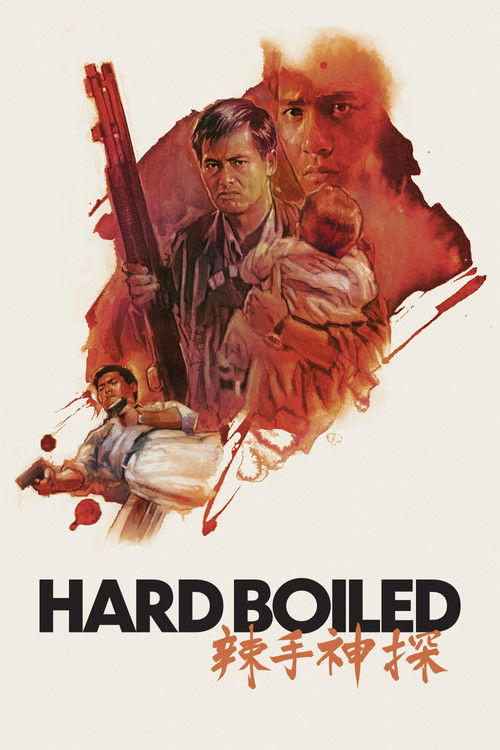
Hard Boiled
1992 · John Woo
When you're craving maximum action — the film to reach for when you want your jaw on the floor and your pulse up, ideally with the volume loud and no interruptions.
What it's about
A hot-headed Hong Kong cop loses his partner in a shootout with gun smugglers and vows to take the ring down. His path collides with an undercover officer buried so deep inside the syndicate — working as a hitman — that he's losing track of who he really is. The two join forces, and the hunt leads to an arsenal hidden inside a hospital, where everything detonates.
The experience
Pure adrenaline — relentless, operatic, almost giddy in its excess, with gunfights staged like violent ballet. It's exhausting in the way a great rollercoaster is exhausting, but there's real melancholy underneath about loyalty and lost identity.
Performances
Chow Yun-fat's swaggering, jazz-playing Inspector Tequila is movie-star charisma at full blast, and Tony Leung Chiu-wai gives the film its soul as the undercover man quietly coming apart.
The craft
John Woo's choreography is the main event: two-gun standoffs, slow-motion dives, and a climactic hospital siege — including one astonishing extended take through corridors mid-firefight — that remains a summit of action filmmaking. The stunt work and practical mayhem reward the biggest, loudest setup you have.
Why it matters
Woo's farewell to Hong Kong before Hollywood, it distilled everything he'd built into one final statement — and its style has been borrowed by action movies and video games ever since.
Snapshot
Hard Boiled is John Woo's farewell to Hong Kong cinema: a maximalist, furiously choreographed crime film that functions simultaneously as a refinement of everything Woo had developed across the preceding decade and as a conscious leave-taking from the industry and genre he had helped define. Released in April 1992 under the Chinese title 辣手神探 (Lat sau san taam, roughly "The Quick-Handed Detective"), it stars Chow Yun-fat as the hot-headed Inspector Tequila and Tony Leung Chiu-wai as Tony, an undercover operative buried so deep inside a gun-smuggling syndicate that his own identity has begun to dissolve. The two converge on a villain's illegal arsenal hidden inside a hospital, and the resulting climax—a sustained, labyrinthine firefight through corridors, wards, and a maternity unit—stands as one of the most extravagant action sequences in the history of commercial cinema. Within a year of the film's release, Woo had accepted Hollywood's overtures and signed on to direct Hard Target (1993). Hard Boiled thus acquired the additional weight of a culmination: the apex and the closing chapter simultaneously.
Industry & production
Hard Boiled was produced by Golden Princess Film Production and Milestone Pictures, with Terence Chang and Linda Kuk serving as producers. Chang had been Woo's producing partner throughout the heroic-bloodshed cycle that began with A Better Tomorrow (1986), and his relationship with Woo would continue into the Hollywood years. The film was made during Hong Kong cinema's commercially and creatively buoyant early-1990s period—the window between the industry's mid-1980s resurgence and the anxiety over the 1997 handover that would increasingly inflect production decisions toward the mid-decade.
The screenplay was written by Barry Wong, a prolific Hong Kong genre writer who had collaborated with Woo on earlier projects. Wong was diagnosed with cancer during the film's development and died before the film was completed; the production proceeded under difficult circumstances, and certain narrative gaps or tonal inconsistencies that critics have noted in the script may reflect the incomplete state in which the work was finished. The degree to which the screenplay was revised after Wong's death is not clearly documented in the available record.
The production's most discussed challenge was the climactic hospital sequence, which by various accounts required between several weeks and several months of shooting—the exact figure is cited inconsistently across interviews and retrospectives. The production reportedly constructed a dedicated hospital set, or made extensive use of a real structure, to accommodate the complexity of staging a continuous multi-room action sequence with practical pyrotechnics, moving cameras, and large numbers of stunt performers. The scale of that undertaking is legible in the finished film: the sequence runs approximately thirty minutes and involves the systematic destruction of nearly every visible space it moves through.
Technology
Hard Boiled's technical signature lies in the marriage of Steadicam mobility with high-density pyrotechnic staging. The celebrated corridor tracking shot midway through the hospital finale—in which Tequila and Tony move through a sustained firefight while Tequila carries an infant—was achieved via Steadicam and represents one of the earlier examples of an extended continuous take being deployed as the governing formal logic of an action climax rather than as an isolated flourish. The shot is commonly cited as running over two minutes without a cut, though accounts vary.
High-speed photography for slow-motion was central to Woo's visual vocabulary by this point, and Hard Boiled employs it more systematically than his prior films. The technique had been refined across A Better Tomorrow, The Killer (1989), and Bullet in the Head (1990), and by 1992 the variable-speed aesthetic—cutting between normal frame rates and undercranked or overcranked passages within a single action beat—had become a recognizable stylistic marker of the heroic-bloodshed genre as a whole. Practical explosives and squibs remain the dominant effects approach; the film predates the era of extensive digital compositing, and its action sequences have consequently retained a physical weight that later CGI-augmented work often lacks.
Technique
Cinematography
The cinematography was handled by Wong Wing Hung, working in an idiom that Woo and his long-term collaborators had developed across the heroic-bloodshed cycle. The visual language privileges lateral movement, low angles that exaggerate kinetic mass, and a restless frame that tracks bodies through space rather than anchoring them within it. Woo and Wong maintain compositional legibility through even the most chaotic exchanges: the spatial geography of the hospital is kept comprehensible largely through sightline consistency and a systematic hierarchy of shot scales that orients the viewer even as the mise-en-scène multiplies into conflagration. The opening tea house sequence, by contrast, demonstrates the same grammar in a compressed register—close angles, fragmentary cutting, the canary cage in frame as an ironic pastoral note before the violence erupts.
Editing
The film was edited by David Wu, who had worked with Woo on earlier productions. Wu's editing approach in Hard Boiled embodies what would become one of the period's most imitated action-editing strategies: beats of hyperdense cutting that articulate bodies and gunfire in near-abstract sequences, punctuated by slow-motion passages that function as lyric dilation—as if time itself hesitates to honor a moment of sacrifice or kinetic beauty. The rhythm is operatic rather than percussive; the editing serves choreography rather than pace in the narrow sense, allowing sequences to breathe and expand well beyond functional duration. The hospital sequence, which eschews conventional shot-reverse-shot grammar for extended periods in favor of following movement, represents the logical extreme of this approach.
Mise-en-scène / staging
Woo's staging operates from a theatrical premise: the gunfight as choreographed performance, its violence formalized into something approaching dance. This extends to blocking that is openly geometrical—characters arrayed in facing configurations that recall dueling codes, bodies that pirouette and slide through space with evident awareness of their own trajectories. The influence of Gene Kelly's MGM musicals, which Woo has cited in interviews as a formative influence, is not merely decorative; the staging logic genuinely treats movement through space as expressive rather than purely tactical.
The hospital's moral dimension is staged with equal deliberateness. The maternity ward forces continuous proximity between mass violence and newborn life; the baby that Tequila carries is not incidental but structurally central, transforming the gunfight into an act of protection and relocating the heroic register from vengeance to something more elemental. The white doves that appear throughout—an established Woo motif, familiar from The Killer—acquire their most explicitly religious charge here: in a brief chapel interlude within the hospital sequence, the presence of doves and votive candles fuses the action film's violence with an iconography of sacrifice and grace.
Sound
The sound design amplifies the percussive impact of the film's firearms while Woo's use of music works against expectation: lyrical or melancholic passages score moments of maximum violence, creating an affective counterpoint that is characteristically his. The score—composed by Michael Gibbs, though the precise division of labor between the film's musical contributors is not exhaustively documented—moves between jazz-inflected passages appropriate to Tequila's character (his name, his occupation of the tea house, the trombone he plays in a quieter early scene) and more propulsive orchestral material. The jazz thread is significant: it aligns the film with a lineage of American noir that Woo has consistently acknowledged, while also establishing Tequila as a figure whose sensibility exceeds the institution he serves.
Performance
Chow Yun-fat by 1992 had refined the cool, slightly melancholic charisma he had developed across Woo's earlier films into a mode that was fully his own: a surface ease that conceals the specific emotional commitments of the character without suppressing them entirely. Tequila is less internally conflicted than Chow's roles in A Better Tomorrow or The Killer, but the actor grounds what might otherwise be a pure kinetic function in palpable feeling. Tony Leung Chiu-wai, working in a more introverted register, brings to Tony a quality of suppressed exhaustion—a man who has lived inside an alias for so long that the return to his actual self is represented less as relief than as disorientation. The chemistry between the two leads is convincing precisely because their stylistic modes are complementary rather than identical. Anthony Wong Chau-sang plays the principal villain Johnny Wong with a flat, administrative menace that is more unsettling than histrionics would be. Philip Kwok's Mad Dog, the lieutenant with a personal code, provides the film with its most conventional figure of honorable adversarialism.
Narrative & dramatic mode
Hard Boiled operates within the narrative grammar of the buddy film and the undercover thriller, but it subordinates plot mechanics to emotional and kinetic stakes with a directness that can make the connective tissue seem thin. The film is less interested in procedure than in the existential condition of men whose professional identity requires them to inhabit roles that gradually consume them: Tequila's impulsive insubordination is one form of this erosion, Tony's near-total immersion in his cover another. The structure moves efficiently from setup through escalating confrontation to the sustained climactic sequence, which in sheer duration overwhelms the preceding acts. The narrative mode is broadly melodramatic in the specific Hong Kong genre sense: male bonds, codes of loyalty and betrayal, sacrificial action as the resolution of moral debts.
Genre & cycle
Hard Boiled belongs to the heroic bloodshed genre (英雄本色 is the title that named the cycle), a distinctly Hong Kong category that Woo and producer Tsui Hark consolidated with A Better Tomorrow in 1986. The genre drew on American film noir, the Italian genre western, and the male melodrama of films like those of Jean-Pierre Melville, fusing these with a Hong Kong synthesis that emphasized filial and fraternal loyalty, the corruption of institutions, and action sequences of escalating formality and scale. By 1992 the cycle had reached a point of saturation—Woo's own Bullet in the Head (1990) had tested the genre's capacity for tragedy—and Hard Boiled can be read as a kind of summative gesture: a film that distills the genre's defining elements to their maximum expression rather than complicating or subverting them. The hospital sequence is in this sense not an excess but a logical terminus.
Authorship & method
Woo's authorial signature across the heroic-bloodshed cycle is legible in Hard Boiled at every level: the formal catholicism that fuses violence with beauty, the recurrence of the double (paired protagonists whose identities mirror and complement each other), the religiosity that inflects sacrifice with transcendent meaning, the sustained interest in male bonds as the film's primary emotional axis. These are not merely stylistic tics but constitutive thematic and structural commitments.
Wong Wing Hung's cinematography provides the visual grammar, David Wu's editing translates choreography into rhythm, and Barry Wong's script—however disrupted in its composition—establishes the narrative poles across which Woo's staging operates. The film is a collaborative product, as all industrial cinema is, but Woo's directorial personality is sufficiently strong and consistent that auteurist readings are not merely plausible but necessary to account for the film's coherence as something beyond a genre exercise.
Movement / national cinema
Hard Boiled is a product of Hong Kong cinema's mature commercial period—the approximately fifteen years between the New Wave's emergence around 1979 and the increasing uncertainty of the mid-1990s preceding the 1997 handover. Hong Kong cinema of this period was distinguished by a remarkable synthesis of genres and influences, a production model that permitted both commercial efficiency and directorial personality, and an action cinema that had no genuine peer in either technical accomplishment or formal ambition during the 1980s and early 1990s. Woo's work represents the genre peak of this period, and Hard Boiled its most technically realized example. The film also reflects the period's characteristic anxiety about institutional loyalty and political belonging—the undercover identity crisis has been read, not implausibly, as an allegory for the colony's impending renegotiation of its own status.
Era / period
The film occupies the cusp between Hong Kong cinema's commercial peak and its subsequent transformation. It also anticipates the stylistic vocabulary that would define Hollywood action filmmaking in the latter half of the 1990s and beyond, functioning as a kind of prospective document: Woo himself would carry versions of its technique into the American system, and its influence on filmmakers who encountered it through festival screenings, laserdisc imports, and bootleg VHS circulation was immediate and traceable.
Themes
The film's thematic core concerns identity under institutional pressure. Both protagonists are men whose professional roles have displaced their personal ones: Tequila's grief for his partner, his troubled relationship with authority, his unacknowledged tenderness (the trombone, the protective fury surrounding the infant); Tony's loss of stable selfhood inside a cover so complete that his rescue by Tequila is partly a rescue from himself. The villain Johnny Wong represents institutional corruption in a pure form—power organized entirely around self-interest and the willingness to annihilate those who stand between it and its goals.
The Catholic iconography Woo deploys—doves, chapels, postures of sacrifice—frames the film's violence in a vocabulary of redemption and grace that does not so much moralize the action as elevate it into a register where moral questions are answered by the willingness to act and to suffer. Innocence, figured by the infant and the patients of the maternity ward, is simultaneously what the violence threatens and what it protects; the contradiction is not resolved but sustained as the film's emotional engine.
Reception, canon & influence
Backward influences: Woo has been consistent and specific about his debts. Sam Peckinpah's The Wild Bunch (1969) established the template for slow-motion violence as aesthetic intensification rather than mere technique; Woo absorbed this and systematized it into a repeatable grammar. Jean-Pierre Melville's crime films—particularly Le Samouraï (1967) and Le Cercle Rouge (1970)—provided the model of the gentleman criminal operating by private codes within a corrupt world, and the stylized, near-abstract quality of their violence. American film noir supplied the institutional cynicism and the morally compromised investigator. Woo's own prior work—A Better Tomorrow, The Killer—constitutes an immediate genealogy; Hard Boiled is legible as a direct extension and amplification of The Killer's formal ambitions.
Critical reception: The film was well received in Hong Kong on release and attracted significant attention at international festivals, where it confirmed Woo's reputation among critics and filmmakers who had been tracking the heroic-bloodshed cycle. In Western markets, much of its initial audience arrived through import channels—laserdisc and VHS—before theatrical distribution in the United States. Critical writing in English tended to focus on the formal accomplishment of the action sequences, sometimes at the expense of the film's more conventional dramatic material; the hospital sequence became a set-piece citation in writing about action cinema for decades afterward. Specific box-office figures for its various releases are not reproduced here, as reliable figures across its theatrical runs are not readily verifiable.
Forward influence: Hard Boiled's influence on Hollywood action cinema from the mid-1990s onward is substantial and well documented. The Wachowskis, in preparation for The Matrix (1999), screened Woo's films extensively and hired action choreographer Yuen Woo-ping to adapt Hong Kong-derived kinetic grammar for a Western production; the slow-motion balletics and the gun-kata aesthetic that The Matrix popularized have their most direct antecedents in Woo's work of this period. Robert Rodriguez and Quentin Tarantino, both of whom championed Hong Kong genre cinema in American critical and filmmaking circles during the 1990s, absorbed Woo's formal strategies visibly. The John Wick franchise (2014–), which consolidated a generation of Hollywood gun-choreography innovation, is unthinkable without the vocabulary that Woo established and that Hard Boiled exemplifies most extravagantly. The video game series Max Payne (2001–) translated the film's visual language—particularly the Steadicam tracking and slow-motion gun play—directly into an interactive medium, naming its core mechanic "bullet time" in a phrase that subsequently migrated back into critical writing about cinema. Hard Boiled has been included in retrospective canon-formation exercises by major film institutions and publications; it is among the films most frequently cited when writers survey the global action genre's formal development across the 1990s and 2000s.
A Deleuzian reading
Inspector Tequila moves down a hospital corridor with a newborn cradled in one arm and a pistol working in the other, and the camera glides beside him for two minutes without cutting away.
The full Deleuzian reading of Hard Boiled →
Reception
A solid hit in Hong Kong, it exploded in the West through the '90s video-store cult around Woo, becoming his calling card for Hollywood — today it's routinely ranked among the greatest action films ever made.
How Hard Boiled was received, from release to now →
Influences: the films it descends from and the films it influenced
- The Wild Bunch (1969) — Peckinpah's intercut slow-motion death sequences—multiple cameras at varying frame rates cut against each other—gave Woo the template for treating gunshot violence as lyric intensification rather than mere incident, a grammar Woo then systematized into repeatable form.
- Le Samouraï (1967) — Melville's near-wordless staging of the gentleman killer operating by private codes within a corrupt institution supplied Woo's model for a protagonist defined entirely by personal ethics over institutional loyalty, with violence rendered nearly abstract through geometric precision.
- Le Cercle Rouge (1970) — Melville's long silent heist sequence—group action choreographed without dialogue, rendered abstract by spatial precision—provided the formal model for staging multi-body violence as something closer to dance than conventional screen action.
- Singin' in the Rain (1952) — Woo has cited Gene Kelly's choreographic architecture—the precise mapping of acrobatic movement through screen space, integrating physicality with emotional expressivity—as a direct model for staging gunfights as dance sequences rather than combat exchanges.
- Bonnie and Clyde (1967) — Penn's slow-motion final ambush established the American precedent for treating gunshot death as a lyric event, legitimizing the aesthetic strategy that fed Peckinpah and, through Peckinpah, reached Woo as the foundational grammar of ballistic beauty.
- A Better Tomorrow (1986) — Established the heroic bloodshed genre's core formal conventions—dual-wielded pistols fired from both hands, slow-motion sacrifice staged as transcendence, male friendship as the primary emotional axis—that Hard Boiled inherits wholesale and then escalates.
- The Killer (1989) — Hard Boiled directly extends this film's formal grammar: the two-protagonist moral mirror, the Steadicam-driven church set pieces, Chow Yun-fat's mythologized performance mode, and the operatic editing rhythm are all continuous from one film to the other—Hard Boiled is its amplification.
- Face/Off (1997) — Woo's Hollywood translation scales the Hard Boiled hospital-sequence model—Steadicam long-take, continuous gun choreography tracked through architecture—to a studio budget, while transposing the identity-dissolution theme into a literal body-swap premise that makes the subtext structural.
- The Matrix (1999) — The Wachowskis screened Woo's films in preparation, hired action choreographer Yuen Woo-ping to adapt Hong Kong kinetic grammar, and named their variable-speed cinematography 'bullet time'—a direct popularization and branding of the slow-motion mechanism Hard Boiled deployed without naming.
- Kill Bill Vol. 1 (2003) — Tarantino appropriates Woo's affective counterpoint—the deliberate scoring of graphic violence with lyric or incongruously beautiful music—and the operatic editing rhythm that treats action sequences as self-contained formal units with their own tempo, climax, and release.
- Infernal Affairs (2002) — Lau and Mak systematize the undercover-identity-dissolution narrative that Hard Boiled deploys as its primary subplot, elevating the device to the central structural and thematic subject—a direct formal consequence of the heroic bloodshed cycle's sustained engagement with the figure of the infiltrator.
- John Wick (2014) — The corridor-clearing, architecturally continuous long-take gun sequences that define Wick's action grammar directly descend from Hard Boiled's hospital tracking shot; the franchise consolidated a generation of Hollywood gun-choreography practice built on the vocabulary Woo established.
- Oldboy (2003) — Woo's hospital corridor climax — a sustained lateral tracking shot following gun combat through narrow institutional hallways — establishes the choreographic grammar of confined-space action filmmaking that Oldboy's hallway brawl directly inherits, substituting exhausted hand-to-hand attrition for ballistic ballet while preserving the fixed-axis, side-scrolling formal logic.
- Mission: Impossible II (2000) — Introduced wire-assisted mobility that transforms gunfighters into aerial dancers and the philosophy of the sustained action sequence as kinetic aria — both migrate directly into MI:II's motorcycle duel and climactic hand-to-hand choreography.
- The Raid (2012) — The hospital basement sequence's two-and-a-half-minute single take — Woo and cinematographer Wong Wing-Hang tracking through corridors and rooms with continuous camera movement — established the sustained-take corridor action grammar that Evans systematizes across The Raid's entire structural logic.
- Confession of Murder (2012) — Provides the Hong Kong action grammar of precisely tracked spatial geography within sustained sequences — who occupies which zone, what sight lines connect them — the technical standard Korean action filmmakers absorbed for spatially coherent cutting.
- The Pig, the Snake and the Pigeon (2023) — Hyperreal physical violence sound design — layered foley impact, gunfire acoustics, spatial reverb — that makes bodily harm register as moral event rather than mere spectacle, a sonic standard that directly informs how Wong's film calibrates the weight of its own violence.
- The Matrix Reloaded (2003) — Pioneered the balletic, choreographed gunplay and heroic-bloodshed staging that informs Neo and the Twins' weapon ballet through the chateau set-piece.
- Atomic Blonde (2017) — Originates the balletic long-take gunfight where camera movement is subordinated to choreographed bodies, the staging principle Leitch inverts into hand-to-hand but keeps as 'camera serves the body.'
- City on Fire (1987) — Ringo Lam's treatment of the undercover cop whose loyalties fracture under sustained infiltration—the identity-dissolution structure that organizes Hard Boiled's entire Tequila arc—is the direct formal and generic peer, produced within the same Hong Kong heroic bloodshed moment.
- A Bullet in the Head (1990) — Woo deploys identical Steadicam-and-slow-motion grammar within the same generic framework but redirects the operatic formal apparatus from cathartic release toward unrelieved tragedy, testing the heroic bloodshed vocabulary against a limit case of suffering rather than sacrifice-as-transcendence.
- Full Contact (1992) — Shares the heroic bloodshed cycle's kinetic camera work and choreographic gun staging in enclosed spaces—including a rotating-camera bullet's-eye-view shot—but substitutes Woo's mythologized cool with visceral brutality, testing the same formal grammar's tonal range.
- Reservoir Dogs (1992) — Woo develops the Mexican standoff as a sustained formal choreographic language — long-duration, geometrically precise, bodies locked in simultaneous aim — through the Hong Kong action tradition, arriving at the same standoff grammar as Reservoir Dogs' warehouse finale from a parallel national cinema working the same professional-codes-as-tragedy argument.
- The Villainess (2017) — Model for bounded-set-piece escalation: a single location exhausted floor by floor in linked long takes with a hidden elevator stitch, and the infant strapped to the gunman as the melodramatic hostage inside the choreography — the same maternal weight Jung hangs on Sook-hee's daughter.
Similar films
- The Killer (1989) — influence & lineage · same viewing thread
- A Better Tomorrow (1986) — influence & lineage · same viewing thread
- Face/Off (1997) — influence & lineage
- Infernal Affairs (2002) — influence & lineage
- City on Fire (1987) — influence & lineage
- John Wick (2014) — influence & lineage
- The Mission (1999) — same viewing thread
- The Furious (2026) — same viewing thread
All the films related to Hard Boiled →
Watch it with: curated runs of related films
- Elegant Savagery — A run of sleek, merciless thrillers where vengeance arrives in tailored suits and is paid in broken bone — watch these when you want beauty and brutality in the same frame.