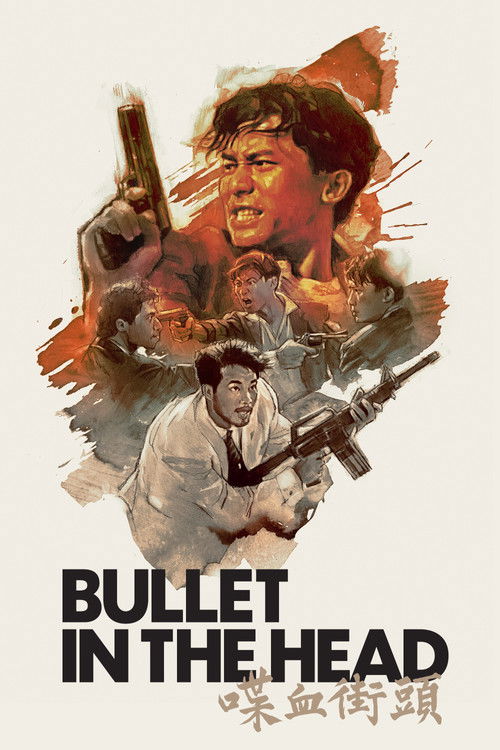
Bullet in the Head
1990 · John Woo
For when you want action cinema with real stakes and a broken heart — an epic that hurts. Not a breezy shoot-'em-up night; this is the one you choose when you want to be devastated as well as thrilled.
What it's about
Three childhood friends from Hong Kong's tenement slums — bonded since boyhood — flee the city after a killing during the 1967 riots and head to wartime Saigon to make their fortune. What begins as a hustler's adventure plunges into the chaos of Vietnam, where war, greed, and a smuggled fortune in gold test their brotherhood past its breaking point.
The experience
Ferocious and operatic — it swings from swaggering camaraderie to some of the most harrowing violence in Hong Kong cinema, and the emotions run as hot as the gunfire. It's exhausting in the way a great tragedy is exhausting: you feel wrung out and marked by it.
Performances
Tony Leung Chiu-wai anchors the film with wounded decency, and Jacky Cheung is astonishing as Frank — a performance of raw, escalating anguish that many count among the finest in Hong Kong film.
The craft
John Woo pushes his balletic action style into war-movie scale — riots, nightclubs, prison camps — staged with furious kinetic energy and sudden, sobering brutality. The film's sweep and carnage reward a big screen, but its most powerful images are faces in extremity.
Why it matters
A commercial gamble that flopped on release, it has since been reclaimed as Woo's most personal and ambitious work — the film where heroic bloodshed collides with history, and a touchstone for how genre cinema can carry political grief.
Snapshot
Bullet in the Head is John Woo's most nakedly personal film and, by wide critical consensus, his most ambitious — a three-hour-plus historical epic compressed into a blood-soaked friendship tragedy that spans the 1967 Hong Kong leftist riots and the killing fields of wartime Saigon. Three boyhood friends from the tenement slums — Ben (Tony Leung Chiu-wai), Frank (Jacky Cheung), and Paul (Waise Lee) — flee Hong Kong after a killing and seek fortune in Vietnam, where greed, war, and a smuggled fortune in gold dissolve their brotherhood into betrayal and mercy-killing. The title refers, literally, to a bullet that lodges in Frank's skull and reduces him to a suffering wreck. Made immediately after The Killer (1989), it arrived as Woo's bid to fuse his signature heroic-bloodshed action with the sweep of the war epic and the gangster saga. It failed commercially in Hong Kong on release and its production was famously troubled, but it has since become a cult touchstone and, for many admirers, the darkest and most emotionally punishing work of Woo's career.
Industry & production
The film emerged directly from Woo's break with producer-director Tsui Hark and Film Workshop, the partnership that had produced A Better Tomorrow (1986), its sequel, and The Killer. Woo had wanted to make a period-set entry in the A Better Tomorrow series — a Vietnam-era story — but that concept instead became A Better Tomorrow III: Love and Death in Saigon (1989), which Tsui directed himself. Woo, estranged from the franchise, redirected his own Vietnam material into an independent production. Bullet in the Head was thus made largely outside the Film Workshop apparatus, with Woo exercising unusual authorial control as director, co-writer, and co-editor.
The production was, by all accounts, arduous and over-budget. Location shooting in Thailand stood in for wartime Saigon, and the scale — crowd scenes, pyrotechnics, urban warfare — strained resources. The most documented production fact is the film's contested ending: Woo assembled an extended cut and shot alternate finales, and the version that reached Hong Kong theaters concludes with a vehicular duel between Ben and Paul. Longer cuts and differing endings have circulated across home-video releases in various territories, and running times vary accordingly. The precise budget figures and the full editorial history are not reliably fixed in the English-language record, and I will not invent them; what is clear is that the film ran long, was recut under pressure, and disappointed at the Hong Kong box office at a moment when Woo's stock as an action director was otherwise rising.
Technology
The film was shot on 35mm using the conventional Hong Kong production tools of its era — a mix of studio and extensive location work, practical squibs and pyrotechnics rather than optical or digital effects, which were not part of this filmmaking economy. Woo's action grammar here is built entirely from in-camera resources: undercranking and overcranking to stretch or accelerate motion, multi-camera coverage of gunfights and explosions, and physical stunt work. There is no meaningful "special effects" dimension in the modern sense; the spectacle is achieved through squib-loaded bodies, gasoline fireballs, and the choreography of live performers amid live ordnance. This is worth stating plainly because the film's overwhelming sensory assault is a product of analog craft and sheer coverage, not post-production trickery.
Technique
Cinematography
The cinematography is credited to multiple hands — the record lists several camera operators/DPs working across the Hong Kong and Thailand shoots — which is consistent with the film's sprawling, multi-unit production; because sources differ on exact attributions, I flag that rather than assign a single definitive author. Visually the film swings between two registers. The Hong Kong scenes favor warm, nostalgic tones and a claustrophobic tenement geography of alleys, rooftops, and neon. The Saigon and jungle sequences turn harsher and more desaturated, with smoke, fire, and mud dominating the frame. Woo's camera is restless and kinetic in the action set-pieces — tracking, craning, and whip-panning through chaos — but capable of sudden stillness for the film's grief-stricken beats. The recurring compositional motif is the frieze of three faces: the friends framed together early, then progressively fractured apart across the frame as the bond breaks.
Editing
Editing is central to the film's identity and to its troubles. Woo is credited among the editors (Hong Kong action of this period was frequently cut by or under the director), and the film's most famous formal signature — the intercutting of slow motion with normal speed within a single burst of violence — is here pushed to an operatic extreme. Action is fragmented into a rain of impacts, each squib hit and fall dilated for maximum emotional weight. Outside the gunfights, the montage leans on cross-cutting to bind the three friends' fates and on elegiac dissolves. The film's editorial instability — the long assemblies, the recut endings — is itself part of its legend: this is a movie whose final shape was fought over, and different surviving cuts leave viewers with materially different last impressions.
Mise-en-scène / staging
Woo stages violence as ritual and friendship as sacrament. The early Hong Kong material is dense with genre-brotherhood iconography — the trio in matching poses, the wedding, the loyalty pledged in blood. The war sequences escalate the mise-en-scène into hellscape: a POW encampment, cages, torture, and the notorious Russian-roulette ordeal. Physical objects carry the moral argument — the box of gold that corrupts Paul, the golden gun, the lodged bullet — each functioning as a concrete emblem of greed, power, and ruin. Woo's Catholic-inflected imagery (crosses, sacrificial poses, arms outstretched) recurs, binding personal loyalty to the language of martyrdom.
Sound
The score is credited to Romeo Diaz and James Wong (Wong Jim), longtime collaborators in Woo's late-80s cycle, blending sentimental melodic themes for the friendship with propulsive scoring for the action. Diegetic music matters here too: the friends' shared songs and the nightclub milieu of Saigon anchor the film's nostalgia and its irony, sweetness undercut by carnage. Beyond the score, the sound design is a wall of gunfire, explosion, and screaming that Woo modulates against sudden drops into near-silence for emotional punctuation. I won't attribute specific song choices I can't verify, but the pattern of tender, almost pop-melodic scoring set violently against extreme brutality is characteristic and deliberate.
Performance
The performances are the film's spine. Tony Leung Chiu-wai, still early in the screen career that would make him one of Asian cinema's most celebrated actors, gives Ben a wounded moral gravity — the conscience of the group. Jacky Cheung, already a Cantopop superstar, delivers the film's most harrowing turn as Frank, whose descent from loyal friend to brain-damaged, drug-addicted casualty is played without vanity; the mercy-killing that follows is the emotional nadir of Woo's cinema. Waise Lee, cast against his A Better Tomorrow villainy or in extension of it, makes Paul's corruption incremental and legible — a good man hollowed out by gold. Simon Yam, as the cool mercenary figure Luke, supplies a strand of icy professionalism that Woo would keep returning to. The ensemble sells the film's central wager: that we must feel the friendship as real before we can be devastated by its destruction.
Narrative & dramatic mode
Structurally the film is a tragedy of brotherhood staged as a historical epic. It follows the classic three-act shape of the crime-partnership saga — rise, transgression, disintegration — but stretches it across a genuine historical canvas, moving from the intimacy of the slum to the abstraction of war. The dramatic mode is melodrama in the fullest, non-pejorative sense: heightened emotion, moral absolutes, sacrifice and betrayal writ large. Woo's storytelling is unabashedly sentimental in its setup and pitilessly cruel in its payoff, a deliberate contrast designed to make the violence hurt. The Russian-roulette sequence functions as the narrative's moral crucible, the point at which survival demands the surrender of innocence. The film's contested endings reflect a genuine structural tension: is this ultimately a story of survivor's guilt and remembrance, or of vengeance? Different cuts answer differently.
Genre & cycle
Bullet in the Head sits at the intersection of several cycles. It belongs to Woo's "heroic bloodshed" run — the Hong Kong action cycle he and Chow Yun-fat effectively defined with A Better Tomorrow and The Killer — but it deliberately grafts that idiom onto the Hollywood war film and the epic gangster saga. It is also part of a specific late-80s Hong Kong wave of Vietnam-set films (alongside A Better Tomorrow III), through which the territory processed war, refugee experience, and, obliquely, its own anxieties about 1997 and the mainland. Within Woo's own filmography it is the outlier: bigger, longer, angrier, and less commercially calculated than the gun-ballet thrillers around it, closer to tragedy than to the cool operatic action of The Killer or the coming Hard Boiled (1992).
Authorship & method
This is Woo's most authorial Hong Kong film, and he has repeatedly framed it as his most personal — rooted in his own memories of growing up poor in Hong Kong and living through the 1967 riots. He is credited as director and co-writer (with collaborators including Patrick Leung and Janet Chun in the writing, per the standard credits) and had a hand in the editing, giving him control over the film's structure to an unusual degree. His method here is total commitment to emotional maximalism: build the friendship with sincerity, then annihilate it. The key collaborators — the composing team of Romeo Diaz and James Wong, the multiple cinematographers marshaled across two countries, the editors who shaped and reshaped the mammoth footage, and above all the actors — serve a vision that is unmistakably Woo's: Catholic iconography, male loyalty as sacred bond, violence as both spectacle and moral reckoning. Because the credited technical roles are distributed and sources occasionally conflict on exact attributions, I've kept those attributions to what is securely established.
Movement / national cinema
The film is a product of the Hong Kong New Wave's commercial maturation and the golden age of Hong Kong action cinema in the late 1980s and early 1990s. It reflects the industry at its most confident and its most anxious — technically virtuosic, globally influential, yet increasingly preoccupied with themes of exile, loyalty, and rupture as the 1997 handover approached. By reaching back to 1967, a year of political convulsion tied to the mainland's Cultural Revolution, and by displacing its action to a foreign war, the film participates in Hong Kong cinema's habit of encoding local political dread in genre and in elsewhere. It is emphatically a Hong Kong film in its brotherhood ethos, its Cantopop-star casting, and its fusion of Eastern and Western genre grammars.
Era / period
Bullet in the Head is doubly a period film: it dramatizes the past (1967–68) from the vantage of 1990. Its opening in riot-torn Hong Kong grounds the friends' desperation in real historical hardship, and its Vietnam material places them inside the era's defining conflict. This historical specificity distinguishes it from the contemporary-set thrillers of Woo's cycle and lends the personal tragedy a generational weight — these are young men crushed by history as much as by one another. The 1990 vantage is inseparable from the pre-handover mood: a backward glance at innocence lost that resonated with a city contemplating its own uncertain future.
Themes
The governing theme is brotherhood (the Chinese ideal of yi, loyalty and righteousness) and its betrayal — the sacred bond of male friendship tested to destruction. Against it Woo sets greed: the box of gold is the serpent in the garden, and Paul's corruption by money is the film's moral engine. Radiating outward are the loss of innocence, the dehumanizing machinery of war, survivor's guilt, and the impossibility of clean survival in a corrupt world. The lodged bullet of the title crystallizes the theme of irreversible damage — some wounds cannot be healed, only ended. Woo's Catholicism suffuses it all: sacrifice, mercy, and the possibility (or failure) of redemption. The mercy-killing of Frank is the thematic core — love expressed as the taking of a life.
Reception, canon & influence
On release the film disappointed commercially in Hong Kong — a notable stumble amid Woo's otherwise ascendant run — and its bleakness and length worked against it with contemporary audiences. Over time, however, its critical reputation grew substantially, especially among Western cinephiles who encountered it as Woo's most serious and personal work; it is now frequently ranked among his finest films and cited as evidence of his ambition beyond pure action spectacle.
Its influences run backward to two clear touchstones. The Vietnam POW ordeal and the Russian-roulette sequence are unmistakably indebted to Michael Cimino's The Deer Hunter (1978); the epic tale of childhood friends sundered by time, crime, and betrayal echoes the friendship-saga tradition exemplified by Sergio Leone's Once Upon a Time in America (1984). Woo's own prior work — A Better Tomorrow and The Killer — supplies the heroic-bloodshed idiom, brotherhood ethos, and gun-ballet grammar the film both fulfills and darkens. The 1967 material draws on Woo's lived experience of Hong Kong's leftist riots.
Forward, the film's legacy is bound up with the broader global influence of Hong Kong action cinema that Woo helped export to Hollywood in the 1990s. His slow-motion-and-carnage grammar, the emotional weighting of violence, and the brotherhood-and-betrayal template rippled through later action filmmaking internationally. Tony Leung Chiu-wai and Jacky Cheung both went on to major careers, and the film is often invoked as an early showcase of Leung's dramatic depth. Within cult and academic film culture it endures as the emotional heavyweight of Woo's Hong Kong period — the film cinephiles point to when arguing that his gunfights were always, at heart, about love and loss.
A Deleuzian reading
Three boys stand shoulder to shoulder in a Hong Kong alley in 1967, packed so tight in the frame they read as one body.
The full Deleuzian reading of Bullet in the Head →
Reception
A box-office flop in 1990 Hong Kong — Woo's expensive, anguished Vietnam epic landed with a thud after the crowd-pleasing highs of A Better Tomorrow and The Killer — but it's since been reappraised as his most personal film, and for many fans his outright masterpiece.
How Bullet in the Head was received, from release to now →
How to watch Bullet in the Head: what to notice on a first viewing
- Watch how close together the three friends are framed early on. Woo repeatedly composes Ben, Frank, and Paul packed into one shape, almost one body. The framing tells you how tight this friendship is before the plot tests it.
- Notice violence shown in slow motion cut against normal speed. Woo dilates single bursts of gunfire, mixing slowed falls and hits with ordinary tempo footage, so a moment of violence stretches out far longer than it would take in life. The stretching gives you time to feel a death instead of just registering that it happened.
- Notice the color shift from warm Hong Kong to gray Saigon. The early tenement scenes glow with nostalgic warmth and neon, while the war scenes turn harsh, desaturated, choked with smoke, fire, and mud. The palette tracks the friendship's decline before the story does, from color you want to live in to color you want to escape.
- Follow the box of gold as it changes hands. The gold, along with a golden gun, recurs as a physical object that draws every eye in the frame. Objects like this carry the film's argument about greed, so you can track the story without a word of dialogue.
The whole guide to watching Bullet in the Head, with the keys for a rewatch →
Influences: the films it descends from and the films it influenced
- The Deer Hunter (1978) — Supplies the Russian-roulette-as-torture set piece and the POW captivity structure — the coerced trigger-pull that shatters male friendship — which Woo transposes almost beat-for-beat into the Vietnam ordeal.
- Once Upon a Time in America (1984) — Provides the decades-spanning friendship-saga architecture — boyhood loyalty corroded by money and one friend's betrayal — that governs Woo's epic three-act rise-and-ruin structure.
- The Wild Bunch (1969) — Originates the multi-camera, cross-cut slow-motion squib ballet and the elegiac 'men who die together by their code' finale that Woo's carnage grammar directly inherits and intensifies.
- A Better Tomorrow (1986) — Establishes Woo's own heroic-bloodshed idiom — sworn-brotherhood ethos, honor-vs-betrayal melodrama, and dual-pistol gun choreography — that Bullet fulfills and then darkens into tragedy.
- The Killer (1989) — Codifies the Catholic-iconography staging — churches, candles, sacrificial framing of the hero — and the treatment of gunfire as sacrament that Bullet carries into its object-emblem and loyalty motifs.
- Mean Streets (1973) — Models the volatile Catholic-guilt street brotherhood and the reckless friend whose loyalty is a liability — the Johnny Boy dynamic Woo echoes in the trio's self-destructive bond.
- Le Samouraï (1967) — Furnishes the minimalist gangster code-of-honor ethos and iconic stillness that Woo repeatedly cites as the moral template beneath his gunmen's loyalty.
- Apocalypse Now (1979) — Provides the hallucinatory river-descent-into-madness rendering of the Vietnam War as moral disintegration, informing Bullet's phantasmagoric wartime middle passage.
- Reservoir Dogs (1992) — Inherits the triangulated Mexican-standoff geometry and the loyalty-betrayal-among-thieves structure that Woo and his HK contemporaries had turned into a signature staging figure.
- Face/Off (1997) — Exports Bullet's gun-fu grammar to Hollywood — the dual-wield standoffs, freeze-frame slow motion, and released doves crossing the frame during gunfire.
- The Matrix (1999) — Openly adapts Woo's dual-pistol, slow-motion balletic gunplay into 'bullet time,' citing the heroic-bloodshed choreography Bullet exemplifies as its action template.
- Infernal Affairs (2002) — Carries forward Tony Leung's dramatic depth and the HK-crime moral-reckoning melodrama, building suspense from divided loyalty in the tradition Bullet showcased.
- John Wick (2014) — Descends directly from Woo's gun-fu — precise close-quarters pistol choreography treated as dance — that Bullet's balletic firefights helped canonize for later action cinema.
- Oldboy (2003) — Extends the fusion of extreme violence with operatic melodrama and long-form vengeance structure, the emotionally-maximalist Asian action mode Bullet pushed to its bleak extreme.
- City on Fire (1987) — A parallel Hong Kong heroic-bloodshed film built on undercover loyalty and betrayal, sharing the same emotionally-weighted violence and doomed-brotherhood grammar of the movement Woo helped define.
- Hard Boiled (1992) — Extends the same gun-ballet vocabulary into sustained long-take set pieces, refining the slow-motion-intercutting and dove imagery that Bullet develops in its most operatic bursts.
- Bullet in the Head (1990) — n/a — seed
Similar films
- Hard Boiled (1992) — influence & lineage
- A Better Tomorrow (1986) — influence & lineage
- The Killer (1989) — influence & lineage
- Infernal Affairs (2002) — influence & lineage
- City on Fire (1987) — influence & lineage
- Face/Off (1997) — influence & lineage
- Oldboy (2003) — influence & lineage
- The Mission (1999) — shared sensibility