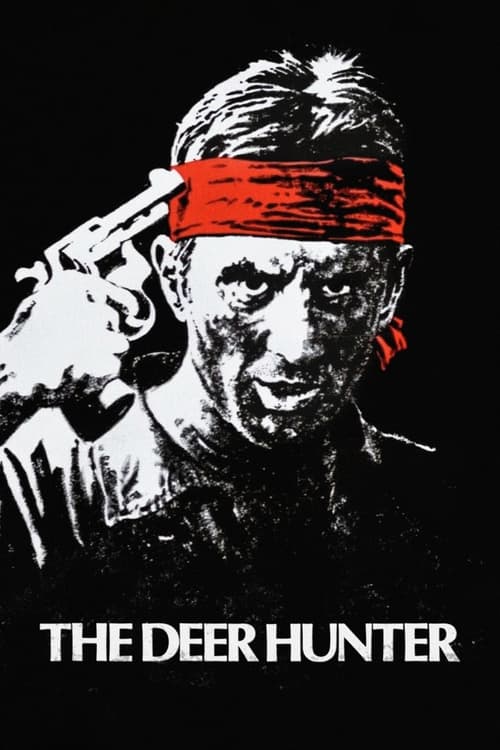
The Deer Hunter
1978 · Michael Cimino
For a night when you want to be wrecked by something serious and have three hours to give it. This is commitment viewing, not comfort viewing — but it repays every minute.
What it's about
Three steelworkers from a tight Russian-American community in Pennsylvania — friends who hunt deer together and drink at the same bar — enlist and are sent to Vietnam, one just after a rushed wedding. The film follows them from the long rituals of home, through the war's brutality, and back to a town that no longer fits the men who return. It's less a combat picture than a story about what war does to a friendship and a community.
The experience
Slow, immersive, and devastating — it spends a full hour just living inside the wedding and the hunt so that everything after lands with real weight. The Vietnam passages are among the most harrowing ever filmed, and the homecoming is quiet, heavy grief.
Performances
Robert De Niro anchors it with contained, watchful strength, and Christopher Walken is unforgettable — a performance of slow, hollowing damage that won him an Oscar. Meryl Streep, in an early role, makes a quiet part ache.
The craft
Built in three long movements — home, war, aftermath — it trusts duration the way few films dare, letting rituals play out in full. The mountain hunting sequences are majestic on a big screen, the Russian-roulette scenes almost unbearably tense, and the editing between the two worlds hits like a blow.
Why it matters
It won five Academy Awards including Best Picture, stood at the front of Hollywood's first real reckoning with Vietnam, and its Russian-roulette imagery became one of cinema's most argued-over metaphors for the war.
Snapshot
The Deer Hunter is a three-hour triptych about a circle of Russian-American steelworkers from western Pennsylvania whose lives are sundered by the Vietnam War. Built as three long movements — a working-class wedding and a final deer hunt before deployment; a compressed, brutal passage of captivity and combat in Vietnam organized around the image of Russian roulette; and a protracted, grief-soaked homecoming — the film trades conventional war-movie momentum for ritual, duration, and the textures of community. It was Michael Cimino's second feature, and it arrived as the most ambitious entry in the first wave of American films to confront Vietnam directly. Lavishly praised and fiercely contested in roughly equal measure, it won five Academy Awards, including Best Picture and Best Director, and made the Russian-roulette motif one of the most argued-over devices in postwar American cinema. Its reputation rests on a paradox the film never resolves: an intensely felt, formally daring elegy for a vanishing industrial America, yoked to a portrait of the war and the Vietnamese that many viewers found, and still find, indefensible.
Industry & production
The film was produced by the British company EMI Films, with Barry Spikings and Michael Deeley as the principal producers (Deeley would accept the Best Picture Oscar), alongside Cimino and John Peverall; Universal handled U.S. distribution. Cimino had directed only Thunderbolt and Lightfoot (1974) before this, and the leap in scale — a long shoot across multiple countries, a three-hour final cut, a wedding sequence running roughly an hour before the war begins — represented a substantial gamble by the financiers.
Production drew on widely separated locations to assemble its single fictional steel town of Clairton: industrial exteriors and community interiors were gathered from several Rust Belt towns in Ohio, West Virginia and Pennsylvania (Mingo Junction, Cleveland and others are commonly cited), the hunting sequences were shot in the mountains of Washington State, and the Vietnam material was filmed in Thailand, with sequences staged on the River Kwai. The shoot ran long and over budget, foreshadowing — though on a far more contained scale — the runaway production of Cimino's next film, Heaven's Gate (1980), whose collapse is often treated as the symbolic end of the New Hollywood director's-cinema era.
The most poignant production fact is the presence of John Cazale, cast as Stan. Cazale was terminally ill with cancer during filming and died in 1978, before the film's release; The Deer Hunter was his final film and the last of the five features (all Best Picture nominees) he made in his short career. Meryl Streep, his partner, took her supporting role partly to remain with him. Accounts hold that the production reorganized its schedule to shoot Cazale's scenes early, and that there was studio pressure over insuring a dying actor — a pressure the principals resisted.
Technology
Technologically the film is a product of late-1970s 35mm anamorphic practice rather than of any novel apparatus, and its achievements are those of craft pushed to an extreme rather than of new tools. It was shot on color negative with anamorphic lenses for a widescreen scope frame, and finished in Technicolor-era photochemical processes standard to the period. The most demanding technical challenges were logistical and physical: the controlled chaos of the river and helicopter work in the Thailand sequences, and the staging of the Russian-roulette scenes, which required actors to handle revolvers in extreme close quarters under conditions engineered for maximum tension. The film's Best Sound Oscar reflects ambitious location and post-production mixing — the layering of industrial noise, gunfire and crowd ambience — more than any single technical innovation.
Technique
Cinematography
Vilmos Zsigmond, one of the defining cinematographers of the American 1970s, shot the film and earned an Academy Award nomination. His work here is built on contrasts of scale and light. The Pennsylvania sequences are rendered in burnished, smoky, often backlit interiors — the bar, the church, the wedding hall — with the steel mill's glare and the gray northern light establishing a palpable industrial weight. The hunting passages open into cold, lyrical mountain vistas, deliberately monumental, that lift the film toward the mythic. The Vietnam material is comparatively hot, close and unstable. Zsigmond's compositions repeatedly set the individual against vast surrounding space — mountains, mill, river — a visual argument the film makes about men dwarfed by forces larger than themselves.
Editing
Peter Zinner won the Academy Award for editing, and the cut is fundamental to the film's design. Its boldest decision is the refusal of conventional proportion: the long first act accumulates communal detail at an unhurried pace, so that the abrupt, violent transition into Vietnam lands as a rupture rather than a development. The film withholds the war's onset — there is no gradual escalation — and the jolt is an editing effect. Within the roulette sequences the cutting tightens to near-unbearable rhythm, intercutting faces, hands and the weapon. The editing's patience in the home-front material, and its violence in Vietnam, are two halves of a single structural idea.
Mise-en-scène / staging
Cimino stages the community scenes for density and authenticity: the Orthodox wedding, the bar where the men drink and sing, the mill floor are crowded with overlapping behavior, ethnic and religious specificity, and ritual. The film is organized around rituals — the wedding, the hunt, the Mass, and finally the unbearable anti-ritual of roulette — and the staging treats each as a structured ceremony. Robert De Niro's Michael articulates a hunter's code ("one shot") that the staging then mirrors and corrupts in the roulette games. The wedding sequence's length is itself a staging strategy: it builds the social fabric whose destruction the rest of the film mourns.
Sound
The film's sound design earned an Oscar and is central to its effect, from the controlled din of the mill and the layered noise of the wedding to the percussive horror of the roulette scenes. Equally important is the score's restraint: rather than a conventional orchestral war score, the film leans on Stanley Myers's "Cavatina," a melancholy solo guitar theme performed by the classical guitarist John Williams (the Australian guitarist, not the American film composer of the same name). Its plaintive simplicity, recurring across the film, became one of its most recognizable elements and stands in deliberate contrast to the brutality on screen.
Performance
Performance is the film's greatest and least contested strength. De Niro anchors it as Michael, the controlled, watchful center of the group, his discipline both heroic and isolating. Christopher Walken, as Nick, won the Academy Award for Best Supporting Actor for a performance that charts a man's psychic dissolution from open-faced warmth to hollowed-out fixation. John Savage as the maimed Steven, John Cazale as the abrasive Stan, George Dzundza and Chuck Aspegren fill out the ensemble with lived-in specificity. Meryl Streep, nominated for Best Supporting Actress, gives Linda a quiet gravity that exceeds the relatively underwritten role; it was an early marker of her ascent. The ensemble's chemistry in the bar and wedding scenes — much of it built through Cimino's emphasis on behavior over plot — is what gives the later devastation its force.
Narrative & dramatic mode
The film's dramatic mode is elegiac and ritualistic rather than expository. Its three-part architecture moves from communal wholeness to violent fragmentation to mourning, and it is far more interested in states of being — friendship, dread, numbness, grief — than in the mechanics of war or politics. Causation is deliberately muted: we never see the men's combat in any sustained tactical sense, and the war reaches us largely through the symbolic compression of the roulette table. The final gathering, in which the survivors haltingly sing "God Bless America," is presented neither as straightforward patriotism nor as obvious irony but as an unresolved, ambiguous act of communal endurance — a register typical of the film, which prefers to hold contradictions open rather than to argue a thesis.
Genre & cycle
The Deer Hunter belongs to the first concentrated cycle of American Vietnam films, arriving the same year as Hal Ashby's Coming Home (1978) and a year before Francis Ford Coppola's Apocalypse Now (1979); it preceded the 1980s cycle led by Oliver Stone's Platoon (1986). But it is only partly a war film. It is equally a working-class community drama and an American hunting-and-frontier narrative, drawing on the imagery of the hunter and the wilderness that runs through American cultural mythology. The film's hybridity — half elegy for industrial America, half war picture — is part of why it resists tidy generic placement and why its politics have been read so variously.
Authorship & method
The film is unmistakably Cimino's in its scale, its romantic monumentalism, and its faith in duration and ritual, and it established the maximalist authorial signature that Heaven's Gate would soon push past the breaking point. His method favored expansive shooting, long takes of behavior, and a willingness to let sequences run far beyond conventional length. Authorship of the screenplay, however, is genuinely contested. The credited screenplay is by Deric Washburn, with the story credited to Cimino, Washburn, Louis Garfinkle and Quinn K. Redeker; Washburn and Cimino reportedly fell out bitterly over the writing and the apportioning of credit, and the exact division of authorship remains disputed in the historical record. Among collaborators, Zsigmond's photography, Zinner's editing and the contributions of the production designer and sound team were essential to realizing Cimino's conception. The director's working relationship with De Niro — who is widely reported to have committed intensely to the role — was a further engine of the film.
Movement / national cinema
The film is a late, monumental product of the New Hollywood — the roughly 1967–1980 period in which American studios financed personal, formally adventurous work by a generation of director-auteurs. It shares that movement's ambitions (the long, uncommercial first act; the refusal of genre reassurance; the auteur's controlling vision) and its eventual fate: Cimino's subsequent Heaven's Gate is conventionally cited as the catastrophe that helped end the era's tolerance for unchecked directorial autonomy. As American national cinema, the film is notable for its attention to a specific immigrant community — Russian-American Orthodox steelworkers — and for using that community as a lens on the nation's experience of the war.
Era / period
Released in 1978, the film appeared at a moment when the United States was beginning, with difficulty, to process the Vietnam War three years after the fall of Saigon. Its setting — a dying or strained industrial town — also registers the early erosion of American manufacturing that would accelerate through the coming decade. The film thus sits at a double historical hinge: between the war and its aftermath, and between an industrial America and its decline. Its near-simultaneous release with Coming Home and its proximity to Apocalypse Now mark 1978–79 as the threshold of mainstream American cinematic reckoning with Vietnam.
Themes
The film's governing themes are friendship and the bonds of male community; ritual as a way of ordering experience (the hunt, the wedding, the Mass) and its perversion (roulette); chance, control and fate, condensed in the hunter's "one shot" ethic and in the random lethality of the revolver; and the destruction of an American community by a war it barely comprehends. The deer hunt itself is the film's central, ambiguous symbol — at once a code of clean, respectful killing and, by the end, a stance Michael can no longer sustain when he declines to shoot. Homecoming, maiming and survivor's grief dominate the final movement. Underlying all of it is a melancholy about loss — of friends, of bodily wholeness, of a way of life — that the film treats as irreparable.
Reception, canon & influence
Critically, the film was widely acclaimed on release for its performances, ambition and emotional power, and it swept the major Academy Awards, winning Best Picture, Best Director, Best Supporting Actor (Walken), Best Film Editing and Best Sound, with further nominations including De Niro, Streep, Zsigmond and the screenplay. It was, at the same time, the object of intense controversy. Critics and commentators — among them figures associated with the antiwar left — attacked its politics; the Russian-roulette device, for which there is no established historical basis as a documented Vietnamese practice, was widely condemned as both a fabrication and a portrayal that rendered the Vietnamese as uniformly sadistic, and the film has been charged with racism and with reducing the Vietnamese to a faceless threat. The controversy reached an international stage when the Soviet delegation and others walked out of the 1979 Berlin International Film Festival in protest. These debates have never been settled; the film's canonical standing as a landmark of 1970s American cinema coexists permanently with serious objections to its representation of the war and its enemy.
Looking backward, the film draws on deep currents of American hunting-and-frontier mythology and on the New Hollywood's appetite for the long, personal, formally ambitious feature; the specific lineage of the roulette conceit is not reliably documented, and is best understood as the film's own symbolic invention rather than a borrowing. Looking forward, The Deer Hunter helped legitimize the long-form, art-cinema treatment of Vietnam and stands beside Apocalypse Now at the head of the serious American Vietnam film. Walken's performance became iconic, and the roulette imagery entered the wider culture as shorthand — and as a recurring object of parody and critique. Its most consequential industrial legacy is indirect: by emboldening Cimino toward the unchecked ambition of Heaven's Gate, it forms part of the arc by which the director-driven New Hollywood gave way to a more cautious studio era.
A Deleuzian reading
Open on the deer.
The full Deleuzian reading of The Deer Hunter →
Reception
It swept the 1979 Oscars (Best Picture, Director) while protesters literally picketed the ceremony over its depiction of the Vietnamese — and that split has never fully healed: canonized as a New Hollywood monument, still argued over as history.
How The Deer Hunter was received, from release to now →
Influences: the films it descends from and the films it influenced
- The Searchers (1956) — Establishes the man-against-landscape frontier idiom — figures dwarfed in widescreen wilderness as moral allegory — that Cimino transposes to the Allegheny mountains and Vietnam jungle.
- The Best Years of Our Lives (1946) — Model for the elegiac homecoming drama: the long, patient study of working-class veterans struggling to re-enter civilian community, ending on communal ritual rather than combat.
- McCabe & Mrs. Miller (1971) — Vilmos Zsigmond's flashed, golden backlit interiors and overlapping layered location sound are the exact photographic and aural palette he carries directly into The Deer Hunter.
- The Godfather (1972) — Pioneers the extended ceremonial set-piece — a full wedding shot in real-time duration as community portrait — the structural device Cimino expands into his hour-long Clairton wedding.
- The Wild Bunch (1969) — Source of the accelerating multi-angle montage and structural rupture, where a sustained tension explodes into fragmented violent editing — the grammar of the roulette sequences.
- Mean Streets (1973) — Template for De Niro's controlled-center performance amid a volatile ethnic working-class male group, behavior observed in long takes of barroom ritual.
- Deliverance (1972) — Zsigmond's earlier work on men tested against an indifferent natural landscape, and the hunting trip as masculine rite turned to trauma.
- The Man Who Would Be King (1975) — Deploys the same frame-narrative irony architecture — a community ritual opening separated by ellipsis from a broken, diminished aftermath — with Vilmos Zsigmond's harsh top-lit location cinematography in extreme terrain, and the same tonal register management between working-class comedy and mythic tragedy that Lloyd's cutting establishes.
- From Here to Eternity (1953) — Cimino's multi-strand novelistic editing tempo — 182 minutes following an ensemble across pre-war, war, and aftermath without melodramatic urgency — replicates Eternity's four-strand pacing strategy, and the against-type casting of De Niro, Walken, and Streep mirrors Zinnemann's deliberate subversion of star personas to generate tragic force.
- Heaven's Gate (1980) — Cimino pushes the same maximalist signature further — the extended communal set-piece (the roller-skating dance echoing the wedding), Zsigmond's diffused light, immigrant working-class community against vast landscape.
- Platoon (1986) — Inherits the legitimized long-form Vietnam combat film, the immersive layered location sound design and the working-class soldier ensemble fractured by trauma.
- Born on the Fourth of July (1989) — Extends the triptych-style arc of innocence-war-shattered-homecoming and the elegiac mode applied to the maimed veteran's re-entry into community.
- The Thin Red Line (1998) — Carries forward the man-against-landscape lyricism and elegiac war mode, dwelling on nature and ritual over combat mechanics in anamorphic widescreen.
- Jacob's Ladder (1990) — Adopts Walken-style psychic dissolution — the Vietnam veteran whose trauma manifests as fractured, hallucinatory subjectivity rendered through structural rupture.
- The Place Beyond the Pines (2013) — Directly revives the formal triptych structure — three discrete movements handing off protagonists — as an architecture for generational, community-bound drama.
- Hell or High Water (2016) — Continues the working-class-community drama set against eroding American landscape, observing male bonds and economic desperation in patient widescreen behavior.
- The Master (2012) — Extends De Niro/Walken-style two-hander of a controlled center and a dissolving psyche, the damaged returning veteran studied through long behavioral takes.
- Full Metal Jacket (1987) — Cimino's diptych structure — extended civilian formation sequences followed by a fragmented Vietnam combat second half in which the characters' psychological disintegration mirrors the narrative's loss of coherence — is the structural template FMJ condenses and freezes: the two-part anatomy of how civilian identity is built in order to be destroyed.
- We Were Soldiers (2002) — Cimino's structural counterpoint between the extended Clairton wedding sequence and the Pa Khe combat sequences — domestic ritual given equal formal weight to combat trauma — established the domestic-combat staging contrast that Wallace deploys between the Fort Benning prologue and the Ia Drang sequences.
- Warrior (2011) — O'Connor's use of Pennsylvania's steel-mill geography as a visual argument about working-class dispossession and post-industrial male identity directly echoes Cimino's foundational practice of rooting male trauma in the specific textures of industrial landscape, while both films encode veteran damage (Vietnam/Iraq) through the register of masculine friendship under pressure.
- American Sniper (2014) — Cimino's home-front / war-zone structural intercutting — using domestic space as a precise measure of what combat has permanently subtracted from a man — is the direct architectural template for American Sniper's Iraq / Texas alternation and its returning-veteran-who-cannot-re-enter structure.
- Apocalypse Now (1979) — The companion serious American Vietnam epic: long-form art-cinema treatment of the war as descent into psychic dissolution, sharing the elegiac monumental scale.
- Coming Home (1978) — Released the same year as the rival post-Vietnam reckoning, treating the war's domestic aftermath through restrained performance and the returned-veteran homecoming.
- The Godfather Part II (1974) — Cimino's parallel-time structure uses working-class community ritual — the wedding — as moral baseline against which a corrupted present is measured, applying the same formal logic as Part II's intercutting, where Vito's warm immigrant world ironizes Michael's cold disintegration.
- Close Encounters of the Third Kind (1977) — Shot by Zsigmond immediately after CE3K using the same anamorphic diffusion and practical-backlight toolkit; both exercise structural patience across extended working-class American domestic sequences before rupturing normality with an event the community cannot assimilate.
- Days of Heaven (1978) — Vilmos Zsigmond's anamorphic widescreen photography of rural Pennsylvania and the film's seasonal-ritual structure — wedding, deer hunt, war, aftermath — runs parallel to Days of Heaven's harvest-cycle architecture; both films deploy ambient environmental sound as an emotional register and treat working-class American pastoral as the moral ground from which characters are violently expelled.
- Cross of Iron (1977) — A contemporaneous post-Vietnam de-romanticizing of the soldiers' code and its hollow aftermath, favoring anti-climactic drift over heroic resolution in the same New Hollywood register.
Similar films
- Apocalypse Now (1979) — influence & lineage · often watched together
- Platoon (1986) — influence & lineage
- The Best Years of Our Lives (1946) — influence & lineage
- The Thin Red Line (1998) — influence & lineage
- Jacob's Ladder (1990) — influence & lineage · often watched together
- The Godfather (1972) — influence & lineage · often watched together
- The Master (2012) — influence & lineage · often watched together
- Hell or High Water (2016) — influence & lineage · often watched together
All the films related to The Deer Hunter →