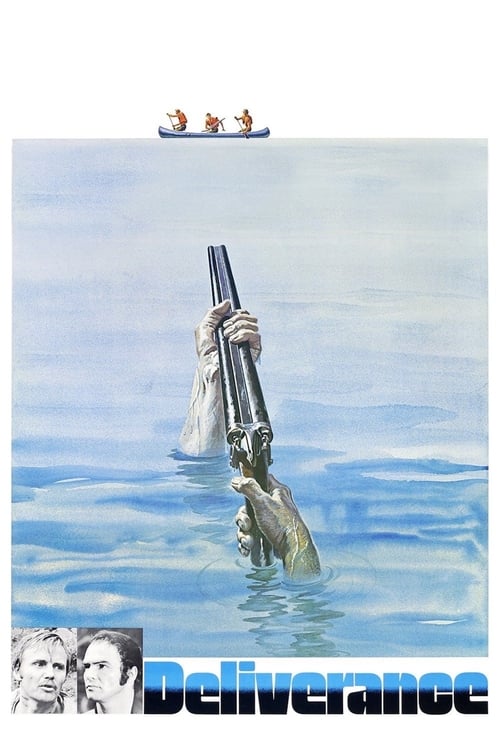
Deliverance
1972 · John Boorman
For when you're craving a serious, white-knuckle thriller with weight — not a popcorn ride but the kind that tests you a little. Definitely a challenge watch; not the film for a light evening.
What it's about
Four Atlanta businessmen set out to canoe a wild Georgia river before a dam floods the valley forever — a weekend of adventure led by Lewis, the group's swaggering survivalist. The locals they meet on the way in are unwelcoming, the rapids are worse than promised, and somewhere downstream the trip stops being recreation and becomes a fight to get out alive with their sense of themselves intact.
The experience
Relentlessly tense once the river takes hold — a survival thriller that keeps tightening until you realize the real subject is what these men are willing to do and live with. It's visceral, beautiful, and disturbing in a way that lingers well past the credits.
Performances
Burt Reynolds found the role of his career as the macho Lewis, and Jon Voight carries the film's soul as the ordinary man forced to become something else; Ned Beatty and Ronny Cox, both in their film debuts, are unforgettable.
The craft
Shot on a genuinely dangerous river with the actors doing their own canoeing, it has a physical authenticity no studio tank could fake, and the wilderness photography is both gorgeous and menacing. The 'Dueling Banjos' scene — a guitar-and-banjo duel between a city visitor and a local boy — is one of the most famous musical moments in movies, and the whole film rewards good speakers.
Why it matters
A landmark of 1970s American cinema that made Burt Reynolds a superstar, seared 'Dueling Banjos' and the phrase 'squeal like a pig' into the culture, and permanently changed how movies depict the wilderness and rural menace.
Snapshot
Deliverance is the film in which the American wilderness stops being scenery and becomes an adversary. Four Atlanta businessmen canoe down a doomed Georgia river for a weekend of weekend-warrior adventure; what they meet instead is violence — natural and human — that strips their civilized assumptions to the bone. Directed by the Englishman John Boorman from James Dickey's 1970 bestselling novel, it arrived at the high tide of New Hollywood and became both a commercial sensation and a cultural touchstone, lodging two images permanently in the popular memory: a guitar-and-banjo duel between a city man and a near-feral mountain boy, and a sexual assault in the woods whose verbal command became a national shorthand for backwoods menace. Beneath the survival thriller is a sober meditation on masculinity, complicity, and the violence underwriting both nature and the men who claim to master it. It earned Academy Award nominations for Best Picture, Best Director, and Best Film Editing.
Industry & production
Deliverance was produced and distributed by Warner Bros. and made on a relatively modest budget, a fact central to its method and its myth. Dickey's novel had been a literary and commercial success, and the property attracted studio interest; Boorman, an Englishman whose American work already included Point Blank (1967) and Hell in the Pacific (1968), took it on as director-producer, giving him unusual control. He cast against the prevailing star system: Burt Reynolds was then known chiefly from television and had not yet broken through to film stardom (his Cosmopolitan nude spread and Smokey and the Bandit fame came later), and the role of the macho survivalist Lewis Medlock helped launch him. Jon Voight, fresh from Midnight Cowboy (1969), took the more interior lead, Ed Gentry. Ned Beatty and Ronny Cox were both making their feature film debuts.
The production's defining decision was to shoot on location on the Chattooga River, along the Georgia–South Carolina border, rather than on controlled water or in studio tanks. The cast performed much of their own canoeing and stunt work; Voight climbed the cliff face himself, and the actors were genuinely at risk in the rapids. This commitment to physical authenticity produced both the film's visceral power and considerable danger on set, and it fed a lasting production legend of a grueling, hazardous shoot. The river itself was the film's subject and its set: the fictional Cahulawassee is about to be dammed and drowned, and the production captured a real wild river before such places were further developed — the film's own conservation-elegiac premise mirrored by its making.
Technology
Two technological choices shaped the film's texture. The first was photochemical: cinematographer Vilmos Zsigmond deliberately desaturated the image using "flashing" — controlled pre-exposure of the negative to light — to mute the lush greens of the Appalachian forest into something cooler, grayer, and more ominous, draining the landscape of postcard prettiness. This lab-based manipulation, negotiated and at times fought over with the processing facility, was an emblematic New Hollywood technique: using the chemistry of film stock itself as an expressive instrument rather than merely recording what the lens saw.
The second was the decision to forgo a conventional orchestral score almost entirely. Apart from the diegetic "Dueling Banjos," the film proceeds without music, relying on the sounds of water, wind, and human exertion. This was an aesthetic-technological choice about the soundtrack as much as the image: the absence of scoring removes the usual cushion of emotional cueing and leaves the audience exposed to the events as the characters experience them.
Technique
Cinematography
Zsigmond's photography is the film's most celebrated craft achievement and a landmark of 1970s American cinematography. Beyond the desaturation, he composed the river as a continuous, enveloping presence, using natural light and the real terrain to make the wilderness feel vast, indifferent, and increasingly hostile as the men descend. The water sequences — shot from canoes, banks, and difficult vantage points — carry genuine kinetic danger because they were genuinely dangerous. The muted palette and the documentary-tinged location shooting align the film with the era's preference for grit over gloss, and Zsigmond's work here, alongside his contemporaneous collaborations with Altman and others, helped define the look of New Hollywood.
Editing
Tom Priestley's editing earned an Academy Award nomination, and its achievement is in pacing tension out of physical action without the orienting help of a score. The river-running and survival sequences depend on cutting to establish geography, escalate danger, and sustain dread; Priestley balances long, contemplative stretches of travel against sudden eruptions of violence. The famous "Dueling Banjos" sequence is also an editing showcase, building rhythm and rising exhilaration through the cutting between the dueling players before the moment curdles.
Mise-en-scène / staging
Boorman stages the film as a descent in every sense — downriver, and down through layers of social pretense. The early scenes establish the four men as types of suburban masculinity (the alpha survivalist Lewis, the sensitive Ed, the soft and complacent Bobby, the gentle musician Drew), and the staging of the canoe trip steadily isolates them from any social safety net. The two notorious set-pieces are staged with deliberate, unbearable plainness: the assault on Bobby and the killing of the mountain man are presented without stylistic distancing, forcing the audience into the moral confusion the characters feel. The landscape is staged as an active element — cliffs that must be climbed, rapids that cannot be reversed — so that physical space dictates dramatic possibility.
Sound
The soundscape is, by design, dominated by the natural world: rushing water, the scrape of canoes, gunfire, and the human voice. Stripped of orchestral underscoring, sound becomes the film's primary atmospheric and tension-building tool. Against this, the single eruption of music — "Dueling Banjos" — registers all the more sharply as a fragile moment of human connection across a vast cultural divide, before the river and the men in it turn deadly.
Performance
The performances anchor the film's psychological realism. Reynolds plays Lewis with a coiled, charismatic machismo whose ideology of self-reliance is tested and broken when he is incapacitated. Voight's Ed undergoes the central arc — from passive follower to the man who must kill — and his largely interior, fear-driven performance, including the cliff climb, carries the film's moral weight. Beatty's Bobby endures the assault in a performance of harrowing vulnerability that made his debut unforgettable, and Cox brings a doomed decency to Drew. The two mountain men, played by Bill McKinney and Herbert "Cowboy" Coward, embody a menace that the film pointedly refuses to caricature into mere monstrosity.
Narrative & dramatic mode
The film operates as a survival thriller built on the classic structure of a journey into a hostile space and a struggle to return. But its dramatic mode is closer to tragedy and moral fable than to adventure. The inciting fantasy — Lewis's romantic ideal of testing oneself against unspoiled nature — is exposed as hubris. The central crisis is not merely physical survival but ethical: whether to bury the killing of the mountain man and lie, and what such a pact does to the men who make it. The narrative withholds resolution and comfort; the men return to civilization carrying guilt and trauma, and the film closes on Ed's nightmare-haunted future rather than on triumph. This refusal of catharsis is characteristic of the period's ambitious genre films.
Genre & cycle
Deliverance sits at the intersection of the adventure film, the thriller, and what would become "backwoods horror" or the rural-menace subgenre. It belongs to the early-1970s cycle of American films interrogating violence, masculinity, and national myth — kin to Straw Dogs (1971) in its anatomy of how civilized men confront and commit brutality, and to the broader New Hollywood appetite for downbeat, morally ambiguous storytelling. It also drew on, and helped crystallize, an anxious vision of rural America that would harden into a horror staple. While not a horror film itself, it functions as a foundational text for the genre's "city people lost among threatening country folk" template.
Authorship & method
John Boorman (director) is the film's controlling intelligence, and his method emphasized location authenticity, physical risk, and thematic seriousness. Boorman has spoken across his career about nature, myth, and the testing of men, preoccupations that run through Deliverance and recur in later films like Excalibur (1981). He shaped the adaptation substantially, paring Dickey's prose toward visual and visceral storytelling.
James Dickey (writer/source) wrote the bestselling novel and the screenplay and received sole screenplay credit. A celebrated poet, Dickey was present during production and clashed with Boorman over the direction of the adaptation; the well-documented friction led to Dickey leaving the set, with Boorman reworking material. Dickey appears in the film in a cameo as the sheriff in the closing stretch.
Vilmos Zsigmond (cinematographer), a Hungarian émigré who became one of the defining cinematographers of New Hollywood, contributed the desaturated, location-rooted look discussed above — arguably the film's signature artistic achievement.
Tom Priestley (editor), a British editor, earned an Oscar nomination for shaping the film's tension and rhythm without a conventional score.
Music: The film famously has no composed score. "Dueling Banjos," performed by Eric Weissberg and Steve Mandell, became a hit recording. The tune's authorship became a legal matter: it derived from Arthur "Guitar Boogie" Smith's earlier composition "Feud'in' Banjos," and Smith successfully litigated for credit and royalties — a fact worth stating plainly because the film initially did not credit him. The banjo-playing boy in the scene was played by local youth Billy Redden, with the actual picking performed off-screen.
Movement / national cinema
Though directed by an Englishman, Deliverance is a central New Hollywood work — part of the American cinema of the late 1960s and 1970s in which younger, often European-influenced filmmakers brought formal ambition, moral ambiguity, and a critical eye to national myths. Its location realism, desaturated photography, refusal of easy resolution, and interrogation of American masculinity place it firmly in that movement, alongside the work of contemporaries who were similarly dismantling genre comforts. Boorman's outsider perspective arguably sharpened the film's critique of American self-image.
Era / period
The film is deeply of its early-1970s moment. Its environmental premise — a wild river about to be drowned by a dam for "progress" — channels the rising ecological consciousness of the period. Its skepticism toward macho self-reliance and its bleak view of violence speak to a post-1960s, Vietnam-era disillusionment with American confidence and conquest. And its frank depiction of sexual violence against a man reflected the era's loosening of censorship and its willingness to confront previously unshowable brutality. Deliverance reads now as a document of 1972 America's anxieties about nature, manhood, and the costs of modernity.
Themes
The film's governing theme is the collision between civilization and wilderness, and the discovery that the line between them runs through the men themselves. Lewis's ideology of primal self-reliance is tested and found both seductive and catastrophic. Masculinity is the film's deep subject — its performance, its fragility, and its entanglement with violence; Ed's transformation into a killer is presented not as heroism but as a loss of innocence. Complicity and the corrosive weight of a shared secret structure the back half. Environmental elegy frames the whole: the river the men come to conquer is itself condemned, so that human and natural violence mirror each other. Class and the gulf between suburban affluence and rural poverty haunt the film, and it has been both praised for and criticized over its portrayal of Appalachian people.
Reception, canon & influence
Deliverance was a major critical and commercial success on release, ranking among the most popular films of 1972 and earning Academy Award nominations for Best Picture, Best Director, and Best Film Editing. (I'll avoid citing specific gross figures, as I can't verify exact numbers here, but its standing as one of the year's biggest hits is well established.) Critical reception was strong and has endured; the film is widely regarded as one of the key American films of its decade and was later selected for preservation in the United States National Film Registry by the Library of Congress as a culturally significant work.
Influences on the film (backward): It descends most directly from Dickey's novel and from the literary tradition of the wilderness-survival narrative. Cinematically it shares DNA with the period's revisionist treatments of violence and masculinity, Straw Dogs (1971) being a frequent point of comparison, and with the broader New Hollywood embrace of location realism and moral ambiguity.
Legacy (forward): Its influence is large and durable. It effectively founded the modern "urbanites menaced in the backcountry" template that runs through Southern Comfort (1981), The Hills Have Eyes lineage, Wrong Turn, and countless backwoods-horror films. "Dueling Banjos" became a cultural artifact in its own right, and the "squeal like a pig" assault entered the language as grim shorthand — to the point that the film's reputation in popular memory sometimes overshadows its artistry and its serious themes. The Chattooga River saw a tourism surge after the film, with subsequent injuries and deaths among inexperienced visitors attempting its rapids, a real-world consequence that uncannily echoed the film's warning about underestimating nature. More than fifty years on, Deliverance remains both a benchmark of survival cinema and a sober study of what violence does to the men who survive it.
A Deleuzian reading
The boy on the porch has a face you can't quite read and fingers that can do anything.
The full Deleuzian reading of Deliverance →
Reception
A box-office smash and Best Picture nominee in 1972, it's still canon — but decades on, the conversation shifted from its survival-thriller power to a reckoning with what it did to Appalachia's image in the American imagination.
How Deliverance was received, from release to now →
Influences: the films it descends from and the films it influenced
- McCabe & Mrs. Miller (1971) — Vilmos Zsigmond pioneered the pre-flashing (fogging) of the negative here to mute and desaturate color, the exact film-flashing technique he carried directly into Deliverance's rain-gray palette.
- The Naked Prey (1965) — Strips story to a near-wordless survival pursuit through hostile landscape, establishing the man-hunted-through-wilderness structure that strips civilized men to primal animals.
- Point Blank (1967) — Boorman's own earlier film established his elliptical, myth-inflected staging and refusal of moral resolution that he reapplies as Deliverance's controlling authorial method.
- Hell in the Pacific (1968) — Boorman's prior survival two-hander, shot on remote location with minimal dialogue, rehearses the men-versus-nature-and-each-other staging and location authenticity of Deliverance.
- The Treasure of the Sierra Madre (1948) — A moral-fable structure in which fear and greed degrade ostensibly civilized men in the wilderness, the tragic-arc skeleton beneath Dickey's adaptation.
- The Wild Bunch (1969) — Cemented the New Hollywood treatment of violence without moral cushioning and aging men out of their element, the revisionist-violence context Deliverance is steeped in.
- The Wages of Fear (1953) — Boorman applies the two-register narrative structure directly: extended pre-ordeal exposition establishes four men's facades that the wilderness then systematically destroys; Vilmos Zsigmond's documentary-location photography strips genre convention as the environment strips masculine pretension, arriving at the same ironic closure that denies catharsis.
- The Texas Chain Saw Massacre (1974) — Extends the rural-degenerates-menace-travelers premise into pure horror, using raw diegetic sound and no conventional score to generate dread exactly as Deliverance withholds music.
- Southern Comfort (1981) — The most direct heir, transplanting outsiders-lost-and-hunted in Southern backcountry to the Louisiana bayou, complete with locals-as-implacable-terrain.
- The Hills Have Eyes (1977) — Adopts the backwoods-horror template of stranded travelers preyed upon by a degenerate rural clan, formalizing Deliverance's wilderness menace into a sub-genre.
- Rituals (1977) — An explicit riff that sends professional men into the backcountry to be hunted, copying the descent-into-survival structure and unseen-antagonist staging.
- Apocalypse Now (1979) — Reconfigures the upriver-journey-as-moral-descent structure, the boat pushing into ever more primal territory as a vehicle for stripping away civilization.
- The River Wild (1994) — Builds a whitewater-rapids survival thriller around the same staging of churning water as a lethal, uncontrollable set-piece that tests its protagonists physically.
- The Descent (2005) — Inherits the literal descent-structure survival ordeal and the refusal of catharsis, ending on damage rather than triumphant rescue.
- The Deer Hunter (1978) — Zsigmond's earlier work on men tested against an indifferent natural landscape, and the hunting trip as masculine rite turned to trauma.
- Rebel Ridge (2024) — Establishes the procedural dread of ordinary competent men and the unromantic, irreversible weight of each violent act — the 'violence is a costly trap' ethic underpinning Saulnier's whole method.
- Shallow Grave (1987) — Codifies urban/outsider travelers menaced by a hostile rural South, shot in naturalistic location light — the available-light-exteriors and menacing-rural backbone.
- Apocalypto (2006) — Codifies the wilderness survival-chase geography — men pursued through unmapped terrain, the river as both threat and escape route — that structures Jaguar Paw's flight.
- The Ritual (2017) — Provides the core narrative engine: a bonded group of city men whose wilderness trip strips male friendship down to guilt and blame as the landscape turns actively predatory.
- Straw Dogs (1971) — Its clinically staged sexual-assault set-piece framed as a test of pacifist masculinity is the unflinching template the 'squeal like a pig' scene extends into the wilderness.
- Aguirre, the Wrath of God (1972) — Stages a river journey as descent into wilderness madness with a cast subjected to genuine on-location peril, parallel to Boorman's literal physical-risk shooting on the Chattooga.
- Jeremiah Johnson (1972) — Shares the same-year New Hollywood commitment to location-natural-light wilderness survival shot with sparse dialogue and weather-driven realism.
- Walkabout (1971) — Builds its civilization-versus-wilderness tension through natural-light landscape photography in which the terrain itself becomes the adversary.
- The Wicker Man (1973) — Outsiders absorbed and destroyed by a closed rural society filmed in unstylized natural light — the city-man-as-prey staging without supernatural cover.
- Hope and Glory (1987) — Authorial ancestor: Boorman's command of staging a controllable, threatening physical world (the river) on location reappears as the constructed suburban street and its progressive ruin, his recurring need for a built environment he can choreograph.
- Sorcerer (1977) — Puts modern men against a genuinely hostile natural environment shot with documentary immediacy — real rapids, real exhaustion — the same wager that physical ordeal on camera reads as truth.
- Wake in Fright (1971) — Shares the casting-and-light method: local non-professional faces shot in available location light, with a voluntary masculine leisure trip degraded step by step into an ordeal the city man can neither refuse nor narrate afterward.
Similar films
- Jeremiah Johnson (1972) — influence & lineage · same viewing thread
- Apocalypse Now (1979) — influence & lineage · same viewing thread
- The Texas Chain Saw Massacre (1974) — influence & lineage
- The Wild Bunch (1969) — influence & lineage
- Straw Dogs (1971) — influence & lineage
- Aguirre, the Wrath of God (1972) — influence & lineage · same viewing thread
- Sorcerer (1977) — same viewing thread
- Point Blank (1967) — influence & lineage · often watched together
All the films related to Deliverance →
Watch it with: curated runs of related films
- Into the Heart of Darkness — A run of grueling journeys into hostile country — jungle, ice, desert, occupied forest — where the ordeal strips men down to something primal, hallucinatory, and often unrecoverable.