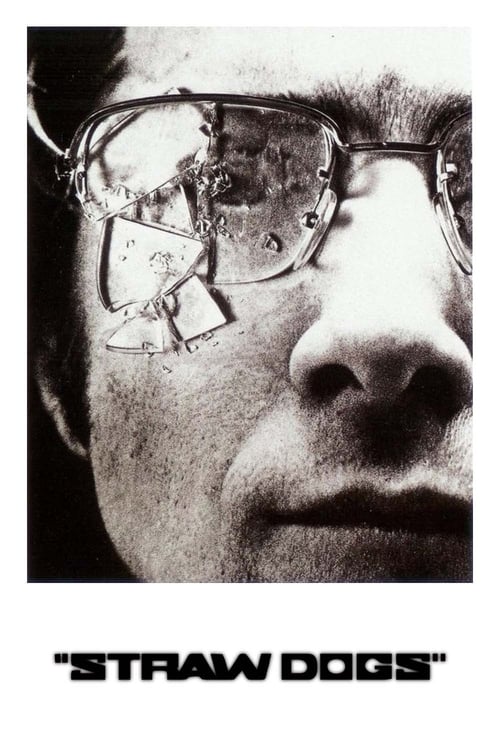
Straw Dogs
1971 · Sam Peckinpah
Only for when you want to be challenged, not comforted — a confrontational film to grapple with and debate afterward, not a casual watch. Fair warning: it contains a sexual assault and its violence is meant to implicate, not thrill.
What it's about
David, a mild-mannered American mathematician, moves with his English wife Amy to the remote Cornish village where she grew up, hoping for quiet. Instead the local men — including Amy's old flame — meet him with mockery that curdles into menace, and the couple's retreat becomes a pressure cooker. It's a story about how far a civilized man can be pushed, and what's waiting underneath when he stops retreating.
The experience
Slow-burning dread that tightens for an hour and then detonates — genuinely harrowing, with scenes of sexual violence and brutality that are meant to disturb and still do. You come out shaken and arguing with it, which is exactly its design.
Performances
Dustin Hoffman is riveting as David — his transformation from timid, conflict-avoidant academic to something far darker is played in small, believable increments that make the finale land like a verdict.
The craft
Peckinpah compresses his whole violent worldview into a single farmhouse: patient, needling escalation for most of the runtime, then a siege edited with his trademark fractured, slow-motion intensity. The rural Cornwall setting — fog, stone, hostile faces — does as much menacing as any character.
Why it matters
Released in 1971 alongside a wave of violent landmark films, it became a central exhibit in the era's argument over screen violence — censored, condemned, and defended for decades — and remains Peckinpah's most disputed work.
Snapshot
Straw Dogs is Sam Peckinpah's most concentrated and most disputed film: a chamber-scale siege thriller that strips his characteristic mythology of the American West down to a single farmhouse in rural Cornwall. Adapted from Gordon Williams's 1969 novel The Siege of Trencher's Farm, it follows David Sumner, a mild American mathematician who retreats with his English wife Amy to her home village, only to find that withdrawal from violence is itself a provocation. The film moves from social humiliation through sexual assault to a final, prolonged defense of the home that has become the most analyzed and condemned set piece of Peckinpah's career. Released in 1971 — the same year as A Clockwork Orange, Dirty Harry, and The French Connection — it became a central exhibit in the era's argument over screen violence, and in Britain its reputation as a "video nasty" kept it effectively suppressed on home video for nearly two decades. Its title, drawn from the Tao Te Ching ("Heaven and Earth are ruthless, and treat the myriad creatures as straw dogs"), signals a film that regards its characters with a deliberately cold, almost ceremonial detachment.
Industry & production
The film was a transatlantic production financed by ABC Pictures, the film arm of the American Broadcasting Company, and produced by Daniel Melnick, who had previously worked with Peckinpah on the celebrated television play Noon Wine. It was shot in late 1970 and early 1971 on location in Cornwall — principally around the village of St Buryan — with interiors at Twickenham Studios. Casting Dustin Hoffman as David was a significant commercial anchor: Hoffman, fresh from Midnight Cowboy (1969) and Little Big Man (1970), brought serious art-house and box-office credibility to a property that was otherwise modestly scaled. Susan George, then early in her career, was cast as Amy after other actresses were considered; her relative youth opposite Hoffman became part of the film's discomfiting texture.
Peckinpah came to the project with a turbulent industry reputation. After the triumph of The Wild Bunch (1969) he had made the elegiac, commercially underperforming The Ballad of Cable Hogue (1970), and his history of clashes with studios — most notoriously over the recut Major Dundee (1965) — preceded him. Straw Dogs was unusual in his filmography for being made largely outside America with European money and crew, and for being a contemporary story rather than a Western or period piece. The production was not free of friction, but it delivered a film on a controlled budget, far from the sprawling logistics of The Wild Bunch.
The film's release was inseparable from censorship politics. In the United States it carried an R rating after negotiation over its content; in Britain the BBFC passed it with cuts. The controversy intensified in the 1980s "video nasties" panic, when Straw Dogs was withheld from legitimate UK video release for years, and a fully uncut version did not circulate freely in Britain until 2002. This protracted censorship history is itself a major part of the film's industrial story.
Technology
Straw Dogs was shot photochemically on 35mm in color, in a standard widescreen aspect ratio, using the conventional film technology of its moment; it is not a film of technical novelty so much as one of technical refinement. Its most distinctive technological dimension is its use of variable camera speeds — overcranking to produce the slow-motion inserts that had become Peckinpah's signature since The Wild Bunch. The climactic siege depends on the interplay of normal-speed and slow-motion footage, which required disciplined coverage and careful exposure compensation when overcranking. Sound was recorded and mixed for a conventional mono/optical theatrical presentation. Where the film is genuinely advanced is not in apparatus but in the editorial assembly of its footage, discussed below.
Technique
Cinematography
John Coquillon, who had shot Michael Reeves's Witchfinder General (1968) and would become a recurring Peckinpah collaborator, photographed the film. His Cornwall is damp, gray-green, and unromantic — a landscape of low cloud, stone, and mud that refuses the picturesque. Interiors at Trencher's Farm are cramped and shadowed, emphasizing thresholds, windows, and doorways: the architecture of a place that will have to be defended. Coquillon's handheld and reactive camerawork during the assault and siege sequences contrasts sharply with the composed, almost static framing of the early domestic scenes, so that the film's deteriorating order is registered visually before it is registered in plot. The famous low-angle and through-glass compositions turn the farmhouse into a fishbowl in which David is watched and judged.
Editing
Editing is where Straw Dogs is most radical. The cutting — credited to a team including Roger Spottiswoode, Paul Davies, and Tony Lawson — extends the fragmented, multi-speed montage Peckinpah and his editors had pioneered on The Wild Bunch, in debt to Eisensteinian collision and to Kurosawa's choreography of violence. Violence is built from many brief shots layered with slow-motion accents, so that an action is simultaneously prolonged and shattered. The film's most contested editorial decision is the intercutting of the assault on Amy with flash-forwards and flashbacks, and the deliberately ambiguous rendering of her response, which the montage refuses to resolve into clear consent or pure violation. The siege climax is a sustained demonstration of rhythmic cutting under pressure, alternating David's improvised defenses with the attackers' incursions until domestic space becomes a kill-box.
Mise-en-scène / staging
The film is organized around the farmhouse as a contested territory. Peckinpah stages the early scenes to establish social geography — the pub, the church social, the moor, the bedroom — and then collapses that geography inward as the threat closes. Recurring props carry meaning: David's glasses (the marker of his ineffectual intellect, which he removes before the final violence), the man-trap mounted on the wall (a Chekhovian object that will be used), the broken spectacles and household implements that become weapons. The hanging of the family cat in the bedroom closet, discovered by Amy, is staged as a quiet domestic horror that announces the village men's intrusion into private space long before the siege.
Sound
Jerry Fielding, Peckinpah's regular composer since The Wild Bunch, wrote a spare, unsettling score that resists conventional thriller cues, favoring dissonance and restraint over reassurance. Equally important is the film's use of diegetic sound — the screech of the bagpipe-like music at the church social, the ambient menace of wind and machinery, and crucially the church-bell and crowd noise that David must hear over and around. The interplay of Fielding's music with environmental sound heightens the sense of a man straining to perceive threat.
Performance
Dustin Hoffman's David is a study in passive-aggression curdling into something else — a performance built on small evasions, nervous smiles, and withheld confrontation, which makes the eventual eruption both shocking and, disturbingly, satisfying in a way the film implicates the viewer for feeling. Susan George's Amy is the film's most difficult and most debated performance: she must register boredom, flirtation, fear, and trauma, often within scenes whose framing works against her interiority. Among the supporting cast, Del Henney as Charlie Venner (Amy's former lover), Ken Hutchison, Peter Vaughan as the menacing Tom Hedden, and David Warner — unbilled — as the damaged Henry Niles give the village its texture of casual, escalating brutality.
Narrative & dramatic mode
The film operates as a slow-burn siege thriller wearing the clothes of a marriage drama. Its dramatic engine is escalation: a sequence of provocations — the leering work crew hired to repair the garage, the cat, the false hunting invitation that strands David on the moor while the assault occurs at home — each of which David fails to confront. The structure is almost classically Aristotelian in its compression toward a single catastrophe, and the assault on Amy sits at the structural center, a pivot the film never lets the audience fully process before the plot resumes. The climax is triggered by an unrelated accident — David's car striking Henry Niles, who has accidentally killed a local girl — so that David's defense of his home is set in motion not by the rape (which he does not know about) but by an abstract principle: "This is where I live. This is me. I will not allow violence against this house." The dramatic irony is severe; the audience knows what David does not.
Genre & cycle
Straw Dogs belongs to several overlapping cycles. It is a home-invasion/siege film, part of a lineage running from The Desperate Hours (1955) back to the Western homestead defense and forward to countless later thrillers. It is also a key text in the early-1970s cycle of films interrogating violence and vigilantism — alongside Dirty Harry and A Clockwork Orange — that crystallized the period's cultural anxiety about aggression, masculinity, and social breakdown. Finally, it sits within the British "rural menace" tradition, the unease of the outsider in an insular countryside, a register it shares with Witchfinder General and The Wicker Man (1973).
Authorship & method
The film is unmistakably Peckinpah's, even relocated from his native idiom. His preoccupations — the violence latent in all men, the thin membrane of civilization, the contested boundary between cowardice and courage, slow motion as a means of moral magnification — are all present, abstracted from the West into a single English farmhouse. The screenplay is credited to David Zelag Goodman and Peckinpah, adapting Williams's novel; the film's most discussed departures from the source, including the handling of the assault, are products of this adaptation. His key collaborators recur from The Wild Bunch: composer Jerry Fielding and, in spirit, the montage approach to violence developed with his editorial teams. Cinematographer John Coquillon, new to Peckinpah here, would shoot several of his subsequent films (Pat Garrett and Billy the Kid, Cross of Iron, The Osterman Weekend), making Straw Dogs the start of an important partnership. Peckinpah's method — long, intense location shoots, an emphasis on faces and reactions, and a refusal to let violence be clean — defines the picture.
Movement / national cinema
The film is a hybrid: an American auteur's vision realized within the British film industry with British finance, crew, and (apart from Hoffman) cast. It is not part of any formal movement, but it intersects with the New Hollywood's willingness to confront violence and moral ambiguity, and with a strain of early-1970s British cinema attentive to provincial darkness. Its outsider's-eye view of rural England — clannish, suspicious, latently violent — is the perspective of an American transposing frontier mythology onto Cornwall, which is part of what made it provocative to British critics and censors alike.
Era / period
Straw Dogs is profoundly of 1971. It arrived at the high-water mark of debate over permissiveness and screen violence, after the loosening of the Production Code into the MPAA ratings system (1968) and amid widespread cultural anxiety about crime, the collapse of consensus, and the meaning of masculinity in the wake of the 1960s. The film's contemporary setting, its skepticism toward both pacifism and machismo, and its willingness to make the audience complicit in violence are all expressions of that moment. Its long censorship afterlife in Britain ties it equally to the conservative reaction of the 1980s.
Themes
The film's governing theme is the proposition that violence is constitutive of manhood and that the refusal to face it is not virtue but evasion — a reading the film advances without ever fully endorsing, since David's final competence is also a kind of moral horror. Allied themes include territory and the home as the ultimate ground of identity; the failure of intellect and reason against physical threat; marriage as a site of mutual incomprehension and unspoken contempt; and the porousness of the line between civilization and savagery. The film is also, unavoidably, a film about sexual violence and its representation, and about the gaze — how the camera watches Amy, and how the village watches David. Its detachment, encoded in the title's Taoist allusion, treats its people as straw dogs: ritual objects, used and discarded.
Reception, canon & influence
Critical reception in 1971 was sharply, often bitterly divided. The film drew serious, hostile attention from major critics who read its escalation toward cathartic violence — and especially its handling of Amy's assault — as morally suspect; Pauline Kael's review was among the most influential of these condemnations, and the charge that the film glorified or eroticized violence has shadowed it ever since. Other critics defended it as a rigorous, unflattering anatomy of male aggression precisely because it implicated the viewer. The assault scene's ambiguity remains the central interpretive battleground, with feminist criticism in particular contesting the film's framing; the record here is one of genuine, ongoing disagreement rather than settled judgment.
Backward, the film's influences are clear: Peckinpah's own The Wild Bunch and its montage of violence; the Western siege/homestead tradition; Kurosawa and Eisenstein in editing; and Williams's source novel, whose plot scaffolding Peckinpah retained while transforming its meaning. Forward, Straw Dogs became a touchstone for the home-invasion thriller and for any film grappling with the spectacle of a "civilized" man's violent capability — its DNA is visible across decades of siege cinema and revenge narratives. It was directly remade by Rod Lurie in 2011, relocated to the American South, a version that clarified the original's ambiguities and, in doing so, demonstrated how much of the 1971 film's power lay precisely in its refusals. Within Peckinpah's body of work it stands beside The Wild Bunch as one of the two films on which his reputation — as both major artist and lightning rod — most rests. It is now widely treated as canonical, taught and written about extensively, though its canonization is permanently entangled with its controversy.
A Deleuzian reading
He takes off his glasses.
The full Deleuzian reading of Straw Dogs →
Reception
One of 1971's lightning rods — released the same season as A Clockwork Ora nge and instantly branded indefensible by many critics, it was effectively banned on UK home video for decades, only passing uncut in 2002. Now it's canon Peckinpah, though 'rehabilitated' is too tidy a word for a film people still argue about this fiercely.
How Straw Dogs was received, from release to now →
Influences: the films it descends from and the films it influenced
- The Birds (1963) — Hitchcock's home-under-siege boarding-up sequence — escalating assault on a fortified house with rising-action dread and offscreen menace — is the structural ancestor of Straw Dogs' final defense.
- Cape Fear (1962) — Extends the escalating-siege-on-the-home structure to its violent endpoint, forcing the rectitudinous man to meet the intruders with brutal force.
- Wait Until Dark (1967) — Escalates the domestic-siege into the victim actively converting the home's architecture and household objects into weapons — extending the light-as-weapon reversal into full spatial counterattack.
- Bad Day at Black Rock (1955) — Takes the outsider-besieged-by-a-rural-community premise and pushes the slow-burn-to-eruption structure to its limit, detonating banked menace into sustained violence as Black Rock detonates its climax.
- The Young One (1960) — Extends the invaded isolated microcosm into siege, staging violence so that no party retains clean moral standing — the anti-melodrama refusal of a legible villain carried forward.
- Funny Games (2008) — Peckinpah established the bourgeois-domestic-siege structure and pioneered the slow-motion aestheticization of violence that Haneke explicitly set out to invert; the 2008 film's absolute refusal of slow-motion, rack-focus, and any visual enhancement of the killings is a direct negative critique of Peckinpah's craft choices, using the same generic skeleton to reach the opposite formal and moral conclusion.
- Nobody (2021) — Peckinpah's grammar of accumulated male humiliation igniting dormant violence in a mild-mannered protagonist is Nobody's structural engine — Hutch's escalating provocation across the bus sequence maps directly onto Peckinpah's emasculation-as-trigger model for disproportionate retaliation.
- Skyfall (2012) — Provides the siege-of-the-isolated-house climax in which a man improvises lethal traps against an overwhelming assaulting force, the structural model for the Skyfall lodge finale.
- A History of Violence (2005) — Pioneers the home-invasion siege in which a mild man discovers his own capacity for savagery, staging domestic space as the arena where suppressed violence is unleashed and the protective and the monstrous become indistinguishable.
- Hot Fuzz (2007) — Establishes the eruption of graphic siege violence within a quaint English rural community, the tonal collision Hot Fuzz weaponizes when Sandford's cozy exterior detonates into carnage.
- The Beasts (2022) — Founds the outsider-couple-in-hostile-countryside siege thriller, where local male provocation escalates by degrees into territorial violence — the structural spine The Beasts inherits.
- An American Werewolf in London (1981) — The blocking template for the Slaughtered Lamb — an American outsider at the bar, locals arranged in a closed semicircle, conversation dying on entry and resuming as coded threat — staged in flat interior light with no horror grammar at all.
- Green Room (2016) — Blocks the siege by mapping the house as a tactical floorplan before the assault so escalation reads as geography, and pins the queasiness on an outsider discovering he will do worse than his attackers.
- Dheepan (2015) — Donates the besieged-dwelling climax as an architectural sequence — the domestic interior converted room by room into a defensible perimeter, doors and stairs re-read as chokepoints — along with its unresolved proposition that killing restores a passive man to a manhood the film had withheld from him.
- The Wild Bunch (1969) — The direct ancestor of Straw Dogs' violence: Peckinpah and his editors built the multi-speed slow-motion montage of bullet impacts here, intercutting overcranked and normal-speed footage to stretch and moralize the moment of death.
- Battleship Potemkin (1925) — Source of Peckinpah's collision-montage grammar — cutting on graphic conflict and fragmenting an assault into rhythmic shards (the Odessa Steps) rather than covering it in continuity, the method behind the ambiguous intercutting of Amy's assault.
- Seven Samurai (1954) — The template for the siege staged as escalating defense of a homestead, plus Kurosawa's multi-camera, varied-speed coverage of violent action that Peckinpah openly adapted into his own slow-motion cutting.
- High Noon (1952) — Ancestor of the moral-cowardice siege: a 'civilized' man abandoned by his community must stand and fight, the real-time tightening dread Peckinpah transplanted from frontier town to English farmhouse.
- The Desperate Hours (1955) — Early home-invasion blueprint: domestic interior turned into a pressure cooker by intruders, the bourgeois household forced to confront its own capacity for violence under siege.
- Pat Garrett and Billy the Kid (1973) — Sibling in the Peckinpah-Coquillon partnership begun on Straw Dogs — John Coquillon's diffused, glass-and-light cinematography and elegiac slow-motion deaths carry directly forward from this film.
- Cross of Iron (1977) — Sibling extending the Peckinpah/Coquillon/Fielding team into combat: dissonant Jerry Fielding scoring under overcranked, fragmented battle montage — the same violence-as-magnification editing developed in Straw Dogs.
- Deliverance (1972) — Sibling in rural-menace cinema: civilized men driven to lethal violence by backwoods locals, sharing Straw Dogs' anatomy of the assault and the thin membrane between civilization and savagery.
- Last House on the Left (1972) — Descendant carrying Straw Dogs' implication-of-the-viewer assault staging and the eruption of a 'civilized' household into retaliatory violence into the rural revenge-horror idiom.
- Death Wish (1974) — Descendant in the '70s 'civilized man discovers his violent capability' cycle — the meek urban professional weaponized, dramatizing the same theme of latent violence Peckinpah staged through Hoffman's David.
- Funny Games (1997) — Descendant of the home-invasion siege that turns the audience's appetite for cathartic violence against itself, formalizing the viewer-implication Peckinpah pioneered in the assault and the farmhouse defense.
- Assault on Precinct 13 (1976) — Descendant transposing the Seven Samurai/Straw Dogs fortress-defense structure — barricading and holding a building against escalating waves of attackers — into the urban siege thriller.
Similar films
- Cross of Iron (1977) — influence & lineage
- The Wild Bunch (1969) — influence & lineage
- Deliverance (1972) — influence & lineage
- No Country for Old Men (2007) — influence & lineage
- Dogville (2003) — influence & lineage
- The Power of the Dog (2021) — shared sensibility
- The Beguiled (1971) — shared sensibility
- The Deer Hunter (1978) — shared sensibility