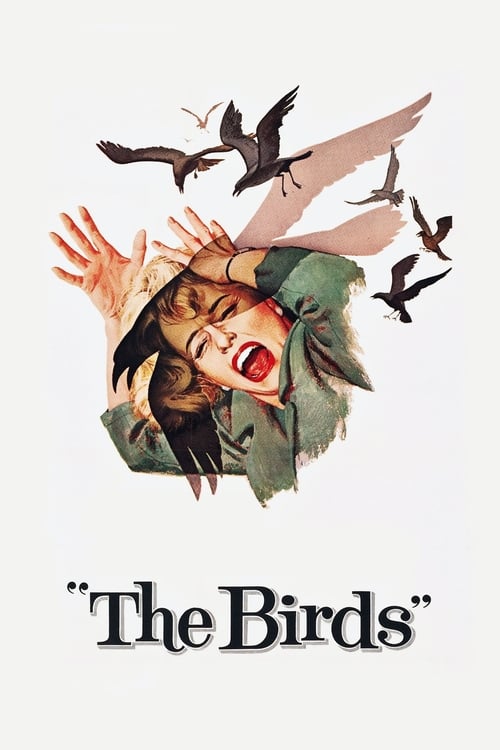
The Birds
1963 · Alfred Hitchcock
When you're craving a real scare of the creeping, existential kind — not gore or jump-scares but the unease of a world that's stopped making sense. A challenge, and a rewarding one.
What it's about
A wealthy San Francisco socialite follows a flirtation to a small seaside town, lovebirds in hand — and then the birds start attacking. First a lone gull, then flocks, then thousands, descending on schoolchildren, homes, and the whole community, with no explanation and no obvious way to stop them.
The experience
Hitchcock strips out the safety nets — there's no musical score, no reason given, no comfort — so the dread builds out of silence, waiting, and the flutter of wings. It's slow-coiling, deeply unsettling horror that gets under your skin and stays there.
The craft
The bird attacks were a landmark of special effects for their time, and the sound design — electronic shrieks and eerie silences instead of music — does the work a score normally would. Hitchcock's staging of sequences like a slowly gathering flock on a playground remains a master class in suspense built from stillness.
Why it matters
A foundational film for nature-turns-hostile horror and for the idea that terror needs no explanation — its refusal to resolve anything influenced decades of ambiguous, apocalyptic-tinged horror.
Snapshot
Hitchcock's most formally radical and thematically unresolved major work, The Birds strips the thriller of its customary machinery — no score, no motive, no resolution — and replaces it with a sustained assault on the viewer's capacity for explanation. A flock of seagulls attacks a man on a dock. Then more birds come. Then more. The film refuses every interpretive escape route it appears to open. What emerges is less a horror film than a meditation on the fragility of social order, the violence latent in sexual transgression, and the fundamental indifference of the natural world to human meaning-making.
Industry & production
The Birds was produced by Alfred Hitchcock's own production company and distributed by Universal Pictures, where Hitchcock had relocated after his long association with Paramount. The transition allowed him greater creative latitude, and The Birds — arriving in the immediate wake of Psycho (1960) — was conceived on an overtly ambitious scale: a prestige production that would also function as a technical experiment. Hitchcock purchased the rights to Daphne du Maurier's 1952 short story (published in the collection The Apple Tree) and hired crime novelist Evan Hunter — known also under his pseudonym Ed McBain — to expand the spare, uncanny tale into a feature-length screenplay. The source story is set in Cornwall; Hitchcock relocated the action to Bodega Bay, a small coastal community north of San Francisco, whose fog, isolation, and physical openness gave the attacks a specifically Californian desolation. The film's considerable budget reflected its effects ambitions, and the production reportedly ran long and over cost, much of that attributable to the complex and labor-intensive work of making thousands of birds behave on cue.
Technology
The Birds stands as a landmark in special visual effects for a sound reason: it demanded the synthesis of techniques that had not previously been combined at this scale. Ub Iwerks — the legendary animator and technician who had co-created Mickey Mouse alongside Walt Disney before turning to effects work — supervised the optical printing process that composited live-action footage with separately filmed bird behavior. Trained ravens, gulls, and mechanical birds were used in varying combinations depending on the sequence; the mechanical birds appear most in close shots requiring precise choreography. Matte paintings extended locations. An early application of sodium vapor process compositing (sometimes called the yellow screen process) allowed birds to be layered over actors with greater precision than the standard blue-screen technology of the era. The results are uneven by later standards — some composite shots retain a ghostly double exposure quality — but certain sequences, particularly the view from above of the gathering birds at the Bodega Bay school, remain startling in their spatial coherence.
The film's other major technological achievement is its sound design. Hitchcock made the unprecedented decision for a major Hollywood production to forgo a conventional orchestral score entirely. Bernard Herrmann, who had scored six previous Hitchcock films, served instead as "sound consultant," guiding the creation of a wholly electronic soundscape produced by German musician Oskar Sala on the Mixtur-Trautonium — an advanced variant of the Trautonium, an early electronic instrument capable of producing overtone-rich, gliding tones that hover between musical and mechanical registers. Sala, working with composer Remi Gassmann at a studio in Berlin, generated the hundreds of bird-sound variants used throughout the film: the clicking of wings, the massed screaming of an attacking flock, the low, menacing murmur of birds at rest. The result is a film in which the sound design is the score, the birds' voices supplying not merely ambient texture but all the emotional modulation normally delegated to orchestral music.
Technique
Cinematography
Robert Burks served as director of photography, his tenth consecutive collaboration with Hitchcock stretching back to Strangers on a Train (1951). Shot in Technicolor, The Birds uses light with unusual restraint for a color production of its era: the Bodega Bay exteriors favor flat, coastal overcast, and the interiors are frequently underlit in ways that give the domestic spaces a quality of enclosure rather than warmth. Burks employs the long lens selectively — notably in the celebrated overhead tracking shot that precedes the bird attack on the town, which begins as a point-of-view from a bird's perspective and slowly widens to reveal the full scope of the disaster below. In contrast, the attack sequences themselves are often shot in close-up and medium range, the editing-driven chaos deliberately denying the viewer the spatial mastery that a wide master shot might provide.
Editing
George Tomasini, Hitchcock's editor since The Wrong Man (1956), cut The Birds with characteristic economy during the dialogue scenes and then unleashed a deliberately disorienting rhythm during the attacks. The schoolhouse sequence — in which Melanie Daniels sits on a bench outside as crows gather, unseen by her, on the jungle gym behind her — is constructed almost entirely in the editing: a series of look/reaction/look shots that transform a deserted playground into something genuinely terrible through accumulation alone. Tomasini controls the pace of revelation with near-mathematical precision.
Mise-en-scène / staging
Hitchcock stages the film's early sequences with the coded formality of a drawing-room comedy — the meet-cute between Melanie (Tippi Hedren) and Mitch Brenner (Rod Taylor) in the San Francisco pet shop is pure Hawks-inflected banter — and then systematically dismantles that register. The Brenner house becomes a fortress; windows become vulnerabilities; the fireplace becomes a breach. Hitchcock's spatial intelligence is most visible in the staging of the Tides restaurant sequence, where news of the first attacks arrives progressively from different directions, and in the final descent into the house interior, where Melanie's movement upward toward the attic inverts every expectation of upward movement as safety.
Sound
The Trautonium sound design functions not merely as a substitute score but as a formal argument: the film refuses to tell the viewer how to feel through conventional melodic means. The only diegetic music in the film — children singing a traditional folk round in the Bodega Bay schoolhouse — occurs in proximity to violence, the playful repetition of the song scored against the viewer's knowledge of the gathering birds outside. This deliberate irony is one of the film's most unsettling formal devices. The sounds of silence, when the birds momentarily cease, function as a more disturbing cue than any musical sting.
Performance
Tippi Hedren, a model with no prior film experience, was discovered by Hitchcock through a television commercial and cast as Melanie Daniels in a calculated strategy to create a new star personality from scratch — as he had with Grace Kelly and Kim Novak before her. Hedren's performance carries a specific quality of controlled surface over unstable depths: she plays Melanie as a woman whose socialite lightness gradually becomes a liability, her composure eroding as the attacks escalate. Rod Taylor brings solid, conventional masculine competence to Mitch; Jessica Tandy, as his mother Lydia, is quietly extraordinary, her grief over her husband's death expressed entirely through a performance of barely contained anxiety. Suzanne Pleshette's Annie Hayworth is the film's most emotionally generous performance, her generosity toward Melanie all the more painful for what it costs her.
The production's dark footnote is the manner of Hedren's filming. She has documented — in her memoir and in other interviews over the decades — that the infamous attic sequence, in which Melanie is attacked by birds in an enclosed space, was shot over multiple days using live birds thrown directly at her, and that the conditions caused her genuine physical and psychological harm. This is part of the film's documented production history.
Narrative & dramatic mode
The Birds operates within a recognizable Hitchcock framework — the wrong-place/wrong-time protagonist, the romantic entanglement, the eruption of violence into quotidian space — while systematically refusing its resolutions. The film is structured in three movements: a comedy of manners (Melanie following Mitch to Bodega Bay), a romantic drama (their tentative attachment set against the attacks), and something closer to apocalyptic horror (the final sequence of carnage and the film's extraordinary ending). Crucially, Hitchcock and Hunter's script provides no explanation for the attacks. No scientific cause is offered, no character theory proves out, no villain is unmasked. The birds simply come. The film ends with Mitch, Melanie, Lydia, and Mitch's sister Cathy leaving the Brenner property into a landscape entirely occupied by birds: not fleeing in panic, but moving carefully, the birds indifferent to their departure. It is one of the most genuinely inexplicable endings in mainstream Hollywood cinema.
Genre & cycle
The Birds arrives after a decade of atomic-age creature features — Them! (1954), Tarantula (1955), the Harryhausen productions — that explained their monstrous nature through radiation, science, or communist metaphor. Hitchcock refuses every one of these explanatory moves and in doing so retroactively exposes the anxiety-management function those explanations served. The film belongs to a strain of early-1960s cinema — alongside Carnival of Souls (1962) and elements of Roger Corman's Poe adaptations — that uses horror to foreground irresolution rather than contain it. It is the foundational text of what would later be codified as eco-horror or "nature attacks" cinema, distinguished from its successors by its absolute refusal of causality.
Authorship & method
By 1963 Hitchcock was the most publicly theorized filmmaker in Hollywood, the Cahiers du Cinéma auteur critics having championed him since the mid-1950s as a master whose technical mastery expressed a coherent personal vision. The Birds is simultaneously his most auteurist film — every formal decision traces back to a single controlling intelligence — and his most collaborative in its production demands. Burks and Tomasini were essential instruments; the Iwerks effects unit was indispensable; Sala and Herrmann shaped the film's entire affective register. Evan Hunter's contribution to the script is substantial: he invented the San Francisco opening, the pet shop meet-cute, and the love triangle structure that du Maurier's story lacks entirely, providing the human architecture within which the attacks acquire their charged, displaced quality. The director's relationship to his screenwriters was famously controlling — Hitchcock is on record saying that films were made in the writing stage — yet Hunter's imprint on The Birds is more visible than many of Hitchcock's collaborative credits.
Movement / national cinema
The Birds is an Anglo-American film in a precise sense: its director is a British émigré working within the Hollywood studio system, adapting a British author's story about coastal England and transposing it to California. The distinctly un-British landscape of Bodega Bay — its flatness, its distance from community, its absence of the social texture du Maurier's Cornwall implied — is itself a formal statement. Hitchcock's British films of the 1930s used architecture and social class as the matrix of suspense; The Birds strips that matrix away and finds something more existentially bare underneath.
Era / period
Released in March 1963, The Birds belongs to a transitional moment in American cinema and culture. It follows Psycho by three years, arriving after that film had already expanded the permissible range of Hollywood horror and demonstrated the commercial viability of genuine shock. The early Kennedy years had seen the Cuban Missile Crisis (October 1962), and the cultural atmosphere of 1963 — the film was in release when Kennedy was assassinated in November — was one of ambient institutional anxiety that the film's images of domestic civilization overwhelmed by inexplicable external force seemed to image, though Hitchcock consistently resisted such readings. The film arrives just before the Hollywood studio system's final crisis period, and its unresolved ending anticipates the more systematically open American cinema of the late 1960s and 1970s.
Themes
The film sustains several interpretive frames without resolving into any of them. The sexual-psychological reading — Melanie's transgressive arrival (she brings lovebirds to Mitch's house as an elaborate flirtation) precipitates the attacks, suggesting the birds as an externalization of repressed violence — is explicitly invited by the script and the visual rhyming of bird imagery with Melanie's sexuality. The Oedipal reading, centered on Lydia's barely suppressed possessiveness of her son and her initial hostility toward Melanie, is equally structured into the film; the relationship between Lydia and Melanie resolves into something like maternal acceptance only after the attacks have reduced Melanie to a state of childlike helplessness. A third reading — the birds as pure nature, indifferent to all human projects — is perhaps the most disturbing because it refuses psychological domestication entirely. The film's power derives partly from its willingness to hold all three simultaneously.
Reception, canon & influence
Backward influences: Du Maurier's story is the primary literary source, but The Birds also draws on the tradition of the uncanny in British literature (Poe's "The Raven" haunts its edges), on the surrealist usage of birds as disruptions of bourgeois order — Buñuel's Un Chien Andalou (1929), L'Age d'Or (1930) — and on Hitchcock's own earlier work, particularly the stuffed and caged birds that populate Psycho's mise-en-scène. The 1950s creature feature is present as a genre to be systematically disassembled.
Critical reception: Initial reviews were mixed, with many critics noting the technical achievement while expressing uncertainty about the film's tonal register and its conspicuous lack of resolution. Over the following decade critical reassessment, driven substantially by the auteurist project of critics like Robin Wood — whose Hitchcock's Films (1965, revised 1989) provided the foundational sustained analysis — elevated The Birds as among Hitchcock's major statements. Camille Paglia later devoted a full volume in the BFI Film Classics series (1998) to the film, reading it through the lens of classical myth, gender, and the sublime.
Forward influence: The film is the direct ancestor of the "nature attacks" cycle of the 1970s — Frogs (1972), Day of the Animals (1977), and most significantly Steven Spielberg's Jaws (1975), which shares its structure of an idyllic coastal community threatened by animal violence and which Spielberg has consistently cited as a formative influence. The absence of explanation in The Birds recurs in later horror films that withhold causality as a deliberate formal strategy. M. Night Shyamalan's The Happening (2008) is a direct thematic descendant. More broadly, the film's refusal to close its narrative loop — its insistence on an ending that is not an ending — influenced the open-ended American horror films of the 1970s and established a template for the genre's more ambitious registers. The electronic, non-orchestral sound design anticipates the synthesizer scores that would define horror in the 1970s and 1980s, from Goblin's work on Argento's films to John Carpenter's self-composed scores.
A Deleuzian reading
Melanie Daniels sits on a bench outside the Bodega Bay school, smoking, waiting, her back to the jungle gym.
The full Deleuzian reading of The Birds →
Reception
Critics in 1963 were split — many found the slow first hour and unresolved ending baffling after the razor precision of Psycho. Now it's canonized as late-Hitchcock at his most experimental, selected for the National Film Registry in 2016.
How The Birds was received, from release to now →
Influences: the films it descends from and the films it influenced
- Rebecca (1940) — Hitchcock's first du Maurier adaptation establishes the Gothic method of staging domestic architecture as a psychically overdetermined space — every room, window, and threshold carrying latent menace — that The Birds inherits wholesale for the Brenner house, including the fireplace as breach-point and the staircase as a contested vertical axis.
- Them! (1954) — Douglas's post-atomic ant-swarm film establishes the genre convention The Birds works against and transforms: collective creature attack staged as accumulating environmental event, with creature-sound (the ants' shrieking) functioning as the primary affective register in place of orchestral scoring.
- Forbidden Planet (1956) — Louis and Bebe Barron's wholly electronic score — the first in a major Hollywood production — established institutional precedent for replacing the orchestra entirely with synthesized sound, the decision Hitchcock and Oskar Sala radicalized seven years later by making the electronic sound diegetically motivated as the birds themselves.
- Vertigo (1958) — Robert Burks' Technicolor photography of coastal California — flat overcast light, long-lens compression of space against the Bay's gray horizon — establishes the exact visual grammar The Birds inherits and darkens, while Hitchcock's construction of Kim Novak as star through directorial imposition rather than pre-existing charisma prefigures the Tippi Hedren creation.
- Psycho (1960) — Herrmann's strings-only score demonstrated that radical restriction of orchestral palette could perform the full range of cinematic affect, laying the direct ground for Hitchcock's more extreme decision in The Birds to eliminate composed music entirely and replace it with Sala's electronic bird-sounds as functional score.
- Mary Poppins (1964) — Ub Iwerks' sodium vapor compositing process, refined on The Birds' bird-layering sequences, was immediately applied by Disney for the seamless live-action/animation integration of the 'Jolly Holiday' sequence — Iwerks winning an Academy Award for the same optical workflow in an entirely different tonal register.
- Rosemary's Baby (1968) — Polanski's staging of the Dakota apartment as domestic fortress — windows mapped as vulnerabilities, neighboring spaces as sites of breach, the floorplan weaponized against its inhabitant — directly extends The Birds' method of converting household architecture into a threat diagram through mise-en-scène alone, without monster-movie explication.
- Night of the Living Dead (1968) — Romero adopts The Birds' complete staging grammar for the domestic siege: windows boarded against iterative assault, exits cataloged as structural vulnerabilities, the house's architectural logic inverted from shelter into trap — transposing The Birds' besieged Bodega Bay farmhouse into the template for all subsequent zombie-siege cinema.
- Straw Dogs (1971) — Peckinpah's farmhouse siege constructs its escalation through the accumulation-editing method Tomasini perfected in The Birds — each wave of assault slightly more penetrating than the last, the cutting rhythm itself performing violence's inevitability before any individual blow lands.
- Don't Look Now (1973) — Roeg's cross-cutting on visual and tactile rhymes rather than causal continuity extends The Birds' accumulation-rhythm editing into a fully temporal grammar, in which montage's associative logic — not plot — generates the dread, and where the absence of explanation is itself the formal subject.
- Phase IV (1974) — Bass's overhead macro-photography of ant-colony behavior deploys The Birds' bird's-eye surveillance grammar as the insects' own optical POV, making collective non-human intelligence legible as geometric pattern — the desert mesa becoming Bodega Bay's coastal flat, the electronic soundscape achieving the same score-replacement function as Sala's Trautonium.
- Picnic at Hanging Rock (1975) — Weir's strategy of refusing causal explanation — the girls vanish, the film offers no account, the landscape absorbs event without meaning — extends The Birds' narrative method of withholding interpretive resolution while maintaining the physical precision of documented event.
- Jaws (1975) — Spielberg's aerial overhead shots of the beach during shark attacks borrow The Birds' bird's-eye predator-POV grammar directly, converting the water's surface into the same visible threshold — between human social order and nature's indifferent violence — that The Birds constructs from the coastal sky above Bodega Bay.
- Apocalypse Now (1979) — Walter Murch's sound design — in which environmental sound (rotor-wash, river ambience, jungle pressure) performs all the emotional modulation normally delegated to orchestral score — extends The Birds' demonstration that diegetic and electronic sound could replace composed music without affective loss, a lineage Murch has explicitly acknowledged in interviews on sound design methodology.
- Jurassic Park (1993) — Hitchcock's staging of human figures in ordinary enclosed spaces progressively colonized by predators — accumulation of discovery-by-discovery shocks rather than a single reveal — established the suspense grammar Spielberg applies directly to the raptor kitchen sequence's systematic elimination of safe zones.
- The Host (2006) — Pioneers creature violence erupting into mundane, sunlit public space against ordinary civilians, with wide compositions that let the attack play as observable geography rather than shock-cut montage—the staging logic of The Host's riverside assault.
- Nope (2022) — Hitchcock's sustained aerial creature attacks across Northern California landscape, with permanently withheld motivation, establish the creature-from-above horror grammar — attacks arriving from the sky as the organizing principle of dread — that Nope directly transposes to the Inland Empire.
- Marnie (1964) — Hitchcock's immediate follow-up retains Robert Burks as director of photography and Tippi Hedren as lead, continuing the program of Technicolor restraint and the construction of a female star-persona through directorial control — the Brenner-house claustrophobia relocated into overt psychosexual architecture.
- War of the Worlds (2005) — Models the escalating, unexplained assault experienced through a strictly restricted civilian POV, the siege of a boarded-up house, and an ending that withholds rational cause — the structural ancestor of the cellar standoff.
- High Anxiety (1977) — Source for the avian-assault staging — Brooks parodies the layered optical compositing and overhead-attack blocking, replacing menace with the pigeons defecating on the fleeing hero.
- Final Destination 3 (2006) — Hitchcock converts the wholly ordinary — birds, a gas-station puddle, a schoolyard jungle gym — into uncanny lethal hostility, the 'scan the mundane room for what will kill you' dread the FD franchise later made shorthand.
Similar films
- Psycho (1960) — influence & lineage
- Marnie (1964) — influence & lineage
- Vertigo (1958) — influence & lineage
- Rebecca (1940) — influence & lineage
- Jaws (1975) — influence & lineage
- Shadow of a Doubt (1943) — shared sensibility
- Rope (1948) — shared sensibility
- Rear Window (1954) — shared sensibility
All the films related to The Birds →