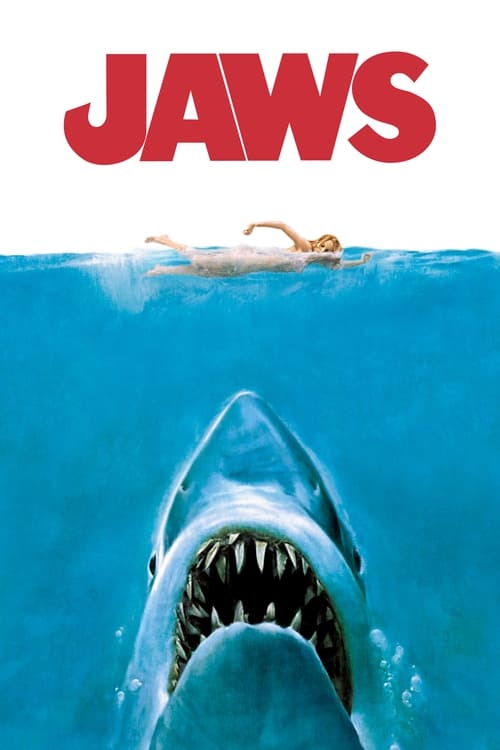
Jaws
1975 · Steven Spielberg
When you're craving a real scare that's also a great time — the definitive summer thriller, best watched with other people and ideally before a beach trip you're willing to ruin.
What it's about
A great white shark starts killing swimmers off Amity Island just as the summer tourist season — the town's whole economy — is about to open. The police chief who hates the water, a young shark scientist, and a salty professional hunter end up on a small boat together, going out to kill it.
The experience
Two movies in one sitting: a mounting-dread thriller on the beaches, then a claustrophobic three-men-and-a-boat adventure that turns the ocean into a trap. The suspense still works completely — you'll flinch at water you can't see into — and the banter between the three men keeps it alive between scares.
Performances
Roy Scheider, Richard Dreyfuss, and Robert Shaw make a perfect mismatched trio, and Shaw's shark hunter Quint delivers one quiet monologue below deck that's among the most chilling scenes ever put in a popcorn movie.
The craft
The malfunctioning mechanical shark forced Spielberg to suggest rather than show, and the result — a predator you feel through John Williams's two-note theme and a camera gliding at swimmer's-eye level — is a masterclass in withholding. Verna Fields's editing times every shock to the millisecond; it demands good speakers for that score alone.
Why it matters
It invented the summer blockbuster — the wide release, the saturation marketing, the event movie — and kept a generation out of the ocean. It made Spielberg's career and rewired Hollywood permanently.
Snapshot
A great white shark terrorizes the resort town of Amity Island; Chief Martin Brody, marine biologist Matt Hooper, and shark hunter Quint put to sea to kill it. Simple in synopsis, Jaws is a masterwork of withheld information and orchestrated dread—a film that permanently altered how Hollywood makes, markets, and releases films. Its two-note bass motif, its refusal to show the predator for most of the running time, and its shift from communal panic to intimate three-man tragedy on the open ocean gave it a structural and emotional range that summer genre films were not previously expected to possess. It is simultaneously the most technically improvised major production of the New Hollywood era and one of the most precisely engineered audience experiences in the medium's history.
Industry & production
Universal Pictures, produced by Richard D. Zanuck and David Brown, acquired Peter Benchley's novel before publication in 1974 on the strength of its high-concept premise. Spielberg, then twenty-six, had directed Duel (1971) for television and The Sugarland Express (1974) theatrically; this was his first production at genuine studio scale. Carl Gottlieb, brought in to revise Benchley's screenplay, rewrote the script incrementally on location throughout the shoot, integrating material generated by the actors and adjusting scenes to accommodate what the production could and could not physically achieve on any given day. Benchley received the primary screenplay credit alongside Gottlieb.
Filming began in May 1974 on Martha's Vineyard, Massachusetts—chosen because its offshore geography could plausibly double for the fictional Amity—and ran well past its original fifty-five-day schedule. Final principal photography extended to approximately one hundred fifty days, and the budget climbed from its initial estimate of around $3.5 million to roughly $9 million, a severe overrun by the standards of the mid-1970s. The production's protracted difficulty generated friction between Spielberg and the studio, with reported discussions at various points about replacing him; the record confirms the conflict was serious, though the full internal correspondence has not been made publicly available. Universal elected to release the film on 20 June 1975, opening it simultaneously across several hundred theaters nationwide—a wide-release strategy amplified by an unprecedented television advertising campaign. The combination of broad platform and saturation marketing established a distribution model that, together with Star Wars two years later, redefined studio calculus. Jaws became the first film to cross $100 million at the domestic box office; precise final grosses varied by release window and accounting method, but the cultural and financial threshold it crossed has never been disputed.
Technology
The central technological fact of Jaws is failure. Three full-scale pneumatic-hydraulic mechanical sharks—informally called "Bruce" after Spielberg's attorney—were constructed by special-effects veteran Bob Mattey, who had built the giant squid for Disney's 20,000 Leagues Under the Sea (1954). In saltwater conditions, the mechanisms corroded, seized, and malfunctioned so chronically that the production could rarely deploy a convincing shark on schedule. Spielberg's response, reportedly arrived at partly out of necessity and partly through a re-reading of the Hitchcock principle that the unseen is always more frightening than the seen, was to restructure the film around the shark's absence. What was an engineering liability became a creative strategy: the predator is suggested through floating barrels, a displaced wake, a severed limb, and a destabilised camera long before it is rendered fully visible.
The Taylors—Ron and Valerie Taylor, Australian underwater cinematographers with previous experience filming actual great white sharks—provided live-shark footage shot in South Australian waters. A smaller-than-average male shark was filmed interacting with a scale-model cage and a diminutive stunt diver so that archival and studio material could be intercut convincingly. The resulting composite is imperfect under scrutiny but viscerally persuasive in context.
Technique
Cinematography
Bill Butler served as director of photography, working in Panavision anamorphic widescreen. The most analyzed single shot in the film—and among the most cited in subsequent cinema—is the dolly zoom on Chief Brody as he witnesses an attack on the crowded beach. The technique, which simultaneously tracks the camera toward the subject while zooming out, collapsing spatial recession and disorienting the viewer's sense of depth, had been developed for Alfred Hitchcock's Vertigo (1958). Spielberg and Butler's deployment isolates Brody in psychological space at the moment his worst fear is realized, making a formal device carry dramatic weight. The film's visual grammar in its first two acts draws heavily on deep-focus compositions in public spaces—beach, town hall, diner—that keep foreground faces and background action simultaneously legible, mapping social pressure onto image geometry. Once the narrative moves to the Orca, Butler's work contracts to tight interiors and wide ocean, the scale inversion reinforcing the three men's vulnerability.
Editing
Verna Fields edited the film and received the Academy Award for Film Editing. Her contribution extended beyond the cutting room: she oversaw the construction of a water tank on the Universal lot where controlled pick-up shots could be made of shark-model material that production had been unable to capture coherently on location. The editing deploys classical suspense grammar—intercutting point-of-view with reaction, withholding resolution—but its deeper achievement is rhythmic. Fields modulates pace across the film's long second act, where the mechanical shark is almost entirely absent, in ways that sustain tension without monster-movie catharsis. The acceleration of the final sequence, aboard a sinking vessel, demonstrates an editorial control of chaos that her contemporaries widely acknowledged.
Mise-en-scène / staging
The Orca's cramped cabin is the film's most productive spatial constraint. The climactic scene in which Brody, Hooper, and Quint drink together and compare scars—an improvisational, loosely structured sequence that draws on all three performers' collaborative energy—relies entirely on the staging of bodies in a small room, with the ocean, and what is in it, just off every frame edge. The USS Indianapolis monologue, delivered by Robert Shaw, was crafted collaboratively: playwright Howard Sackler worked on early drafts, Shaw rewrote substantial portions of the final text himself, and John Milius has also been credited with contributions. The precise authorship remains genuinely contested in the record. The staging—Shaw alone in medium close-up for extended stretches, the others listening—gives it the character of testimony rather than performance.
Sound
John Williams composed the score; his main theme, a two-note ostinato in E minor that rises in frequency and volume as threat increases, is one of the most effective and imitated cues in the medium's history. Williams reportedly presented the motif to Spielberg at the piano and was met with laughter before Spielberg grasped its menacing efficiency. The score is notable for what it does not do as much as for what it does: long passages of the film's third act run without music, or with sparse, dissonant strings, allowing ambient ocean sound to carry dread. Williams won the Academy Award for Original Score. The sound design more broadly—the abrupt intrusion of Chrissie's underwater attack in the opening sequence, cut against silence—established an approach to acoustic shock that horror filmmaking absorbed thoroughly.
Performance
Roy Scheider's Brody anchors the film in domestic anxiety; his fear of the water is presented not as weakness but as a reasonable civilian's response to conditions that exceed his training. Richard Dreyfuss's Hooper is the film's intellectual and comedic foil, a performance that keeps the film from tipping into pure dread. Shaw's Quint is the most overtly theatrical element, an Ahab-adjacent obsessive whose Indianapolis monologue transforms the film momentarily into something closer to chamber drama. The line "You're gonna need a bigger boat"—delivered by Scheider—has been widely described by cast and crew as improvised on set; Gottlieb and others have offered slightly differing accounts of its origins, and the precise degree of spontaneity is not definitively established. What is clear is that it was not in the distributed screenplay.
Narrative & dramatic mode
The film operates in three structural movements with distinct modal registers. The first act is communal horror: attacks on a public beach, the town's refusal to act, the assertion of economic interest over safety. The second is procedural and political: investigation, expert consultation, municipal pressure, the failed attempts to manage the shark through conventional means. The third is stripped to its essentials—three men, a boat, an antagonist. This compression into a quasi-Conradian voyage clarifies the film's deeper concerns. The shark is not a character but a condition, an inhuman force against which human bonds—between professional obligation, personal courage, and social background—are tested and, in one case, destroyed. The narrative withholds resolution on the shark until the final scene; what it resolves earlier, and more carefully, is the question of what kind of man Brody is.
Genre & cycle
Jaws operates as a monster film, a thriller, and an adventure picture simultaneously, and it renovated each of those genres in ways that determined the decade that followed. Its clearest ancestors in the monster-film tradition are the creature features of the 1950s—Creature from the Black Lagoon (1954), The Beast from 20,000 Fathoms (1953)—but it imports from Hitchcock a concern with ordinary social space made lethal and from the New Hollywood a willingness to let character texture accumulate before genre mechanics take over. The film created a cycle of killer-animal pictures—Orca (1977), Joe Dante's Piranha (1978), Alligator (1980)—and a broader template for the "high concept" summer release. The blockbuster formula it inaugurated (wide release, saturation advertising, pre-sold property, sequel potential) is the dominant studio model to this day.
Authorship & method
Spielberg's authorship of Jaws is inseparable from improvisation under constraint. His ability to reframe a production crisis—the shark's dysfunction—as a formal opportunity reflects a practical intelligence that defines his working method more broadly. The collaboration with Verna Fields and John Williams is central: Fields shaped the film in post-production at least as significantly as Spielberg shaped it on location, and Williams's score is not illustrative accompaniment but a structural element. Bill Butler's contribution is underacknowledged in most popular accounts; the film's visual coherence across radically different shooting conditions—bright beach exteriors, practical ocean work, tank pick-ups—required genuine cinematographic problem-solving. Carl Gottlieb's function as a writer who was present on set and adjusting scenes in response to daily realities is also significant; Jaws is as much a piece of collaborative opportunism as of directorial vision.
Movement / national cinema
Jaws sits at the intersection of New Hollywood's personal filmmaking ambitions and the studio system's commercial imperatives, and its success pulled those tendencies apart. The film belongs to the generation of American cinema shaped by the Movie Brats—Coppola, Scorsese, Lucas, De Palma, Friedkin—who brought European-influenced concerns with form and authorship into the studio context. Spielberg shared their formation but his instincts were consistently more oriented toward popular entertainment than toward artistic statement. The commercial scale of Jaws and Star Wars effectively ended the brief period of studio risk-tolerance that had produced The Godfather, Chinatown, and Nashville, redirecting investment toward franchise properties and broad-audience events. Whether Jaws is celebrated or indicted for this depends on the critic's prior commitments.
Era / period
The film appeared at a specific American cultural moment: post-Watergate, post-Vietnam, the mid-point of a decade defined by institutional distrust and civic anxiety. Mayor Vaughn's insistence on keeping Amity's beaches open against Brody's warnings reads in this context as a precise allegory of official denial at the expense of public welfare—a reading that reviewers made at the time and that has only accumulated resonance. Whether Spielberg consciously encoded this political subtext or whether the cultural moment simply made it available is a question the director has answered inconsistently over the years.
Themes
The film's explicit subject is predation and civic cowardice, but its sustained theme is the adequacy of ordinary men in extreme circumstances. Brody is not an exceptional figure; he is a transplant from the mainland who has not properly adapted to the coastal community he serves, afraid of the water, unused to genuine violence. The film's dramatic arc is his passage from managed inadequacy to improvised competence. Quint represents the danger of a purely martial response—obsession with the enemy that ultimately makes the obsessive expendable. Hooper, knowledge without instinctive courage, requires the social container the Orca provides to act effectively. The three together constitute a provisional community, assembled from incompatible parts, that barely survives.
Reception, canon & influence
Jaws received broadly enthusiastic critical notices on release, though some reviewers noted the manipulation of audience fear as a commercial calculation rather than an artistic one. The film was nominated for the Academy Award for Best Picture and won three Oscars: Film Editing (Verna Fields), Original Score (John Williams), and Sound. It was added to the United States National Film Registry in 2001. The American Film Institute has consistently ranked it among the greatest American films and placed it at or near the top of its genre rankings for thriller and horror. Pauline Kael's mixed response—admiring the craftsmanship, suspicious of the emotional coercion—has represented one pole of the film's critical history; the opposing position, that Spielberg's engineering of suspense constitutes a genuine formal achievement, has become the consensus.
Looking backward, Jaws draws from Hitchcock's grammar of ordinary settings made terrifying (The Birds, 1963), from the underwater anxiety of the 1971 documentary Blue Water, White Death, and from the Western's conventions of the outsider lawman confronting a community unwilling to face its danger. Melville's Moby-Dick shadows the third act; Benchley's novel had made the allusion explicit, and the film retains it structurally even where it simplifies the novel's plot.
Looking forward, its influence operates at every level of the medium. Its distribution model—wide simultaneous release backed by television advertising—became the studio default within two years. Its technique of withholding the antagonist to maximize menace became the first principle of the creature-feature sub-genre and is visible in films as varied as Alien (1979) and Cloverfield (2008). Williams's score demonstrated that a theme of radical simplicity could carry more menace than orchestral complexity and became the template for scores in which music functions as a physiological cue rather than an emotional commentary. Verna Fields's editorial construction of a film around the absence of its central prop set a precedent for post-production problem-solving that editors have cited for decades. And Spielberg's own subsequent career—Close Encounters of the Third Kind, Raiders of the Lost Ark, E.T.—is a systematic elaboration of the craft principles Jaws demonstrated: that popular entertainment and formal precision are not in conflict, and that the management of audience expectation is itself an art.
A Deleuzian reading
Three yellow barrels skid across the chop, and you stop watching the screen — you watch the water, the spot where the rope goes taut, the place the barrels are being dragged.
The full Deleuzian reading of Jaws →
Reception
No reappraisal needed — it was a phenomenon on arrival, inventing the summer blockbuster and becoming the highest-grossing film ever until Star Wars. Fifty years on it's only climbed, now firmly 'greatest films ever made' material rather than mere popcorn history.
How Jaws was received, from release to now →
Influences: the films it descends from and the films it influenced
- Vertigo (1958) — Bill Butler and Spielberg's dolly zoom on Chief Brody at the beach attack is a direct reproduction of the Vertigo effect Hitchcock and cameraman Irmin Roberts developed—simultaneous track-in and zoom-out to collapse spatial recession and dissociate the subject from their environment, making a formal device carry psychological weight at the moment of trauma.
- Psycho (1960) — Bernard Herrmann's scored-shock grammar in the shower scene—sudden orchestral assault precisely synchronized to cutting rather than anticipation—directly informs how John Williams and editor Verna Fields construct Jaws' kill sequences, pairing musical stings to the moment of impact and establishing the cued-shock template Williams then systematized.
- The Birds (1963) — Hitchcock's template of a nature predator disrupting a coastal community through accumulative, escalating attack sequences—each expanding in communal scope before contracting to individual victims—structures Jaws' first two acts, including the town-hall panic scene's staging of collective fear as a political and social pressure system.
- 20,000 Leagues Under the Sea (1954) — Bob Mattey built the pneumatic-hydraulic giant squid for this Disney production before building Jaws' mechanical sharks; the engineering methodology—large marine creature actuated by pressurized mechanisms on a controlled underwater set—transfers directly, along with the lessons about saltwater corrosion and the creative pivot required when the mechanism fails in the frame.
- Duel (1971) — Spielberg's TV movie is his direct rehearsal for the withheld-menace strategy: the antagonist truck driver is never clearly seen—the vehicle itself is the threat—and Spielberg structures dread through the truck's unexpected reappearances and mechanical displacement rather than confrontation, practicing precisely the approach he would transfer to the shark.
- Godzilla (1954) — The two most transferable devices: the creature withheld for an hour and represented by sound plus its effects on bodies, and the municipal-authority procedural — the council meeting where officials suppress the threat for economic reasons — which is Honda's hearing sequence relocated to a town hall.
- Close Encounters of the Third Kind (1977) — Spielberg redeploys the graduated-revelation structure of Jaws—withholding the central spectacle until a climactic third-act disclosure—while Williams transposes the motif-as-dread logic of the shark theme into the five-note contact sequence, converting threat-announcement into wonder-announcement through the same compositional architecture of repetition and harmonic restraint.
- Halloween (1978) — Carpenter's piano ostinato for Michael Myers—a repeating figure built on a minimal interval, rhythmically relentless, functioning as a threat-announcement signal before any visual disclosure of the killer—directly imitates the structural logic of Williams' two-note bass motif, using rhythmic minimalism to prime the audience's nervous system for violence rather than to score violence itself.
- Piranha (1978) — Produced by Roger Corman explicitly to replicate Jaws' commercial formula, Piranha has Dante and editor Mark Goldblatt directly imitating Jaws' scored-shock kill-sequence editing—rapid cutting paired with musical stings and withheld predator footage—while reproducing the communal-pool panic sequence as a structural set piece; Spielberg reportedly called it the best of the Jaws imitations.
- Alien (1979) — Scott and Dan O'Bannon adopted Jaws' creature-withholding strategy wholesale, restricting the xenomorph's full form through partial framings, darkness, and motion-tracker abstraction for most of the running time; Scott has cited Jaws as the source of his principle that the unseen monster is always more frightening than the shown one, and the film's pacing—long dread, sudden violence—is Jaws' rhythm transposed to confined-space science fiction.
- The Thing (1982) — Ennio Morricone's score uses a bass ostinato figure structurally analogous to Williams' shark motif—a minimal, low-register pulse that signals threat without describing it—while Carpenter inverts Jaws' withholding strategy: the Thing is perpetually present and visible but visually unknowable through shape-shifting, replacing withheld visibility with withheld identity as the engine of dread.
- Jurassic Park (1993) — Spielberg re-applies the Jaws toolkit eighteen years later: the T-Rex is introduced through physical displacement—a vibrating water cup and rippling puddle—before any direct sighting, directly reprising the floating-barrel and displaced-wake strategy; Williams scores the disclosure with a motif held back until the reveal moment; and the saturation wide-release distribution model follows Jaws' own template, now refined into the modern blockbuster playbook.
- A Quiet Place (2018) — Krasinski extends Jaws' strategy of signaling the predator through indirect physical displacement—the creatures are announced by reactive behavior in the environment rather than direct sighting, as Jaws' shark is announced by displaced water and floating barrels—while Marco Beltrami's score observes the same restraint as Williams' motif, using silence and sudden sonic assault rather than sustained scoring to calibrate the audience's threat-response.
- Disclosure Day (2026) — Establishes the withheld-creature suspense economy and the dolly-zoom slow-push-in onto the everyman's dawning-dread face that the seed lists as a core cinematographic device.
- The Host (2006) — Codified the doctrine of concealing the creature to protect both suspense and effects; The Host deliberately inverts it with a sustained daylight master reveal that dares the CGI to survive direct light, a defiance only legible against Jaws's withholding.
- Nope (2022) — Spielberg's enforced absence of the shark across the first two acts — substituting water surface, victim POV, and Williams's cues for the creature itself — is the direct formal model for Peele and van Hoytema's strategy of withholding the full creature form as the film's primary compositional engine.
- Godzilla Minus One (2023) — Spielberg's grammar of sustained creature withholding — the shark established through sound design and surface disturbance before full visibility — and his third-act structure of a civilian-improvised hunting operation running without institutional sanction directly shape Yamazaki's economy of Godzilla revelation and the internal logic of the Shinkai Maru mission.
- Jurassic Park III (2001) — Established the Spielberg house-style creature-suspense grammar — withheld-then-revealed predator, water-line stalking — that JP3 reuses directly in the Spinosaurus river attack.
- The Exorcist (1973) — Friedkin's deployment of Mike Oldfield's Tubular Bells as a repeating low-register ostinato associated with supernatural threat, combined with a saturation-marketing wide release, establishes the twin conditions—motif-scored horror plus event-movie distribution—that Jaws inherits two years later and institutionalizes as the blockbuster template.
- Star Wars (1977) — John Williams developed his neo-Korngold orchestral leitmotif language scoring Jaws before applying it to Star Wars; both films together institutionalize the symphonic blockbuster score as genre convention, with Williams' two-note shark theme and Star Wars' character motifs deploying the same compositional architecture—minimal intervallic figure as narrative signal—across the same summer-event release strategy.
- Outbreak (1995) — Source of the authorities-deny-the-threat dynamic — officials suppressing a public danger for political convenience while experts fight to force a shutdown, recycled as Outbreak's Pentagon cover-up.
- Godzilla: King of the Monsters (2019) — Model for the human-scaled disaster melodrama bolted onto a monster picture — the fractured-family and besieged-experts subplot structure the franchise inherits as its 'ground-level' counterweight.
- War of the Worlds (2005) — Establishes Spielberg's grammar of withholding the threat — keeping the tripods' full reveal delayed and partial — and of staging terror through reaction shots and off-screen menace rather than continuous monster display.
- Raiders of the Lost Ark (1981) — Establishes Spielberg's house craft — Williams's two-note predatory leitmotif and suspense built through legible, audience-oriented action cutting — that Raiders inherits.
- Godzilla (1998) — The withhold-the-creature suspense logic — keeping the monster offscreen, dim, and partial to build dread — which Emmerich borrows but is faulted for never paying off in clear daylight reveals.
- Final Destination 3 (2006) — Spielberg's withheld predator and editing that turns a sunlit beach into a kill zone is the menace-in-the-mundane suspense FD3 abstracts — the threat is the ordinary space itself, not a visible antagonist.
- Final Destination Bloodlines (2025) — Perfects Chekhovian hazard coverage — deliberately planting mundane objects and off-screen threats in early framing so their later lethal payoff feels both shocking and pre-ordained, the exact coverage logic Bloodlines uses to seed its traps.
- Twisters (2024) — Models the grounding-spectacle-in-character-and-place method critics praised in Chung — withholding and rationing the natural threat while a low-frequency sonic dread and small-town texture do the emotional work between attacks.
Similar films
- Halloween (1978) — influence & lineage · same viewing thread
- Jurassic Park (1993) — influence & lineage
- Duel (1971) — influence & lineage
- The Birds (1963) — influence & lineage
- Psycho (1960) — influence & lineage
- Close Encounters of the Third Kind (1977) — influence & lineage
- Alien (1979) — influence & lineage
- A Quiet Place (2018) — influence & lineage · same viewing thread
All the films related to Jaws →
Watch it with: curated runs of related films
- Nowhere Left to Hide — Watch these when you want pure primal terror — ordinary people cornered by something relentless, from open water to a silent farmhouse to a stairwell in Barcelona.