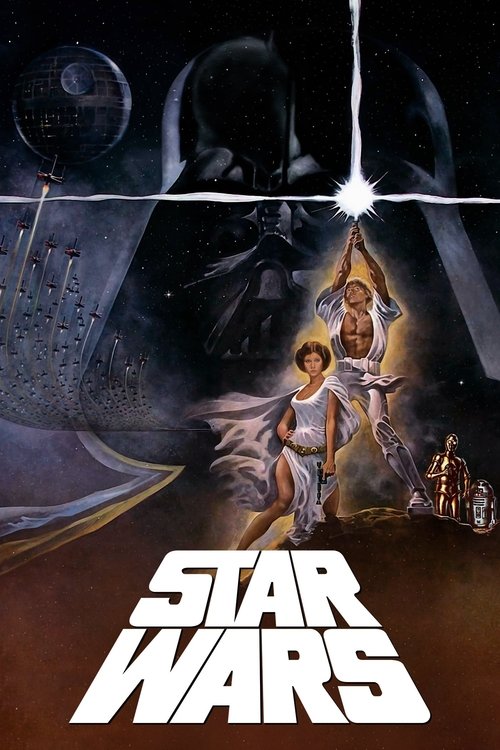
Star Wars
1977 · George Lucas
For when you want wonder without cynicism — a crowd-pleaser night, a family night, or the comfort rewatch that reliably lifts you out of a slump.
What it's about
A farm boy on a desert planet gets pulled into a galactic rebellion when a captured princess hides stolen plans inside a small droid. With an old hermit who knows more than he lets on, a mercenary pilot, and two bickering robots, he sets off across the stars to rescue her and strike a blow against an empire that seems unstoppable.
The experience
Pure momentum — a rousing, big-hearted adventure that moves like the Saturday serials it grew from, with dogfights, escapes, and a swelling score that tells you exactly when to grin. It's earnest without being naive, and it makes you feel twelve years old in the best way.
Performances
Harrison Ford's roguish, throwaway charm as Han Solo made him a star, and Alec Guinness lends the whole fantasy instant gravity as the weathered mentor Obi-Wan Kenobi.
The craft
Lucas stitched together mythology, Westerns, and WWII aerial combat footage into something that felt brand new, and the groundbreaking model work and motion-control effects still hold up as tactile, lived-in spectacle. John Williams's score is arguably the most famous in movie history. Absolutely a big-screen, big-speakers film.
Why it matters
It rewired Hollywood overnight — inventing the modern blockbuster, the summer event movie, and the merchandising empire — and remains the template every franchise still chases.
Snapshot
George Lucas's space opera ignited a cultural and industrial transformation whose aftershocks still govern mainstream filmmaking. Released on May 25, 1977, to limited engagements that quickly became national hysteria, Star Wars synthesized mythology, pulp serialdom, the Western, and the aerial war film into a family adventure of operatic scale. It is simultaneously a consummation of cinema history—drawing explicitly on Akira Kurosawa, John Ford, Leni Riefenstahl, and the Saturday matinee serials of the 1930s and 40s—and a rupture with the countercultural cinema that immediately preceded it. No single commercial film of the sound era has more visibly reorganized the economic priorities, technical infrastructure, and aesthetic expectations of Hollywood.
Industry & production
Star Wars was developed against sustained institutional resistance. Universal passed on the project after Lucas's commercial hit American Graffiti (1973); Twentieth Century-Fox greenlit it largely on the faith of production chief Alan Ladd Jr., who responded to Ralph McQuarrie's painted concept illustrations before a frame of footage existed. The agreed budget, initially in the range of eight to eleven million dollars (accounts vary), escalated significantly during a chaotic shoot. Lucas formed Industrial Light & Magic (ILM) expressly to produce visual effects the existing effects houses could not deliver; the startup team, based initially in a Van Nuys warehouse, had to invent much of its own tooling from scratch.
Principal photography ran from late March to July 1976, centered at EMI Elstree Studios outside London, with location work in Tunisia (the Tatooine desert sequences, partly around Djerba and Tozeur) and a single unit in Guatemala for the Massassi temple exteriors at Tikal. Relations between Lucas and the largely British crew were reportedly tense throughout; many crew members were skeptical of the premise and unfamiliar with the genre Lucas was working in. The droid suits were physically punishing and mechanically unreliable. Fox periodically considered pulling support. The film's completion under these conditions is itself a production-historical document of managerial persistence.
Gary Kurtz produced; John Barry served as production designer, with Ralph McQuarrie's pre-production illustrations functioning as a conceptual bible that gave the entire enterprise a visual grammar before sets were built. Barry's sudden unavailability late in the project was absorbed by his art department without disrupting the visual continuity McQuarrie had established. Joe Johnston contributed spacecraft design drawings that shaped the look of the Rebel and Imperial fleets.
Technology
The central technological achievement is the Dykstraflex, a computer-controlled motion-control camera system developed by John Dykstra and his ILM team. Previous effects cinematography required locked-off cameras or manually repeated moves of only approximate accuracy; the Dykstraflex allowed precise, repeatable multi-axis camera movements programd and stored electronically, enabling the compositing of separately photographed elements—spacecraft, stars, laser fire—into a coherent moving image. This system, and the companies and practitioners it spun off, restructured the effects industry for the following decade.
The theatrical release was one of the first major Hollywood films to use Dolby Stereo optical encoding extensively on a commercial scale. Selected 70mm presentations ran with a six-channel magnetic mix. The combination of directional audio and the Dolby noise-reduction system redefined audience expectations for the theatrical sound experience. Exhibitors began upgrading auditoriums in direct response to the film's release, a capital investment cycle that would prove lasting.
Technique
Cinematography
Gilbert Taylor (BSC), who had shot Dr. Strangelove (1964) and The Omen (1976), photographed the film in anamorphic widescreen on Panavision equipment, rendering the frame at approximately 2.35:1. The visual language oscillates between two tonal registers that the story requires to coexist: a warm, dust-saturated naturalism for the Tatooine sequences, and a harder, high-contrast aesthetic for the Imperial interiors. Taylor reportedly clashed with Lucas over lighting philosophy—Lucas wanted practical, on-set sources to motivate the look; Taylor favored more traditional studio setups—and the resulting images carry evidence of that negotiation. Some sequences (the Death Star corridors, the Mos Eisley cantina) achieve the "used universe" grit Lucas had theorized; others retain a more conventionally polished sheen. The starfield composite shots and planetary vistas, composited separately by ILM, maintain compositional consistency with Taylor's principal photography while operating on an entirely different photographic logic.
Editing
The editing of Star Wars is one of the more instructive episodes in Hollywood post-production history. The first assembly cut, overseen by British editor John Jympson, was judged by Lucas to be inert; Jympson was replaced, and three editors—Paul Hirsch, Richard Chew, and Marcia Lucas—reconstructed the film in post. Their work, particularly on the pacing of the first act and the rhythmic orchestration of the Death Star trench sequence, is widely credited with rescuing the project. The trench run applies the logic of the cutting-on-action aerial combat films of the 1940s—quick cutting between cockpit close-ups and spatial establishing shots, with intercutting to simultaneously developing threats—at a pace calibrated to John Williams's score. The result is a formal template that has been reproduced, with diminishing returns, in action cinema ever since.
Mise-en-scène / staging
Lucas's most consequential staging decision was the "used universe" principle: every surface, vehicle, and garment in the Rebel and civilian world shows wear, repair, and accumulated history. This verisimilitude, absent from most prior science fiction cinema (compare the antiseptic geometry of 2001: A Space Odyssey, 1968), grounds the fantastical premise in a register of material reality the audience can process as lived-in. The Imperial aesthetic is deliberately contrasted—clean angles, monochromatic uniforms, symmetrical staging—to encode fascist visual order against the Rebellion's organic disorder. This opposition between entropy-as-freedom and efficiency-as-tyranny is carried almost entirely through production design and staging rather than dialogue.
The Mos Eisley cantina sequence is the exemplary mise-en-scène achievement: a dense, apparently casual accumulation of alien types implying a vast off-screen world, with the camera moving through the space as if encountering rather than exhibiting its contents.
Sound
Ben Burtt's sound design is, by most scholarly accounts, the most influential work in the film's technical legacy. Burtt constructed the Star Wars sound vocabulary by recording found-world material—projector motors, walrus calls, bear vocalizations, bicycle cables, cave resonances—and processing these through studio electronics to produce sounds that feel simultaneously unfamiliar and physically intuitive. The lightsaber hum derives from an intermodulation between a film projector motor and a television picture-tube interference; R2-D2's vocabulary combines infant vocalizations with synthesized tones; Chewbacca's voice layers bear, walrus, and other animal sounds. The methodology—meaning through analogy and material texture rather than pure synthesis—established a model for film sound design that persists in practice and in film school pedagogy.
John Williams's orchestral score recovers the idiom of the late-Romantic Hollywood sound that had largely retreated before electronic and pop-inflected scores through the early 1970s. Williams works explicitly in the tradition of Erich Wolfgang Korngold's adventure scores and draws on the Wagnerian leitmotif system, assigning distinct themes to characters, institutions, and the Force itself. The score's legibility—the audience can track narrative and emotional development through musical cues alone—was both critically derided as manipulative and empirically effective in holding a diverse mass audience. Williams's Academy Award that year marked a revaluation of orchestral dramatic scoring that continues to shape studio practice.
Performance
The performances operate primarily in a register of physical presence and reactive energy rather than psychologically developed interiority—a deliberate choice consistent with the serial melodrama and mythological archetypes Lucas was working with. Harrison Ford's Han Solo is the film's acting achievement: Ford locates within a stock archetype (the cynical rogue with a concealed conscience) a deadpan comic specificity that saves the character from cardboard. Mark Hamill calibrates Luke's earnestness against Ford's detachment in a pairing that does genuine dramatic work. Alec Guinness's Obi-Wan Kenobi carries the weight of world-historical authority the story requires; Guinness reportedly held the project in some contempt, which may account for the enigmatic reserve he brings to the role. Carrie Fisher's Leia is more assertively competent than the synopsis suggests—she is the sharpest tactical mind in the Rebel leadership—though the script constrains her agency in the final act.
Narrative & dramatic mode
The narrative architecture follows Joseph Campbell's "monomyth" as systematized in The Hero with a Thousand Faces (1949) with an explicitness that amounts to almost pedagogical illustration: call to adventure, refusal, mentor, threshold crossing, ordeal, revelation, return. Lucas has stated directly that Campbell was a conscious structural model, and the fit is close enough that the film has become a standard teaching example for the framework in literature and screenwriting courses. This is not reductive: what the mythological substrate provides is a story rhythm calibrated to produce a specific sequence of emotional charges—separation, initiation, return—that speaks across cultural particularity.
The dramatic mode is classical melodrama in the sense that moral legibility is absolute and externalized: costume, production design, and casting all code characters as aligned with light or dark before they have spoken. There is no psychological ambiguity in the principals; the fascination of later franchise installments in testing that legibility is only visible in retrospect.
Genre & cycle
Star Wars is generically synthetic almost beyond classification, which is part of its operation. It is most accurately a space opera—a term from pulp science fiction denoting melodramatic adventure in an interstellar setting—but it integrates the Western (the frontier town of Mos Eisley, the lone-gun ethic of Han Solo), the chivalric romance (the imprisoned princess, the knight-in-training), the World War II aerial combat film (the Death Star trench run is structured and edited on the model of the RAF-dogfight films of the 1940s, and Lucas has cited The Dam Busters (1955) and 633 Squadron (1964) as direct references), and the samurai film.
Its commercial success, combined with that of Jaws (1975), consolidated what has been called the blockbuster paradigm: wide release, saturation marketing, tie-in merchandise, franchise potential, and the alignment of studio tentpole strategy around event films rather than mid-budget adult dramas. The careers of every major American filmmaker from the late 1970s onward were shaped by the opportunity structure this paradigm created—and, for many, by the creative constraints it imposed.
Authorship & method
Lucas functions as a genuine auteur in the sense that the film's conceptual architecture—its mythological substrate, its visual vocabulary, its sonic register, its tonal optimism—is his. He spent years developing the project through multiple draft treatments and screenplays, with early drafts departing significantly from the released film in scale, complexity, and characterization. The final screenplay is leaner and more archetypal than its predecessors.
The question of collaborative authorship is, however, genuinely complicated. The film most people experienced was substantially shaped by the editing team's rescue of the first assembly; by John Williams's score; by Ben Burtt's sound design; by Ralph McQuarrie's visual conceits; and by Harrison Ford's on-set rewrites of Han Solo's dialogue. Lucas acknowledges much of this. Star Wars is probably best understood as a case where directorial vision provided the generative framework and the gravitational center, while a set of exceptional collaborators—each operating with considerable creative latitude—produced specific elements that exceeded what the framework alone could have generated.
Movement / national cinema
Star Wars is a definitive American cinema object, but it is also a specific product of the post-studio, New Hollywood moment that it helped to close. Lucas was trained at USC during the period when French New Wave influence and the auteur theory were reshaping film education; THX 1138 (1971) shows this formation clearly. Star Wars represents a turn away from that formation—toward popular genre, toward spectacle, away from alienation-effects and formal experimentation—that can be read as either a betrayal or an extension of the director's underlying populism, depending on the critic. The film was shot in England using a British crew and a production infrastructure rooted in British studio filmmaking; this transnational character is largely invisible in the finished film's mythological American vernacular.
Era / period
The film appeared at the end of a mid-1970s moment of American cultural anxiety: Watergate, Vietnam, energy crisis, urban disorder. The critical literature has noted, without consensus, the relationship between the film's narrative of a small Rebellion overthrowing a mechanized imperial bureaucracy and its historical moment; readings range from the anti-Vietnam to the straightforwardly escapist to the apolitically mythological. What is legible is that the film's emotional register—optimism, clarity, heroism rewarded—marked a deliberate counter to the tragic or morally ambiguous tonality of the major American films immediately preceding it (Chinatown, Taxi Driver, Nashville, One Flew Over the Cuckoo's Nest). Whether this was political programming or commercial intuition is undecidable from the available record.
Themes
The Force—explicitly presented as an energy field binding all life—synthesizes elements from Zen Buddhism, Taoism, and a generalized Western vitalism into a narrative device that functions theologically without committing to any specific doctrine. Its tractability as metaphor is part of its staying power.
The tension between technology and organic capability is the film's most persistent motif: Luke succeeds by turning off his targeting computer and trusting embodied perception. The Death Star is the apotheosis of the technological sublime that must be defeated by individual heroism operating at human scale. This technophobia is complicated by the film's simultaneous celebration of the Rebel fleet's machinery and the franchise's subsequent embrace of technological spectacle as its primary commercial mode.
Reception, canon & influence
Influences on the film. Kurosawa's The Hidden Fortress (1958)—its two peasant characters caught in a samurai conflict and escorting a disguised princess through hostile territory—is the most cited single source, and Lucas has confirmed it directly. The serial melodramas of Flash Gordon and Buck Rogers provided the episodic plot logic and the visual vocabulary of space combat. The Westerns of John Ford and Sergio Leone contributed landscape mythology and genre archetypes. Joseph Campbell provided structural scaffolding. The World War II aerial combat genre provided editing templates for action sequences. Fritz Lang's Metropolis (1927) contributed visual architecture for the Imperial machine-world.
Critical reception. Initial trade and popular press reviews were largely enthusiastic; the New York Times praised the spectacle while gently noting its thin characterization. Serious critical opinion was more divided. Pauline Kael, writing in The New Yorker, acknowledged its kinetic pleasure while characterizing it as a form of audience regression—a view that has been frequently reprised and contested in the decades since. The film received ten Academy Award nominations and won seven, including Sound, Visual Effects, Editing, Art Direction, Costume Design, and Original Score, with Williams losing the Adapted Score category to A Little Night Music but winning Original Score.
Legacy. The film's downstream effects operate on at least three levels. Industrially, it institutionalized the blockbuster release model, the franchise logic, and the licensed-merchandise economy that now constitutes a significant portion of major studio revenue. Technically, ILM became the world's dominant visual effects company for more than a decade and trained the generation of practitioners who populated the field through the 1980s and 90s; the Dykstraflex's descendants are embedded in contemporary production. Cinematically, it established a style of continuity action cinema—clear spatial grammar, emphatic scoring, archetypal character function—whose influence on commercial filmmaking, globally, is difficult to overstate. The "used universe" aesthetic has been absorbed into science fiction and fantasy production design as a default setting. Burtt's sound methodology is taught in film programs and practiced by a generation of designers who never worked directly with him.
The film's cultural saturation also generated a counter-tradition of scholarship and criticism preoccupied with what its dominance foreclosed: the mid-budget adult drama, the formally experimental studio film, the cultural legitimacy of the non-franchise object. Star Wars thus functions in film history not only as a monument but as a dividing line against which subsequent critics and filmmakers define their positions.
A Deleuzian reading
For about a minute, *Star Wars* stops.
The full Deleuzian reading of Star Wars →
Reception
No flop-to-classic arc here — it was a cultural earthquake from opening weekend in 1977, with lines around the block for months. What's shifted is the object itself: the endless Special Edition tinkering means fans now campaign for the original theatrical cut, which Lucasfilm has never properly released on modern formats.
How Star Wars was received, from release to now →
Influences: the films it descends from and the films it influenced
- The Hidden Fortress (1958) — Lucas directly adopted Kurosawa's screen-wipe as chapter transition, and the device of two bickering low-status comic companions (Tahei and Matashichi → R2-D2 and C-3PO) whose ground-level perspective anchors a larger dynastic adventure.
- Triumph of the Will (1935) — The Empire's ceremony staging quotes Riefenstahl's visual grammar precisely: massed troops in receding geometric rank seen from overhead, a lone figure elevated on a platform, banners framing the procession — the medal ceremony finale is a structural and compositional transposition.
- The Dam Busters (1955) — The Death Star trench run borrows its editing schema from this film's climactic low-level attack: intercutting between cockpit dialogue, targeting-computer readouts, and controller anxiety on the ground, with the outcome withheld until the final release-point beat.
- The Adventures of Robin Hood (1938) — Erich Wolfgang Korngold's brass-fanfare leitmotif scoring here is John Williams's explicit model: distinct themes introduced with each hero and reprised at action climaxes, with orchestral swells synchronized to cutting rather than to dramatic dialogue.
- Metropolis (1927) — The fascist-geometry-versus-organic-underground opposition in set design (Death Star corridors / Rebel base) is a transposition of Lang's Machine City against the underground worker warrens; R2-D2 and C-3PO's chrome surfaces and servile body language descend directly from the Maschinenmensch.
- The Searchers (1956) — Luke's binocular shot scanning the twin-sun Tatooine horizon is a direct visual quotation of Ford's doorframe compositions; the desert frontier as morally charged wilderness where the hero is constitutively displaced derives from Ford's mythic staging of landscape as inner state.
- Flash Gordon (1936) — Lucas synthesized the space-opera genre conventions codified in this serial: planet-to-planet episodic adventure, a royal villain commanding a technological superweapon, throne-room confrontation, energy-weapon duels, and a princess-rescue MacGuffin.
- Lawrence of Arabia (1962) — Lean's Super Panavision anamorphic desert cinematography established the visual precedent Lucas required: an arid, vast, sun-bleached terrain photographed in scope ratio that renders solitude as spiritual condition, and a leitmotif orchestral score (Maurice Jarre) mapped to landscape rather than to action.
- 2001: A Space Odyssey (1968) — Douglas Trumbull's slit-scan and front-projection effects work here was the motion-control precedent John Dykstra's Dykstraflex explicitly improved upon; the concept that space hardware should be photographed with practical weight and physical plausibility (if not the weathering) is the technical baseline ILM reacted against.
- THX 1138 (1971) — Lucas developed the fascist/organic visual opposition here first: the totalitarian white-corridor world versus the subterranean resistance aesthetic that becomes the Empire/Rebellion design grammar; the dehumanized soldier with obscured face (chrome-helmeted riot police → Stormtroopers) is continuous.
- Seven Samurai (1954) — Lucas adopted the horizontal and diagonal wipe transitions as a direct formal homage throughout, while the structural chassis — an ensemble of specialists with complementary capacities recruited for a near-impossible mission against an overwhelming force — is lifted intact from Seven Samurai via The Hidden Fortress.
- Samurai I: Musashi Miyamoto (1954) — Lucas's Jedi concept distils the spiritual-warrior formation narrative Inagaki consolidated: a young man's elliptical training toward inner mastery under a sage mentor, with the sword as index of spiritual rather than merely technical development — the specific cluster of associations Inagaki's Oscar-winning trilogy had embedded in Western popular imagination.
- Raiders of the Lost Ark (1981) — Deploys the archetype-register ensemble performance mode developed in Star Wars — each character a mythic type (the rogue, the hero, the mentor's avatar) identified behaviorally rather than psychologically — and Williams's heroic leitmotif system, applying both to the period serial-adventure form Lucas had theorized but not executed in a non-SF register.
- Starship Troopers (1997) — Inverts the fascist ceremony staging Lucas used earnestly: the Federation's parade formations, banner iconography, and recruitment-film inserts quote Riefenstahl's grammar (which Lucas applied to the Empire) and apply it to the ostensible heroes, exposing the visual language Star Wars naturalized for its 'good' side.
- Dune (2021) — Greig Fraser's anamorphic Arrakis cinematography consciously works within the Lean–Lucas desert-as-spiritual-terrain tradition, and Villeneuve's Campbellian monomyth adaptation of Herbert's space-opera source (which Lucas had also read before writing Star Wars) closes the loop between the two most direct applications of the Hero's Journey to the genre.
- The Lord of the Rings: The Return of the King (2003) — John Williams established the modern Hollywood model of Wagnerian leitmotif structure — assigning discrete orchestral themes to characters, objects, and locations within a fantasy-adventure context — that Howard Shore directly inherited; Shore's system of separate identifiable themes for the Shire, the One Ring, the Ringwraiths, and the Fellowship is Williams's compositional methodology applied to Tolkien's mythology.
- Star Trek (2009) — Abrams explicitly modeled the film's adventure-first energy over hard-SF ideas on Lucas's original, adopting the anamorphic-35mm space opera grammar — practical sets, spectacle-driven momentum — that the Kelvin Timeline inherits wholesale, consciously departing from Trek's cerebral television tradition.
- Toy Story 2 (1999) — Directly pastiched in the Zurg/'I am your father' gag and the opening Buzz video-game homage, drawing on the same Lucasfilm/Skywalker Sound craft lineage Pixar grew out of.
- Return of the Jedi (1983) — Birthed the in-house ILM motion-control optical-compositing pipeline and the leitmotif/monomyth architecture that Jedi inherits wholesale and scales up.
- The Avengers (2012) — Williams' leitmotif-driven declarative fanfare and the serialized multi-film saga model that made the studio's planning unit the arc rather than the single picture.
- Looper (2012) — Originated the lived-in, worn-and-dented production design — the blunderbuss, the patched vehicles, the scavenged future — that Johnson's art department openly cites.
- Star Wars: The Force Awakens (2015) — TFA reconstructs its plot architecture wholesale — desert-orphan, secret map hidden in a droid, cantina menagerie, trench-run climax against a planet-killer — and inherits its 'used universe' production design and Williams leitmotif grammar.
- Top Gun: Maverick (2022) — Its Death Star trench run — cut from WWII dogfight footage into legible attack geometry — is the readable-spatial-assault grammar Maverick explicitly cites in its trench-and-pull-up sequence.
- Dead Ringers (1988) — The Dykstraflex motion-control rig made repeatable moving-camera passes possible; Dead Ringers adapts that motion-control technology so its split-screen twins can share a single moving frame rather than a locked-off shot.
- Close Encounters of the Third Kind (1977) — Both films in 1977 established Dolby Stereo spatial sound as a narrative instrument rather than a reproduction format; Spielberg and Lucas were in direct industrial dialogue during post-production, and the theatrical upgrade cycle both films triggered was a joint rather than sequential effect.
- Apocalypse Now (1979) — Walter Murch's found-sound layering approach — recording real-world sources (helicopters, jungle, distorted radio) and processing them into continuous environmental texture — is the closest industrial precedent to Ben Burtt's method; both Murch and Burtt operated in the Bay Area milieu and the approach was a conscious parallel development.
- Blade Runner (1982) — Scott's production designer Lawrence G. Paull has cited the 'used universe' aesthetic philosophy — layered functional decay, no surface pristine — as the design baseline extended into urban noir; the film is in productive argument with Star Wars's staging logic, applying the same principle to a world where organic life is what's corroding.
- Jaws (1975) — John Williams developed his neo-Korngold orchestral leitmotif language scoring Jaws before applying it to Star Wars; both films together institutionalize the symphonic blockbuster score as genre convention, with Williams' two-note shark theme and Star Wars' character motifs deploying the same compositional architecture—minimal intervallic figure as narrative signal—across the same summer-event release strategy.
- Star Wars: The Last Jedi (2017) — Establishes the Wagnerian leitmotif architecture Williams extends here (Luke's, Leia's, and the Force themes returned and harmonically darkened) and the optically-composited space-opera dogfight grammar.
- Dune: Part Two (2024) — The desert-planet hero's-journey blockbuster that Herbert's novel originally birthed, against which Dune: Part Two consciously inverts the messianic arc into anti-heroic tragedy rather than triumph.
- Warriors of the Wind (1984) — Its used-future texture — grimy machinery, lived-in ruins — informs Nausicaä's insistence on hand-drawn mechanical wear and the tactile decay of the Sea of Corruption's tanks and gunships.
- Star Trek II: The Wrath of Khan (1982) — ILM's Dykstraflex motion-control camera, built for Star Wars, is the same rig that let Khan repeatably pan and track the Reliant/Enterprise miniatures for its composited ship combat.
- Indiana Jones and the Last Crusade (1989) — The shared Lucasfilm craft nexus — Burtt's library-built sound editing, Williams's leitmotif scoring, and ILM's optical/mechanical compositing — is the same technical apparatus deployed on the Grail-temple climax and aerial dogfight.
Similar films
- Raiders of the Lost Ark (1981) — influence & lineage
- 2001: A Space Odyssey (1968) — influence & lineage
- Close Encounters of the Third Kind (1977) — influence & lineage
- The Hidden Fortress (1958) — influence & lineage
- Metropolis (1927) — influence & lineage
- Blade Runner (1982) — influence & lineage · same viewing thread
- Star Wars: The Force Awakens (2015) — same viewing thread
- The Empire Strikes Back (1980) — same viewing thread
All the films related to Star Wars →
Watch it with: curated runs of related films
- The Blockbuster Sci-Fi Canon — A run of the effects-driven epics that taught modern audiences what a movie could feel like — from the desert planets of Star Wars to the rain of Blade Runner and the sands of Arrakis.
Film essays and courses that include it
- The Magnificent Loop: Ford, Kurosawa, Leone, and the Western That Ate Itself
- Impossible Made Visible: One Hundred Years of Engineered Spectacle
- The Blockbuster Blueprint: From Epic to Universe
- Sequel Logic: The Engineering of the Franchise Saga
- The Speck That Moves the World: Action Cinema's Grandest Form
- The Ten Years the Directors Won
- The Director the West Kept Remaking