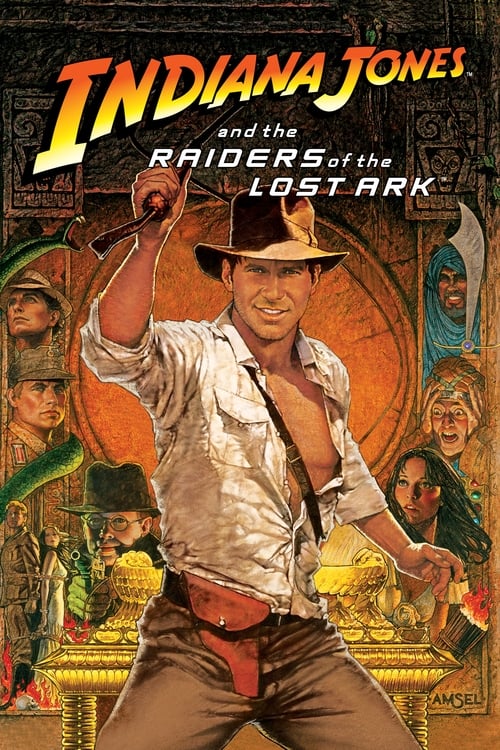
Raiders of the Lost Ark
1981 · Steven Spielberg
For when you want guaranteed fun — a crowd-pleaser for family night, a rainy Sunday, or anytime you need to remember why you love movies. Total comfort, zero homework.
What it's about
A tweedy archaeology professor with a bullwhip and a battered fedora is hired by the U.S. government to find the Ark of the Covenant before Nazi Germany can seize its power. The hunt runs from a booby-trapped South American temple through Nepal to the dig sites of Egypt, with rivals, snakes, and an old flame in the mix. It's the modern template for the globe-trotting adventure.
The experience
Pure forward motion — a cliffhanger every ten minutes, wit folded into every scrape, peril that's thrilling without ever turning grim. Two hours evaporate; you come out grinning.
Performances
Harrison Ford makes Indiana Jones iconic precisely by playing him human — winded, bruised, improvising, visibly annoyed — and Karen Allen matches him as a heroine who drinks men under the table.
The craft
Spielberg directs set pieces with a clarity almost no action film has matched since — you always know where everything is, which is why the stunts land — while John Williams's march became instantly immortal. It absolutely rewards the biggest screen and loudest speakers you can find.
Why it matters
It codified the grammar of the modern action-adventure blockbuster — the set-piece structure, the relentless momentum, the humor in danger — launched a franchise, and shaped Hollywood adventure cinema for decades.
Snapshot
Raiders of the Lost Ark is the foundational modern adventure film: a deliberate, affectionate reconstruction of the 1930s and 1940s serial in the idiom of a late-1970s blockbuster. Conceived by George Lucas and directed by Steven Spielberg from a screenplay by Lawrence Kasdan, it follows archaeologist Indiana Jones in a race against Nazi Germany to recover the Ark of the Covenant. Made for a then-disciplined budget on a tight schedule, it became one of the defining commercial successes of its era and launched a franchise. More than a hit, it codified a grammar of kinetic, set-piece-driven action filmmaking — the cliffhanger structure, the relentless forward momentum, the wit folded into peril — that shaped Hollywood adventure cinema for decades. Its enduring reputation rests on craftsmanship: precise editing, robust stunt work, Harrison Ford's grounded star performance, and a sense that every sequence has been engineered for maximum legibility and propulsion.
Industry & production
The film originated in a famous conversation between George Lucas and Steven Spielberg, reportedly on a Hawaiian beach around the 1977 release of Star Wars, when Spielberg expressed interest in directing a James Bond picture and Lucas pitched him something "better" — a throwback adventure hero rooted in the matinee serials of his youth. Lucas had developed the concept (initially with Philip Kaufman, who contributed the Ark of the Covenant idea) and brought in Lawrence Kasdan to write the screenplay. A celebrated multi-day story conference among Lucas, Spielberg, and Kasdan — later widely circulated as a transcript — hammered out the character and structure; readers interested in the precise attributions should consult that document directly rather than secondhand summaries.
The picture was produced by Lucas's company in partnership with Frank Marshall and Kathleen Kennedy, and distributed by Paramount Pictures, which financed it after other studios were wary of Lucas's terms. Production unfolded across 1980 at EMI Elstree Studios in England and on location in Tunisia (standing in for Egypt), Hawaii, and elsewhere. Spielberg, conscious of the cost overruns that had plagued 1941 and Jaws, made a point of bringing Raiders in on schedule and at or near budget — a discipline that became part of the film's professional legend and helped restore studio confidence in him. The exact final budget and grosses are widely reported but vary by source; the safe historical claim is that the film was made economically for a major effects-adventure picture and returned many times its cost, ranking among the top earners of 1981.
Technology
Raiders is, by design, a largely practical film. Its spectacle derives from physical stunt work, location shooting, full-scale sets, and in-camera action rather than from the optical or emerging digital effects then associated with science fiction. Where the film does deploy visual-effects technology, it is concentrated and decisive: the climactic opening of the Ark, in which spirits emerge and the Nazis are destroyed, was executed by Industrial Light & Magic using a combination of optical compositing, animation, cloud-tank and other in-camera elemental effects, and matte work. The melting and exploding faces of the climax are practical makeup-effects illusions, achieved with materials manipulated and filmed in ways that could be composited into the live action.
The famous rolling-boulder of the opening sequence was a large practical prop built and rolled on set, with Harrison Ford performing in proximity to it — a choice that prizes physical credibility over trickery. Throughout, the production relied on traditional 35mm photography, anamorphic-era craft, and the accumulated stagecraft of a major studio facility. The film stands as a high-water mark for the pre-digital action picture: its technology is the technology of carpentry, pyrotechnics, stunt rigging, and optical printing, marshaled with unusual precision.
Technique
Cinematography
Douglas Slocombe, the veteran British cinematographer, shot Raiders (and would return for the two sequels). His photography gives the film a warm, burnished, classical look — saturated without garishness, with strong silhouettes and a painterly attention to light shafts, fire, and shadow. The recurrent motif of light cutting through dust and darkness (the map room, the Well of Souls, the tomb interiors) is a Slocombe signature pressed into thematic service: the film is repeatedly about illumination, revelation, and the dangerous power of looking. Slocombe favored clean, readable compositions that keep geography intelligible even in chaos, a discipline essential to the film's action. His work is notable for its old-school craft — he was known for shooting without a light meter at times, relying on long experience — and it lends the picture a handcrafted solidity that distinguishes it from glossier contemporaries.
Editing
Michael Kahn's editing, which won the film's Academy Award in that category, is arguably the single most influential element of Raiders. Kahn — Spielberg's principal editor across most of his career — cuts for momentum and clarity, building set pieces (the Nepal bar fight, the truck chase, the fight around the flying wing) as escalating chains of cause and effect in which the viewer always understands space, stakes, and proximity to danger. The film's reputation as a machine of pure forward motion is largely an editorial achievement: it withholds dead air, lands its comic beats on precise frames, and sustains tension by cross-cutting and rhythmic acceleration. The truck-chase sequence in particular is a textbook of continuity action cutting, frequently studied for how it sustains a long, complex chase without losing legibility.
Mise-en-scène / staging
Spielberg's staging is the film's connective tissue. He favors the unbroken, choreographed action beat — the gag built and paid off within a sustained piece of blocking — and the expressive use of foreground/background relationships. Production designer Norman Reynolds and his team built environments (the South American temple, the Tanis dig, the map room, the Well of Souls) that are both atmospheric and functionally legible as arenas for action. Spielberg repeatedly stages reveals through character reaction and camera movement rather than exposition, and he uses physical comedy as a release valve within danger — the celebrated moment in which Jones, confronted by a showy swordsman, simply shoots him (a solution reportedly arrived at on location when Ford was ill) epitomizes the film's tonal control: violence, wit, and economy delivered in a single staged beat.
Sound
The sound design works to make the film's physical world tactile — whips, gunfire, stone, fire, the swarm of insects and snakes — and to amplify the percussive impact of its action. As with the effects, the priority is visceral credibility. Ben Burtt, the sound designer associated with Lucas's productions, is part of this lineage of inventive practical sound work; readers wanting precise crew attributions for specific effects should consult the film's credits, as popular accounts sometimes conflate contributions across the Lucasfilm sound team.
Performance
Harrison Ford anchors the film with a performance that balances heroic competence and human fallibility. Cast after Lucas's initial reluctance and a late search (Tom Selleck having been a noted near-miss owing to television commitments), Ford grounds the fantastical material: his Indiana Jones is resourceful but bruisable, sardonic, frequently improvising and frequently in pain. Karen Allen's Marion Ravenwood is one of the more spirited and equal romantic foils of the period's action cinema — tough, drunken-brawling, unsentimental. Paul Freeman's Belloq supplies a suave, mirror-image antagonist (the "shadowy reflection" of Jones, in the film's own terms), and Ronald Lacey's Toht provides grotesque menace. The supporting playing — John Rhys-Davies as Sallah, Denholm Elliott as Brody — gives the adventure warmth and texture.
Narrative & dramatic mode
Raiders is built on the serial's cliffhanger logic: a sequence of self-contained crises, each opening with the hero already in motion and closing on a new threat, strung along a quest spine. The famous prologue functions as a complete adventure-in-miniature that establishes character and method before the plot proper begins — a structural move widely imitated since. The dramatic mode is propulsive melodrama leavened with comedy: stakes are clear and large (a supernatural weapon in Nazi hands), motivation is simple and legible, and the storytelling privileges momentum over psychological interiority. A frequently noted irony, sometimes raised by critics, is that the protagonist is arguably incidental to the climax — the Ark destroys its captors regardless — which reframes the film thematically (see Themes) even as it pays off the adventure machinery.
Genre & cycle
The film is a knowing revival of the 1930s–40s adventure serial (Republic and Universal chapter-plays, Spy Smasher, Don Winslow, and their kin), filtered through the boys'-adventure tradition, pulp archaeology, and the period spy thriller. It belongs to the post-Star Wars, post-Jaws cycle of nostalgically pitched, set-piece-driven blockbusters that Lucas and Spielberg defined, in which Old Hollywood genres are reconstructed with contemporary technical resources and a heightened velocity. It also inaugurated its own cycle: the "archaeologist-adventurer" and "race for the artifact" film, whose progeny — official sequels and a long tail of imitators across film and games — constitute a recognizable subgenre.
Authorship & method
Raiders is a paradigmatic case of shared authorship within the New Hollywood's producer-director system. George Lucas is the originating creative force — the concept, the character, the serial sensibility, and the production architecture are his — while Steven Spielberg is the directorial author whose staging, comic timing, and command of action realize the material on screen. Lawrence Kasdan's screenplay supplies structure, dialogue, and tonal balance; the trio's story-conference method (collective, transcribed, argued out in advance) is itself a notable artifact of how the film was authored. The key collaborators recur as a stable craft ensemble: cinematographer Douglas Slocombe, editor Michael Kahn, production designer Norman Reynolds, and — crucially — composer John Williams, whose "Raiders March" became one of the most recognizable themes in American film music, a leitmotif-driven score in the symphonic-adventure idiom Williams had already revived for Lucas and Spielberg. Industrial Light & Magic supplied the effects. The film exemplifies Spielberg's method: meticulous pre-visualization (he is known for storyboarding action extensively), on-set problem-solving, and a relentless focus on shot legibility and audience orientation.
Movement / national cinema
Raiders is a product of American New Hollywood in its blockbuster phase — the moment when the film-school generation's cinephilia (Lucas's and Spielberg's love of classical genre cinema) fused with the high-concept, wide-release commercial model that Jaws and Star Wars had established. Though shot substantially in Britain at Elstree with significant British craft talent (Slocombe, Reynolds, and a largely UK crew), its authorship, financing, and sensibility are emphatically American. It is less an entry in any avant-garde or national-cinema movement than a defining text of the corporate-auteur blockbuster, the dominant industrial form of late-twentieth-century Hollywood.
Era / period
The film carries a double period identity. As a 1981 production, it belongs to the early-Reagan-era resurgence of confident, unironic American adventure and to the consolidation of the blockbuster system; its restored faith in heroism and spectacle is of its moment. As a fiction, it is set in 1936, on the eve of the Second World War, and mobilizes Nazis as archetypal villains — a choice that is both a serial convention and a morally legible engine for adventure. The period setting also licenses the film's nostalgic textures: globe-trotting maps, propeller planes, fedoras, and the romance of the pre-war archaeological expedition. The film's depiction of colonial-era artifact-hunting has, in later decades, drawn critical reconsideration regarding archaeology, plunder, and the representation of non-Western peoples — a reframing worth noting honestly rather than projecting back onto the film's own self-understanding.
Themes
Beneath the adventure, Raiders is preoccupied with faith, power, and the limits of human agency before the sacred. Its most discussed thematic stroke is the climax: the Ark cannot be possessed or instrumentalized: those who would weaponize it, and even Jones, must avert their eyes from a power that judges its handlers. Knowledge and looking are dangerous — the film repeatedly punishes the gaze and rewards humility before mystery. Secondarily, the film stages a contest between two archaeologists, Jones and Belloq, distinguished less by competence than by reverence versus appetite; Belloq's willingness to traffic with the Ark (and with the Nazis) marks his fall. Running through it is a more conventional but well-handled thread of romance, loyalty, and the reluctant hero's recovery of human attachment (the Marion relationship). The tension between the secular adventurer's skepticism and the manifest reality of the supernatural gives the film a quiet moral seriousness beneath its pulp surface.
Reception, canon & influence
Raiders was both a major commercial success and, unusually for an action-adventure, a critical one. It received multiple Academy Award nominations including Best Picture and Best Director, and won several craft awards (among them editing and art direction); precise nomination and win tallies should be checked against the official record, but its strong showing across technical categories is well established. Critics praised its craftsmanship, pace, and Ford's performance, and it has since been broadly canonized — inducted into the United States National Film Registry and routinely cited on lists of the most influential American films.
Its influences (backward) are explicit and avowed: the Republic and Universal serials of the 1930s and 1940s; pulp adventure literature; the James Bond films (whose set-piece architecture Spielberg admired); and the broader tradition of classical Hollywood adventure (the swashbucklers and jungle pictures of the studio era). The film is in part a curatorial act — a loving anthology of forms its makers grew up on.
Its legacy (forward) is vast. It established a template for the modern action set piece — escalating, legible, wit-laced — that became industry common sense, and the cold-open mini-adventure prologue is now a convention. The character of Indiana Jones entered the permanent pop-culture pantheon, spawning sequels (Temple of Doom, Last Crusade, and later entries), a television series, and a long lineage of imitators across film and especially video games (the Tomb Raider and Uncharted franchises among the clearest descendants). The "Raiders March" became a fixture of the concert and cultural repertoire. Perhaps its deepest influence is tonal: it demonstrated that a blockbuster could be simultaneously thrilling, funny, and craftsmanlike, and that nostalgia for old genres could be a generative rather than merely sentimental force — a lesson the subsequent decades of franchise filmmaking absorbed thoroughly, for better and worse.
A Deleuzian reading
He closes his eyes.
The full Deleuzian reading of Raiders of the Lost Ark →
Reception
No reappraisal needed — it was the biggest hit of 1981, snagged a Best Picture nomination, and has only calcified into 'the perfect action movie' since, though Pauline Kael famously panned it as machine-tooled at the time.
How Raiders of the Lost Ark was received, from release to now →
Influences: the films it descends from and the films it influenced
- Adventures of Captain Marvel (1941) — Witney's method of breaking fistfights into discrete, geographically legible beats — and the chapter-ending cliffhanger structure — is the serial DNA Raiders revives in its escalating set pieces.
- Stagecoach (1939) — Yakima Canutt's signature stunt of dropping beneath a speeding vehicle and being dragged underneath is restaged almost shot-for-shot in the truck chase.
- Gunga Din (1939) — Supplies the comic-adventurer tone and the temple-cult / chasm-bridge action architecture Spielberg openly drew on for the franchise's set-piece grammar.
- The Adventures of Robin Hood (1938) — Erich Wolfgang Korngold's leitmotif-driven symphonic swashbuckler scoring is the very idiom John Williams resurrects in the 'Raiders March.'
- Goldfinger (1964) — Codifies the self-contained pre-credits teaser — a complete mini-adventure detached from the plot — that Raiders adopts as its cold-open prologue.
- From Russia with Love (1963) — The Bond template of exotic-location, escalating set-piece architecture is the modern adventure scaffolding Spielberg admired and rebuilt.
- The Secret of the Incas (1954) — Charlton Heston's Harry Steele — fedora, leather jacket, satchel, map-led treasure hunt — is the direct costume and character blueprint for Indiana Jones.
- Lawrence of Arabia (1962) — Lean's staging of lone figures against vast space and shafts of haze-diffused light feeds Douglas Slocombe's 'light through dust' lensing and scale.
- Star Wars (1977) — Shares the exact production apparatus: Lucas's serial-revival sensibility, Williams's full symphonic leitmotif score, and ILM optical compositing.
- The Empire Strikes Back (1980) — Written by Kasdan concurrently with his Empire revision, the screenplay shares the same serial-cliffhanger rhythm and banter-driven ensemble dynamics — the two scripts are twin products of the same Brackett-inflected adventure-dialogue mode, and both end on unresolved narrative threads that defer closure to the next installment.
- Where Eagles Dare (1968) — Makes the sustained practical set-piece (the truck convoy) the narrative engine itself, prioritizing kinetic spectacle over interiority — the war-adventure-as-action-machine ethos Spielberg has named Eagles Dare a formative favorite for.
- Indiana Jones and the Last Crusade (1989) — Extends the cold-open prologue into a young-Indy origin and reuses Michael Kahn's continuity-action cutting across the tank chase.
- Romancing the Stone (1984) — Transplants the wit-laced, escalating jungle set piece and grounded reluctant-adventurer hero into a romantic-comedy frame.
- The Goonies (1985) — Spielberg-conceived kids' treasure hunt that applies Raiders' booby-trapped temple logic — sequential traps cleared by ingenuity — to an ensemble.
- The Mummy (1999) — Revives the 1930s-set serial-adventure template wholesale, pairing choreographed comic action beats with ILM-lineage effects.
- Pirates of the Caribbean: The Curse of the Black Pearl (2003) — Rebuilds the legible, escalating, humor-punctuated set piece — and the curse-driven supernatural MacGuffin — as four-quadrant franchise common sense.
- The Adventures of Tintin (2011) — Spielberg restages the single continuous, choreographed action set piece through performance-capture animation while preserving Raiders' beat-by-beat spatial legibility.
- Uncharted (2022) — Adapts the games that explicitly modeled their treasure-hunter hero and physical-puzzle set pieces on Raiders' choreographed-action-beat grammar.
- Jurassic Park (1993) — Spielberg and Kahn systematized chess-game intercutting — cutting between threat vectors and spatially dispersed characters to maintain coherent geography during multi-location action — that Jurassic Park applies to the T. rex attack, intercutting Grant/Lex/Tim in the vehicles with Malcolm in the jeep across a precisely mapped spatial field.
- Jurassic Park III (2001) — Model for the kinetic, momentum-driven adventure set-piece construction and Williams-scored chase logic that the Spielberg-architected franchise applies as default craft.
- Star Wars: The Force Awakens (2015) — Kasdan's serial-adventure scene construction and breathless cliffhanger-to-cliffhanger set-piece pacing feed TFA's propulsive editing rhythm.
- Back to the Future (1985) — Model for serial-cliffhanger momentum and escalating-clock set-piece construction; the clocktower-lightning climax is engineered with the same beat-by-beat kinetic pacing Spielberg codified.
- Spider-Man 2 (2004) — Model for legible geographic action staging in which every beat of a moving-vehicle setpiece reads spatially clear, the discipline Raimi cites for the train fight.
- Jaws (1975) — Establishes Spielberg's house craft — Williams's two-note predatory leitmotif and suspense built through legible, audience-oriented action cutting — that Raiders inherits.
- Return of the Jedi (1983) — Same Lucas-story/Kasdan-script/Williams-score/ILM team reviving the 1930s serial's cliffhanger pacing and matinee-adventure tone in parallel with the Star Wars films.
- Mission: Impossible - Fallout (2018) — Codifies the escalating chain of discrete practical set-pieces strung on a propulsive globe-trotting spine — the structural architecture Fallout follows beat for beat.
Similar films
- Indiana Jones and the Last Crusade (1989) — influence & lineage
- Star Wars (1977) — influence & lineage
- The Adventures of Tintin (2011) — influence & lineage
- Jaws (1975) — influence & lineage
- Pirates of the Caribbean: The Curse of the Black Pearl (2003) — influence & lineage
- Indiana Jones and the Temple of Doom (1984) — shared sensibility
- Jurassic Park (1993) — shared sensibility
- Schindler's List (1993) — shared sensibility
All the films related to Raiders of the Lost Ark →