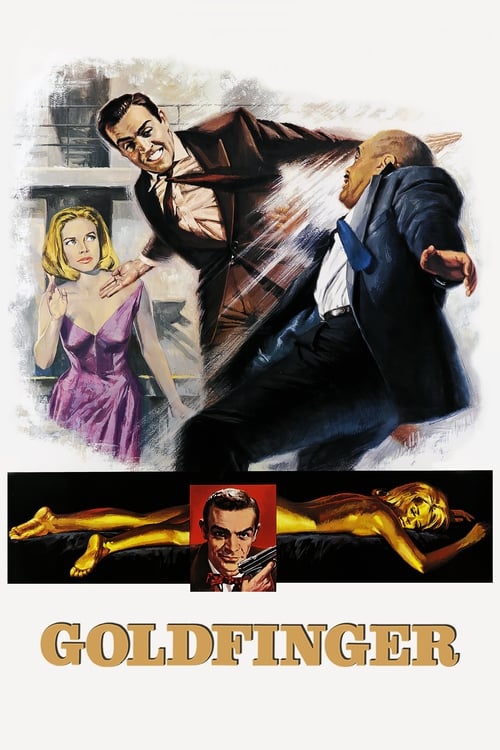
Goldfinger
1964 · Guy Hamilton
For when you want swagger and spectacle with zero homework — a rainy-Sunday crowd-pleaser that goes down like a well-made martini.
What it's about
British agent James Bond is sent to investigate Auric Goldfinger, a gold-obsessed tycoon whose smuggling operation turns out to be cover for something far bigger — a scheme aimed at Fort Knox and the world economy. Along the way: a tricked-out Aston Martin, a lethal bowler-hatted henchman, a laser table, and a golf game with everything riding on it.
The experience
Pure confident fun — fast, glamorous, and winking at you the whole time, with set-pieces that still pop and one-liners delivered under mortal threat. It never drags and never takes itself too seriously.
Performances
Sean Connery at his most effortless, the swagger and menace in perfect balance; Gert Fröbe's Goldfinger set the mold for every grandiose movie villain who followed.
The craft
This is where the Bond machine was perfected: the pre-credits stunt, the title song blasting over the credits, the gadget briefing, the villain's lair. Shirley Bassey's theme is a brass-and-velvet knockout, and the production design — from the Aston Martin DB5 to the Fort Knox interior — is franchise iconography at its birth.
Why it matters
The film that turned Bond from a successful series into a global phenomenon and locked in a formula the franchise still follows sixty years later; nearly every spy movie since is either copying it or reacting against it.
Snapshot
Goldfinger is the third James Bond feature produced by Albert R. Broccoli and Harry Saltzman's EON Productions, and it is the film that consolidated the series into a formula so durable that it still governs the franchise more than half a century later. Where Dr. No (1962) established the character and From Russia with Love (1963) proved the property could sustain a richer plot, Goldfinger fused the two impulses into a template: the pre-credits set-piece, the title song over animated titles, the gadget-laden car, the technological briefing, the megalomaniac with a grand scheme, the larger-than-life henchman, and the quips delivered under mortal threat. Directed by Guy Hamilton, working from a screenplay by Richard Maibaum and Paul Dehn adapting Ian Fleming's 1959 novel, it is widely regarded as the film that turned Bond from a successful series into a global cultural phenomenon. Its imagery — Sean Connery in a dinner jacket beside the Aston Martin DB5, a woman painted head to toe in gold, a laser advancing toward Bond's groin — became instantly iconic and remains among the most recognizable in popular cinema.
Industry & production
Goldfinger was made by EON Productions for release through United Artists, the American studio that had backed Bond from the outset and whose distribution muscle underwrote the series' international reach. The budget was substantially larger than that of its two predecessors, reflecting UA's growing confidence — the first two films had been profitable, and the studio was willing to invest more heavily. Principal photography took place at Pinewood Studios in England, with location work in Switzerland (the Furka Pass sequence and the Auric Enterprises exteriors) and second-unit material associated with the American settings, though the Kentucky and Fort Knox material was largely realized on sets and at Pinewood rather than at the actual bullion depository, which the production could not enter. Ken Adam's Fort Knox interior — a soaring, gleaming vault stacked with gold, invented rather than replicated since no outsider had seen the real vaults — is one of production design's most celebrated set-pieces precisely because it is a stylized fiction.
The film is also notable for a change of director. Terence Young had helmed the first two entries; Guy Hamilton, an Englishman who had earlier been offered Dr. No, took over here and brought a lighter, more ironic touch. The production was not without friction — accounts from the era describe tensions and a demanding schedule — but the commercial result was decisive. Goldfinger was an enormous hit, breaking box-office records in several markets and reportedly recouping its cost with unusual speed; it is frequently cited as having earned back its budget within a matter of weeks, though precise figures vary across sources and should be treated with appropriate caution. Its success accelerated the pace of the franchise and expanded the scale of merchandising, most famously through the Aston Martin DB5, which became a commercial property in its own right.
Technology
Within the fiction, technology is elevated from a supporting element to a defining pleasure. This is the film that fully realized "Q Branch" as a recurring institution: the workshop briefing in which Desmond Llewelyn's Q outfits Bond with equipment that will, with near-perfect narrative economy, be deployed later. The Aston Martin DB5 — fitted with revolving number plates, machine guns, an oil slick, a bulletproof rear shield, tyre-slashers, and the celebrated passenger ejector seat — is the centerpiece and effectively the film's second star. The gadgets are practical effects and mechanical rigs rather than optical trickery, which grounds their appeal; audiences responded to the tactile plausibility of a car that visibly does these things.
Behind the camera, the film was shot photochemically on 35mm and presented in the standard widescreen ratios of the period, with Technicolor and the industrial craft apparatus of a major British studio production. The industrial-laser threat in the vault sequence dramatizes contemporary anxieties about new technology — the laser was a genuinely recent scientific development, and the film exploits its novelty for menace. Nothing here is digital; the spectacle is achieved through models, full-scale sets, stunt engineering, and precise mechanical design.
Technique
Cinematography
Cinematography was by Ted Moore, the South African–born, BSC-winning director of photography who shot the early Bonds and gave the series its glossy, saturated, travelogue-inflected look. Moore's work here balances the polished studio glamour of the interiors — the Miami hotel, the Auric Enterprises rec room, the gold-hued vault — with brisk, legible coverage of action. The palette leans into the film's central motif: warm golds and metallic sheens recur, culminating in the vault. The famous shot of Shirley Eaton's gilded corpse is a piece of pure pictorial audacity, lit and framed to shock. Moore's compositions favor clarity and elegance over expressionist distortion, an approach that suits Hamilton's cooler, more ironic register.
Editing
The film was edited by Peter Hunt, whose contribution to the Bond house style is disproportionately large. Hunt is often credited with the propulsive, elliptical cutting that gave the early Bonds their momentum — trimming action to its most kinetic beats and letting the rhythm carry the audience past logical gaps. His approach to the pre-credits sequence and the set-pieces established a template of pace that the series would follow for decades. Hunt would later graduate to directing On Her Majesty's Secret Service (1969), a promotion that reflects how central his editorial sensibility was to the franchise's identity.
Mise-en-scène / staging
Production design by Ken Adam is the film's signature visual achievement. Adam's Fort Knox interior — vast, vertical, theatrical — is deliberately unrealistic, a modernist cathedral of gold that prioritizes graphic impact over documentary accuracy. Adam's designs throughout favor bold geometry, gleaming surfaces, and a sense of scale that dwarfs the human figure, a style that would reach its apotheosis in later Bonds and in his work for Stanley Kubrick. Hamilton stages the film with an eye for iconic tableaux — the golf match between Bond and Goldfinger, the laser table, Oddjob's lethal bowler hat — each composed to be memorable in isolation.
Sound
The film's aural identity is inseparable from John Barry's score and from the title song. Barry, who had arranged the "James Bond Theme" for Dr. No and scored From Russia with Love, here delivered a brass-forward, muscular symphonic sound that became the definitive Bond idiom. The title song, "Goldfinger," composed by Barry with lyrics by Leslie Bricusse and Anthony Newley and performed by Shirley Bassey, is one of the most famous of all movie themes — Bassey's belted delivery over Barry's ominous brass established the "Bond song" as an event unto itself. Sound design in the action sequences is crisp and emphatic, matching Hunt's cutting.
Performance
Sean Connery, in his third outing, gives what many consider the definitive Bond performance: relaxed, sardonic, physically assured, and entirely comfortable inside the character's now-established rituals. The film also depends heavily on its antagonists. Gert Fröbe plays Auric Goldfinger as a corpulent, obsessive aesthete of gold; Fröbe, a German actor whose English was limited, was dubbed by Michael Collins, a fact now well documented. Harold Sakata, a former Olympic weightlifter, plays the mute henchman Oddjob with a compact menace that made the character an archetype. Honor Blackman, arriving from British television's The Avengers, plays Pussy Galore, a more capable and self-possessed foil than the series' earlier women, and her casting brought a recognizable star into the role.
Narrative & dramatic mode
Goldfinger operates in the mode of ironic adventure-thriller. Its dramatic engine is not suspense in the Hitchcockian sense but a sequence of escalating confrontations between Bond and a single, vivid antagonist, punctuated by spectacle and wit. The screenplay refines Fleming's plot — notably by changing Goldfinger's aim from stealing the Fort Knox gold (logistically absurd) to irradiating it, thereby detonating a nuclear device to render the reserve worthless and multiply the value of his own holdings, a cleverer scheme than the novel's. The film's tone is crucial: it treats mortal peril with detachment and humor, teaching audiences to enjoy Bond's danger as a game. The famous exchange at the laser table — Bond asking whether Goldfinger expects him to talk, Goldfinger replying that he expects him to die — crystallizes the series' signature blend of threat and quip.
Genre & cycle
The film sits at the head of the 1960s spy cycle. It belongs to the espionage-adventure genre but, more importantly, it defined a sub-cycle of glamorous, gadget-driven, sexually frank spy entertainment that flooded international screens in the mid-to-late 1960s. Its success directly provoked a wave of imitators and parodies — the Matt Helm and Derek Flint films, the Man from U.N.C.L.E. phenomenon, and countless "Eurospy" productions across Italy, France, Spain, and West Germany. Goldfinger is the cycle's fountainhead: the film that codified the conventions everyone else then borrowed or lampooned.
Authorship & method
Authorship of a Bond film is emphatically collaborative, held together by the producers Broccoli and Saltzman, who functioned as the series' true auteurs of continuity. Within that structure, Goldfinger's creative identity is shaped by a handful of decisive collaborators. Guy Hamilton directed with a lighter, more ironic hand than Terence Young, tilting the series toward humor and iconography; he would return to direct three later entries. Richard Maibaum, the series' most important screenwriter, provided the structural adaptation of Fleming, with Paul Dehn contributing to the dialogue and tone. Ted Moore's cinematography, Ken Adam's production design, Peter Hunt's editing, and John Barry's score are each so central that the film is best understood as the moment these department heads' contributions locked into a repeatable system. It is in Goldfinger that the "Bond film" becomes a genre defined by its craft team as much as by its star.
Movement / national cinema
Goldfinger is a product of the British film industry at a particular moment of confidence, made at Pinewood with British and émigré talent but financed and distributed by an American studio for a global market. It is not part of any art-cinema movement; rather, it exemplifies a transatlantic commercial cinema in which British craft and settings served international entertainment. Its release coincided with the wider mid-1960s "Swinging London" moment and the global visibility of British popular culture, and Bond became one of Britain's most successful cultural exports of the decade — a national product with deliberately international ambitions.
Era / period
The film is deeply of its Cold War, early-1960s moment, even as it displaces overt geopolitics into a criminal-mastermind plot. Fort Knox and the gold standard anchor it in anxieties about economic security; the nuclear device gestures at the era's atomic fears; the laser signals the period's fascination with cutting-edge science. Culturally, the film registers the loosening sexual mores of the decade and the emergence of consumer glamour — travel, cars, casinos, tailoring — as aspirational spectacle. Its treatment of women and its casual attitudes, particularly around the Pussy Galore relationship, are very much of 1964 and have been the subject of substantial later critical re-examination.
Themes
Gold — as obsession, as value, as death — is the film's organizing metaphor, embodied literally in Goldfinger's mania and figured in the gilded body of Jill Masterson. Beneath the surface the film is about greed and the corruption of value, the fragility of economic order, and the contest between individual excess and institutional authority. Bond himself embodies a fantasy of competence, control, and consumption: mastery over machines, women, and danger alike. The recurring motif of games — golf, cards, the wager over Fort Knox — frames the whole as a contest of wits between two men who treat the world as a board on which to play.
Reception, canon & influence
Goldfinger was a major critical and commercial success on release and is routinely ranked among the finest entries in the series and among the defining popular films of the 1960s. Retrospective assessment has been remarkably stable: it is the Bond film most often named as the series' template-setter and one of its best. Its influences flow backward from Fleming's fiction, from the earlier Terence Young Bonds that established the character, and from a broader tradition of adventure and thriller storytelling. Its forward legacy is immense and can be traced with precision. It fixed the structural grammar of the franchise — the cold open, the Bassey-Barry title song, the Q gadgetry, the henchman, the doomsday scheme — that every subsequent Bond film has either followed or consciously varied. It launched the 1960s spy cycle and its parodies, made the Aston Martin DB5 a permanent icon (and revived it in later Bond films as a nostalgic touchstone), and turned the Bond song into a durable cultural institution. Later action cinema's marriage of spectacle, gadgetry, and quip owes a substantial debt to the formula that Goldfinger perfected. If any single film converted James Bond from a hit property into a self-perpetuating cultural franchise, the consensus of film history holds that it was this one.
Reception
No reappraisal needed — it was a phenomenon on arrival, packing theaters around the clock and becoming one of the fastest-grossing films ever at the time. Sixty years on it's still the consensus template: the moment the Bond formula clicked into place.
How Goldfinger was received, from release to now →
Influences: the films it descends from and the films it influenced
- Dr. No (1962) — Established the Bond template and gave Ken Adam his first villain-lair (Crab Key's reactor room), whose expressionist-modernist geometry Goldfinger scales up into Fort Knox.
- From Russia with Love (1963) — Introduced Peter Hunt's kinetic elliptical cutting and the first Q-branch gadget (the weaponized attaché case) that Goldfinger systematized into the DB5 and the recurring armory briefing.
- North by Northwest (1959) — Model for the debonair-man-in-peril adventure staged as glossy set-pieces on national landmarks with an ironic wink — the exact tonal register Hamilton adopts over Young's straighter thrillers.
- The 39 Steps (1935) — Codified the MacGuffin-driven chase carried by a wry, unflappable hero — the narrative engine Maibaum's structural adaptation of Fleming runs on.
- Goldfinger (Fleming novel adaptation lineage) — Charade (1963) — Continental romantic-thriller glamour shot in saturated Technicolor with banter over violence, the same lush travelogue-and-wit palette Ted Moore gives Goldfinger.
- Charade (1963) — John Barry's jazz-brass orchestral scoring of the spy thriller, Sean Connery's star-centered knowing wit, and the international glamour staging amplify and masculinize the formula Charade's facets identify as anticipating the spy cycle; Bond inherits the template and scales it into a franchise.
- The Ipcress File (1965) — Saltzman's deliberate anti-Bond, built by the same craft economy — a John Barry score and gadget-espionage grammar — proving the 'Bond film' had become a portable department-head system.
- Thunderball (1965) — First film to lock in the Goldfinger grammar wholesale: Bassey-style Barry title song, pre-credits cold open, doomsday scheme and henchman as fixed structural beats.
- You Only Live Twice (1967) — Ken Adam's hollowed-volcano lair pushes the Fort Knox monumentalism to its logical extreme — the single most influential 'supervillain HQ' set in cinema.
- Diamonds Are Forever (1971) — Hamilton returns to double down on his own innovation — the ironic-camp tone and precious-metal-greed plotting he first perfected here, now openly self-aware.
- Our Man Flint (1966) — Head of the 1960s spy-parody cycle Goldfinger spawned, lampooning the exact gadget-briefing and megalomaniac-scheme beats the film had just made formula.
- Austin Powers in Goldmember (2002) — Parody so precise its title and gold-obsessed villain are lifted directly from Goldfinger, mocking the henchman, laser-table peril and lair-monologue conventions the film canonized.
- Raiders of the Lost Ark (1981) — Spielberg's avowed Bond-substitute after being turned down for the series; inherits the pre-credits self-contained set-piece and globe-trotting serial-adventure grammar.
- The Incredibles (2004) — Direct homage to Ken Adam's island/volcano lair architecture paired with a Barry-style muscular brass spy score by Michael Giacchino.
- Kingsman: The Secret Service (2014) — Explicitly reboots the Q-branch gadget briefing and the single-madman-doomsday-scheme structure, foregrounding the henchman-with-a-signature-weapon (Gazelle) as Oddjob's heir.
- Skyfall (2012) — Revives the actual Goldfinger DB5, ejector seat and all, deploying the car as a self-referential nostalgic touchstone — the franchise quoting the film that made it a franchise.
- Enter the Dragon (1973) — The villain's private island fortress, the assembled roster of adversaries sorted by national and stylistic difference, and the infiltrating operative's double-identity structure are lifted wholesale from the Bond formula, giving Enter the Dragon's narrative architecture instant legibility for Western audiences unfamiliar with wuxia conventions.
- Iron Man (2008) — Codified the gadget-tech / Q-lab tradition and the suave wisecracking hero whose hardware is demoed before it's deployed.
- Dr. Strangelove (1964) — Ken Adam's other 1964 masterwork; the monumental raked War Room and Fort Knox interior share his signature vocabulary of vast, stylized modernist volumes dwarfing the human figure.
- The Man from U.N.C.L.E. (2015) — Codified the Fleming-adjacent spy-fi villain, lair, and set-piece scale that U.N.C.L.E. pastiches while sanding off the sadism.
Similar films
- Skyfall (2012) — influence & lineage
- Raiders of the Lost Ark (1981) — influence & lineage
- The 39 Steps (1935) — influence & lineage
- Casino Royale (2006) — shared sensibility
- The Maltese Falcon (1941) — shared sensibility
- The Man from U.N.C.L.E. (2015) — shared sensibility
- Tinker Tailor Soldier Spy (2011) — shared sensibility
- The Pink Panther (1963) — shared sensibility