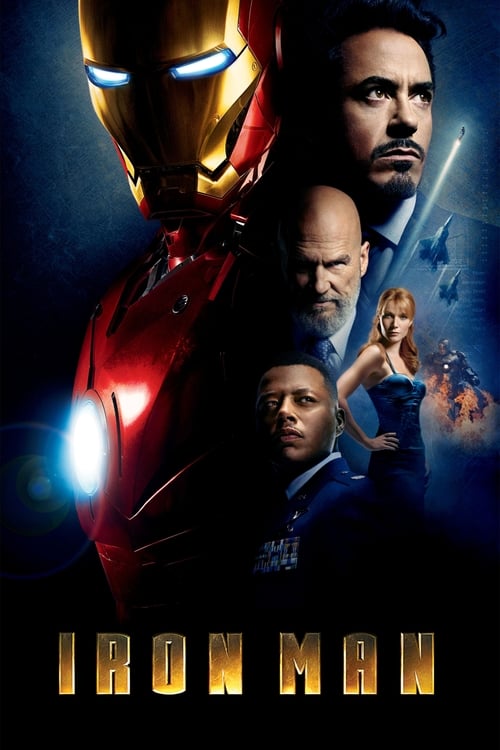
Iron Man
2008 · Jon Favreau
For when you want pure, reliable fun — pizza-night viewing that's smarter and snappier than it needs to be. Zero homework required; it's comfort food that still crackles.
What it's about
A billionaire weapons designer — brilliant, arrogant, permanently amused by himself — is ambushed and held captive in Afghanistan by fighters using his own missiles. In a cave, with scraps and a car battery keeping him alive, he builds a way out, and comes home a changed man with a new obsession: a flying suit of armor and a reckoning with what his company has been selling. It's an origin story told as a redemption comedy with jet boots.
The experience
Breezy, quick-witted, and effortlessly charming — the action is solid but the real pleasure is watching people talk fast and spar. It's a blockbuster that feels light on its feet even when things explode.
Performances
Robert Downey Jr. gives one of the great star performances of the century — motor-mouthed, self-mocking, improvising half his charm — a piece of casting so right it rebuilt his career and launched an empire on his shoulders.
The craft
Jon Favreau kept the tone loose and conversational, letting actors riff inside a big-budget machine, and grounded the armor in tactile, practical-feeling design so the suit reads as engineering rather than magic. The suit-up sequences — all whirring servos and snapping plates — remain some of the most satisfying hardware moments in the genre.
Why it matters
This is the film that founded the Marvel Cinematic Universe — a self-financed gamble on a second-tier hero that ended up defining how Hollywood builds franchises for the next two decades.
Snapshot
Iron Man is the film that converted a second-tier comic-book property and a debt-laden licensing experiment into the foundation of the most commercially dominant franchise architecture in modern Hollywood. Released in May 2008, it was the first picture produced and financed by Marvel Studios as an independent entity rather than a property licensed out to an established major, and its success retroactively justified an enormous gamble: Marvel had borrowed against the film rights to its own characters to fund self-production. Directed by Jon Favreau and built around a career-rehabilitating performance by Robert Downey Jr., the film is notable less for formal innovation than for tone — a wry, talky, improvisation-friendly register grafted onto a large-scale action template. It established the house style that the Marvel Cinematic Universe would standardize across more than a decade: grounded-but-quippy heroes, a glossy industrial-technological aesthetic, and the now-ubiquitous post-credits "stinger" that converted individual films into chapters of a serialized whole. As both a discrete work and an origin point, Iron Man sits at a hinge in industry history.
Industry & production
The production history of Iron Man is inseparable from the corporate reinvention of Marvel. The Iron Man character had drifted through development for years across studios including Universal, Fox, and New Line without reaching production. By the mid-2000s the rights had reverted to Marvel, which under Avi Arad and, increasingly, Kevin Feige, resolved to produce films in-house. Marvel Studios secured a financing arrangement — widely reported as a credit facility through Merrill Lynch — that pledged a slate of characters as collateral. Iron Man, not then a top-rank Marvel name comparable to Spider-Man or the X-Men (whose film rights sat with Sony and Fox respectively), became the flagship by a combination of availability and ambition. Paramount Pictures handled distribution.
Favreau, whose directing credits to that point ran to Elf and Zathura, was an unconventional choice for a tentpole, and his casting instincts proved more consequential than the studio's initial caution. The decision to cast Robert Downey Jr. — an actor whose well-documented legal and substance troubles had made him a perceived insurance risk — was, by all reliable accounts, championed by Favreau against institutional hesitancy. Downey screen-tested, and his fit with the role of a brilliant, self-destructive, charismatic industrialist was immediate. The supporting cast assembled Jeff Bridges as Obadiah Stane, Gwyneth Paltrow as Pepper Potts, and Terrence Howard as James Rhodes (a role recast with Don Cheadle for subsequent films).
The screenplay credit is shared among multiple writing teams — Mark Fergus and Hawk Ostby, and Art Marcum and Matt Holloway — but the more salient production fact is that the film was shot without a locked script. Favreau encouraged extensive improvisation, and many scenes were developed on set, with the actors workshopping dialogue. This method, risky on a film of this budget, is generally credited with the picture's loose, conversational texture. Production took place largely in California, including at the former Hughes Aircraft facilities, lending the film an authentic aerospace-industrial backdrop.
Technology
Iron Man arrived at a moment when computer-generated imagery and practical effects could be blended seamlessly enough that audiences need not register the seam, and the film's effects strategy was deliberately hybrid. The lead visual-effects house was Industrial Light & Magic, with Stan Winston Studio (in one of the studio's final major projects before Winston's death in 2008) building practical armor suits and the bulky "Mark I" cave-built prototype. The production's stated philosophy was to favor practical builds wherever a physical suit could be worn or puppeteered, switching to CG for flight, high-speed combat, and shots impossible to stage practically. This practical-first instinct gives the early armor sequences a tactile weight that purely digital constructions of the era often lacked.
The film is also an early and influential example of the heads-up-display interior — the in-helmet graphical interface through which the audience sees Stark's point of view — as a storytelling and characterization device rather than mere spectacle. Equally significant is J.A.R.V.I.S., the disembodied artificial-intelligence assistant (voiced by Paul Bettany), which dramatizes Stark's relationship to his own technology. Within the diegesis, the film's technological premise — the "arc reactor," a compact power source — functions less as hard science than as a clean narrative engine: it is simultaneously the thing keeping Stark alive, the source of the suit's power, and the object Stane covets, concentrating the plot's stakes into a single glowing device in the protagonist's chest.
Technique
Cinematography
The cinematography, by Matthew Libatique — a frequent Darren Aronofsky collaborator whose presence signals Favreau's reach toward a more textured visual sensibility than the standard tentpole — is functional and clean rather than showy, but it makes deliberate tonal distinctions. The Afghanistan cave sequences are shot with a grittier, handheld-inflected immediacy, while the Malibu and corporate Los Angeles scenes are glossier and more composed. Libatique's work serves the performances first: the film is comfortable holding on faces during long dialogue exchanges, a choice consistent with its improvisational shooting method. The flight and action sequences are legible — a notable virtue in an era of incoherent shaky-cam action — keeping spatial relationships clear even at speed.
Editing
The editing, credited to Dan Lebental, manages an unusual structural problem: the film is, for long stretches, a workshop movie, watching a man build things. The celebrated armor-construction montages turn iterative engineering into propulsive cinema, cross-cutting tinkering, failure, and refinement so that process itself becomes the spectacle. The cutting accommodates the loose performances by giving scenes room to breathe rather than chopping dialogue to a metronomic beat. The pacing problem the film must solve — a relatively action-light first two acts building to a comparatively brief climactic suit-versus-suit battle — is handled by front-loading character and trusting Downey to carry momentum.
Mise-en-scène / staging
Production design contrasts two worlds: the spare, improvised menace of the cave workshop and the antiseptic luxury of Stark's cliffside Malibu home with its subterranean garage-laboratory. The lab is the film's true principal location — a space of glass, exposed machinery, holographic interfaces, and sports cars that externalizes Stark's character as a man who lives inside his own engineering. Costuming the armor itself is a staging problem the film treats with care, progressing visibly from the crude gray Mark I to the silver Mark II to the iconic red-and-gold Mark III, each iteration legible as a stage in the protagonist's transformation.
Sound
Ramin Djawadi's score is guitar-forward and rock-inflected, matching Stark's swagger, though the film's most discussed musical choices are its needle-drops — most famously the closing use of Black Sabbath's "Iron Man," a joke the film withholds until the final moment. The sound design of the suit — the servo-whir of the armor, the hum of the arc reactor, the layered audio of the HUD — does significant characterization work, making the technology feel inhabited.
Performance
Performance is the film's center of gravity and its lasting legacy. Downey's Tony Stark is built from rapid, overlapping, frequently improvised speech; arrogance laced with self-awareness; and a wounded vulnerability beneath the wit. It is a performance that treats a superhero as a fully realized adult character rather than a costume, and it reset industry expectations for what comic-book acting could be. Jeff Bridges, shaven-headed, supplies a relaxed avuncular menace as Stane that resists camp. Paltrow and Downey generate a screwball verbal rapport that gives the Pepper-Tony relationship genuine charge. Howard's Rhodes is more sketched than developed, a limitation the film does not fully overcome.
Narrative & dramatic mode
Iron Man is, structurally, a redemption-through-competence story welded to a classic origin arc. Its dramatic mode is comic-heroic: the film is fundamentally serious about its protagonist's moral awakening — a weapons manufacturer confronting the human cost of his own products after being wounded by them — while remaining tonally light, even glib, on the surface. This tonal doubleness is the Marvel formula in embryo: real stakes delivered with a wink. The narrative is unusually interior for an action film; its central drama is Stark's change of conscience, dramatized first in the cave (where collaborator Yinsen's sacrifice supplies the moral fulcrum) and then in his renunciation of arms dealing. The villain's late-arriving turn — Stane as corporate betrayer and dark mirror — is the film's most conventional element, a functional rather than rich antagonism. The climactic battle is almost an afterthought to the character work; the film's true climax is arguably Stark's improvised press-conference admission, "I am Iron Man," which discards the secret-identity convention central to the superhero genre and points the franchise toward its celebrity-hero ethos.
Genre & cycle
The film belongs to the post-X-Men (2000), post-Spider-Man (2002) wave of comic-book adaptations that had, by 2008, become a reliable studio mainstay. But 2008 was a pivotal year for the form: Iron Man and Christopher Nolan's The Dark Knight arrived within months of each other and modeled two divergent paths. Where Nolan pulled the superhero film toward operatic crime tragedy and moral darkness, Iron Man pulled it toward charm, technological optimism, and serialized world-building. Marvel's path proved the more imitated as an industrial model. Within the genre, Iron Man helped shift the center of gravity from the angst-ridden, secret-burdened hero toward the confident, public, wisecracking one. It is also a techno-thriller and, in its arms-dealer-redeemed premise, a post-9/11 picture engaging — if cautiously — with the contemporary politics of the American military-industrial complex and the wars in Afghanistan and Iraq.
Authorship & method
The authorship of Iron Man is genuinely distributed, and the film is a useful case study in collaborative, producer-driven, improvisation-tolerant blockbuster filmmaking. Favreau's directorial signature is less a visual style than a management philosophy: hire skilled people, cast for chemistry, and leave room for discovery on set. His background as an actor and writer (notably Swingers) informs his prioritization of performance and dialogue rhythm. Kevin Feige's role as the emerging architect of a connected universe is the other authorial force, exerting pressure toward continuity and franchise coherence that would, over subsequent films, increasingly constrain individual directors. Among key collaborators, Libatique brought indie-cinema craft, Stan Winston Studio brought practical-effects pedigree, and Downey's authorship-by-performance was so substantial that the line between actor and co-writer blurred in the improvised scenes. The shared, multi-team screenplay credit reflects the reality that the film's script was a living document rather than a single authored text.
Movement / national cinema
Iron Man is a thoroughly American studio product, and it is best understood not within an aesthetic movement but within an industrial one: the consolidation of franchise filmmaking and "intellectual property" as the organizing logic of Hollywood. It is a Californian film in setting and sensibility — aerospace, tech wealth, coastal luxury — and a product of the New Hollywood-descended blockbuster system rather than any auteurist or national-cinema tradition. If it belongs to a "movement," it is the one it inaugurated: the cinematic-universe model, a structural rather than stylistic phenomenon that would shape global popular cinema and be imitated by competing studios with markedly less success.
Era / period
The film is a precise artifact of 2008. It emerged at the tail of the DVD-revenue era and just before streaming reshaped distribution economics, into a market where theatrical event films still drove the industry. Its release coincided with the onset of the global financial crisis, and its fantasy of a benevolent billionaire-genius reading partly as wish-fulfillment, partly as a critique of unaccountable corporate power. Its engagement with the post-9/11 security landscape — the cave captivity, the privatized-weapons anxiety, the conspicuous setting of its opening in Afghanistan — situates it firmly in the American cultural moment of the late Bush years. Technologically, it sits at the threshold where seamless CG-practical hybrids became routine, allowing the film to look both tactile and impossible.
Themes
The film's governing theme is responsibility for the consequences of one's work — the arms manufacturer who must reckon with the downstream uses of what he builds. Around this orbits a cluster of related concerns: redemption and second chances (mirroring, pointedly, its star's own biography); the relationship between a man and his machines, and whether technology extends or replaces the human; legacy and inheritance (the shadow of Stark's father, Howard, and the betrayal by his father's partner Stane); and the ethics of American power abroad. The arc reactor is the film's central symbol — a literal heart, a power source, a wound, and the proof that the thing keeping Stark alive is the same technology that could destroy others. The film treats heroism as a choice repeatedly made through labor and conscience rather than as a gift of circumstance.
Reception, canon & influence
Iron Man was met with strong critical reception, with near-unanimous praise directed at Downey's performance and the film's wit, and it was a major commercial success — figures I won't cite precisely here, but its box-office performance was substantial enough to greenlight Marvel's entire connected-universe strategy. Critics widely credited it with proving that a charismatic adult performance could anchor a comic-book film, and many singled out the tonal balance of humor and stakes as a model.
Influences on the film run backward to the techno-thriller and the engineer-hero tradition, to the buddy-comedy rhythms of Favreau's earlier work, and to decades of Iron Man comics — though the film freely modernized the character's Cold War-era origin (originally set in Vietnam) into a contemporary Afghanistan-and-terrorism framework. Downey's improvisational mode draws on a screwball and stand-up sensibility more than on prior superhero performances.
Its influence forward is enormous and well documented. The mid-credits scene introducing Nick Fury (Samuel L. Jackson) and "the Avengers Initiative" established the serialized post-credits convention and announced the Marvel Cinematic Universe as a deliberate project, not a series of sequels. The film's tonal template — quippy, grounded-glossy, sincere-but-light — became the dominant register of mainstream Hollywood action filmmaking for over a decade, imitated across the industry and eventually subject to critical backlash precisely because of its ubiquity. It made Robert Downey Jr. one of the most bankable stars in the world and cemented Kevin Feige's producer-driven model as the template for franchise management. Whatever one's judgment of the cinematic-universe era it inaugurated, Iron Man is the document of its origin, and its industrial consequences arguably exceed its considerable merits as a film.
A Deleuzian reading
The first thing Tony Stark builds is not a weapon.
The full Deleuzian reading of Iron Man →
Reception
A hit and critical darling on arrival in 2008, it's since been reframed as ground zero for the MCU — which means it now carries both the credit for launching the franchise era and, for some, the blame. Either way, it's routinely called the best origin film Marvel ever made.
How Iron Man was received, from release to now →
Influences: the films it descends from and the films it influenced
- RoboCop (1987) — Established the practical man-in-a-suit armored hero as a vehicle for satirizing a corporate weapons-maker, with iterative-suit reveals and a critique of the military-industrial complex that Stark's arc inverts.
- The Terminator (1984) — Originated the first-person cyborg HUD — the red targeting overlay with scrolling readouts — that is the direct formal template for Iron Man's in-helmet interface.
- Frankenstein (1931) — Defined the lab-as-character and the 'responsibility-for-creation' drama in which a maker must confront and answer for the technology he builds.
- Goldfinger (1964) — Codified the gadget-tech / Q-lab tradition and the suave wisecracking hero whose hardware is demoed before it's deployed.
- Blade Runner (1982) — Modeled tech-noir production design where screens, readouts, and the workspace itself become diegetic interface, feeding the HUD and lab-as-character staging.
- Top Gun (1986) — Fused glossy military-hardware spectacle with needle-drop rock cues laid over flight, the grounded-glossy aerial sound-and-image grammar Iron Man reuses for its flight tests.
- Swingers (1996) — Written by and starring Favreau, it set his improv-tolerant dialogue-rhythm method and chemistry-first casting philosophy that licensed Downey's on-set rewriting.
- Pi (1998) — Source of cinematographer Matthew Libatique's handheld, close-quarters indie craft for shooting obsessive work inside a cramped lab.
- Requiem for a Dream (2000) — Libatique's rapid-fire 'hip-hop montage' of process and assembly is the precedent for Iron Man's construction-montage editing of the suit being built.
- Batman Begins (2005) — Provided the grounded origin-redemption template in which corporate R&D (Lucius Fox / Wayne Enterprises) is the plot engine that forges the hero's gear, mirrored by Stark's lab.
- The Rocketeer (1991) — Earlier hero who builds and straps on a flying suit, prototyping the trial-and-error practical jetpack/flight-test beats Iron Man stages as comedy.
- Minority Report (2002) — Directly lifts the gestural holographic interface — manipulating volumetric data in midair with sweeping hand movements — that McDowell and Spielberg's futurist summit invented, making it the franchise UI vernacular.
- Sherlock Holmes (2009) — Transplants Downey's exact improv-driven, motor-mouthed quip persona — plus an analytical on-screen overlay — into another franchise built around his authorship-by-performance.
- The Avengers (2012) — Cashes the mid-credits 'Avengers Initiative' stinger into a feature, realizing the serialized post-credits convention and shared-continuity model Iron Man announced.
- Guardians of the Galaxy (2014) — Scales up Iron Man's needle-drop strategy into a wall-to-wall diegetic mixtape that character-codes its lead, extending the MCU's pop-soundtrack craft.
- Ant-Man (2015) — Inherits the buddy-comedy-register, improv-light tone and the shrinking-suit-as-evolving-tech lab arc, with Favreau himself recurring as a connective on-screen presence.
- Iron Man 2 (2010) — Established the Favreau-Downey improv-driven, screwball-register approach to a superhero lead, the AC/DC needle-drop musical identity, and the Libatique/Lebental craft team that Iron Man 2 directly continues.
- Avengers: Age of Ultron (2015) — Codified the MCU's improv-loose comic register and the post-credits crossover stinger, the serialized-universe scaffolding Age of Ultron is built to service.
- Real Steel (2011) — Legacy Effects' practical hero suit augmented by digital extension pioneered the specular-metal lighting and physically-present-then-digitally-completed workflow Real Steel adopts for its fighters.
- Iron Man 3 (2013) — Establishes Downey's improvised, self-deprecating Stark cadence and the self-assembling-suit VFX grammar that Iron Man 3 deliberately inverts by stranding the hero away from a working armor.
- Big Hero 6 (2014) — Provides the tech-genius-armors-a-body origin template and the team-assembly structure of the MCU that Big Hero 6 absorbs wholesale, down to Baymax's fabricated carbon-fiber suit echoing the workshop suit-up montage.
- Spider-Man: Far From Home (2019) — Inaugurated Feige's post-credits-stinger and shared-universe producorial architecture that governs FFH's two saga-designed credits scenes, and seeds the Tony/EDITH mentor-legacy that structures Peter's inheritance-and-worthiness arc.
- The Dark Knight (2008) — Released the same year, it shares the project of anchoring a comic-book film in an adult, morally serious lead performance rather than juvenile spectacle.
- Star Trek (2009) — Released the same summer and sharing the same franchise-origin strategy — compressed action prologue, charismatic-lead reconfiguring of existing IP, commercially-paced editing subordinating visual style to character momentum — the superhero genre's concurrent reinvention of an identical reboot playbook.
Similar films
- The Avengers (2012) — influence & lineage
- Guardians of the Galaxy (2014) — influence & lineage
- Batman Begins (2005) — influence & lineage
- Captain America: The First Avenger (2011) — same viewing thread
- Iron Man 2 (2010) — shared sensibility
- Iron Man 3 (2013) — shared sensibility
- Avengers: Endgame (2019) — shared sensibility
- Avengers: Age of Ultron (2015) — shared sensibility
All the films related to Iron Man →
Watch it with: curated runs of related films
- You Are Who You Choose to Be — A run of origin stories where the real transformation isn't the powers but the choice to use them well — watch them together and the same good soul keeps getting reborn in steel and cape.