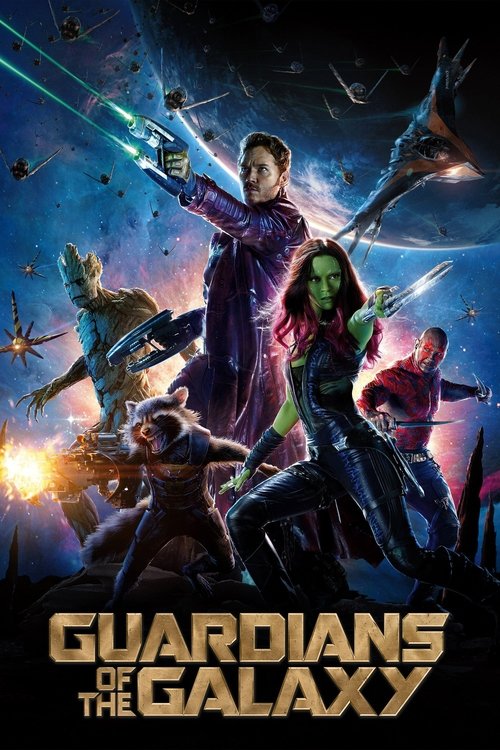
Guardians of the Galaxy
2014 · James Gunn
For when you want pure escapist joy — a crowd-pleaser for family movie night, a bad week, or anyone who needs a galaxy-sized pick-me-up. Total comfort viewing.
What it's about
Peter Quill, abducted from Earth as a kid and raised among thieves, swipes a mysterious orb and lands at the center of a galactic manhunt. Forced into an alliance with a deadly assassin, a literal-minded warrior, a talking raccoon, and a walking tree, he leads a crew of misfits who might accidentally save the galaxy. It's a treasure-hunt caper across an invented cosmos, scored to a mixtape of 60s and 70s pop.
The experience
Buoyant, quick, and consistently funny, with a surprising streak of earnestness underneath the jokes — a space adventure that keeps making you laugh and then sneaks up on your feelings. It moves fast and never stops being fun.
Performances
Chris Pratt's turn as Quill redefined him overnight as a leading man, and Bradley Cooper's voice work makes a CGI raccoon the film's scene-stealing, secretly wounded heart.
The craft
James Gunn's masterstroke is the soundtrack — the 'Awesome Mix' of vintage pop isn't decoration but character, memory, and punchline all at once. The invented cosmos is colorful and tactile, and the whole thing pops on a big screen with the music up.
Why it matters
Marvel's riskiest bet became one of its most beloved films, launching a franchise from unknown characters and normalizing needle-drop soundtracks and irreverent comedy across a decade of blockbusters.
Snapshot
Guardians of the Galaxy is the tenth film in the Marvel Cinematic Universe and, at the time of its release, its riskiest bet: a space opera built around a talking raccoon, a sentient tree, and a set of second-tier comic-book properties largely unknown to general audiences. Directed and co-written by James Gunn, it converts that obscurity into freedom, staging a treasure-hunt caper across an invented cosmos and scoring it to a mixtape of 1960s and 1970s pop. The result is a tonal hybrid — sincere adventure braided with self-aware comedy — that reframed what a Marvel Studios picture could sound and feel like. Its critical and commercial success established the ragtag-cosmic-crew as a durable franchise pillar and helped normalize needle-drop scoring, irreverent humor, and non-terrestrial world-building across the subsequent MCU.
Industry & production
The film was produced by Marvel Studios under Kevin Feige as part of the studio's "Phase Two," the slate that followed The Avengers (2012). Marvel had, by 2014, established a house method: relatively contained budgets by tentpole standards, a producer-driven development structure, and a willingness to hand distinctive material to directors with strong personal voices. Guardians was distributed by Walt Disney Studios Motion Pictures, following Disney's 2009 acquisition of Marvel Entertainment.
The script originated with Nicole Perlman, who developed the property through Marvel's writing program before Gunn was brought aboard to rewrite and direct; the two share screenplay credit, with story ultimately rooted in the 2008 comics relaunch by Dan Abnett and Andy Lanning that assembled this particular team lineup. Gunn's hiring was itself notable: he came from the low-budget genre world of Troma Entertainment, had written the 2004 Dawn of the Dead remake, and had directed the horror-comedy Slither (2006) and the dark superhero satire Super (2010). Casting Chris Pratt — then known primarily for television comedy — as leading man was a comparable gamble.
Principal photography took place largely at Shepperton Studios in England, with a large practical build program supporting the extensive digital environments. The picture opened in the United States in August 2014. I'll flag here that precise budget and box-office figures are the kind of number I won't reproduce from memory; the film was, by consensus, a major commercial success that exceeded cautious industry expectations for an unfamiliar property, and it launched an ongoing sub-franchise.
Technology
Guardians is a heavily digital production, and two of its five leads are entirely computer-generated: Rocket, a genetically engineered raccoon-like creature, and Groot, a tree-humanoid. Both were realized through CGI by effects houses including Framestore and MPC, with Rocket in particular built through detailed animation and reference study rather than direct performance capture of the on-set voice actors. The film's cosmic settings — the mining colony Knowhere housed in a severed celestial head, the ordered world of Xandar, Ronan's warship — rely on large-scale digital environment work integrated with practical sets and makeup.
The film was shot digitally. Prosthetic and makeup work — the blue and green skins of Gamora, Nebula, Yondu, and Ronan, and the full-body tattooing of Drax — was extensive enough that the picture earned an Academy Award nomination for Best Makeup and Hairstyling, alongside its nomination for Best Visual Effects. It was released in 3D via post-conversion and in IMAX formats, part of the era's standard premium-large-format exhibition strategy.
Technique
Cinematography
Ben Davis, who would become a recurring Marvel cinematographer, photographed the film. The visual approach favors saturated, candy-bright color — magentas, teals, and golds — that distinguishes the picture's palette from the cooler, more grounded look of the contemporaneous Avengers and Captain America films. Davis stages the action for legibility within dense digital environments, using wide framings that keep the ensemble readable and reserving showier camera moves for signature beats. The look is glossy and comic-forward rather than naturalistic, matching Gunn's tonal register.
Editing
The film was cut by Fred Raskin, Craig Wood, and Hughes Winborne. Its editorial signature is the integration of pre-existing songs into rhythm and structure: sequences are built so that image and cutting lock to the "Awesome Mix" tracks, most famously the opening title sequence in which Quill dances through a ruined alien landscape to Redbone's "Come and Get Your Love." The editing modulates briskly between comedy and action, using cutaways and comic timing that reflect Gunn's script while maintaining the propulsive pace expected of a summer tentpole.
Mise-en-scène / staging
Gunn's staging leans into density and texture — junk-strewn interiors, crowded alien marketplaces, the layered vertical spaces of Knowhere. The production design (led by Charles Wood) constructs a lived-in, secondhand cosmos closer in spirit to the used-future aesthetic of 1970s science fiction than to sleek utopian futurism. Character introductions are frequently staged as set pieces in themselves — the prison sequence, for instance, choreographs the assembling of the team through physical comedy and spatial clarity. Costume and makeup do heavy characterizing work, each Guardian silhouetted and color-coded for instant recognition.
Sound
The soundtrack is the film's most discussed formal element. Quill's cassette of his late mother's mixtape — "Awesome Mix Vol. 1" — functions simultaneously as plot object, emotional throughline, and score. The diegetic and non-diegetic boundary is deliberately porous: songs the character listens to also score the audience's experience. Tyler Bates composed the original orchestral score around and beneath these songs, a reversal of the usual workflow in which songs are laid over finished score. The sound design of the CG characters — Rocket's vocal texture, Groot's limited "I am Groot" register — carries substantial characterization.
Performance
The ensemble balances broad and grounded registers. Chris Pratt plays Quill as a roguish, self-mythologizing man-child, importing comic timing into an action-lead frame. Zoe Saldana's Gamora supplies the film's straighter dramatic spine; Dave Bautista, in a breakout performance, mines Drax's literal-mindedness for deadpan comedy. Two of the central performances are vocal: Bradley Cooper voices Rocket and Vin Diesel voices Groot, the latter conveying a full emotional arc through a single repeated phrase and vocal inflection. Supporting turns from Lee Pace (Ronan), Michael Rooker (Yondu), Karen Gillan (Nebula), Benicio del Toro (The Collector), Glenn Close, Djimon Hounsou, and John C. Reilly populate the world. The chemistry of the central five — the sense of a found family assembling out of mutual antagonism — is the performance dimension most frequently credited for the film's warmth.
Narrative & dramatic mode
Structurally the film is a caper: a contested MacGuffin (the Orb, later revealed to contain an Infinity Stone) draws together a group of self-interested outsiders — a thief, an assassin, a vengeful brute, and a bounty-hunting duo — who must cooperate first for profit and then, reluctantly, for a larger cause. The dramatic mode is comedic-heroic, undercutting grandeur with deflating humor while still committing to melodramatic emotional beats: Quill's unresolved grief for his mother frames the opening and pays off in the climax. The film runs on the reversal of the antihero-into-hero arc familiar from the western and the war-movie "dirty half-dozen," and its central movement is affiliative — strangers becoming a family. Exposition is delivered lightly, often through comedy, and the villain plot (Ronan's fanatical war against Xandar) functions largely as a pressure engine for the team's bonding.
Genre & cycle
Guardians sits at the intersection of the modern superhero cycle and the older tradition of space opera. It belongs to the comic-book-blockbuster cycle inaugurated commercially by the early-2000s X-Men and Spider-Man films and consolidated by the MCU, but it self-consciously reaches back to pre-Star Wars and post-Star Wars science-fiction adventure — the swashbuckling, planet-hopping, morally loose register of pulp SF. Within the MCU it functions as the "cosmic" wing, expanding the franchise's scale from Earth-bound superheroics to a galactic canvas populated by alien empires. It also participates in the comedy-action hybrid lineage, using humor not as occasional relief but as the film's governing tone.
Authorship & method
The film is strongly authored by James Gunn, whose sensibility — genre affection crossed with irreverence, sincerity smuggled inside crudeness and comedy — is legible throughout and is continuous with his earlier Slither and Super. Gunn's method is notable for foregrounding music as a structuring principle from the screenplay stage: the song choices were written into the script rather than selected in post, making the soundtrack an authorial rather than supervisory decision. His frequent collaborator Michael Rooker appears as Yondu, one of several throughlines connecting the film to Gunn's earlier work.
Key collaborators anchor the craft: cinematographer Ben Davis, composer Tyler Bates (a longtime Gunn collaborator whose score is built to coexist with the pop soundtrack), production designer Charles Wood, and the editing trio of Fred Raskin, Craig Wood, and Hughes Winborne. Co-writer Nicole Perlman originated the screenplay before Gunn's rewrite. Above them all sits the producer-driven Marvel Studios system under Kevin Feige, which supplied the connective-tissue continuity (the Infinity Stones, the tease of Thanos) that ties the standalone adventure into the larger franchise architecture. The film is thus a genuine case of authorial voice operating within, and productively negotiating with, a house style.
Movement / national cinema
The film is an American studio blockbuster, a product of the Hollywood franchise system in its most integrated form. As with much contemporary tentpole production, its physical manufacture was transnational — shot in England at Shepperton, with visual-effects labor distributed across international facilities — but its authorship, financing, and cultural idiom are American. It belongs to no art-cinema movement; its lineage is commercial genre filmmaking. If it has a "movement" affiliation at all, it is to the loose contemporary tendency of genre directors from low-budget and horror backgrounds being absorbed into major franchise filmmaking.
Era / period
Guardians is a document of the mid-2010s peak of the shared-cinematic-universe model. By 2014 the MCU had proven that interlocking serialized films could function as a dominant theatrical business, and the industry was pivoting hard toward franchise, IP, and premium-format exhibition (3D, IMAX). The film reflects the period's technological confidence in fully digital lead characters and large-scale environment work, and its commercial strategy — a soundtrack of licensed nostalgia pop marketed alongside the film — is characteristic of an era attentive to cross-platform monetization. It also arrives at a moment of accelerating nostalgia in popular culture, its 1970s-80s musical and design cues speaking to that broader retro sensibility.
Themes
The film's governing theme is chosen family: a set of damaged, self-interested loners who find belonging in one another. Grief and loss underwrite that arc — Quill's unprocessed mourning for his mother frames the narrative and is embodied in the mixtape, an object that literalizes memory and inheritance. Related motifs include the redemption of the outsider or criminal, the tension between selfishness and sacrifice, and a persistent deflation of heroic grandeur through comedy, which the film uses to argue that sincerity and absurdity can coexist. Groot's climactic gesture crystallizes the sacrifice theme; the recurring "we are the Guardians of the Galaxy" self-naming dramatizes identity as something chosen rather than given.
Reception, canon & influence
Critically, Guardians was received as a pleasant surprise — praised for its humor, energy, ensemble chemistry, and distinctive voice, and widely credited with demonstrating that Marvel could succeed with unfamiliar, tonally offbeat material. It earned Academy Award nominations for Best Visual Effects and Best Makeup and Hairstyling. Its soundtrack became a genuine cultural phenomenon; "Awesome Mix Vol. 1" was notably successful on the pop charts, a rare case of a film soundtrack composed entirely of previously released songs achieving major commercial standing (I'd flag the exact chart claims as something to verify against the record rather than assert from memory).
Influences on the film (backward): The picture draws on the post-Star Wars space-opera tradition and its used-future aesthetic, on the "assembling a band of rogues" structure common to the western and the men-on-a-mission war film, and on the needle-drop scoring lineage associated with directors like Martin Scorsese, Quentin Tarantino, and Cameron Crowe, in which pop songs carry narrative and emotional weight. Its comic-book source is the 2008 Abnett–Lanning Guardians relaunch. Its comedy-inflected genre sensibility is continuous with Gunn's own Troma-rooted, horror-comedy background.
Legacy (forward): Guardians established the MCU's cosmic branch and directly enabled Guardians of the Galaxy Vol. 2 (2017) and Vol. 3 (2023), while its characters became central to Avengers: Infinity War and Endgame. More broadly it validated a strategy of pairing franchise material with strong directorial voice and comedic tone, and its needle-drop soundtrack model was widely imitated across subsequent blockbuster filmmaking. It helped elevate Chris Pratt and Dave Bautista to leading-man status and confirmed James Gunn as a major franchise author — a trajectory that ultimately led to his appointment overseeing the rival DC film universe. Within the culture, the film's fusion of nostalgia pop, irreverence, and sincerity became a recognizable template that later tentpoles repeatedly echoed.
A Deleuzian reading
He steps off his ship onto a drowned, ruined alien world, thumbs a Walkman, and starts to dance.
The full Deleuzian reading of Guardians of the Galaxy →
Reception
In 2014 this was 'Marvel's biggest gamble' — a talking raccoon and a C-list property nobody outside comics knew — and it became the year's surprise smash. Now it's remembered as peak-fun MCU, though hindsight also tags it as the movie that taught every blockbuster to quip.
How Guardians of the Galaxy was received, from release to now →
How to watch Guardians of the Galaxy: what to notice on a first viewing
- Watch Quill put on headphones and start dancing alone. He steps onto a drowned alien world to steal something and dances instead. Redbone plays over the ruins, nobody is watching him, and the plot simply waits for ninety seconds. The story stops and the world does the moving, which becomes the film's favorite trick from here on.
- Watch the cassette tape and who is holding it. Quill's mother made the mixtape, and it carries Earth, the abduction, and his unfinished grief in one object. It is also the score you are listening to. One prop holds everything the film is about, and a 1970s tape over an alien vista makes you look twice.
- Watch the junk, rust, and secondhand gear in every room. Charles Wood builds a used cosmos of dented ships, crowded markets, and salvage. Knowhere is a mining colony inside a severed god's skull, with a bar and a gambling den cut into the bone. Nobody can be pompous in a place built out of scrap, which keeps the film's scale from swelling.
- Watch for magenta, teal, and gold in the same frame. Ben Davis shoots candy-bright and saturated, a long way from the cooler look of the other Marvel films of the period. Wide framings keep the whole ensemble readable inside dense digital sets. The palette tells you this corner of the franchise plays by different rules before anyone opens their mouth.
- Count how many scenes are cut to fit a song. Gunn wrote the song choices into the screenplay instead of choosing them in post. Image and cut lock to the record, and Tyler Bates then wrote orchestral score underneath the tracks. The music came first and the film was built onto it, which reverses the usual order of the job.
The whole guide to watching Guardians of the Galaxy, with the keys for a rewatch →
Influences: the films it descends from and the films it influenced
- Star Wars (1977) — Established the used-future production design — deliberately worn, dinged, grease-stained hardware — that Guardians' scavenger aesthetic (the Milano, Knowhere carved from a Celestial's skull) inherits wholesale.
- Flash Gordon (1980) — Precedent for scoring a primary-saturated, camp space opera to an anachronistic pop/rock soundtrack (Queen), coupling garish color with music that sits outside the diegesis.
- The Dirty Dozen (1967) — Supplies the men-on-a-mission architecture of welding squabbling criminal misfits into a reluctant fighting unit, the 'assemble the rogues' structure Gunn runs on the team's formation in the Kyln.
- Mean Streets (1973) — Codified needle-drop scoring — cutting pre-existing pop records, not orchestral cues, directly into scenes so the song itself carries the emotional and narrative beat.
- Reservoir Dogs (1992) — Ironic counterpoint of an upbeat oldies track against onscreen menace, the tonal-clash needle-drop that Gunn echoes in 'Hooked on a Feeling' over Quill's arrest montage.
- Almost Famous (2000) — Model for the needle-drop as unguarded sincerity — the group sing-along that disarms cynicism — the sincere-inside-cool register Gunn uses for 'Come and Get Your Love' and the closing dance-off.
- Raiders of the Lost Ark (1981) — Revived the pulp-serial adventure with a roguish, wisecracking lead and a set-piece rhythm of escalating scrapes, the comic-adventure tempo Quill's caper inherits.
- Blade Runner (1982) — Maximalist used-future texture — layered, decayed, neon-lit urban density — that informs the crowded, lived-in vertical design of Knowhere and Xandar.
- Slither (2006) — Gunn's own horror-comedy method — practical creature grotesquerie played simultaneously for laughs and pathos — plus the Michael Rooker collaboration carried forward into Yondu.
- Super (2010) — Establishes Gunn's signature of smuggling earnest emotional sincerity inside transgressive crudeness, the authorial tonal balance that governs Guardians' whole comic-yet-sincere voice.
- The Fifth Element (1997) — Gunn's irreverent space-opera deploys the pursuit-and-assembly structure with a comic ensemble whose performances register in the same camp register — particularly Lee Pace's theatrical villain frontality — that Besson established as viable mainstream genre grammar, making it the most commercially consequential downstream adoption.
- Iron Man (2008) — Scales up Iron Man's needle-drop strategy into a wall-to-wall diegetic mixtape that character-codes its lead, extending the MCU's pop-soundtrack craft.
- Guardians of the Galaxy Vol. 2 (2017) — Directly extends the script-stage song method with 'Awesome Mix Vol. 2' and pays off the Rooker/Yondu surrogate-father thread with a needle-drop-scored funeral, deepening the chosen-family device.
- Deadpool (2016) — Capitalizes on Guardians proving tonally offbeat comic properties can headline, pairing an irreverent fourth-wall-breaking hero with ironic needle-drop scoring (Juice Newton's 'Angel of the Morning').
- Guardians of the Galaxy Vol. 3 (2023) — Established the diegetic 'Awesome Mix' cassette structure and Rocket's mocap-plus-VFX-fur lead performance that Vol. 3 pays off.
- Superman (2025) — Gunn's own house method: found-family ensemble blocking, needle-drop scoring, and abrupt pivots from comic bit to earnest sincerity within a single scene.
- The Fantastic 4: First Steps (2025) — First translated Jack Kirby's cosmic-Marvel palette — saturated energy fields and 'Kirby crackle' — into a coherent screen color language that First Steps inherits and period-shifts.
- Thor: Love and Thunder (2022) — Invented the cosmic-MCU needle-drop architecture — cutting action and montage to classic-rock tracks — with Love and Thunder's wall-to-wall Guns N' Roses standing in for Gunn's Awesome Mix.
- Thunderbolts* (2025) — Established the MCU template Thunderbolts* inherits: grafting comedic warmth and a curated needle-drop rhythm onto a roster of expendable, damaged misfits so the ensemble reads as a chosen family rather than a mission unit.
- Thor: Ragnarok (2017) — Imports Guardians' comedy-action hybrid and synth/rock needle-drop scoring (Led Zeppelin's 'Immigrant Song' over the battle beats) into another MCU cosmic property.
- The Suicide Squad (2021) — Gunn re-runs the exact craft package — misfit-criminal ensemble, script-written needle-drops, and Troma-rooted gore-comedy played with sincerity — for the rival DC universe.
- Baby Driver (2017) — Pushes music-locked cutting to its limit, editing every action beat in precise sync to pre-selected pop tracks — the logical extreme of Gunn's write-the-songs-into-the-script approach.
- Ant-Man (2015) — MCU sibling from the same wave that fuses a comedic voice with an explicit heist/caper structure, extending Guardians' proof that lighter genre-hybrid tones fit the shared-universe architecture.
- The Martian (2015) — Simultaneous development of diegetic period pop music as a space-survival emotional counterpoint device: both films structure their soundtracks around curated 70s pop as character-defining cultural artifact, deploying comedy and anachronistic pleasure as psychological armor against spatial isolation.
- The Avengers (2012) — Extends the ensemble-comic-timing and bickering-misfit interplay within the MCU, adding needle-drop scoring but keeping Whedon's verbal-friction-as-bonding mechanism.
- Avengers: Age of Ultron (2015) — Shares cinematographer Ben Davis, whose high-key, saturated ARRI Alexa palette carries directly over as the Marvel house look of both films.
- Kingsman: The Golden Circle (2017) — Deploys a nostalgia-pop jukebox soundtrack as ironic counterpoint to spectacle, the same weaponizing of mismatched needle-drops Kingsman uses (Elton John, John Denver).
- X-Men: Days of Future Past (2014) — Same-year peak of the diegetic period-pop needle-drop as emotional-comic scoring device, letting a curated older track carry a blockbuster action-and-character beat exactly as DoFP does with Croce.
Similar films
- Guardians of the Galaxy Vol. 2 (2017) — influence & lineage
- Deadpool (2016) — influence & lineage
- Guardians of the Galaxy Vol. 3 (2023) — shared sensibility
- The Lego Movie (2014) — shared sensibility
- The Avengers (2012) — shared sensibility
- The Fantastic 4: First Steps (2025) — shared sensibility
- Deadpool & Wolverine (2024) — shared sensibility
- Black Panther (2018) — shared sensibility