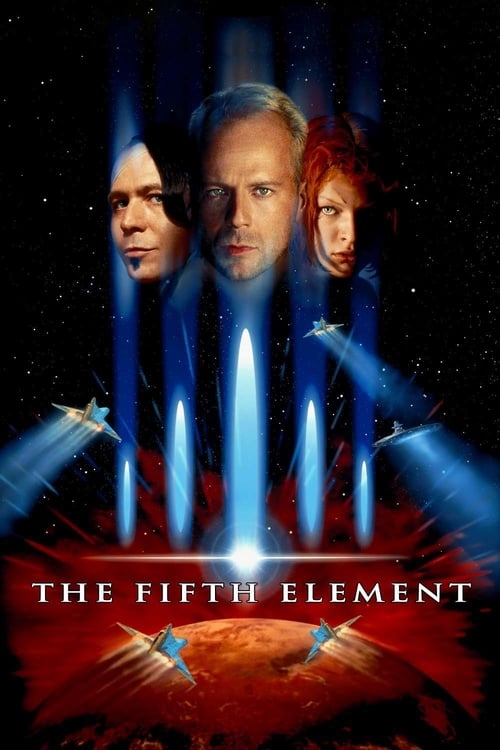
The Fifth Element
1997 · Luc Besson
For when you want pure fun with zero cynicism — a Friday-night crowd-pleaser that's equal parts action movie and fashion show. Total comfort viewing for anyone who likes their future loud and orange.
What it's about
In the 23rd century, a New York cab driver named Korben Dallas has a passenger crash through his roof: a bewildered young woman who turns out to be the key to stopping an ancient force of pure evil from wiping out life itself. With priests, mercenaries, a flamboyant radio host, and a scenery-devouring arms dealer all in the mix, saving the universe becomes a race through flying-car traffic, a luxury space cruise, and one unforgettable opera.
The experience
Fast, loud, funny, and gleefully ridiculous — a candy-colored rush that never slows down long enough for you to question it. It's the rare sci-fi spectacle that feels like play rather than homework.
Performances
Bruce Willis anchors the chaos as the weary everyman, Milla Jovovich made her name as the fierce, funny Leeloo, and Gary Oldman's drawling, preening villain is one of the most entertainingly unhinged bad guys of the nineties. Chris Tucker's motor-mouthed radio host either steals the film or hijacks it, depending on your taste.
The craft
The world was designed by legendary French comic-book artists and dressed by Jean Paul Gaultier, so every frame bursts with invention — flying taxis stacked a hundred lanes deep, alien divas, costumes no other blockbuster would dare. Eric Serra's score and the famous opera sequence make it a genuine big-screen, big-speakers experience.
Why it matters
The most successful French production of its era, it proved a European sensibility could compete with Hollywood at blockbuster scale, and its look — playful, couture, comic-book bright — still gets referenced whenever sci-fi wants to be fun instead of grim.
Snapshot
A maximalist science-fiction opera in which a twenty-third-century New York cab driver, Korben Dallas, is drawn into a cosmic struggle between primordial good and the abstract force of ultimate evil. The film's central conceit — that the fifth element binding the four classical ones is love itself — anchors an extravagant visual argument conducted in primary colors, haute couture, and operatic excess. Equal parts blockbuster action film and bande dessinée brought to life, The Fifth Element remains the most internationally successful film of Luc Besson's career and the fullest expression of a very specific strain of Franco-European genre filmmaking.
Industry & production
Besson has stated publicly that the kernel of The Fifth Element dates to his adolescence — he began developing the world and its mythology as a teenager in the early 1980s, long before he was a filmmaker of any standing. By the time he brought the project forward as a viable production, he had enough leverage from Nikita (1990) and Léon: The Professional (1994) to attract major studio participation. Columbia Pictures (then Sony) co-financed and distributed the film, pairing with Gaumont, giving it a budget in the region of ninety million dollars — placing it among the most expensive European-originated productions made to that point, though precise final figures were never officially confirmed by the studio.
Much of the principal photography took place at Pinewood Studios in England, where the production commandeered multiple stages for its elaborate interior environments. Location work extended to Mauritania, where the film's desert prologue was shot, lending a material aridness that contrasts with the film's overwhelming chromatic density elsewhere. The sheer scale of set construction and costume production — thousands of extras required wardrobe — made the shoot an unusual logistical undertaking for a French director working in the Hollywood mode.
Robert Mark Kamen, who had collaborated with Besson on Léon and brought a practiced screenwriter's hand to dialogue and action structure, shares the screenplay credit. Besson provided the mythology and visual architecture; Kamen helped shape the dramatic mechanics. The collaboration produced a script that reads more like an illustrated story treatment than a conventional Hollywood spec — more interested in spectacle and tonal provocation than psychological interiority.
Technology
The Fifth Element arrived at a pivotal transitional moment for visual effects, when digital compositing was displacing the miniature photography that had dominated practical effects for decades, yet before CGI environments were taken for granted. The film's solution was deliberately hybrid. Digital Domain, founded in 1993 and already building a reputation through True Lies and Apollo 13, handled the principal effects work, with VFX supervisor Mark Stetson coordinating a methodology that layered physical miniatures — many constructed at considerable scale — with digital environments and composited performers.
The film's signature achievement is the future New York megacity, a vertical labyrinth of stacked traffic arteries, exhaust vents, and neon advertisements. Establishing shots of this environment combined miniature sets with early CGI crowd simulation, creating a layered density that clearly references Fritz Lang's Metropolis (1927) while speculating beyond it. The flying-vehicle sequences required precisely coordinated practical stunt work and digital extensions; the production is notable for the attention paid to consistency in depicting the city's three-dimensional logic across scales.
Practical effects remained central elsewhere: the Mondoshawan suits were full mechanical costumes of considerable weight and bulk, worn by performers who could barely move in them — a deliberate choice that gave those sequences a lumbering, ceremonial quality no digital equivalent could reproduce at the time.
Technique
Cinematography
Thierry Arbogast, Besson's regular director of photography from Nikita onward, shot The Fifth Element in a style calibrated for density and saturation rather than subtlety. Working with a production design palette dominated by orange, yellow, and electric blue — Jean-Paul Gaultier's costuming frequently anchors the frame chromatically — Arbogast lit the interior environments as if every surface were its own light source. The effect is deliberately overwhelming, refusing the gray-metal minimalism that had governed Hollywood science fiction since Alien (1979).
Camera movement tends toward the roving and energetic in action sequences; the film does not favour the locked-down shot as an aesthetic signature. Arbogast's work is functional rather than ostentatiously authored — the cinematography serves the spectacle rather than inflecting it with a personal visual argument.
Editing
Sylvie Landra, who had cut Léon: The Professional, edited The Fifth Element with a rhythm calibrated to the film's tonal lurches — from broad comedy to action to sincere sentiment — rather than to any single pace. The editing is notably un-austere: sequences accumulate quickly, often favoring momentum over spatial clarity. The Fhloston Paradise sequence, which intercuts the assassin subplot with the diva's performance and a corridor action beat, asks the audience to track several registers simultaneously, a demand more characteristic of operatic stagecraft than classical Hollywood cross-cutting.
Mise-en-scène / staging
The staging is consistently theatrical in its logic. Characters are positioned and moved in ways that foreground their iconic qualities rather than simulate naturalistic behavior. Zorg's office scenes with Oldman are staged as dominance displays; the diva's aria is framed as pure presentation, frontally composed like a theatrical event. Leeloo's first appearance in Korben's cab is spatially organized to emphasize her otherness — she occupies the frame differently from everyone around her, a staging choice that reinforces her status as something apart from the film's human world.
Besson uses high angles over the megacity to convey scale and social stratification, placing the action at street level — or taxi-lane level — against a vertiginous backdrop of descending and ascending space. The vertical axis carries consistent thematic weight throughout.
Sound
Éric Serra's score fuses orchestral passages with electronic textures and world-music inflections in ways that were somewhat unconventional for a studio action film of the period. The score's most discussed set-piece is the "Diva Dance" sequence, in which the performance of a coloratura aria — drawn from the Mad Scene of Donizetti's Lucia di Lammermoor — transitions into a technically extended passage that was vocally performed by Albanian soprano Inva Mula, with digital pitch manipulation pushing the singing into registers beyond unaided human production. The fusion of operatic tradition and electronic extension became the film's most cited musical moment.
Ambient sound design reinforces the city's industrial cacophony: traffic, broadcast noise, compression systems, and radio chatter layer into a texture that codes the future as relentlessly busy and under-quiet.
Performance
Bruce Willis plays Korben Dallas as a compressed variation on his Die Hard persona — sardonic, physically capable, professionally capable but existentially adrift — and the film does not ask much more from him than reliable action-hero groundedness. The performance functions as an anchor against which the film's more extreme registers play out.
Gary Oldman's Zorg is a deliberately camp exercise in baroque villainy: a corporate autocrat with a sculpted forelock and a southern American affectation, played at a pitch calibrated to theatrical excess rather than psychological menace. Oldman embraced the register wholly, producing a performance that reads as caricature by design.
Milla Jovovich carries the film's emotional argument as Leeloo. She was in her early twenties during production, and the role demanded physical training, a constructed language (Besson devised what he called "Divine Language" for Leeloo's early dialogue), and the ability to shift from near-feral unfamiliarity with human experience to something approaching recognizable grief. The performance is uneven in places where the script leaves her without dramatic grounding, but the sequence in which Leeloo absorbs the history of human warfare and retreats from the task of saving humanity is genuinely affecting.
Chris Tucker's Ruby Rhod polarized audiences and critics: a media personality of exaggerated flamboyance and relentless volubility, Tucker's performance operates at a register the rest of the film doesn't quite match, generating either delight or exasperation depending on the viewer's tolerance for sustained comic maximalism.
Narrative & dramatic mode
The narrative is structured as a pursuit-and-assembly plot layered over a countdown to cosmic catastrophe, a format borrowed from adventure serials and space opera comics. The film is not primarily interested in dramatic irony or psychological development; its mode is one of escalating spectacle punctuated by tonal pivots. Sentiment arrives in compressed beats — the dossier montage, the final revelation — rather than being developed across arcs. This is a feature, not a deficiency, of the form: The Fifth Element operates more like an illustrated novel or a large-format comic than a psychological drama.
The metaphysical conceit — that evil is defeated by love rather than force — is handled with a seriousness the surrounding material doesn't always prepare the viewer for, producing a tonal shock in the final act that is either moving or jarring.
Genre & cycle
The Fifth Element belongs to the tradition of European space opera most fully developed in French bande dessinée — the large-format comics tradition that had been pushing science fiction toward visual extravagance and tonal range since the 1960s. It also participates in the Hollywood action blockbuster cycle of the mid-1990s, inflecting that genre with a European sensibility that foregrounds design, irony, and operatic set-piece over plot mechanism. The resulting hybrid was commercially successful but critically difficult to categorize: too loud and broad for the art-house audience Besson had cultivated, too peculiar and European in sensibility for mainstream Hollywood genre classification.
Authorship & method
Besson functions here as something closer to an auteur-producer than a conventional director: the film's visual world, mythology, and tonal register are identifiably his, but the sheer scale of production required delegating visual execution to collaborators of considerable independent authority.
Jean-Claude Mézières, the French comics artist who co-created the Valérian and Laureline series with Pierre Christin from 1967, was brought in as a conceptual designer. Mézières' visual vocabulary — layered future cities, alien biological forms, densely detailed vehicles, baroque diversity of humanoid types — is legible throughout the film's design, and the collaboration was significant enough that Mézières later noted, with some complexity, the overlap between the film's designs and his own prior work. Besson would return to the Valérian source two decades later with Valerian and the City of a Thousand Planets (2017).
Jean-Paul Gaultier's contribution as costume designer was not merely functional but constitutive of the film's visual identity. His designs — the bandage ensemble worn by Leeloo, the airline uniforms aboard Fhloston Paradise, Zorg's corporate tailoring — were conceived as fashion rather than period extrapolation, grounding the film in a Parisian couture sensibility that inflects the science fiction setting with haute irony. The collaboration was extensively documented in behind-the-scenes coverage and forms part of the film's lasting cultural footprint.
Arbogast and Serra were, by 1997, established Besson collaborators: Arbogast had shot every Besson feature since Nikita, while Serra had scored them from Le Grand Bleu (1988) onward. This continuity of craft gave the production an expressive consistency even at Hollywood scale.
Movement / national cinema
The film is a product of French commercial cinema operating in explicit dialogue with Hollywood. Besson had long been associated with the cinéma du look tendency — a strand of French filmmaking in the 1980s associated with directors including Jean-Jacques Beineix and Leos Carax, characterized by visual spectacle, genre reference, and an aesthetic emphasis on surface and style. The Fifth Element can be read as the logical extrapolation of that tendency to blockbuster scale: it is, in effect, what cinéma du look looks like when given a studio budget and an American star.
The film's relationship to the bande dessinée tradition is equally important. French and Belgian comics had developed a science fiction visual language of considerable sophistication through the 1960s and 1970s, and the influence of that tradition — mediated directly through Mézières and felt more broadly through the aesthetic references the film accumulates — distinguishes The Fifth Element from its American blockbuster contemporaries.
Era / period
The film appeared at the peak of mid-1990s blockbuster confidence, between the CGI breakthroughs of Jurassic Park (1993) and the pre-digital-saturation period before effects became invisible. It is a document of its specific industrial moment: expensive enough to mount genuine spectacle, still reliant enough on practical construction to have material weight, released before visual effects grammar had fully normalized digital environments. The aesthetic it represents — exuberant, operatic, design-forward, deliberately excessive — would become harder to sustain as production costs rose and global market pressures pushed blockbusters toward tonal consistency.
Themes
The film's central metaphysical proposition — that love constitutes an irreducible fifth element alongside the classical four — is explicitly developed in its final act, when physical force proves insufficient against a cosmological force of evil and emotional authenticity is required. This framing positions the film within a long tradition of science fiction that uses speculative machinery to make arguments about what is irreducibly human.
Corporate nihilism, embodied in Zorg's willingness to broker planetary extinction for profit, is the film's primary political target — a concern with the relationship between capitalism and catastrophe that would become more prevalent in science fiction in subsequent decades. Zorg believes evil is a natural force he can align himself with; the film's dramatic argument is that this misrecognises the nature of evil, which is not a presence but an absence — the void left by the negation of love.
Leeloo's arc from weapon to person, from constructed perfect being to experiencing subject, tracks a concern with constructed versus experienced humanity that also runs through the bande dessinée tradition from which the film draws. Her rejection of the task assigned to her — refusing to save a species she has come to understand as self-destructive — is the film's most genuinely challenging moment, resolved through sentiment rather than argument.
Reception, canon & influence
Influences on the film (backward): Fritz Lang's Metropolis is the most legible precursor in the film's urban design language. The bande dessinée tradition — specifically Mézières' Valérian and Laureline and the broader aesthetic of the French magazine Métal Hurlant (Heavy Metal in its American edition) — provides the more immediate visual and tonal inheritance. Richard Fleischer's Soylent Green (1973) and John Carpenter's Escape from New York (1981) inform the dystopian-city construction. The film's operatic ambition and tonal range recall Italian genre cinema of the 1960s and 1970s, though the specific debts are diffuse rather than documentable. Besson has cited comics as his primary visual education rather than cinema, which accounts for the film's relative distance from established Hollywood science fiction grammar.
Critical reception: The film premiered in competition at the 1997 Cannes Film Festival, where it won the Technical Grand Prize — recognition of its craft achievements that sidestepped the question of its artistic merits. Critical reception was sharply divided: American critics were frequently dismissive, finding the film loud, incoherent, and overstuffed; European reception was warmer and more attentive to its generic lineage. The film was a substantial commercial success internationally, performing particularly well in Europe and Asia, though it did not quite match studio expectations in the North American market.
Legacy and forward influence: The Fifth Element exercised considerable influence on the visual language of science fiction in games, animation, and film throughout the late 1990s and 2000s. Its chromatic approach — saturated primary colors, design-led environments, biological diversity in alien forms — became a visible alternative to the desaturated, industrial aesthetic that had dominated Hollywood science fiction since the late 1970s. Directors working in animated and live-action science fiction in subsequent years drew on its visual vocabulary, though often without direct attribution. The film developed a substantial cult following through home video, and its reputation rehabilitated significantly over the twenty years following its release, as critics and audiences retroactively valued its commitment to visual extravagance and tonal risk. Besson's Valerian and the City of a Thousand Planets (2017) revisited the same thematic and visual territory at greater expense and with substantially less success, which retroactively clarified how precisely calibrated The Fifth Element's specific tonal register had been. The diva sequence, in particular, has been widely cited as a formal set-piece of genuine inventiveness, and the film as a whole is increasingly regarded as a distinctive, unrepeatable collision of French popular culture ambition with Hollywood industrial resources.
A Deleuzian reading
Start with the blue woman singing.
The full Deleuzian reading of The Fifth Element →
Reception
Critics in 1997 were split — it opened Cannes to a mix of boos and cheers, and American reviews called it gorgeous nonsense — but it was a big international hit and has since settled into beloved cult-classic status, routinely cited as one of the great maximalist sci-fi films.
How The Fifth Element was received, from release to now →
Influences: the films it descends from and the films it influenced
- Metropolis (1927) — Besson's future New York megacity directly extends Lang's layered-miniature vertical city logic — stacked traffic arteries, crowd-filled shafts — which Digital Domain's composite work explicitly homages at the scale Lang could only approximate with models and superimposition.
- Barbarella (1968) — Vadim's use of haute-couture costume design (Paco Rabanne) to construct a fantastical space-opera world as wearable spectacle establishes the methodology Besson and Gaultier formalize: costuming as primary world-building instrument rather than period or character signifier.
- Flash Gordon (1980) — Hodges's operatic camp-villainy performance mode — Ming as theatrical dominance display staged frontally, with primary-color fantastical production design — establishes the register in which Oldman performs Zorg, including the deliberate tonal separation between villain's scenes and action plot.
- Diva (1981) — Beineix's invention of Cinéma du look's saturated color-as-emotional-architecture, and his structural conceit of intercutting an operatic-soprano performance with an urban pursuit, are direct formal antecedents to Besson's Fhloston Paradise aria sequence.
- Blade Runner (1982) — Scott's practical-miniature vertical megacity — lit with neon and layered through in-camera optical compositing — establishes the hybrid practical-effects logic for dense urban sci-fi spectacle that Besson extends into the digital compositing domain twenty years later.
- Brazil (1985) — Gilliam's staging of an absurdist bureaucratic future through theatrical production-design excess and abrupt tonal lurches between black comedy and sincere pathos provides a template for Besson's comic-bureaucratic sequences and the tonal intercutting that governs the Fhloston structure.
- Subway (1985) — Besson's Cinéma du look debut establishes theatrical frontality and icon-based character staging — figures composed as archetypes rather than psychological subjects — that The Fifth Element scales to space-opera dimensions, carrying the same Arbogast-adjacent high-contrast interior lighting.
- Nikita (1990) — Besson's first full collaboration with Arbogast and Landra calibrates the cinematographic language — saturated interior lighting, denial of the gray-metal minimalism dominant in Hollywood sci-fi — and the editing rhythm of tonal intercutting that The Fifth Element inherits without modification.
- Total Recall (1990) — Verhoeven demonstrates that a satirically self-aware genre blockbuster can sustain hybrid practical/digital effects at studio scale, and his vertical future-city action sequences — executed with similar miniature-plus-composite methodology — constitute a direct parallel prior art for Besson's approach.
- Léon: The Professional (1994) — The immediate prequel to The Fifth Element's technical grammar: Landra's editing of sequences that demand rapid tonal shifts between deadpan comedy and violent spectacle, and Arbogast's high-contrast saturated interiors, are both transported directly into the 1997 film's visual and rhythmic vocabulary.
- Time Masters (1982) — Realizes Moebius/Jean Giraud production design in live action, the fullest Hollywood flowering of the SF-cityscape and vehicle language he supplied to Time Masters.
- Immortel (ad vitam) (2004) — Bilal imports The Fifth Element's Franco-European bande dessinée-to-screen methodology — vertical megacity built through digital compositing, saturated color as primary emotional register, theatrical frontality in staging — into a film that literalizes the graphic-novel source rather than disguising it.
- Speed Racer (2008) — The Wachowskis push The Fifth Element's saturated-color-palette methodology to its formal limit, applying tonal intercutting between comedy, sentiment, and action spectacle to a maximalist chromatic field where every frame functions as color-coded emotional argument — the logical terminus of the Cinéma du look blockbuster.
- Guardians of the Galaxy (2014) — Gunn's irreverent space-opera deploys the pursuit-and-assembly structure with a comic ensemble whose performances register in the same camp register — particularly Lee Pace's theatrical villain frontality — that Besson established as viable mainstream genre grammar, making it the most commercially consequential downstream adoption.
- Valerian and the City of a Thousand Planets (2017) — Besson's direct return to the same visual grammar — Arbogast's cinematography, Gaultier-adjacent costuming, multicultural vertical megacity built through evolved digital compositing — constitutes a formal continuation that tests how far the saturated-color space-opera mode can be extended across the twenty intervening years of CGI development.
- Resident Evil (2002) — Besson's staging of Milla Jovovich as a physical action presence established the very performer-template Anderson invented Alice around.
- TRON: Legacy (2010) — Precedent for total design-first world-building where couture costume, saturated color-blocking and production design precede and outweigh narrative logic.
- Dracula (2025) — Besson's method of image-driven operatic world-building — trusting maximalist spectacle and score to carry emotion the script renders in broad strokes — is the working procedure Dracula reuses.
- Dark City (1998) — Proyas's vertical constructed-city built from layered practical miniatures and digital composites — assembled by alien will, revealed through pursuit — shares The Fifth Element's hybrid-effects city logic and assembled-world mythology, constituting a parallel elaboration of the same mid-1990s practical-digital idiom.
- The Matrix (1999) — The Wachowskis' hybrid wire-work and digital-effects action choreography, and their construction of a costumed-archetype mythological language delivered through theatrical frontal staging, constitute a parallel evolution of the same practical-digital blockbuster grammar Besson was developing simultaneously.
- Black Cat, White Cat (1998) — Immediately precedes the seed film in cinematographer Thierry Arbogast's filmography, showcasing the saturated color and constantly mobile camera that Arbogast brings as professional gloss against Kusturica's rough material.
- Memories (1995) — Twins Magnetic Rose's craft on two axes: a diegetic operatic aria staged as a bravura action set-piece, and production design drawn straight from the bande dessinée tradition (Mézières).
Similar films
- The Matrix (1999) — influence & lineage
- Metropolis (1927) — influence & lineage
- Nikita (1990) — influence & lineage
- Total Recall (1990) — influence & lineage
- Star Wars (1977) — shared sensibility
- Transformers (2007) — shared sensibility
- Avatar (2009) — shared sensibility
- Independence Day (1996) — shared sensibility