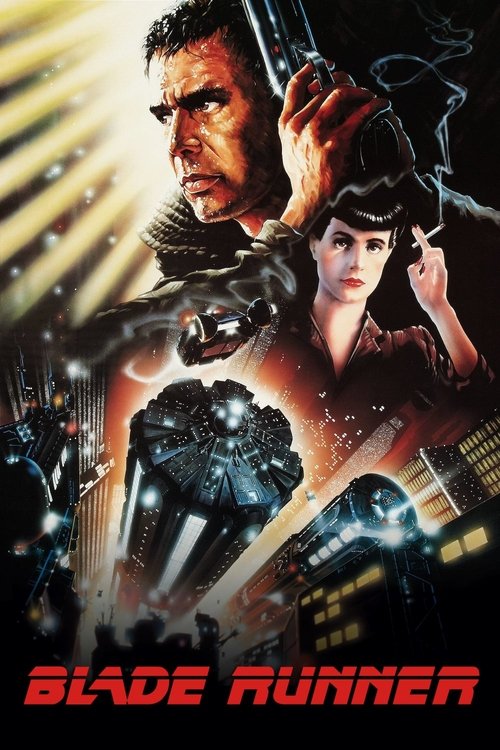
Blade Runner
1982 · Ridley Scott
As famous now for press-tour belligerence ("go f— yourself" to historical accuracy critics of Napoleon) as for the films; Gladiator II's "are you not entertained" marketing and shark-in-the-Colosseum discourse kept him meme-central in his late 80s. The industry's most quotable octogenarian.
When you want to be transported somewhere completely — a late-night, lights-off film for brooding on mortality inside the most beautiful dystopia ever built. Patience required; the payoff is atmosphere and ache, not action.
What it's about
In a rain-soaked, neon-choked Los Angeles of the future, a burned-out detective is forced back to work hunting four escaped replicants — artificial humans nearly indistinguishable from the real thing — who have come to Earth looking for their creator, because they were built with brutally short lifespans and they want more time. What starts as a manhunt becomes a question the hunter can't shake: what actually separates him from the things he's retiring?
The experience
Slow, hypnotic, and drenched in melancholy — less a chase movie than a mood you sink into, all rain, smoke, synthesizer, and towering cityscape. It's contemplative rather than propulsive, and it leaves you with a lump in your throat you didn't see coming.
Performances
Rutger Hauer is unforgettable as the lead replicant — terrifying, playful, and finally heartbreaking, delivering one of the most famous closing speeches in movies. Harrison Ford plays effectively against his own charm as the weary, morally compromised hunter.
The craft
The production design and effects built a future city so dense and tactile that filmmakers have been borrowing from it for forty years — miniatures, smoke, and neon that still put digital worlds to shame. Vangelis's synth score is half the film's soul, and it absolutely demands a big screen and good speakers.
Why it matters
A flop on release that became one of cinema's great second acts: through its later cuts it grew into the founding visual language of cyberpunk and the benchmark for every screen dystopia since.
Snapshot
A dystopian neo-noir science fiction film set in a rain-drenched, overpopulated Los Angeles of 2019, Blade Runner follows Rick Deckard — a retired detective coerced back into service — as he hunts four rogue Nexus-6 replicants who have returned to Earth seeking their maker. Adapted from Philip K. Dick's 1968 novel Do Androids Dream of Electric Sheep?, the film transmutes Dick's suburban paranoia into an operatic visual poem about mortality, memory, and the instability of identity. Its theatrical underperformance in 1982 gave way to one of cinema's most consequential second lives: through home video, a 1992 Director's Cut, and a 2007 Final Cut supervised by Scott, Blade Runner accreted canonical status to become the foundational visual grammar of cyberpunk and one of the most debated texts in science fiction cinema.
Industry & production
The path to production was circuitous. Hampton Fancher, an actor turned writer, spent years developing the adaptation independently before Michael Deeley came aboard as producer and the project found a home at Warner Bros. and The Ladd Company. Ridley Scott — fresh from the commercial and critical success of Alien (1979) — replaced original director Martin Scorsese, who had briefly been attached. Scott's commitment to a fully realized, coherent visual world raised the budget substantially; the production was expensive for its era, and the shoot at Warner Bros. (with extensive location work at the Bradbury Building and the Ennis House in Los Angeles) was prolonged and at times fractious.
David Peoples was brought in to substantially rewrite Fancher's screenplay, adding philosophical depth to the replicants while tightening the thriller structure. Both Fancher and Peoples receive screen credit. The decision to make the replicants sympathetically complex — rather than straightforwardly villainous — fundamentally shaped the film's thematic ambiguity. Philip K. Dick, who died in March 1982, three months before the film's June release, had seen an effects reel during post-production and wrote admiringly about what he saw; he and Scott had reportedly achieved a mutual understanding that the film, while departing from the novel, captured its essential spirit.
The 1982 theatrical cut was released with a studio-mandated voiceover by Harrison Ford and an optimistic ending that repurposed aerial footage shot for Stanley Kubrick's The Shining. Neither intervention was Scott's preference, and the ongoing tension between Scott's vision and the studio-approved version generated a versioning saga unique in Hollywood history — at least seven distinct cuts of the film exist in some form.
Technology
Blade Runner's visual effects were led by Douglas Trumbull (who had worked on 2001: A Space Odyssey and Close Encounters of the Third Kind) and Richard Yuricich, with EEG (Entertainment Effects Group) executing large-scale practical miniatures for the cityscape. The approach was emphatically photochemical and in-camera: the "Hades landscape" and "Spinner" sequences relied on detailed scale models, optical printing, and careful integration of matte paintings rather than digital compositing, which was not yet cinematically viable at this scale. The results achieved a density and tactility that purely digital successors have often been unable to replicate.
Industrial designer Syd Mead was engaged as "visual futurist," producing the foundational concepts for the Spinners, the street furniture, and the Tyrell Corporation pyramid. Mead's "retro-fitted" philosophy — the idea that a city's strata of old and new would coexist messily rather than the future replacing the past — gave the film's world its distinctive layered quality. Lawrence G. Paull served as production designer, realizing Mead's concepts at full scale. The Voigt-Kampff empathy-testing machine was a practical prop of considerable visual ingenuity, and its design has entered the iconographic record alongside HAL 9000.
Technique
Cinematography
Jordan Cronenweth's cinematography is among the most influential in American science fiction. Cronenweth, drawing on a tradition of low-key noir lighting, worked with Scott to produce images of radical darkness: deep shadow pools cut by shafts of sodium-coloured light, lens flares from artificial sources, venetian-blind striping that recalls the chiaroscuro of 1940s crime cinema. The palette is a desaturated amber-and-black punctuated by neon. Rain is near-constant, serving both atmospheric and practical functions — wet streets reflect light and multiply visual complexity without additional set dressing. Anamorphic lenses preserve a wide aspect ratio that accommodates the film's landscape-scale compositions; close-ups of faces are often lit with a theatrical formality that aestheticizes rather than naturalizes. The sequence in which Rachael is photographed in Deckard's apartment — spotlit against a penumbra, smoke curling through the frame — compresses three centuries of portraiture conventions into a single sustained shot.
Editing
Terry Rawlings edited the film and managed the difficult tonal balance between noir procedural, action sequences, and meditative interludes. The pacing is measured, sometimes slow by the standards of 1982 summer releases, allowing the world-building to accumulate weight. The cutting in action sequences (particularly the Pris-Deckard confrontation and the rooftop pursuit) is harder and more kinetic, creating jarring contrast with the film's otherwise contemplative rhythm. The multiple extant versions required Rawlings to participate in recutting across years; the differences between the theatrical and Final Cuts are instructive about how much tonal meaning resides in editorial choices rather than in footage alone.
Mise-en-scène / staging
Scott's mise-en-scène is totalising: every plane of every frame is filled with visual information. Extras speak untranslated Cityspeak (a composite argot of Japanese, Spanish, German, and Hungarian coined for the film), advertisements blink from blimps, and the architecture incorporates elements from every period of Los Angeles history — Spanish Colonial, Art Deco, Brutalist — collapsed into vertical density. The staging consistently positions characters as small against large architectural volumes, underlining their insignificance within systemic structures. Roy Batty's final monologue, filmed on a rain-soaked rooftop with Hauer backlit and white-doved, is composed with an almost operatic sense of pictorial climax.
Sound
Vangelis composed the score entirely on synthesizers, producing an ambient electronic soundscape that resists conventional dramatic punctuation. His approach — largely improvised and recorded in extended sessions — yields a score of unusual tonal ambiguity: melancholy rather than heroic, elegiac rather than propulsive. The saxophone theme associated with Rachael invokes film noir directly while maintaining an electronic distance. The sound design, supervised by effects editors working from a dense location and studio sound palette, layers industrial hum, sub-bass drone, and rainfall into a constant acoustic texture that functions as world-building. The famous absence of scoring during Roy Batty's final speech places the full weight on Hauer's performance and the ambient soundscape of the city.
Performance
Harrison Ford plays Deckard with a characteristic minimalism that courts blankness — a noir detective's affect, useful for the film's central ambiguity but divisive among audiences expecting the charisma of Indiana Jones or Han Solo. Ford has noted publicly that he found the voiceover requirement frustrating. Rutger Hauer's Roy Batty is the performance by which the film is ultimately measured: physically imposing, capable of abrupt shifts between menace and grief, and luminous in the final scenes. Hauer rewrote and condensed the film's climactic speech the night before filming, replacing a longer scripted version with the lines as they appear in the film — the "tears in rain" coda is Hauer's own addition and is among the most quoted passages in science fiction cinema. Sean Young's Rachael negotiates an extraordinarily difficult task — playing a character who may not know her memories are false — with a controlled, glassy affect that reads as both artificial and vulnerable. Edward James Olmos's Gaff, with his origami clues and untranslated Cityspeak, functions as a kind of sub-textual trickster, and his performance generates interpretive speculation disproportionate to his screen time.
Narrative & dramatic mode
Blade Runner operates as a noir procedural at its surface and a philosophical interrogation at its depth. The Chandleresque structure — lone detective, femme fatale, corrupt power — is preserved but rendered ironic: the "criminals" have more claim to humanity than the institutions pursuing them, and the detective's own ontological status is uncertain. The film withholds resolution on its central question (is Deckard a replicant?) across all versions, though the Director's and Final Cuts introduce a unicorn dream sequence that points, without confirming, toward a positive answer. This unresolved ambiguity is not a narrative flaw but the film's structural argument: the question "what is human?" cannot and should not be definitively closed.
The dramatic mode is elegy. Blade Runner mourns things that have not yet been lost — sunlight, animals, open space — and things already gone. Roy Batty's enumeration of sights he has witnessed ("attack ships on fire off the shoulder of Orion, c-beams glittering in the dark near the Tannhäuser Gate") is an act of witness and lament: he will die, and with him, singular experience that no record preserves. The film is saturated with this mourning logic.
Genre & cycle
Blade Runner fused science fiction and film noir at a moment when neither genre was positioned to expect such a hybrid. It arrived after the first wave of post-Star Wars blockbuster science fiction (optimistic, space-operatic) and offered something categorically different: urban, interior, morally exhausted, visually dark. It belongs to a loose cycle of 1970s–80s science fiction films concerned with corporate dystopia and the erosion of selfhood — THX 1138 (1971), Soylent Green (1973), Alien (1979) — but exceeds them in aesthetic ambition and philosophical density. It is the foundational text of cyberpunk cinema, preceding William Gibson's Neuromancer (1984) by two years; Gibson has noted that the visual idiom of Blade Runner and his novel converged independently from shared cultural anxieties rather than one influencing the other.
Authorship & method
Ridley Scott's authorial claim rests primarily on the film's visual coherence, which survived a troubled production and multiple re-edits to remain among the most distinctive bodies of design in Hollywood film. Scott's method is production-design-forward: he draws extensively from the earliest stages of pre-production, treating concept art as a form of scriptwriting. His background in television advertising gave him an unusual literacy with the image-per-second economy of the commercial and a perfectionist tolerance for repeated takes in pursuit of specific visual effects. His relationship with actors has occasionally been described as secondary to his preoccupation with the frame.
Jordan Cronenweth's contribution to the film's visual identity is inseparable from Scott's; their collaboration established a template for "grimy lux" cinematography that cinematographers have cited ever since. Vangelis's refusal of conventional orchestral scoring and his improvisational recording method produced a sonic identity that could not have been anticipated from a brief. Hampton Fancher's and David Peoples's screenplay holds a difficult balance between hard-boiled genre convention and philosophical inquiry, and Peoples's additions are generally credited with deepening the replicants' existential stakes.
Movement / national cinema
Blade Runner is a Hollywood production shot largely at a British studio (Burbank, with a crew that included significant British talent from Scott's Alien production), and it is often grouped with a loose formation of British-inflected Hollywood films from the period — formally ambitious, design-driven, literary in their influences. It has no direct national cinema affiliation beyond this general transatlantic character. Its influence on Japanese anime and live-action science fiction is substantial and well-documented: Ghost in the Shell (Mamoru Oshii, 1995) conducts an explicit dialogue with Blade Runner's visual vocabulary and its questions about artificial consciousness.
Era / period
The film sits at the cusp of the Reagan-era science fiction renaissance and the emergence of the blockbuster as the dominant Hollywood form, and reads retrospectively as a counter-program to E.T. (released the same summer): where Spielberg's film offers suburban comfort and the redemptive alien, Scott's offers urban decay and the uncanny android. The anxieties it encodes — industrial outsourcing, corporate sovereignty over life, ecological collapse, mass migration to off-world elsewhere — were the anxieties of early 1980s deindustrialisation in both the United States and Britain, though the film displaces them into the future with sufficient estrangement to permit simultaneous identification and disavowal.
Themes
Blade Runner is organized around the question of what constitutes the human, approached from multiple angles simultaneously. The Voigt-Kampff test defines humanity as the capacity for empathy — a deliberately unstable criterion, since the film demonstrates that empathy can be performed, suppressed, or induced by false memories regardless of substrate. Memory is the film's secondary obsession: Rachael's implanted recollections raise the question of whether a self built on fabricated experience is ontologically different from a self built on "real" experience — a question the film refuses to resolve, because its implicit answer is that the distinction may not be meaningful.
Corporate power appears as the organizing context for all these questions: the Tyrell Corporation creates life for commercial deployment and obsolesces it on schedule, and the film's dystopia is less the result of political catastrophe than of market logic taken to its conclusion. The "off-world colonies" promise — a frontier mythology deployed to manage the surplus population left behind in the ecological wreckage of Earth — reads as a critique of imperialism's spatial logic. Against these systemic forces, the film places individual moments of witness and beauty: Roy Batty's catalog of wonders, the animal (possibly artificial) owl in Tyrell's offices, the photograph Rachael holds as evidence of a past she may have never had.
Reception, canon & influence
Critical reception. The film's initial critical and commercial reception was mixed to negative; it opened in June 1982 against E.T. and was perceived by mainstream reviewers as cold, slow, and narratively obscure. The Siskel-and-Ebert-era reviewing apparatus was not well positioned for what the film was doing. Cult reassessment through VHS and cable television through the mid-1980s shifted its reputation substantially, and the 1992 Director's Cut — which removed the voiceover and the optimistic ending, restored the unicorn sequence, and clarified Scott's intended ambiguity — consolidated its critical standing. By the time the 2007 Final Cut appeared, scholarly and critical consensus had long since placed the film in the canon of major American science fiction; the versioning debate itself had become a productive site of film studies inquiry into authorship and textuality.
Influences on the film (backward). The primary literary source is Dick's novel, which Scott and his screenwriters substantially transformed. Fritz Lang's Metropolis (1927) is the film's most visible visual ancestor — the tiered city, the gulf between corporate penthouse and street-level degradation, the female android as philosophical provocation. Film noir, particularly the visual grammar of 1940s cinematographers like John Alton, is refracted through Cronenweth's lighting. Jean-Luc Godard's Alphaville (1965) had already proposed the merger of noir and science fiction in a contemporary city, and Scott was aware of it. The Heavy Metal magazine tradition and the work of French illustrator Moebius (Jean Giraud) informed the production design's visual density. Edward Hopper's nocturnal isolation and the paintings of Vermeer have been cited — by Scott and by critics — as influences on specific compositional choices.
Legacy / what it shaped (forward). Blade Runner's legacy is arguably unmatched in science fiction cinema in terms of the volume and longevity of its influence. It defined cyberpunk's visual aesthetic before the literary genre had fully consolidated — the rain-soaked neon city, the decayed corporate future, the philosophical android — and every major science fiction film of the subsequent four decades that inhabits urban darkness owes it a formal debt. Total Recall (1990), Dark City (1998), The Matrix (1999), A.I. Artificial Intelligence (2001), Minority Report (2002), and Ghost in the Shell (1995, 2017) are among the most directly engaged works in the lineage. James Cameron's Terminator films share its anxieties if not its aesthetics. The film's influence on video game design — particularly in the cyberpunk and noir-inflected titles of the 1990s and the Cyberpunk 2077 cycle — represents a secondary wave of transmission. Denis Villeneuve's Blade Runner 2049 (2017), with cinematography by Roger Deakins, represents the most sustained critical engagement with the original, and the two films together constitute one of the more serious diptychs in science fiction cinema.
The ongoing debate over Deckard's replicant status — unresolved across versions, commented upon by cast and crew with contradictory authority — has been generative for film theory's engagement with authorial intentionality and readerly interpretation. That a major Hollywood film could sustain such interpretive openness without collapse was itself a productive demonstration of what genre cinema might do.
A Deleuzian reading
She brings a photograph.
The full Deleuzian reading of Blade Runner →
Reception
A famous flop-to-classic story: it opened in summer 1982 against E.T., underperformed, and split critics — then climbed to canonical status through home video and the 1992 Director's Cut, which stripped the studio-imposed voiceover and happy ending. Few films have been reappraised harder.
How Blade Runner was received, from release to now →
Influences: the films it descends from and the films it influenced
- Metropolis (1927) — Scott directly inherits Lang's vertical-city spatial grammar — elite towers above, subterranean slums below — staging Tyrell's pyramid against street-level squalor as a transposition of the Metropolis/Machine City opposition; the technique of dwarfing figures against monumental architecture through forced-perspective staging is reproduced shot for shot in the Hades landscape sequences.
- Double Indemnity (1944) — Jordan Cronenweth's venetian-blind shadow striping — the defining lighting motif of Blade Runner's interiors — is a direct quotation of John Seitz's technique for Wilder; the theatrical cut's hardboiled voiceover procedural deploys the same confessional-retrospective narration device Wilder used to open his film, placing the detective as a man already defeated by the case he is recounting.
- Vertigo (1958) — The staging of Deckard's apartment scenes — Rachael spotlit against darkness, reconstructed as an image by the detective's obsessive gaze — transposes Scottie's fabrication of Madeleine from fragments; Bernard Herrmann's use of sustained orchestral romanticism as a vehicle for uncanny dread establishes the emotional grammar that Vangelis inherits and translates into synthesizer register.
- Alphaville (1965) — Godard deploys a Chandleresque operative (Lemmy Caution) in a future city shot as available-light contemporary noir rather than constructed futurism, establishing the sci-fi/noir hybrid template that Scott and Peoples adapt; Raoul Coutard's high-contrast locations shot for alienation rather than wonder prefigure Cronenweth's approach of using noir darkness to defamiliarise the future rather than spectacularise it.
- 2001: A Space Odyssey (1968) — Douglas Trumbull carried the practical-miniature-and-optical-printing pipeline directly from 2001 into Blade Runner's Hades landscape sequences; Kubrick's template of science fiction as sustained philosophical meditation — with contemplative pacing that refuses thriller momentum — establishes the formal register that Scott's director's cut fully inhabits.
- Alien (1979) — Scott's own prior film establishes the retrofitted-future mise-en-scène that Blade Runner expands to city scale: every surface layered with industrial grime, decals, and deferred maintenance rather than clean chrome, so the future looks lived-in rather than designed — a philosophy Blade Runner inherits and Syd Mead extends from the Nostromo's corridors to an entire urban streetscape.
- La Jetée (1962) — Inherits the conceit of the photograph as the fragile material trace of a moment already lost—snapshots scrutinized as the only (and unreliable) proof that a remembered past occurred.
- The Big Sleep (1946) — Jordan Cronenweth's cinematography translates the venetian-blind shadow motif — light striping through horizontal slats across faces and walls — into a neon-and-rain urban texture; the picaresque structure of a detective moving through layered underworld encounters without achieving cognitive mastery of his environment is transferred intact to science fiction.
- Shanghai Express (1932) — Extends the noir lineage Shanghai Express seeded — atmospheric haze, fan-light and smoke, and light filtered through layered foreground slats glamorizing the femme figure as luminous surface.
- Silent Running (1972) — Trumbull's miniature-cityscape work and his signature smoke-and-backlight atmospheric lighting carry his Silent Running effects sensibility into a fully realized future environment.
- Kiss Me Deadly (1955) — Fuses noir's low-angle, rain-slick nocturnal detective grammar with apocalyptic technological dread in a future Los Angeles, the same genre-splice Aldrich performed with the atomic bomb.
- The Duellists (1977) — Extends the painterly-light-and-production-design-as-meaning principle, chiaroscuro and haze doing the psychological work the script withholds.
- The Terminator (1984) — Brad Fiedel's synthesizer score adopts the same arpeggio-and-sustained-pad grammar Vangelis established — electronic music as the emotional carrier for a story about machines that simulate humanity — and Cameron's android/human identity question is driven by the same narrative engine: a figure of uncertain ontological status is hunted by a procedural protagonist who cannot be certain of his quarry's interiority.
- RoboCop (1987) — Jost Vacano's cinematography deploys Cronenweth's low-key near-future city at night — rain-wet streets, sodium-light pools, deep shadow — while Verhoeven's corporate-dystopia aesthetic extends Blade Runner's retrofitted future as failing public infrastructure; the protagonist's identity-through-mechanical-alteration poses the replicant question (what makes a person human) through a different mechanical metaphor but identical staging of the uncanny body.
- Akira (1988) — Otomo applies Blade Runner's anamorphic megacity visual grammar to hand-drawn animation — Neo-Tokyo is composed in wide-format compositions with figures dwarfed by neon-layered architectural mass — and the retrofitted-future aesthetic (1980s Tokyo infrastructure overgrown with 2019 additions) is Mead's messy-coexistence principle translated into anime's frame-by-frame density rather than practical miniature photography.
- Ghost in the Shell (1995) — Oshii directly borrows Blade Runner's rain-soaked Asian megacity visual grammar — deep-focus shots of layered neon signage over canal streets in the same amber-and-black palette — and Kenji Kawai's score places orchestral-choral textures in the same register as Vangelis' synthesizer romanticism; the Major's ontological ambiguity (is a being whose memories are entirely implanted a person?) is the philosophical inheritance of the Rachael question posed without Scott's ambiguity about the answer.
- Strange Days (1995) — Bigelow deploys recorded-memory playback as both commodity and noir MacGuffin — directly extending Blade Runner's conceit that memory is the definitive medium of identity, such that false or purchased memories constitute a false or purchased self — and Matthew F. Leonetti's cinematography of a near-future Los Angeles at night uses the same saturated-neon/deep-shadow contrast ratios Cronenweth established.
- Se7en (1995) — Darius Khondji's cinematography — desaturated palette, extreme low-key lighting in which actors emerge from shadow rather than being placed in it, rain-soaked nocturnal city as moral landscape — is the most direct photographic inheritance of Cronenweth's approach; Fincher reconstructs the Chandleresque two-detective procedural within the same visual register of productive darkness that Blade Runner established for the neo-noir city.
- Dark City (1998) — Proyas directly inherits the implanted-false-memory plot mechanism — the detective who discovers his own memories are fabricated is the Deckard-as-replicant question made structurally explicit — and Dariusz Wolski's anamorphic cinematography replicates Cronenweth's city-always-at-night visual grammar: deep shadow, sodium-orange artificial light, and rain-slicked streets with no natural light source as an expression of ontological unmooring.
- The Matrix (1999) — The Wachowskis extend Blade Runner's ontological question — how do you know your memories are real? — into full action-film grammar; Bill Pope's cinematography adopts a desaturated green-tinted low-key palette for the simulated city, and the noir hero's awakening to a constructed false reality is the Rachael plot recoded as a blockbuster franchise engine that reaches audiences Blade Runner's theatrical run never did.
- Minority Report (2002) — The production design's retrofitted-future layering — present-day Washington D.C. infrastructure wrapped in 2054 interfaces — applies Mead's coexistence philosophy at city scale, while the neo-noir procedural structure in which the detective's own investigation destabilises his memory and identity is Blade Runner's narrative inheritance; Spielberg's pre-crime system is the Voigt-Kampff test institutionalized into a judicial apparatus.
- Blade Runner 2049 (2017) — Roger Deakins extends Cronenweth's anamorphic low-key approach — substituting monochrome desolation for the original's amber neon, expanding the palette while preserving the grammar of shadow as epistemology — while Hans Zimmer and Benjamin Wallfisch work within Vangelis' synthesizer-romanticism register; Villeneuve extends the measured contemplative pacing of Scott's director's cut into a formal commitment to science fiction as philosophical elegy rather than genre entertainment.
- The Fifth Element (1997) — Scott's practical-miniature vertical megacity — lit with neon and layered through in-camera optical compositing — establishes the hybrid practical-effects logic for dense urban sci-fi spectacle that Besson extends into the digital compositing domain twenty years later.
- Twelve Monkeys (1995) — David Peoples co-wrote both screenplays; his structural method of grounding existential paranoia in dystopian bureaucratic architecture, and his interest in protagonists who may not be what they believe themselves to be, is the direct craft inheritance linking the two films.
- Brazil (1985) — Norman Garwood's production design applies the same Mead-adjacent messy-coexistence philosophy — ducts, tubes, and retrofitted bureaucratic technology piled onto existing architecture — to satirical rather than melancholy ends; both films use totalizing mise-en-scène in which every frame plane is filled with period-layered environmental detail that implicates the viewer in the world's logic before narrative begins.
- Star Wars (1977) — Scott's production designer Lawrence G. Paull has cited the 'used universe' aesthetic philosophy — layered functional decay, no surface pristine — as the design baseline extended into urban noir; the film is in productive argument with Star Wars's staging logic, applying the same principle to a world where organic life is what's corroding.
- The Empire Strikes Back (1980) — Jordan Cronenweth's chiaroscuro for Blade Runner — deep industrial shadow bisected by isolated hard sources — extends the visual grammar Suschitzky established for Empire's Imperial interiors, both films deploying expressionist light-against-void to make architecture itself register as authoritarian threat.
- Manhunter (1986) — Contemporary neo-noir that pairs synthesizer scoring (Vangelis) with neon-and-glass modernist production design and a detective doubled with his quarry — the same early-'80s stylization Manhunter channels into procedure.
- Thief (1981) — The same-era elaboration of the wet-neon nocturne — rain-slick reflective surfaces and a synth score (Vangelis) — extending Thorin and Tangerine Dream's visual-sonic register into SF.
- Open Your Eyes (1997) — Establishes the neo-noir science-fiction register where memory may be manufactured and the protagonist's own status is in doubt, the Philip K. Dick questioned-reality strain Open Your Eyes inherits.
- Altered States (1980) — Jordan Cronenweth carried his exact chiaroscuro control — hard shafting key lights raking through smoke and darkness — straight from this shoot into Scott's film.
- Escape from New York (1981) — Parallel founding text of cinematic cyberpunk: a decaying near-future metropolis rendered in low-key night and rain, scored by an analog synth (Vangelis) used as immersive worldbuilding.
- Tron (1982) — Syd Mead's industrial 'visual futurist' design work here is the direct sibling of his Tron vehicle and environment designs, sharing one designer's hard-surface geometric futurism across both films.
Similar films
- Minority Report (2002) — influence & lineage · often watched together
- Blade Runner 2049 (2017) — influence & lineage · often watched together
- Dark City (1998) — influence & lineage · often watched together
- Brazil (1985) — influence & lineage · often watched together
- Metropolis (1927) — influence & lineage
- The Terminator (1984) — influence & lineage
- RoboCop (1987) — influence & lineage
- Ghost in the Shell (1995) — influence & lineage
All the films related to Blade Runner →
Watch it with: curated runs of related films
- The Blockbuster Sci-Fi Canon — A run of the effects-driven epics that taught modern audiences what a movie could feel like — from the desert planets of Star Wars to the rain of Blade Runner and the sands of Arrakis.
Film essays and courses that include it
- What the Ear Sees: A Century of Cinematic Sound
- Impossible Made Visible: One Hundred Years of Engineered Spectacle
- After the Monolith: Science Fiction's Formal Inventions
- Guilty by Design: The Art and Architecture of Film Noir
- Scope and Shadow: The Anamorphic Vision
- The Grammar of Shadow: Chiaroscuro from Expressionism to Digital Noir
- The Dream at the End of the Road: Los Angeles & California
- The Architecture of Ruin: Ninety Years of Dystopian Cinema
- Commanded Vision: The Auteur Epic
- Built to Think, Made to Feel
- Light Made Visible: Cinema's Great Image
- The Shadow That Outlived the Light
- The Style That Knew It Was Doomed
- The Fear That Moved From the Machine to the Self
- The Organism Made of Strangers
- The Measure of Us
- The Thing We Build in Our Image
- The World-Builder