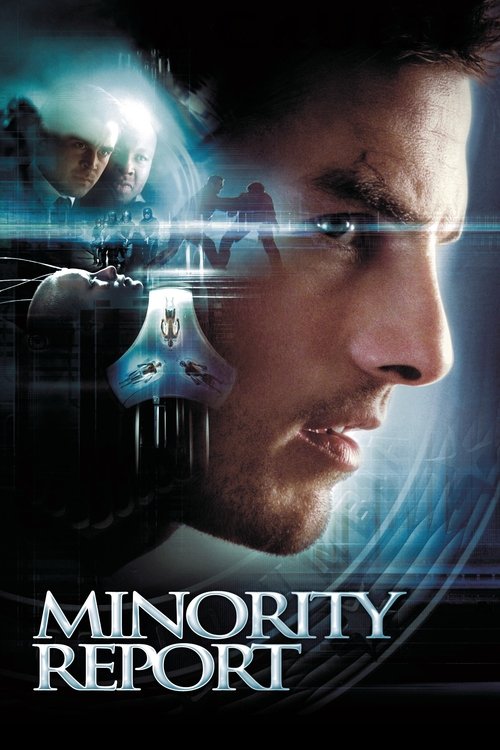
Minority Report
2002 · Steven Spielberg
When you want a smart blockbuster — a big, fast Friday-night thriller that still gives your brain something to argue about at dinner afterward.
What it's about
Washington, D.C., 2054: murder has been abolished because three clairvoyants — precogs — see killings before they happen, and an elite Precrime unit arrests the perpetrators-to-be. John Anderton runs that unit and believes in it completely, until the system spits out his own name as a future murderer. He goes on the run through a city built to track everyone, hunted by the machine he helped perfect and forced to ask whether a predicted crime is a certain one.
The experience
A relentless, propulsive chase that keeps handing you a moral puzzle mid-sprint — it's slick and kinetic but leaves a cold, uneasy residue about surveillance and fate. Tense for two-plus hours, with flashes of grim wit.
Performances
Tom Cruise channels his star momentum into a man cracking under his own certainty, and Samantha Morton is haunting as the precog Agatha — pale, trembling, and somehow the film's conscience.
The craft
Spielberg built his 2054 with a summit of real futurists, and it shows: gesture-controlled screens, eye-scanning ads, and self-driving highways rendered so plausibly the film reads as forecast. The bleached, desaturated look and hurtling set pieces — including a jetpack pursuit and a spider-robot sweep of a tenement — are pure big-screen material. Play it loud.
Why it matters
It became the default visual reference for how the near future would look — designers still cite its interfaces — and stands at the center of the early-2000s wave of paranoid, surveillance-minded science fiction.
Snapshot
Minority Report is Steven Spielberg's 2002 science-fiction thriller, adapted from Philip K. Dick's 1956 short story "The Minority Report" and set in a meticulously imagined Washington, D.C., of 2054. John Anderton (Tom Cruise) heads "Precrime," an experimental police division that arrests murderers before they kill, acting on the visions of three mutated clairvoyants called "precogs." When the system names Anderton himself as a future killer, he becomes a fugitive inside the very machine he polices. The film fuses the chase architecture of film noir with a near-future production design so dense and plausible that it has been treated less as fantasy than as forecast. It is one of Spielberg's most formally aggressive works — desaturated, kinetic, and morally unsettled — and stands as a central text in the early-2000s cycle of surveillance cinema. Critically acclaimed and commercially successful on release, it has since become a touchstone in debates over predictive policing, gestural computing, and free will.
Industry & production
The project descends from a long, tangled development history. Jon Cohen wrote an early adaptation of Dick's story in the 1990s, and for a period the property circulated in proximity to a mooted sequel to Total Recall (itself drawn from Dick). The decisive turn came when Tom Cruise and Steven Spielberg — who had wanted to work together for years — attached themselves around the turn of the millennium, with screenwriter Scott Frank substantially reworking the script into its final detective-thriller form. The film was a co-production of DreamWorks Pictures and 20th Century Fox, the two studios splitting domestic and international distribution; it was released in the United States in June 2002.
Its production is most famous for an unusual act of pre-design. Rather than improvise a future, Spielberg and production designer Alex McDowell convened a multi-day "think tank" or idea summit of futurists, technologists, and designers to extrapolate a credible Washington of 2054 — its transit, advertising, computing, law, and built environment. The deliberations were distilled into a so-called "2054 bible" that governed the film's world-building, a methodology that has been widely cited as a model of "design fiction." Among the participants commonly named in accounts of the summit is MIT Media Lab researcher John Underkoffler, whose work directly shaped the film's signature interface.
Production followed immediately on the heels of Spielberg's A.I. Artificial Intelligence (2001), making Minority Report the second of two future-set films he completed in close succession — a notable concentration of speculative work from a director better known for adventure and historical drama.
Technology
Minority Report's most lasting contribution to the screen is its vision of human–computer interaction. Anderton "scrubs" through the precogs' visions using a gestural, glove-driven interface — sweeping, pinching, and pulling translucent images across a glass display — designed in consultation with John Underkoffler, who derived it from genuine research into spatial computing. The sequence became one of the most influential interface concepts in modern cinema, frequently invoked in the subsequent development of multi-touch and gesture-based systems, though the precise line between the film's depiction and later commercial technology is one of inspiration rather than direct engineering.
The world is saturated with other extrapolations: retinal scanners that identify pedestrians and trigger personalized advertising that calls them by name; "sick stick" non-lethal weapons; spider-like robotic sensors that crawl a tenement performing forced biometric scans; magnetic-track vehicles that climb building façades; and the eye-transplant black market Anderton resorts to in order to defeat the city's pervasive optical surveillance. The precogs themselves are presented as a quasi-organic technology — human beings instrumentalized as predictive infrastructure, floating in a "temple" pool. The film's coherence comes from treating all of this as a single integrated system rather than a parade of gadgets, which is what gives its surveillance state its unnerving plausibility.
Technique
Cinematography
Janusz Kamiński, Spielberg's regular cinematographer since Schindler's List (1993), gave the film a deliberately drained, high-contrast palette. He overexposed the image and employed a silver-retention (bleach-bypass) process across a large portion of the film, suppressing color, crushing the look toward cold blues and steely grays, and lending the futuristic D.C. the texture of degraded news footage or classic monochrome noir. The effect estranges a sunlit world, making even daylight feel surveilled and clinical. Camera movement is restless and handheld in the chase passages, contrasting with the eerie stillness of the precog temple. The desaturated, "blown-out" aesthetic became one of the film's most imitated visual signatures in subsequent science fiction.
Editing
Michael Kahn, Spielberg's longtime editor, cuts the film as a propulsive manhunt while accommodating its more disorienting material — the fragmented, repeating, non-linear flashes of the precog visions, which the editing presents as glimpses out of temporal order to be reassembled. Set-piece sequences (the automated-highway escape, the jetpack pursuit through the tenement, the eye-surgery interlude) are constructed with classical clarity of geography even at high velocity. The pacing sustains thriller momentum across a long running time without losing the procedural logic that the mystery requires.
Mise-en-scène / staging
The film's staging is dominated by Alex McDowell's production design, which renders 2054 as a lived-in, bureaucratic environment rather than a gleaming utopia. Spielberg repeatedly stages action against transparent and reflective surfaces — glass interface walls, the precog pool, vehicle canopies — visually reinforcing the themes of seeing, watching, and being seen. The Precrime headquarters is choreographed around the interface ritual, with Anderton conducting images like an orchestra. Domestic and decayed spaces (the drug den, the slum) are staged in grimy contrast to the institutional sheen, marking the social stratification beneath the technocratic surface.
Sound
John Williams supplies a comparatively restrained, noir-inflected score, leaning on darker orchestral textures and moments of unease rather than the soaring themes associated with his work for Spielberg's adventure films; it underlines the film's status as a thriller with a melancholy undertow. The sound design renders the future city as an enveloping field of scanners, transit, and ambient announcements, with the advertising that addresses pedestrians by name functioning as an aural extension of the surveillance theme.
Performance
Tom Cruise anchors the film with a physical, anguished performance, playing Anderton as a grieving father (his son's disappearance is the wound driving him) whose certainty in the system collapses into desperation. Samantha Morton's Agatha, the most gifted precog, is a fragile, haunted presence whose halting speech — "Can you see?" — gives the film its conscience. Max von Sydow brings avuncular gravitas to Precrime's director, Lamar Burgess, weaponizing his warmth for the film's central betrayal. Colin Farrell, in an early high-profile English-language role, plays the skeptical federal investigator Danny Witwer with brittle ambition. Lois Smith has a memorable single scene as the scientist who explains the precogs' origins.
Narrative & dramatic mode
The film operates as a detective story turned inside out: a "howcatchem" in which the investigator is also the accused, and the crime in question has not yet happened. Its dramatic engine is the paradox at the heart of Dick's premise — if the future can be seen, can it be changed? The plot's title refers to the rare "minority report," the dissenting vision of a single precog when the three do not agree, which proves that an alternate future is possible and therefore that the system condemns people for choices they might never make. The narrative builds through procedural investigation toward a noir-classic revelation of institutional corruption: the founding murder concealed beneath Precrime's perfect record. Spielberg structures it as a moral mystery, repeatedly forcing Anderton — and the audience — to choose between trust in the apparatus and the evidence of contingency.
Genre & cycle
Minority Report is a deliberate hybrid of science fiction and neo-noir, sometimes labeled "future noir" — a lineage running through Blade Runner (1982), to which it is frequently compared, given both films' descent from Philip K. Dick. It belongs to the early-2000s wave of dystopian and surveillance-themed science fiction, and to a broader cycle of Dick adaptations that includes Total Recall (1990) and, later, Paycheck (2003) and A Scanner Darkly (2006). Within Spielberg's own output it forms a loose speculative diptych with A.I., and within the thriller tradition it reanimates the wrong-man chase associated with Hitchcock, refracted through a technocratic future.
Authorship & method
The film is a study in Spielberg's mature collaborative ensemble. His core authorial team — cinematographer Janusz Kamiński, editor Michael Kahn, and composer John Williams — execute a darker, more stylistically severe register than his populist reputation suggests, confirming the late-career turn toward ambivalence visible across his post-Schindler's List work. The screenplay, credited to Scott Frank and Jon Cohen, is notable for grafting a tightly plotted detective mechanism onto Dick's more abstract metaphysical conceit, foregrounding character motive (Anderton's lost child) where the source story was more schematic. Production designer Alex McDowell functions almost as a co-author of the film's world, and his summit-driven, research-led method has been influential well beyond this picture. Spielberg's own method here is characteristically meticulous in world logic while remaining commercially propulsive — a blockbuster built on a philosophical premise.
Movement / national cinema
This is mainstream American studio filmmaking at its most resourced — a Hollywood blockbuster from the industry's most commercially powerful director — but one consciously in dialogue with European and noir traditions, from its Hitchcockian plotting to the casting of Swedish screen icon Max von Sydow. It does not belong to a self-identified movement; rather, it exemplifies the high-end speculative blockbuster of the early digital era, in which spectacle is yoked to social anxiety. Its design-fiction methodology has had an afterlife in fields beyond cinema, making it an unusual case of a Hollywood film influencing technology and design discourse directly.
Era / period
Conceived and shot at the turn of the millennium and released in June 2002, Minority Report arrived in the immediate aftermath of the September 11 attacks. Though its surveillance premise was developed largely before that moment, the film landed squarely in a cultural climate newly preoccupied with preemption, security, and the trade-off between liberty and safety — themes that would intensify with subsequent debates over state surveillance. This timing has shaped its reception ever since, lending its fiction of preemptive justice a documentary charge it might not otherwise have carried. It also marks a transitional technical period, blending practical effects and physical sets with extensive digital environments.
Themes
The film's governing theme is the conflict between determinism and free will: if a future act can be foreseen with certainty, the moral basis for punishing it dissolves, and the existence of the "minority report" insists that the future remains open. Around this sit a cluster of related concerns: the ethics of preemptive justice and the seductive danger of a system that promises perfect safety; surveillance and the commodification of identity, dramatized in the retinal-scanning advertisements and the loss of anonymity; vision and blindness, threaded through the precogs' sight, the eyes Anderton trades away, and the literal and figurative refusal to see institutional rot; and grief and guilt, with Anderton's dead-end mourning for his son driving him and being cynically exploited by the system's architect. The film ultimately frames the corruption of a utopian premise by human self-interest — the founding crime hidden inside the perfect machine.
Reception, canon & influence
Minority Report was warmly received on release, widely praised as one of Spielberg's strongest and most intelligent entertainments and frequently singled out for its design, its visual style, and its ideas; it appeared on numerous critics' best-of-year and, later, best-of-decade lists. It was also a commercial success, though specific box-office and award figures are best confirmed against primary records rather than asserted here.
Influences on the film (backward): its bedrock is Philip K. Dick's 1956 short story, with its central premise of precognitive policing and the dissenting "minority report." Stylistically it draws on classic film noir and on the Dick-derived future-noir of Blade Runner, and structurally on the Hitchcockian wrong-man thriller. Its world was further shaped by the real futurists and technologists Spielberg consulted, making contemporary research an unusually direct influence.
Legacy (forward): the film's gestural interface became a defining reference point for designers and engineers working on touch and gesture-based computing, and is among the most-cited examples of cinema anticipating an interaction paradigm. Its imagery and premise entered public and policy discourse around "predictive policing," with "Minority Report" becoming shorthand for algorithmic preemption and its civil-liberties hazards. The desaturated, bleach-bypassed aesthetic influenced the look of subsequent science fiction. The franchise later extended into a short-lived 2015 television series, a continuation indicative of the original's enduring brand resonance. More broadly, Minority Report helped establish the research-driven "design fiction" approach to imagining futures on screen, an influence felt across both filmmaking and the technology industry.
A Deleuzian reading
Anderton stands before a wall of glass, gloved hands raised, and pulls a murder toward him out of the future — sweeping, pinching, dragging translucent fragments across the display like a conductor cueing strings he cannot hear.
The full Deleuzian reading of Minority Report →
Reception
A critical and commercial hit in 2002, but its stock has only risen — every year the real world catches up to its predictive policing, eye-scanning ads, and gesture screens, and it gets re-crowned as Spielberg's most prophetic film.
How Minority Report was received, from release to now →
Influences: the films it descends from and the films it influenced
- Blade Runner (1982) — Established the Philip K. Dick future-noir template Minority Report directly extends — rain-slicked detective-as-hunter framing, retrofitted urban dystopia, and the moral instability of the investigator, here transposed to a bleached daylight palette instead of neon dark.
- M (1931) — Pioneered the procedural manhunt cross-cut between police apparatus and pursued man, and the question of punishing a crime before/without conventional agency — the structural and ethical scaffolding under Precrime's preemptive-justice machinery.
- The Wrong Man (1956) — Supplies the Hitchcockian innocent-accused engine Anderton runs on — the ordinary man framed by a deterministic system, subjective-POV identification with the hunted, and suspense built from institutional certainty turned against the protagonist.
- Vertigo (1958) — Model for the obsessive surveillant detective undone by vision — Anderton's eye-fixated voyeurism, scopophilic 'previsions,' and the literalized theme of sight-as-trap descend from Scottie's pathological looking.
- Saboteur / North by Northwest set-piece method (1959) — Source of the bravura escalating-chase architecture — innocent fugitive threading absurd mechanized environments (the auto-factory escape, jetpack rooftops) as discrete tour-de-force suspense modules strung on a manhunt.
- Se7en (1995) — Codified the bleach-bypass / silver-retention procedural look — desaturated, high-contrast, rain-soaked detection — that Kamiński overexposes and pushes further toward a blown-out, near-monochrome future-noir surface.
- Schindler's List (1993) — Where the Spielberg–Kamiński team first weaponized blown-out overexposure, handheld immediacy and severe high-contrast monochrome — the photographic grammar Minority Report secularizes into its desaturated dystopia.
- Total Recall (1990) — Parallel Philip K. Dick adaptation that grafts a kinetic blockbuster chase and reality-instability paranoia onto Dick's metaphysics — the same 'is the protagonist's perceived reality engineered?' mechanism Minority Report inverts into precognition.
- Gattaca (1997) — Extends Gattaca's biological surveillance infrastructure into a running-man thriller: the retinal scan as identity checkpoint replaces the DNA screen, and the plot turns on a protagonist who must evade a system that reads his biology as his destiny — here predictive criminal identification rather than genetic caste assignment.
- The End of Violence (1997) — Develops the pre-emptive surveillance state into full design, with the architect of the watching system becoming its hunted target, echoing this film's operator-turned-fugitive structure.
- The Fugitive (1993) — Reworks the wrongful-man-on-the-run as a lawman framed for a future crime, forced to flee his own institution while solving the case himself.
- Johnny Mnemonic (1995) — Develops Johnny's gestural, glove-driven manipulation of floating data into a fully designed gestural holographic interface.
- Children of Men (2006) — Inherits the desaturated, handheld, research-grounded near-future — credible extrapolated tech embedded in lived-in grime — pushing Minority Report's plausible-future design fiction toward documentary-realist immersion.
- Iron Man (2008) — Directly lifts the gestural holographic interface — manipulating volumetric data in midair with sweeping hand movements — that McDowell and Spielberg's futurist summit invented, making it the franchise UI vernacular.
- District 9 (2009) — Extends the design-fiction method: a meticulously prototyped near-future built from consultant research and faux-functional technology, plus the surveillance-and-control state apparatus as the SF subject.
- The Adjustment Bureau (2011) — Re-runs Minority Report's Dick-derived determinism-vs-free-will thriller — a man fleeing a predictive institution that claims to know his future — explicitly modeled on the chase-the-fate structure Scott Frank built.
- Looper (2012) — Carries forward the future-noir-meets-precognition premise — law enforcement organized around foreknowledge of crime and the moral arithmetic of preempting a not-yet-guilty person — as a self-conscious heir to Precrime's ethics.
- Inception (2010) — Pairs Tom Cruise-scale star-driven cerebral spectacle with reflective-surface, reality-bending production design and a non-linear architecture, extending Minority Report's model of a philosophically loaded blockbuster built on plausible interface tech.
- Her (2013) — Heir to the consultant-driven design-fiction ethos — extrapolating a warm, plausible interaction paradigm (voice/ambient computing) from present research — the optimistic counterpart to Minority Report's gestural-interface prophecy.
- Déjà Vu (2006) — The dominant contemporary pre-crime surveillance procedural: future evidence rendered as a navigable, scrubbable interface that the investigator physically manipulates to read a crime before it happens.
- Iron Man 2 (2010) — Pioneered the gestural holographic interface — hands sweeping through translucent floating data — that Stark's lab manipulations and JARVIS displays directly imitate.
- Oblivion (2013) — Shapes Cruise's clean-future-tech star persona — gestural transparent interfaces and sleek hardware — that Oblivion leans on for the Sky Tower's control surfaces.
- Ready Player One (2018) — Kamiński's bleach-bypassed, desaturated future register and pre-vis-heavy gestural-interface staging seed the bifurcated real/virtual look split he deploys across RPO.
- I Origins (2014) — Builds a world where iris uniqueness is public infrastructure (the Eyedentiscan) and where identity can be physically carried across bodies by a transplanted eye — the operational precedent for I Origins' database-match plot, used for surveillance dread where Cahill uses it for transcendence.
- A.I. Artificial Intelligence (2001) — Immediate companion in Spielberg's post-Schindler ambivalent-SF turn: same chilly futurism, research-led production design, and a determinism/free-will inquiry rendered through cold reflective surfaces and a child at the emotional center.
- Strange Days (1995) — Near-future noir built on recorded/replayed subjective POV as forensic evidence and voyeuristic technology — kin to Agatha's previsions and the playback-of-vision interface as both plot device and surveillance critique.
- Dark City (1998) — Contemporary future-noir of an amnesiac wrong-man fleeing an omniscient controlling order through expressionist cityscapes — the same Lang-via-Dick lineage of deterministic systems versus contested human agency.
- Disclosure Day (2026) — Kamiński's bleach-bypass blows highlights into the same backlight bloom, and its hero is a whistleblower-on-the-run fleeing his own agency — the seed's conspiracy spine inside a Spielberg/Kamiński frame.
- Terminator 2: Judgment Day (1991) — Minority Report extends T2's structural preoccupation with determinism-vs-agency: the protagonist acts to prevent an event predicted by a system that cannot be wrong, staging the same philosophical thesis T2 encodes in the phrase 'no fate but what we make,' but relocating it from time-travel mechanics to algorithmic precognition.
- Enemy of the State (1998) — Spielberg and Kaminski's construction of pre-crime surveillance as gesture-driven editorial interface—the protagonist's hands sorting video streams through a spatially choreographed montage system—extends Enemy of the State's surveillance-montage editing into speculative procedural form, literalizing the networked-self-as-targeting-system thesis as operational workflow.
- War of the Worlds (2005) — Sibling in Spielberg's anxious twenty-first-century run, sharing Kamiński's bleached high-contrast look and a paranoid, surveillance-haunted hero forced into flight across a hostile landscape.
- I, Robot (2004) — Contemporary cool-desaturated future-noir in which a detective unravels a logic-trap conspiracy via gesture-driven interfaces — the same procedural-mystery-in-glossy-tech register.
Similar films
- Blade Runner (1982) — influence & lineage · often watched together
- Disclosure Day (2026) — influence & lineage · often watched together
- Dark City (1998) — influence & lineage · often watched together
- Looper (2012) — influence & lineage
- A.I. Artificial Intelligence (2001) — influence & lineage
- Total Recall (1990) — influence & lineage
- Schindler's List (1993) — influence & lineage · often watched together
- Vertigo (1958) — influence & lineage · often watched together
All the films related to Minority Report →