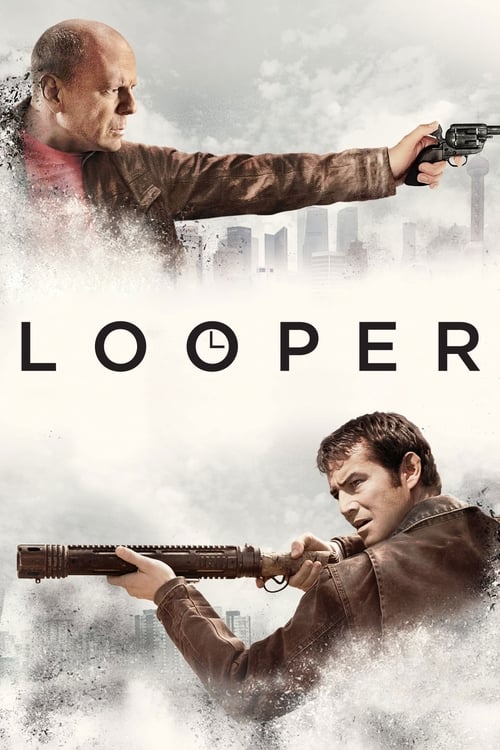
Looper
2012 · Rian Johnson
When you want smart, muscular sci-fi that respects your intelligence — a Friday-night thriller that turns into something to chew on for days. Challenging enough to spark debate, entertaining enough that it never feels like homework.
What it's about
In a run-down near-future America, the mob of 2074 disposes of its enemies by zapping them thirty years into the past, where hired guns called loopers shoot them the instant they appear. Joe is one of these killers, living fast on silver bars, fully aware of the job's catch: one day the mob sends back your own older self, and you close the loop. When Joe's future self arrives and gets away, both versions of the same man end up hunted — and the chase leads to a Kansas farmhouse where the stakes turn unexpectedly intimate.
The experience
It moves like a lean, violent thriller but keeps stopping to ask hard questions — about fate, about what you'd sacrifice to fix your own worst self. Tense and propulsive in its first half, quieter and more unnerving in its second, it leaves you arguing with yourself on the way out.
Performances
Joseph Gordon-Levitt does something genuinely strange and great: playing the young Bruce Willis, he borrows Willis's squint, cadence, and stillness until you believe these two actors are one man at two ages. Willis, meanwhile, gives one of his last truly engaged performances — weary, dangerous, and heartbroken.
The craft
Rian Johnson wrote and directed it as proof that a mid-budget original could still swing big: the time-travel rules are laid out with brutal clarity, the near-future is built from rusted trucks and retrofitted gadgets rather than glossy effects, and one diner conversation between the two Joes does more work than most films' entire third acts. The action is punchy and legible, and the sound design gives every gunshot real weight.
Why it matters
A commercial and critical hit that became the standard argument for original mid-budget science fiction in a franchise era, and the film that vaulted Rian Johnson from indie puzzle-maker to major studio director.
Snapshot
Looper is Rian Johnson's third feature and his first to operate at studio scale: a mid-budget science-fiction thriller that uses time travel less as a puzzle than as a moral apparatus. In a decaying near-future America, organized crime in 2074 disposes of bodies by sending victims thirty years into the past, where contract killers called "loopers" execute them on arrival. The system's cruel symmetry is that each looper eventually murders his own future self — "closing the loop" — in exchange for a retirement payout. The film's engine starts when young Joe (Joseph Gordon-Levitt) hesitates and his older self (Bruce Willis) escapes. What begins as a chase narrative pivots, roughly at its midpoint, into a chamber piece on a Kansas farm, where the question becomes whether a child fated to become a monster can be saved or must be killed. Johnson's wager — that an audience will accept loose temporal mechanics if the emotional logic is exact — largely paid off, and the film became a touchstone for a brief revival of original, idea-driven studio genre cinema.
Industry & production
Looper was produced by Ram Bergman, Johnson's longstanding producing partner, with financing through Endgame Entertainment and additional Chinese investment from DMG Entertainment, a then-novel co-financing arrangement that shaped the film's geography. Reported budgets cluster around $30 million — modest for a special-effects genre film and a deliberate constraint Johnson has discussed as creatively clarifying. Sony's TriStar Pictures handled North American distribution; the film opened the 2012 Toronto International Film Festival, a prestige berth unusual for a genre release and a signal of the festival's interest in elevated science fiction.
The DMG involvement had concrete consequences. A portion of the future-world material was relocated from Paris (as earlier drafts imagined) to Shanghai, and the film exists in a longer Chinese cut that expands the Shanghai sequences. Principal photography took place largely in Louisiana, whose tax incentives underwrote the production and whose flat farmland doubled for Kansas. The casting of Bruce Willis gave the project a bankable anchor while Gordon-Levitt — coming off Inception and (500) Days of Summer, and a Johnson collaborator since Brick — carried the lead. Emily Blunt, Jeff Daniels, Paul Dano, Noah Segan, Garret Dillahunt, and the child actor Pierce Gagnon filled out an ensemble weighted toward character actors rather than stars, consistent with the film's mid-budget positioning.
Technology
Looper is a useful marker of a transitional moment in production technology. It was shot digitally, and cinematographer Steve Yedlin's later prominence as a researcher and advocate for resolution-independent, "film-emulation" digital imaging makes the film an early data point in his career-long project of making digital capture behave like a continuous, format-agnostic image rather than a "video" look. The film's effects are restrained by the standards of contemporaneous tentpoles: the telekinesis ("TK") effects, the futuristic vehicles (cars retrofitted with visible struts and panels rather than fully CG vehicles), and the time-travel arrivals are handled with a tactile, practical-leaning sensibility that suits the grimy production design.
The most discussed technical intervention is cosmetic rather than digital: the work done to make Gordon-Levitt read as a young Bruce Willis. This combined prosthetic makeup (a reshaped nose, brow, and lips, plus colored contact lenses) with Gordon-Levitt's studied imitation of Willis's vocal cadence and stillness. The choice was contentious — some viewers found the makeup distracting — but it reflects a pre-deepfake, performance-and-prosthetics approach to a problem that a decade later would invite digital de-aging or face replacement. As a document of "how this was solved in 2012," the film is instructive precisely because it solves it analog.
Technique
Cinematography
Steve Yedlin's photography gives Looper a sun-bleached, dust-and-neon materiality that grounds the speculative premise. The Kansas exteriors are wide, hazy, and overexposed at the edges; the city sequences are denser, dirtier, and more saturated. Yedlin favors compositions that hold the actor in a legible frame — the film is full of clean, classically balanced setups rather than restless handheld coverage — which pays off in the dialogue-heavy back half. The much-cited diner confrontation between young and old Joe is built on patient over-the-shoulder reverses that let the prosthetic-and-mimicry illusion survive sustained scrutiny rather than hiding it in cutting. Across the film the camera is disciplined and motivated; spectacle is rationed, so that when the image does open up — the rolling cane fields, the farmhouse at dusk — it carries weight.
Editing
Bob Ducsay edited the film, and its structure is the editing's most striking feature. Looper deliberately front-loads exposition and then compresses its protagonist's entire alternate life — older Joe's thirty years, his marriage, the love that radicalizes him — into a wordless, music-driven montage. This sequence is a structural hinge: it grants Willis's character a fully felt history in minutes, so that the moral stakes of the second half land. Ducsay and Johnson also handle the film's branching timelines with restraint, declining to over-explain paradoxes; the cut trusts the viewer to hold two versions of events. The transition from kinetic first act to the slower farmhouse movement is managed as a genuine tonal gearshift rather than a stumble.
Mise-en-scène / staging
The production design (by Ed Verreaux) imagines a future built atop visible decay: 2044 is not chrome and glass but a patched, scavenged version of the present, with solar panels bolted onto vintage cars, vagrants in the streets, and a wealth gap rendered architecturally. This "used future," descended from Ridley Scott and the Star Wars lineage, is central to the film's realism. The staging organizes the film around two poles — the predatory city and the exposed farm — and the farmhouse sequences are blocked almost theatrically, with the kitchen, the bedroom, and the cane field as recurring stage spaces. Costuming marks class and time period efficiently; older Joe's coat and younger Joe's sharp looper attire visually separate the two selves before makeup is even read.
Sound
Nathan Johnson — the director's cousin and recurring composer — built a score partly from sounds sampled and processed out of the film's own world, an approach he has described in interviews as constructing music from concrete, location-derived noise. The result is a percussive, industrial-tinged score that avoids conventional orchestral sci-fi grandeur and instead reinforces the film's grimy texture. Sound design carries narrative load as well: the recurring "closing the loop" routine, the report of the blunderbuss, and the unsettling acoustic signature of the TK powers are all distinct sonic motifs.
Performance
The performances are calibrated to the film's central conceit of doubling. Gordon-Levitt plays Joe as guarded and self-interested, his Willis impression most convincing in stillness and economy of gesture. Willis, in one of his more invested late performances, gives older Joe a desperate tenderness that curdles into ruthlessness — a man willing to do something monstrous out of love. Emily Blunt's farmer Sara is flinty and protective; Pierce Gagnon, as the child Cid, delivers one of the more remarkable child performances in recent genre film, oscillating between sweetness and terror. Jeff Daniels, as the displaced future enforcer Abe, supplies a weary, ironic menace, and Paul Dano and Noah Segan round out the looper milieu with nervy, expendable energy.
Narrative & dramatic mode
Looper runs on a bait-and-switch of dramatic mode. It presents as a hard-boiled crime thriller — voiceover narration, a doomed protagonist, a criminal economy with its own rules — and then converts into something closer to a tragedy of fate and a moral fable about nature versus nurture. The time-travel premise is consciously held loose: Johnson has the older Joe wave away paradox in dialogue ("it doesn't matter"), a self-aware refusal to be a mechanism film. The narration is itself a device the film eventually retires, ceding the floor to dramatized action. The structure is two-act in feel — chase, then siege — joined by the elliptical life-montage. The ending hinges on a single decisive act of self-negation, an ethical climax rather than an action one, which retroactively reframes the entire genre exercise as a story about breaking cycles of violence.
Genre & cycle
The film sits inside an early-2010s cycle of "smart," original, mid-budget science fiction that briefly flourished between franchise tentpoles — alongside Source Code (2011), Moon (2009), In Time (2011), Predestination (2014), and the Wachowskis' work. Within the longer time-travel tradition it converses with The Terminator (the assassin sent to forestall a future monster), 12 Monkeys (Willis himself, fate, and dread), and La Jetée. Its hybridity — neo-noir crime film fused with speculative premise and a horror-tinged third act — is characteristic of Johnson's career-long genre-blending. The film is frequently cited as a high-water mark for the proposition that audiences would pay for original science-fiction ideas, a proposition the subsequent decade of intellectual-property dominance complicated.
Authorship & method
Looper is a strong instance of Johnson's authorship and of his reliance on a tight, recurring creative family. He wrote and directed; the screenplay grew from a short he had conceived years earlier, and the long gestation is visible in the density of worldbuilding. His key collaborators are a near-repertory company: cinematographer Steve Yedlin and composer Nathan Johnson have worked with him since Brick (2005), and Gordon-Levitt likewise originates in that debut. Editor Bob Ducsay and producer Ram Bergman anchor the production side. Johnson's method here — accepting budgetary limits, foregrounding character and theme over mechanism, smuggling an art-film structure inside a genre package — is continuous with Brick and The Brothers Bloom and prefigures the formal confidence of Knives Out and his subsequent Star Wars work. His authorial signature is legible in the film's refusal to resolve its time-travel logic cleanly in favor of emotional resolution.
Movement / national cinema
Looper is an American studio production, but its financing locates it within the early-2010s wave of Hollywood–China co-financing, an industrial "movement" as much as an aesthetic one. The DMG Entertainment investment, the Shanghai setting, and the existence of an expanded Chinese cut make the film a case study in how the Chinese market began reshaping American genre cinema's geography and capital structure in this period. Aesthetically it belongs to no national-cinema school; its lineage is the American genre tradition inflected by the international "elevated genre" festival circuit that welcomed it at Toronto.
Era / period
The film is a product of the post-Inception moment (2010–2014), when a brief studio appetite for complex, original, mid-budget spectacle coincided with the maturation of digital capture and the rise of Chinese co-financing. Its anxieties are recognizably those of its era: visible economic precarity and vagrancy in the future cityscape, a vision of decline rather than gleaming progress, and a fatalism about violence that reads as post-financial-crisis. Made just before franchise consolidation fully closed the window on this kind of project, Looper now reads partly as an elegy for a vanishing category of film.
Themes
The governing theme is the cycle of violence and the possibility of refusing it — the literal "loop" as metaphor for inherited, self-perpetuating brutality. Around this orbit several others: nature versus nurture, dramatized through the child Cid, whose future as the tyrannical "Rainmaker" may be set by trauma rather than destiny; the ethics of preemptive killing (is it permissible to murder a child to prevent a future evil?); the self confronting the self, with young and old Joe as competing moral arguments about selfishness and love; and motherhood and protection as redemptive forces. The film is finally about agency within determinism — whether a fixed future can be unmade by a present choice — and it answers with an act of sacrifice that converts fatalism into freedom.
Reception, canon & influence
Critically, Looper was warmly received, widely praised as one of the more intelligent and original genre films of its year, with particular admiration for its ambition, its performances, and its willingness to subordinate spectacle to idea; the prosthetic transformation of Gordon-Levitt and the occasional looseness of its time-travel logic were the most common reservations. It performed well commercially relative to its modest budget. Precise box-office and award tallies I am not stating here, to avoid inventing figures, but the film's strong performance-to-cost ratio is part of why it is so often cited.
Looking backward, the film's influences are clear and partly self-declared: The Terminator and 12 Monkeys (the Willis casting is itself an allusion), the noir tradition Johnson had already mined in Brick, the "used future" production-design lineage of Blade Runner and Star Wars, and the philosophical time-travel of La Jetée. Looking forward, Looper consolidated Rian Johnson's reputation and was a significant factor in his selection to write and direct Star Wars: The Last Jedi — arguably its largest concrete legacy. More diffusely, it became a recurring reference point in debates about whether original, mid-budget science fiction could survive the franchise era, and a model frequently invoked for how to make idea-driven genre cinema on disciplined means. Its critical standing has remained durable, and it is now generally regarded as a key entry in the early-2010s renaissance of smart studio science fiction.
A Deleuzian reading
There's a booth in a Kansas diner where two men sit with the same face.
The full Deleuzian reading of Looper →
Reception
A critical hit out of the gate (it opened TIFF 2012), Looper has since hardened into Exhibit A in the 'they don't make original mid-budget sci-fi anymore' conversation — and the film that vaulted Rian Johnson from indie darling to Star Wars.
How Looper was received, from release to now →
Influences: the films it descends from and the films it influenced
- The Terminator (1984) — Self-declared model for the assassin-sent-through-time premise and the grease-and-rust industrial future, where time-travel is a delivery mechanism for a kill rather than a wonder to be marveled at.
- 12 Monkeys (1995) — The Bruce Willis casting is a deliberate allusion to his weary time-traveler here, and both films build a deterministic loop in which a man is forced to witness the shape of his own fate.
- La Jetée (1962) — Source for the philosophical loop of a traveler confronting his own death, and the still-frame compression of a life into images prefigures Looper's wordless 'thirty years in Shanghai' montage.
- Blade Runner (1982) — The foundational neo-noir 'used future': rain-slicked decay, retrofitted tech and grime layered over the frame instead of clean chrome futurism.
- Star Wars (1977) — Originated the lived-in, worn-and-dented production design — the blunderbuss, the patched vehicles, the scavenged future — that Johnson's art department openly cites.
- Brick (2005) — Johnson's own debut founds the repertory method carried into Looper — cinematographer Steve Yedlin, composer Nathan Johnson, and star Gordon-Levitt — and the trick of smuggling hard-boiled noir grammar into an unexpected genre frame.
- Shane (1953) — The farm-second-act template: a lone killer defends a mother and child on an isolated homestead while a watching child absorbs the violence, restaging the Western's blood-and-innocence tableau.
- Akira (1988) — The telekinetic child as latent apocalypse — the Rainmaker's escalating psychic destruction echoes Tetsuo's power blooming into catastrophe, framing childhood trauma as a weapon.
- Primer (2004) — The low-budget cerebral time-travel film whose obsessive paradox-logic Looper explicitly pushes back against — Abe's 'I don't want to talk about time-travel...diagrams' is a direct rebuttal to that mode.
- Children of Men (2006) — Established the sun-bleached, handheld, documentary-grain near-future where dystopia is rendered through naturalistic texture and grime rather than glossy spectacle.
- Source Code (2011) — A near-contemporary mid-budget time-loop genre piece that prioritizes character redemption and emotional landing over the rigor of its temporal mechanism.
- Déjà Vu (2006) — Extends the change-the-past, reverse-the-irreversible mechanics into time-travel noir, where the protagonist's intervention closes a causal loop he is implicated in.
- Predestination (2014) — Extends the doubling-mimicry engine to its limit — a bootstrap loop in which a performer must physically confront and embody an earlier/later version of the same self.
- Edge of Tomorrow (2014) — Uses a time mechanic as a character-forging engine rather than a puzzle box, the same subordination of spectacle to an idea-driven studio sci-fi premise Looper modeled.
- Arrival (2016) — Carries forward Looper's proof that original prestige sci-fi can smuggle an art-film structure inside a genre package on disciplined means and find a mainstream audience.
- Star Wars: The Last Jedi (2017) — The film's largest concrete legacy: Looper's success won Johnson the franchise job, where his nature-vs-nurture and subversion-of-expectation instincts carry directly over.
- Knives Out (2019) — Perfects Johnson's bait-and-switch structural authorship and repertory production method, reorganizing a genre around a mid-film rug-pull just as Looper pivots from city-noir to farm-set drama.
- Inception (2010) — Defined the post-Inception template Looper works within: mid-to-high-budget original sci-fi that resolves on an emotional rather than mechanical beat, letting feeling override airtight rule-logic.
- Tenet (2020) — Johnson constructs a bootstrap paradox where a character explicitly acknowledges that diagramming the causal loop 'would take all day'—then proceeds with forward dramatic momentum despite logical instability; Tenet adopts the identical stance when Neil instructs the Protagonist not to try to understand the time mechanics, prioritizing kinetic propulsion over theoretical resolution.
Similar films
- The Terminator (1984) — influence & lineage · same viewing thread
- Predestination (2014) — influence & lineage · same viewing thread
- Source Code (2011) — influence & lineage
- Blade Runner (1982) — influence & lineage
- Edge of Tomorrow (2014) — influence & lineage
- Inception (2010) — influence & lineage
- Back to the Future Part II (1989) — same viewing thread
- Back to the Future (1985) — same viewing thread
All the films related to Looper →
Watch it with: curated runs of related films
- Tampering With the Timeline — A run of films that all reach for the undo button — meddling with the past, outrunning the future, and living with the paradoxes that snap back.