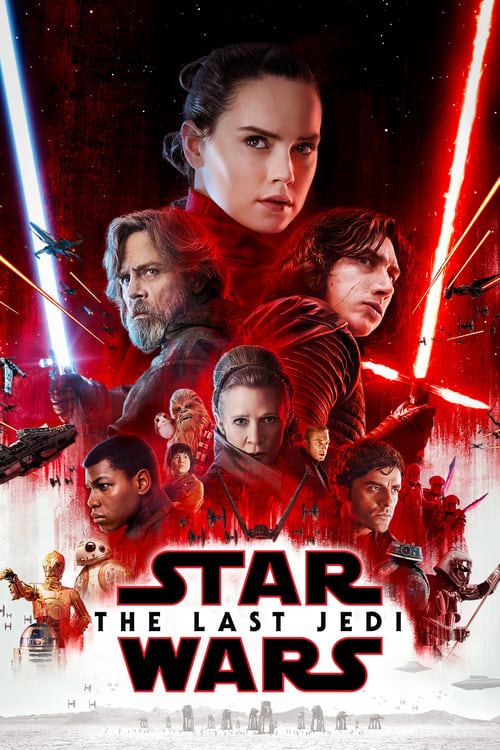
Star Wars: The Last Jedi
2017 · Rian Johnson
When you want blockbuster spectacle that actually argues with itself — popcorn scale with something to chew on after. Great for a loud movie night, but expect to be debating it at breakfast.
What it's about
Rey tracks the legendary Luke Skywalker to a remote island, hoping for a teacher, and instead finds a bitter recluse unsettled by the raw strength of her powers. Meanwhile the Resistance, low on fuel and hope, flees a First Order fleet in a slow-motion chase through space, and every hero in the story is forced to reckon with failure.
The experience
Big, fast, and emotionally spikier than you expect — it swings from thunderous space battles to genuinely funny beats to quiet scenes about doubt and legacy. It keeps pulling the rug out, which is exhilarating or infuriating depending on what you came for.
Performances
Mark Hamill gives Luke Skywalker real weight and wounded pride in his richest turn in the role, and Adam Driver makes Kylo Ren's volatility magnetic.
The craft
Rian Johnson stages some of the most striking images the saga has produced — a battlefield of white salt over blood-red earth, a silent moment of destruction that stuns a full theater. The sound design and John Williams score make it a genuine home-theater showcase; see it big and loud.
Why it matters
The most critically divisive entry in the saga, it ignited a still-running argument about what a franchise owes its past — and cemented Johnson as a director willing to take real risks at blockbuster scale.
Snapshot
Star Wars: The Last Jedi is the eighth episode of the Skywalker saga and the second installment of the sequel trilogy that Lucasfilm launched after Disney's 2012 acquisition of the company. Written and directed by Rian Johnson, it picks up almost immediately after The Force Awakens (2015): Rey delivers Luke Skywalker's lightsaber to him on the island of Ahch-To while the Resistance flees the First Order in a slow, fuel-starved pursuit through space. The film is unusual among blockbusters for the deliberateness with which it interrogates its own franchise — it is a Star Wars movie about the burden of legacy, the failure of heroes, and the question of who gets to inherit a myth. Among the saga's entries it is the most formally adventurous and the most critically divisive, prized by many critics for its ambition and resented by a vocal segment of fandom for its revisionism. It stands as the pivotal text in any account of how the franchise negotiated nostalgia and reinvention in the Disney era.
Industry & production
The film was produced by Lucasfilm under president Kathleen Kennedy and distributed by Walt Disney Studios, part of the studio's strategy of releasing a Star Wars film roughly annually in the mid-2010s, alternating "saga" episodes with standalone "Story" pictures. Johnson was hired in 2014, reportedly on the strength of his earlier features, and was given latitude to write the screenplay himself — a notable degree of authorial control for a tentpole of this magnitude. Principal photography took place largely at Pinewood Studios in England, with location work including Skellig Michael off the coast of Ireland (standing in for Ahch-To, as it had briefly at the close of The Force Awakens) and the salt flats of Salar de Uyuni in Bolivia, which provided the visual basis for the red-earth-beneath-white-salt of the planet Crait.
The production carried an emotional weight from the death of Carrie Fisher in December 2016, after she had completed her work as General Leia Organa; the film is dedicated to her, and her presence reframed the trilogy's planning, since Leia had been intended to anchor the subsequent episode. Reliable budget reporting placed the film among the most expensive ever made, and it became one of the highest-grossing releases of 2017, though I would avoid citing precise figures without verification. Its commercial success was unambiguous; its standing within fan culture was contested in ways that demonstrably shaped the more conciliatory approach of the trilogy's concluding chapter.
Technology
The Last Jedi was photographed digitally on the Arri Alexa 65, the large-format camera system that captures images on a sensor roughly the size of a 65mm film frame, lending the picture a high-resolution clarity and shallow depth of field that cinematographer Steve Yedlin exploited for its painterly close-ups. Yedlin is known within the industry for his rigorous, almost scientific approach to digital imaging and for his work developing image-processing pipelines designed to give digital capture a controllable filmic character.
The film married this digital acquisition to a strong commitment to practical effects, miniatures, and physical creature work — a deliberate aesthetic alignment with the original trilogy's handmade textures, executed through the resources of Industrial Light & Magic. Creatures such as the porgs of Ahch-To and the crystalline vulptices of Crait were realized through a blend of puppetry, animatronics, and digital augmentation. The throne-room sequence and the climactic battle on Crait integrated extensive computer-generated imagery with photographed elements, and the red salt kicked up by the speeders was rendered to read as a visceral, paint-like spray.
Technique
Cinematography
Yedlin's photography is among the most discussed elements of the film. The color design is bolder than the franchise norm: the deep crimson of Snoke's throne room, against which the silhouetted duel plays out; the contrast of white salt and red mineral on Crait; the saturated, almost neon excess of the Canto Bight casino. Yedlin favours expressive, sometimes theatrical lighting and a willingness to let faces fall into shadow. The composition repeatedly isolates figures against vast negative space — Luke on his cliff, Rey in the mirrored cave, the lone Resistance survivors in the cavernous base — visually underscoring themes of isolation and diminished hope.
Editing
Bob Ducsay edited the film, which runs over two and a half hours and sustains three major parallel storylines: Rey and Luke on Ahch-To, the Resistance fleet's attritional flight, and the Finn–Rose excursion to Canto Bight and back. The cross-cutting structure has drawn criticism for pacing — the casino subplot in particular — but it also enables the film's signature rhythmic surprises, most famously the silent cut accompanying Holdo's lightspeed ramming maneuver, where the soundtrack drops to near silence at the moment of greatest violence.
Mise-en-scène / staging
Johnson stages several of the film's most memorable images as deliberate compositions rather than coverage: the throne-room duel, the hyperspace "Holdo maneuver," and Luke's final confrontation on Crait, where he faces down the First Order's full firepower with theatrical stillness, brushing dust from his shoulder. The production design by Rick Heinrichs extends the saga's lived-in vocabulary while introducing new spaces — the opulent, morally compromised glamour of Canto Bight, the monastic austerity of Ahch-To's Jedi temple, the industrial First Order interiors rendered in cold red.
Sound
John Williams composed the score, his continued stewardship providing musical continuity across the saga. The film deploys established leitmotifs — Luke's theme, the Force theme — with new material, and the sound design's most celebrated gesture is the aforementioned silence around the lightspeed collision, a moment that uses the absence of sound for shock and elegy, a striking choice in a franchise defined by its sonic density.
Performance
The film gave Mark Hamill his richest dramatic material in the role of Luke Skywalker, reconceived as a disillusioned hermit haunted by his failure with Ben Solo; Hamill has spoken publicly about his initial disagreement with this characterization, a tension that arguably feeds the performance's bitterness and eventual transcendence. Daisy Ridley's Rey and Adam Driver's Kylo Ren anchor the film's central relationship, their scenes — particularly the Force-connection dialogues — among its most intimate. Carrie Fisher's Leia carries an inevitable poignancy. Supporting turns include Andy Serkis (motion-capture) as Snoke, Domhnall Gleeson's heightened General Hux, Laura Dern as Vice Admiral Holdo, Kelly Marie Tran as Rose Tico, and Benicio del Toro as the codebreaker DJ.
Narrative & dramatic mode
Dramatically, the film operates as a sustained subversion of franchise expectation. It systematically dismantles the mystery-box hooks left dangling by The Force Awakens: Rey's parentage is revealed (by Kylo Ren, at least) to be nothing — "they were nobody" — Snoke is killed mid-film before his backstory is explained, and Luke's heroism is reframed as a single moment of weakness and its long penance. The structure is one of failure and partial redemption: nearly every plan within the film fails — the Canto Bight mission, Poe's mutinous instincts, the assault on Crait's cannon — and the heroes survive less through triumph than through endurance, sacrifice, and the choice to keep faith. The dramatic mode is tragic and elegiac as much as adventurous, concerned with the passing of one generation and the uncertain inheritance of the next.
Genre & cycle
The Last Jedi belongs to the space-opera tradition that Star Wars itself codified for modern cinema — a synthesis of the serial adventure, the mythic quest, the war film, and the samurai picture. Within that lineage it functions as a self-reflexive entry, a blockbuster that turns its genre's conventions back on themselves. It sits inside the larger cycle of legacy-sequel and franchise-revival filmmaking that dominated 2010s Hollywood, but distinguishes itself by treating the act of inheriting a beloved property as a subject rather than merely a marketing premise — "let the past die," Kylo Ren urges, in a line that reads as a meta-commentary on the franchise's own anxieties.
Authorship & method
Rian Johnson came to the project as an idiosyncratic genre stylist whose earlier work — the high-school noir Brick (2005), the con-man drama The Brothers Bloom (2008), and the time-travel thriller Looper (2012) — established his interest in playing established genres against their conventions. The Last Jedi extends that sensibility to the largest possible canvas. His key collaborators include cinematographer Steve Yedlin, a longtime associate who shot all of Johnson's features and whose technical experimentation underpins the film's look; editor Bob Ducsay; production designer Rick Heinrichs; and composer John Williams, the saga's enduring musical author. The decisive authorial fact is that Johnson wrote the screenplay alone and was permitted to follow his revisionist instincts — a rare alignment of singular vision and franchise scale that accounts for both the film's distinctiveness and the backlash it provoked. Johnson and Ducsay's partnership continued into his subsequent original murder mysteries, Knives Out (2019) and its sequels.
Movement / national cinema
As a Lucasfilm/Disney production shot largely in the United Kingdom with an American writer-director, the film belongs to the transnational mode of contemporary Hollywood tentpole production. It does not belong to a film "movement" in the art-cinema sense, but its deepest aesthetic debts are explicitly cross-cultural: Star Wars was famously shaped by Akira Kurosawa's jidaigeki, and Johnson has cited mid-century influences across his career. The film's most pointed homages — the throne-room confrontation, the stark island compositions — draw on that inherited vocabulary of the samurai film and the Western as filtered through the saga's own founding sources.
Era / period
The film is a product of the late-2010s franchise economy, when the major studios consolidated around intellectual property and the annual blockbuster calendar. It also belongs to a specific cultural moment in which fan communities, empowered by social media, exercised unprecedented and often toxic influence over the reception of popular cinema; the organized backlash against The Last Jedi, including documented harassment directed at Kelly Marie Tran, became a widely studied case in the sociology of contemporary fandom. The film thus marks a period in which the relationship between studios, authorship, and audience entitlement was being renegotiated in public.
Themes
The film's governing theme is failure as the necessary precondition of growth — Yoda's spectral lesson to Luke, "the greatest teacher, failure is," articulates it directly. Around this cluster several others: the demythologizing of heroism and the danger of worshipping legends; the democratization of the Force, dramatized in Rey's "nobody" parentage and in the closing image of the broom boy who lifts a tool with an unconscious gesture, suggesting that heroism is not the inheritance of bloodlines; the moral compromise of war, embodied in Canto Bight's arms dealers who profit from both sides; and the tension between reckless individual heroics and the humbler discipline of preserving life, the arc Poe Dameron is made to learn. Underlying all of it is a meditation on legacy and renewal — what must be discarded, and what is worth carrying forward, from the past.
Reception, canon & influence
Critically, The Last Jedi was broadly well received on release, with many reviewers praising its ambition, visual boldness, and willingness to take the saga in unexpected directions; it was simultaneously the most polarizing entry in the franchise, generating an unusually sharp split between professional critical acclaim and a segment of fan rejection. I would treat any specific aggregate scores or audience-poll figures as needing verification, but the qualitative divide is well documented and became the dominant narrative around the film.
Its influences run backward to the saga's own foundations — The Empire Strikes Back's structure of training, defeat, and dark revelation is the clear template against which Johnson works, often inverting it — and to the broader heritage of the samurai film, the Western, and the war picture that Star Wars has always absorbed. Looking forward, the film's most consequential legacy may be a negative one: the intensity of the fan backlash demonstrably influenced Lucasfilm's course-correcting approach to The Rise of Skywalker (2019), which walked back several of Johnson's boldest choices, an unusually visible instance of audience reaction reshaping a trilogy mid-stream. Beyond the franchise, the film has become a touchstone in academic and critical discussions of fandom, authorship within corporate IP, and the limits of subversion in commercial cinema. Its critical reputation has, if anything, risen with distance, as commentators increasingly regard it as the sequel trilogy's most artistically distinctive and intellectually serious installment — the one entry that genuinely tried to say something about what Star Wars is for.
A Deleuzian reading
He takes the lightsaber.
The full Deleuzian reading of Star Wars: The Last Jedi →
Reception
Landed in 2017 to rapturous reviews and one of the loudest fan revolts in blockbuster history — review-bombed, petitioned against, endlessly relitigated. Nearly a decade on it's steadily reappraised as the boldest and most personal of the Disney-era Star Wars films, though 'reappraised' has never meant 'settled'.
How Star Wars: The Last Jedi was received, from release to now →
Influences: the films it descends from and the films it influenced
- Looper (2012) — Johnson and cinematographer Steve Yedlin's digital large-format experimentation and shallow-focus genre-revisionism is the immediate technical and authorial precursor to this film's look.
- The Empire Strikes Back (1980) — Provides the training-defeat-dark-revelation template Johnson works against, reworking Yoda's reluctant Dagobah tutelage of an impatient student into Luke's bitter refusal to teach Rey on Ahch-To.
- Star Wars (1977) — Establishes the Wagnerian leitmotif architecture Williams extends here (Luke's, Leia's, and the Force themes returned and harmonically darkened) and the optically-composited space-opera dogfight grammar.
- The Hidden Fortress (1958) — Source of the jidaigeki lowly-bystander POV and the flat, frieze-like theatrical staging of figures against landscape that Johnson revives in the Canto Bight and throne-room blocking.
- Seven Samurai (1954) — Models the weathered master who has renounced his code and must be coaxed back — the disillusioned-Luke characterization descends directly from this archetype.
- Ran (1985) — Source of saturated, emblematic single-color design — Snoke's all-crimson throne room and the red salt bleeding through white Crait echo Kurosawa's use of color as theatrical declaration.
- Throne of Blood (1957) — Provides the Noh-derived static theatrical tableau — characters held in stylized, near-symmetrical stillness — that Johnson uses for the Praetorian Guard standoff and confrontations.
- 2001: A Space Odyssey (1968) — Origin of the absolute-silence-in-vacuum device that Johnson deploys for the Holdo lightspeed ram, cutting all sound at the moment of maximum spectacle.
- The Searchers (1956) — Model for hollowing a mythic Western hero into an embittered, failed figure framed in doorways and vast negative-space vistas — the demythologized-legend mode applied to Luke.
- The Adventures of Robin Hood (1938) — Korngold's symphonic, leitmotif-driven adventure scoring is the Golden Age ancestor of the Williams idiom that defines the saga's musical authorship.
- Brick (2005) — Johnson's debut establishes his signature method of importing a rigid genre's conventions and playing them against expectation — the subversion engine he scales up here.
- Logan (2017) — Sibling in the elegiac-demythologizing mode — a franchise legend rendered aged, broken, and reluctant, treating heroic failure and mortality as the subject rather than the spectacle.
- Blade Runner 2049 (2017) — Sibling in large-format expressive color-blocking and negative-space isolation, placing single figures against vast monochrome fields as compositional argument.
Similar films
- Star Wars (1977) — influence & lineage
- The Empire Strikes Back (1980) — influence & lineage
- Blade Runner 2049 (2017) — influence & lineage
- Dune (2021) — influence & lineage · same viewing thread
- Prometheus (2012) — same viewing thread
- Star Wars: The Force Awakens (2015) — shared sensibility
- Rogue One: A Star Wars Story (2016) — shared sensibility
- Return of the Jedi (1983) — shared sensibility
All the films related to Star Wars: The Last Jedi →
Watch it with: curated runs of related films
- Galaxies to Get Lost In — Watch these when you want to disappear into an entire built world — hostile planets, star empires, colonial expeditions gone wrong — at full blockbuster scale.