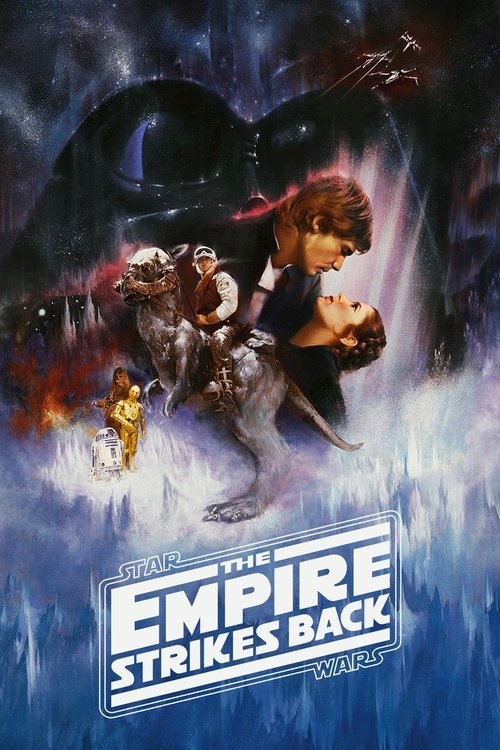
The Empire Strikes Back
1980 · Irvin Kershner
For when you want the gold standard of adventure on a big night in — equally right as a comfort rewatch or a first-time event. Just know it's the chapter that leaves you hanging, so keep the next one within reach.
What it's about
The rebellion is on the run. After the Empire strikes their hidden base on an ice planet, Luke Skywalker goes to a remote swamp world to train under the ancient Jedi master Yoda, while Han Solo, Princess Leia, Chewbacca, and the droids flee across the galaxy with Darth Vader hunting them at every turn. Everyone is being pushed toward a trap — and toward truths they aren't ready for.
The experience
Darker and moodier than you expect a space adventure to be: the thrills are real — asteroid chases, snow battles, lightsaber duels — but dread keeps gathering underneath them. It's romantic, funny, and genuinely tense, and it ends with your stomach in a knot in the best way.
Performances
Harrison Ford's Han Solo is at his most roguishly alive here, and his sparring with Carrie Fisher's Leia gives the film its heartbeat. Frank Oz's Yoda — a puppet, performed and voiced so fully you forget that within minutes — is one of the great characters in popular cinema.
The craft
The effects work — the snow battle with walking war machines, the asteroid field, the cloud city — still holds up as tactile, handmade spectacle, and John Williams' score, including the Imperial March, does half the storytelling. It absolutely rewards the biggest screen and best sound you can give it.
Why it matters
It proved a sequel could be darker, sadder, and better-regarded than the original, and its cliffhanger structure rewired how franchises tell stories. It's routinely cited as the high-water mark of the entire saga.
Snapshot
The second installment of George Lucas's Star Wars saga, The Empire Strikes Back expands the universe of its predecessor into darker, more emotionally demanding territory while delivering one of cinema's most celebrated plot revelations: that the villain Darth Vader is the father of the hero Luke Skywalker. Where the original Star Wars (1977) operated as a triumphant adventure rooted in serial mythology, Empire introduces sustained dread, a narrative cliffhanger, and an unresolved moral calculus that would redefine expectations for franchise filmmaking. Made outside the Hollywood studio system through Lucas's own financing, with Irvin Kershner directing from a screenplay completed by Lawrence Kasdan after Leigh Brackett's death, the film synthesizes myth, melodrama, and genre spectacle into something that has come to be regarded — by critics, audiences, and the industry alike — as one of the finest sequels in cinema history.
Industry & production
The Empire Strikes Back was produced entirely outside the traditional studio financing model, a direct consequence of Lucas's decision to retain sequel and merchandising rights when negotiating with Twentieth Century Fox for the original Star Wars. The extraordinary commercial success of that film gave Lucas the capital and leverage to fund Empire himself through Lucasfilm, with Fox distributing. This arrangement granted the production an unusual degree of creative autonomy but also placed enormous personal financial risk on Lucas: cost overruns were absorbed out of his own resources.
Principal photography took place primarily at Elstree Studios in Hertfordshire, England, which had also housed portions of the original film. The opening Hoth sequences were filmed on location at Finse, Norway, on and around the Hardangerjøkulen glacier in early 1979. The shoot was notorious for its conditions: blizzard weather regularly exceeded safety thresholds, curtailed filming days, and shaped the claustrophobic atmosphere of the sequences it was meant to illustrate. The extreme cold partly inspired the film's opening scene in which Han Solo slices open a tauntaun to shelter the hypothermic Luke — a sequence reportedly developed in direct response to what cast and crew were experiencing.
The screenplay has a layered history. Leigh Brackett — a veteran of hard-boiled fiction (she co-wrote the Howard Hawks adaptations of The Big Sleep and Rio Bravo) and science fiction literature — delivered a draft in early 1978, but died of cancer in March of that year before revisions could proceed. Lucas then hired Lawrence Kasdan, who had recently completed the Raiders of the Lost Ark script, to write the screenplay from scratch using Lucas's story. The extent to which Brackett's draft influenced the final film remains debated among scholars; it is generally understood that the two documents diverged considerably, though Brackett received co-screenplay credit.
The production faced a further setback when production designer John Barry — who had worked on the original Star Wars — died during the production in June 1979. Norman Reynolds took over and completed the production design, including the immense Cloud City sets and the swamp environment of Dagobah.
Gary Kurtz produced; he and Lucas would part ways before Return of the Jedi, with Kurtz later expressing that commercial pressures increasingly shaped creative decisions across the trilogy. Kershner, a former USC film instructor whom Lucas knew personally, was chosen precisely because Lucas wanted a director skilled at working with actors and shaping character scenes — dimensions of filmmaking that Lucas acknowledged were not his own strengths.
Technology
The Empire Strikes Back marks a consolidation and expansion of the visual-effects methods developed at Industrial Light & Magic (ILM) for the original film. Rather than radical invention, it represents a deepening of technique.
The AT-AT walkers of the Hoth battle sequence remain among the film's most technically celebrated achievements. Phil Tippett supervised the go-motion animation of these machines — a refinement of traditional stop-motion in which motion blur is introduced during exposure to reduce the strobing effect that had long made stop-motion creatures appear weightless. The Hoth battle represents one of the most sustained deployments of this technique in Hollywood filmmaking.
Yoda, introduced as Luke's Jedi master on Dagobah, was realized as a puppet designed by Stuart Freeborn and performed primarily by Frank Oz, who was at the time best known for his Muppet work (Fozzie Bear, Miss Piggy). The character's expressive range — achieved through radio-controlled mechanisms alongside cable-operated elements and Oz's puppetry — was widely understood at the time as a significant technical accomplishment. ILM's effects supervisors on the film included Richard Edlund, Brian Johnson, and Dennis Muren.
The Dagobah sequences required the construction of an elaborate practical swamp environment on a Elstree soundstage — tons of vegetation, fog, and standing water creating conditions that were reportedly miserable to shoot in. The film relied heavily on in-camera compositing, matte paintings, and optical printing, with relatively little distinction in the workflow from its predecessor, though the scale of the composite shots increased.
Technique
Cinematography
Peter Suschitzky served as director of photography, replacing Gilbert Taylor, who had shot the original Star Wars with a deliberately flat, Saturday-matinee brightness. Suschitzky, who would later become David Cronenberg's regular cinematographer, brought a more textured, shadow-conscious approach. The film's dominant palette is cooler: the blue-white glare of Hoth, the green murk of Dagobah, the warm amber of Cloud City interiors contrasted against the void beyond its windows. Lighting in the Cloud City sequences — particularly the carbon-freezing chamber — draws on expressionist chiaroscuro, silhouetting figures against backlit steam for compositional drama. This shift toward shadow represents a deliberate visual counterpart to the narrative's darker emotional register.
Editing
The editing of The Empire Strikes Back operates across three intercut narrative strands: Luke's solitary training on Dagobah, the fugitive flight of the Millennium Falcon through Imperial pursuit, and the galactic context connecting them. Kershner and editor Paul Hirsch — who had shared Oscar credit on the original Star Wars — manage this intercutting with a patience unusual for the genre, allowing scenes in Dagobah to breathe and develop character interiority while maintaining tension in the parallel story. The climactic lightsaber duel between Luke and Vader is edited for punishing momentum, a contrast to the more stately dueling rhythm of the original film.
Mise-en-scène / staging
Kershner brought a theatrical rigor to staging that is evident in the film's performance-heavy scenes — particularly the interiors of Cloud City and Vader's Star Destroyer. He favored close coverage of faces, using eyeline and reaction to generate suspense rather than relying primarily on effects spectacle. The carbon-freezing chamber sequence — all industrial steam, asymmetric risers, and characters framed in long shots that emphasize their smallness against the machinery — is a prime example of Kershner's compositional intelligence. The staging of the Vader revelation exploits depth of field: Luke and Vader separated by a vertical chasm, each occupying a different architectural plane as the disclosure lands.
Sound
John Williams's score is the film's most influential sonic contribution, introducing the Imperial March — which has since become one of the most recognizable leitmotifs in the history of film music. The march's relentless, brass-driven regularity encodes the Empire's mechanized power in musical form and represents a compositional shift from the Wagnerian sweep of Luke's theme toward something militaristic and implacable. Sound design continued the work of Ben Burtt, who had developed the sonic vocabulary of the Star Wars universe in the original film: the characteristic breathing of Vader's respirator, the sounds of lightsabers, the distinctive reports of blaster fire. The film won Academy Awards for Best Sound.
Performance
Harrison Ford's Han Solo reaches his most complex register here, moving from roguish charisma into the territory of genuine romantic feeling — the "I know" response to Leia's declaration of love before his carbonite freezing was, according to established accounts, Ford's improvisation over scripted dialogue and has become one of cinema's most cited examples of a performer finding the precisely correct note. Mark Hamill is asked to carry the more inward and psychologically demanding arc: the Dagobah sequences require sustained portraiture of fear, self-doubt, and dawning moral knowledge. Irvin Kershner's particular skill was in creating conditions in which actors could make these discoveries without the pressure of spectacle dominating every moment. Billy Dee Williams's introduction as Lando Calrissian presented one of the few Black characters of significance in mainstream American science fiction cinema of the period.
Narrative & dramatic mode
Empire operates structurally as the second act of a three-part narrative and inherits the formal problems of that position: the hero must be tested without being resolved, darkness must accumulate without despair becoming terminal. Kershner and Kasdan solve this by separating the hero from the action for long stretches — Luke's training on Dagobah is essentially a waiting game overlaid with philosophical instruction, while the Han-Leia storyline furnishes the kinetic chase plot. The two arcs are formally rhymed: both involve betrayal (the Imperial tracker on the Falcon, Lando's deal with Vader), and both end in defeat or capture rather than triumph.
The revelation of Vader's paternity is narratively unprecedented in the series and constitutes a genre-breaking pivot: what had been a fairly schematic contest between Good and Evil is retroactively complicated by blood, obligation, and the possibility of the villain's redemption. The film ends without resolution — Han is frozen, Luke is mutilated and traumatized, the Rebellion is scattered. This willingness to conclude on defeat was rare in Hollywood commercial filmmaking at the time and has since been canonized as a formal virtue.
Genre & cycle
The Empire Strikes Back belongs to the space-opera tradition, the American science-fiction blockbuster cycle inaugurated by the original Star Wars, and the war film — most explicitly in the Hoth battle sequence, which draws on the staging logics of World War II infantry combat films. The film is also a Western in its skeletal character arrangements: Solo the mercenary gunfighter, Leia the political idealist, the frontier fort under siege. The Dagobah sequences invoke the fantasy tradition of the wizard-mentor and the liminal threshold space — Yoda's swamp functions as an enchanted forest out of Arthurian or Tolkienian narrative.
The film participates in the cycle of mythology-inflected popular cinema that Lucas, following his engagement with Joseph Campbell's The Hero with a Thousand Faces, had embedded into the first film — the monomyth of departure, initiation, return now complicated by the revelation that the father-figure is the primary antagonist. This Oedipal inversion lends the narrative an archetypal weight that has attracted sustained scholarly attention.
Authorship & method
Irvin Kershner remains a somewhat underacknowledged figure in film history, often credited as a vehicle for Lucas's vision rather than an auteur in his own right. His earlier work — A Fine Madness (1966), The Luck of Ginger Coffey (1964), Eyes of Laura Mars (1978) — reflects a consistent interest in character psychology and morally complicated protagonists. His contribution to Empire is most evident in what the film does differently from its predecessor: the pacing is more deliberate, the performances more inward, the emotional register more sustained. He has spoken in interviews about resisting Lucas's instinct for faster cutting and bigger spectacle in favor of scenes that establish interiority.
Lawrence Kasdan's screenplay establishes the voice that would define the trilogy: wry, emotionally intelligent, capable of dramatic grandeur without tipping into self-parody. He is the principal architect of the dialogue that audiences have committed to memory. John Williams's score is his most compositionally durable contribution to the saga, anchoring character and moral conflict in musical leitmotif with a thoroughness that remains a model for orchestral film scoring. Peter Suschitzky's cinematography sets a visual template for darkness and shadow that the series would attempt to retrieve in later installments.
Movement / national cinema
The Empire Strikes Back is an American production in the sense that its financing, creative control, and cultural mythology are American, but its production infrastructure was substantially British: Elstree Studios, British crew, British character actors (Anthony Daniels, Kenny Baker, Jeremy Bulloch as Boba Fett, and others). This transatlantic arrangement — which Lucas had also employed for the original Star Wars — drew on British studio craft traditions while keeping creative and narrative authority in American hands. It belongs to no national cinema in a strict sense; it is post-studio Hollywood at a specific moment of industrial reorganization around the blockbuster.
Era / period
The film arrives at the moment of consolidation for the blockbuster model that Jaws (1975) and Star Wars had together established. By 1980, the industry had reorganized its release calendar, marketing apparatus, and financing logic around the summer event film. Empire both exemplifies and complicates this model: it is unquestionably a spectacle film, but its narrative structure — ending in defeat, refusing resolution — runs counter to the triumphalist formula that studios were already beginning to codify as the blockbuster template. In retrospect, Empire represents a moment when the commercial and artistic ambitions of blockbuster filmmaking were briefly but productively aligned.
Themes
Lineage, inheritance, and corruption are the film's central preoccupations. The revelation that Luke's adversary is his father transforms the conflict from a political-ethical one (Rebellion vs. Empire) into a familial-psychological one, raising questions about whether the son can escape the father's trajectory. Failure and loss are thematized throughout in ways unusual for genre entertainment: the film is structured around its heroes' defeats. Mentorship and transmission appear in the Yoda sequences, which are also a meditation on limitation and impermanence — Yoda is old, unimpressive in appearance, constrained; wisdom does not guarantee strength or victory. Betrayal and complicity structure the Cloud City arc: Lando collaborates with the Empire under duress, raising questions about the moral legibility of collaboration that the film chooses not to fully adjudicate.
Reception, canon & influence
Critical reception at release was mixed in ways that have since been largely forgotten. Some reviewers found the film's dark ending unsatisfying, its narrative incomplete, and its length excessive. The lack of resolution — unusual in mainstream American commercial cinema — generated discomfort. Over subsequent decades, critical opinion reversed dramatically: The Empire Strikes Back is now routinely cited as the definitive entry in the saga and as one of the finest sequels in Hollywood history, often ranked alongside The Godfather Part II (1974) as an example of a sequel that surpasses its original.
Influences on the film include Akira Kurosawa's samurai pictures (particularly the mentor-student relationship of Seven Samurai and the wandering-warrior narratives of the Toshiro Mifune films), the theatrical serialized adventure tradition of 1930s and 1940s Flash Gordon and Buck Rogers serials that Lucas explicitly cited, and the classical Hollywood adventure film. The Vader-Luke relationship draws structurally on the Oedipal myths of Greek tragedy. The training sequences have antecedents in the kung fu and chambara (sword-fighting) films that were circulating widely in American markets during the 1970s.
Forward legacy is extensive. The film established what has become a genre convention: the "dark middle chapter" of a trilogy, in which the protagonist is defeated and the narrative horizon is deliberately clouded. This structure has been replicated in countless franchises — explicitly or by analogy — from the Matrix series to the Marvel Cinematic Universe. The Vader revelation became a cultural touchstone for the dramatic plot twist itself, referenced and parodied so extensively that it now functions as a cultural shorthand for unexpected disclosure. The Imperial March has achieved a life well beyond cinema; it is among a handful of film music cues recognizable to populations who have never seen the films. The film's depiction of the AT-AT walker established design vocabulary for mechanized military science fiction that has informed visual culture for four decades.
The film also set a precedent for franchise filmmaking in which sequels could be tonally and structurally differentiated from their originals — could be about something, rather than merely continuing action — while remaining commercially viable. That this was achieved under the unconventional conditions of independent financing, with a director whose work was not primarily in spectacle filmmaking, and with a screenplay whose principal author died before the script was finished, is part of what makes The Empire Strikes Back a genuinely instructive case study in the contingency of cinematic achievement.
A Deleuzian reading
The walkers come over the white lip of Hoth with their heads lowered, slow and patient, and for a few minutes the film promises exactly what the first one delivered: an enemy you can see, a line you can hold, a problem some action will solve.
The full Deleuzian reading of The Empire Strikes Back →
Reception
Hard to believe now, but reviews in 1980 were mixed — several major critics found it a gloomy, unresolved middle chapter. Decades of reappraisal have flipped it into the consensus best Star Wars film and the standard-bearer for 'the sequel that tops the original.'
How The Empire Strikes Back was received, from release to now →
Influences: the films it descends from and the films it influenced
- Metropolis (1927) — Lang's expressionist chiaroscuro — deep shadow cuts defining the machine-man antagonist's silhouette against industrial point sources — is the direct visual grammar Suschitzky applies to Vader's entrances and the contrast-heavy Empire interiors, establishing masked authority as a photographic convention.
- King Kong (1933) — Willis O'Brien's stop-motion animation is the foundational technique Phil Tippett refined into go-motion for the AT-AT walkers, introducing controlled motion blur during exposure to eliminate the weightless strobe effect that made classical stop-motion creatures appear disconnected from live-action plates.
- The Wizard of Oz (1939) — The wizard-mentor fantasy template — a diminutive, eccentric figure in an alien environment who trains the hero through cryptic instruction, then withholds the revelation that reframes his mission — structures Yoda's entire narrative and staging function on Dagobah.
- Citizen Kane (1941) — Gregg Toland's deep-focus staging — dramatically opposed figures held in sharp relief simultaneously across multiple planes — is the technical ancestor of the depth-of-field revelation shots in which Vader's masked form is framed against receding corridors, using focus itself as a disclosure mechanism.
- Casablanca (1942) — The wartime melodrama's refusal to resolve its romantic triangle — the hero conceding love through terse deflection rather than declaration — provides the template for Han and Leia's irresolution, and Ford's improvised 'I know' is explicitly a Bogart-mode act of romantic understatement within that tradition.
- The Hidden Fortress (1958) — Kurosawa's three-strand intercutting between a princess's covert escape and a parallel peasant subplot provided Lucas with the multi-protagonist narrative structure that Empire deploys across three simultaneously advancing storylines — Luke on Dagobah, Han and Leia through space, Lando at Cloud City — each advancing independently toward a single convergence.
- Vertigo (1958) — Herrmann's technique of assigning a transforming theme to a character whose identity is later revealed — the Madeleine motif retroactively recontextualizing the entire film once the deception is exposed — is the structural model Williams applies to the Imperial March / Force Theme relationship at the Vader paternity revelation.
- Rio Bravo (1959) — Leigh Brackett co-wrote this screenplay, establishing the banter-as-character-revelation technique — ensemble under pressure, reluctant hero's loyalty tested through terse exchange — that she brought directly to her Empire draft, shaping Han Solo's voice before Kasdan completed the script after her death.
- Chinatown (1974) — Polanski's deployment of the paternal-crime revelation as the film's structural climax — the villain-as-father inversion that retroactively reframes the entire protagonist quest and forecloses a satisfying resolution — is the most direct cinematic precursor to the Vader-as-Luke's-father shock and its narrative irresolution.
- Jason and the Argonauts (1963) — Phil Tippett's AT-AT and tauntaun animation is Harryhausen's armature puppetry with go-motion blur added to defeat strobing, still married to live plates by the same foreground/background matte split.
- Raiders of the Lost Ark (1981) — Written by Kasdan concurrently with his Empire revision, the screenplay shares the same serial-cliffhanger rhythm and banter-driven ensemble dynamics — the two scripts are twin products of the same Brackett-inflected adventure-dialogue mode, and both end on unresolved narrative threads that defer closure to the next installment.
- Dragonslayer (1981) — Phil Tippett applied the go-motion blur-during-exposure technique he developed for Empire's AT-AT walkers to the dragon Vermithrax, making this the most direct and technically explicit continuation of the Hoth battle's animation method and the clearest demonstration of go-motion as a standalone craft.
- Labyrinth (1986) — Frank Oz's achievement of sustained character performance through Yoda's puppet mechanics — expressive range that required the creature to be treated as a principal actor rather than a special effect — directly licensed the Henson Company's approach to Hoggle and Ludo as dramatically credible puppet protagonists sharing scenes with live actors.
- Naked Lunch (1991) — Suschitzky's sustained partnership with Cronenberg — launched here — extends the shadow-textured, deep-focus sensibility he developed for Empire's interiors into body horror, the chiaroscuro of bureaucratic dread and physical transformation drawing on the same vocabulary of unease that defined his Empire work.
- The Two Towers (2002) — Jackson's decision to advance three simultaneously separated storylines across a single film — each strand developing independently with no reunion — applies precisely the three-strand intercutting structure Empire refined, including the technique of ending each strand on an unresolved beat to sustain serial pressure across a multi-film arc.
- The Dark Knight (2008) — Nolan structured his middle installment as a deliberate franchise-redefining exercise in tonal darkness and narrative irresolution — Batman fugitive, Harvey Dent destroyed, the hero unable to claim victory — directly modeling the cliffhanger-as-artistic-statement that Empire pioneered as a template for the serious-sequel form.
- WALL-E (2008) — Ben Burtt, who designed Empire's mechanical sound vocabulary, created WALL-E's voice and soundscape, directly extending his method of non-verbal sonic characterization — mechanical clicks, tonal inflections, and rhythmic patterning replacing dialogue as the primary emotional language for a non-speaking protagonist.
- Star Trek (2009) — Established father-son revelation and confrontation as space opera's structural emotional spine, and codified the dialectical duo (Luke/Vader as complementary opposites whose split defines the franchise's ideological axis) as narrative engine — the formal template for Kirk/Spock's rearranged dynamic.
- Return of the Jedi (1983) — Tippett's go-motion (motion-blurred stop-motion) debuted on the AT-ATs here, the exact technique ILM reuses for Jedi's AT-ST chase and rancor.
- Star Wars: The Force Awakens (2015) — Lawrence Kasdan's co-writing of TFA carries forward the same screenwriting voice and parentage-reveal structure he authored here, the direct line of saga authorship.
- RoboCop (1987) — Tippett's stop-motion tauntaun and AT-AT walkers establish the armatured-machine puppetry vocabulary that ED-209's stiff, servo-driven movement directly inherits.
- Avengers: Infinity War (2018) — Codified the downbeat middle-chapter of a serialized saga that ends on defeat and cliffhanger rather than resolution — the tonal and structural blueprint for the dusting.
- Body Heat (1981) — Kasdan's directorial debut channels the same Brackett hard-boiled tradition he brought to Empire's screenplay — the terse, sexually charged banter between Hurt and Turner is the neo-noir expression of the Han/Leia dialogue mode, both rooted in Brackett's Hawks-era screenplay grammar of desire communicated through deflection.
- Blade Runner (1982) — Jordan Cronenweth's chiaroscuro for Blade Runner — deep industrial shadow bisected by isolated hard sources — extends the visual grammar Suschitzky established for Empire's Imperial interiors, both films deploying expressionist light-against-void to make architecture itself register as authoritarian threat.
- Star Wars: The Last Jedi (2017) — Provides the training-defeat-dark-revelation template Johnson works against, reworking Yoda's reluctant Dagobah tutelage of an impatient student into Luke's bitter refusal to teach Rey on Ahch-To.
- El Dorado (1966) — Brackett wrote the first draft, carrying forward her Hawksian instinct for wry professional banter between bickering partners under pressure that defines El Dorado's two-shot exchanges.
Similar films
- Raiders of the Lost Ark (1981) — influence & lineage
- Blade Runner (1982) — influence & lineage · same viewing thread
- Star Wars (1977) — same viewing thread
- Star Wars: The Force Awakens (2015) — same viewing thread
- Star Wars: Episode I - The Phantom Menace (1999) — same viewing thread
- Rogue One: A Star Wars Story (2016) — same viewing thread
- Star Wars: Episode II - Attack of the Clones (2002) — same viewing thread
- Star Trek II: The Wrath of Khan (1982) — same viewing thread
All the films related to The Empire Strikes Back →
Watch it with: curated runs of related films
- The Blockbuster Sci-Fi Canon — A run of the effects-driven epics that taught modern audiences what a movie could feel like — from the desert planets of Star Wars to the rain of Blade Runner and the sands of Arrakis.