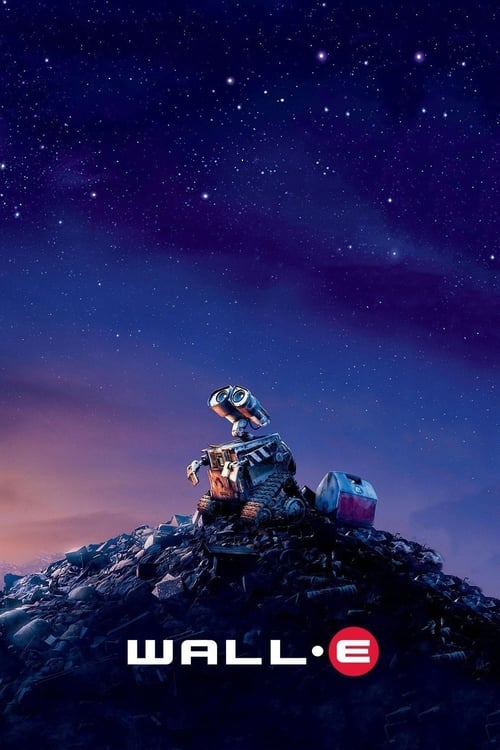
WALL·E
2008 · Andrew Stanton
For when you want your heart warmed and your imagination stretched at the same time — a cozy watch with real melancholy under it. Perfect for a family night, or for anyone who wants to fall in love with two machines who barely speak.
What it's about
Centuries after humanity abandoned a garbage-choked Earth, one little trash-compacting robot is still dutifully doing his job — alone except for a cockroach and a collection of salvaged treasures. Then a sleek probe named EVE drops from the sky, and the lonely machine falls hopelessly in love. When she's recalled to space, he stows away after her, and his devotion accidentally sets the future of the whole planet in motion.
The experience
Tender, funny and quietly awe-inspiring — the nearly wordless first act plays like a silent comedy set at the end of the world, and the romance between two robots lands harder than most human ones. It's a family film that leaves adults a little choked up and a little haunted by its ruined-Earth vision.
Performances
Ben Burtt, the sound designer behind cinema's most famous robots, essentially gives the lead performance — building WALL·E's entire personality out of designed beeps, whirs and one endlessly expressive name.
The craft
Pixar bets its whole first act on pure visual storytelling — almost no dialogue for over half an hour — and wins, telling you everything through pantomime, sound design and light. The photography mimics real lenses and grime, so the ruined Earth feels tactile and the space sequences genuinely sweep. It rewards good speakers as much as any live-action film.
Why it matters
An Oscar winner for Best Animated Feature and a rare studio blockbuster that's also a pointed environmental fable, it's widely held up as the peak of Pixar's golden run and proof that mainstream animation could be formally daring.
Snapshot
WALL·E is a Pixar Animation Studios production distributed by Walt Disney Pictures, and the studio's ninth feature film. Running approximately ninety-eight minutes, it opens on a ruined, tower-stacked Earth abandoned by humanity and follows a small waste-compacting robot — the last functional unit of his model — as he falls in love with a sleek reconnaissance probe named EVE and pursues her across the galaxy. The film's most discussed structural gambit is its near-silent first act of roughly thirty-five to forty minutes, during which sustained dialogue is almost entirely absent. It won the Academy Award for Best Animated Feature and received nominations for Best Original Screenplay and Best Original Score, among others, making it one of the most decorated animated films of its decade. Critics and scholars have treated it as the clearest statement of what prestige American animation could aspire to in the digital era: a children's film that openly invokes silent cinema, dystopian science fiction, and classical Hollywood romance.
Industry & production
Andrew Stanton has stated in interviews that the core concept — "the last robot on Earth" — emerged from a 1994 lunch at the Mexican restaurant where he, John Lasseter, Pete Docter, and the late Joe Ranft famously sketched ideas that would eventually become A Bug's Life, Monsters, Inc., Finding Nemo, and Up. WALL·E was the last of those ideas to reach production. After Stanton directed Finding Nemo (2003), he returned to the concept and spent several years developing it before active production commenced in earnest.
The film required Pixar to develop new simulation software to render the unprecedented quantities of debris, dust, and atmospheric particulate matter that define the Earth sequences. The studio had to model rust, grime, and mechanical deterioration — textures that run counter to the clean-surface aesthetic Pixar had traditionally showcased. Simultaneously, the Axiom sequences aboard the giant spaceship required rendering thousands of overweight human extras in a believable crowd environment, a different kind of computational challenge. The live-action footage of Fred Willard playing Buy N Large CEO Shelby Forthright — shot on actual film and cut against the animated material — was a deliberate formal decision to intensify the uncanny contrast between the world humanity had abandoned and the corporate cheerfulness that caused it.
The film's production budget has been reported at approximately $180 million, with worldwide theatrical gross surpassing $530 million. These figures place it within the upper tier of Pixar's commercially successful output, though it trailed the studio's highest earners at the time.
Technology
WALL·E represents a pivotal moment in the history of computer-generated imagery precisely because it works against CGI's tendency toward technical perfection. For the Earth-set first act, Pixar developed lens-simulation software in collaboration with Roger Deakins — the British cinematographer of No Country for Old Men and Blade Runner 2049, among other films — who served as a visual consultant on the production. This software replicated the optical imperfections of anamorphic photographic lenses: chromatic aberration, lens flare, shallow depth of field with genuine bokeh, rack-focus pulls, and film-grain-style noise. The virtual camera on Earth behaves as though operated by a documentary or naturalistic live-action cinematographer, with slight handheld tremor and imprecise framing.
By contrast, the space sequences aboard the Axiom were rendered with a cleaner, more classically animated look — wider depth of field, brighter and more even lighting — drawing a formal line between the organic, weathered Earth and the sterile commercial spaceship. This deliberate contrast of cinematographic registers within a single film was remarked upon by critics and practitioners as a technically sophisticated choice that served the film's thematic concerns.
Ben Burtt's sound design also involved what might be called acoustic engineering from scratch. Working with Stanton, Burtt constructed WALL·E's voice from organic and mechanical sound sources to give him expressivity without intelligible speech, extending techniques Burtt had developed on the original Star Wars trilogy. EVE's vocalizations were designed separately, using a more electronic and melodic palette, to suggest her different origin and personality.
Technique
Cinematography
The Director of Photography credit belongs to Jeremy Lasky and Danielle Feinberg, with Deakins's visual consultancy shaping the foundational approach. The Earth act operates in warm ochres, browns, and the dusty amber of late-afternoon light filtered through a polluted atmosphere — a palette that evokes both classical western landscape photography and the burnished tones of silent film tinting. Sunrise and sunset are used with particular intention: WALL·E's daily routines are punctuated by them, anchoring a robot's repetitive existence within natural time. When EVE arrives, accompanied by harsher white light and metallic surfaces, the color temperature shifts register her as alien to this landscape. In space, the Axiom's interior is bathed in the blue-white light of fluorescent screens, connecting the film's visual logic to its thematic critique of screen-mediated passivity.
The use of rack focus to isolate WALL·E's eyes — his expressive binoculars — from background clutter draws the audience into close identification with a character who cannot speak in sentences. Several compositions are structured around eyeline matches that stand in for conventional shot-reverse-shot dialogue editing.
Editing
Stephen Schaffer edited the film. The Earth act's editing is notably patient by the standards of contemporary American animation, cutting on action and movement rather than dialogue cues, and holding on reaction shots long enough to build genuine emotional weight. The film's pacing in its first half aligns more closely with silent-era comedy rhythm — extended gags, slow builds to payoffs — than with the fast-cutting tempo that had become standard in animated features of the 2000s. The transition from Earth to space accelerates the cutting rate, reflecting both narrative urgency and the more chaotic, populated world WALL·E has entered.
Mise-en-scène / staging
Stanton stages WALL·E's Earth as a space of accumulation and repetition that gradually reveals personality. His trailer, filled with carefully sorted human artifacts — a Rubik's cube, a spork filed as a curiosity, a videotape of Hello, Dolly! — is a mise-en-scène of longing without a referent: he preserves objects whose use he barely understands. The Hello, Dolly! sequences are particularly precise in their staging; WALL·E watches and imitates the hand-holding sequence from "It Only Takes a Moment," a gesture he will rehearse and eventually complete with EVE. Stanton uses this repeated staging to create the film's emotional architecture: the simplest possible human gesture becomes the axis of the story.
The Axiom is staged as a floating mall, its corridors designed to funnel passengers toward screens and consumption. The contrast with Earth's vertical, compressed geography — towers of garbage as inverted skyscrapers — gives both spaces a satirical coherence.
Sound
Ben Burtt's work on WALL·E is among the most celebrated sound-design achievements in American animation. In the near-silent first act, sound carries what dialogue would conventionally carry: WALL·E's loneliness is communicated through the ambient recordings of his daily labor, and his delight through small, upward-inflected electronic chirps. The Hello, Dolly! playback — tinny and warm, leaking from a battered screen — functions as an emotional counterweight to the surrounding silence and devastation. EVE's arrival is announced by a change in wind and a sonic palette that is smoother, more synthetic.
Thomas Newman's orchestral score, which blends conventional orchestration with electronic textures, was composed to work with rather than against Burtt's sound design — itself an unusually collaborative arrangement. Peter Gabriel wrote and performed "Down to Earth" over the end credits, and while the song lies outside the film proper, it consolidates the film's emotional register upon exit.
Performance
WALL·E is voiced by Ben Burtt himself, using assembled sounds rather than conventional voice acting. Elissa Knight performs EVE through a similar process of electronically inflected vocalization. Jeff Garlin voices the Captain, and Sigourney Weaver voices the ship's computer — a casting choice that quietly invokes the synthetic intelligences of the science-fiction tradition without being reducible to parody.
The absence of conventional acting in the film's first act displaces performance onto movement and sound: WALL·E's gait, the way he retracts into his chassis under threat, the careful way he arranges his treasures. Stanton and his animation team drew extensively on the physical comedy tradition of silent film, studying Chaplin and Keaton for the vocabulary of body-as-expressive-instrument that WALL·E's characterization required.
Narrative & dramatic mode
The film is constructed as a classical three-act love story interrupted by a science-fiction adventure plot, and the tension between these modes is productive rather than uncomfortable. The first act, on Earth, is essentially a silent comedy of loneliness and romantic longing. The second act, aboard the Axiom, introduces narrative conflict in a more conventional sense: conspiracy, a MacGuffin (the plant that proves Earth is again habitable), and physical jeopardy. The third act returns to Earth for resolution.
What distinguishes the narrative is its willingness to let a first act of nearly forty minutes pass without conventional plot mechanics, trusting the audience to sustain attention through character alone. This was identified at the time as a significant risk for a major-studio animated feature aimed in part at children. The film integrates its environmental and political satire into the narrative fabric rather than appending it as message: the Buy N Large corporation is not explained in a prologue so much as revealed through accumulation of detail, and the humans' passivity is dramatized rather than editorialized.
The names WALL·E and EVE carry obvious Edenic freight — the lone figure in a ruined garden, the probe whose discovery of life restores the possibility of return — and Stanton has acknowledged this register without reducing the film to allegory.
Genre & cycle
WALL·E belongs to several overlapping generic traditions. As a post-apocalyptic narrative it draws on the long tradition of ruined-Earth science fiction, but the ruination here is specifically consumerist rather than nuclear or biological, and the tone is elegiac and ultimately hopeful rather than despairing. As a robot film it participates in the cycle of sympathetic-machine narratives that runs from Metropolis (1927) through Short Circuit (1986) and AI Artificial Intelligence (2001). As a love story it is a classical cross-cultural romance in which two beings from different worlds discover connection — a structure with roots in silent comedy.
The film also belongs to the specific cycle of Pixar prestige animation that began consolidating in the early 2000s, in which the studio produced films calculated to win critical and awards recognition alongside family-audience commercial performance. WALL·E sits at the ambitious extreme of this cycle, alongside Up (2009) and Inside Out (2015), in its willingness to extend narrative risk into the structural and formal registers of the film rather than confining it to theme or subject matter.
Authorship & method
Andrew Stanton came to WALL·E as an established auteur within the Pixar house style, having co-written Toy Story (1995) and directed Finding Nemo (2003). His method on WALL·E has been described as unusually research-intensive with respect to both its emotional core and its science-fictional premises, though the film is avowedly speculative rather than rigorously extrapolative. Stanton has spoken of wanting the film to feel like a discovery, requiring audiences to assemble meaning from observation rather than exposition — an aspiration that connects to his stated admiration for silent cinema.
Roger Deakins's consultancy was formative. His approach to natural light, camera placement at human scale, and the strategic use of shallow focus gave the film's Earth sequences a tactile specificity that purely animated productions of the era rarely achieved. This collaboration between an animation director and a prestige live-action cinematographer anticipated subsequent experiments in bridging these modes.
Thomas Newman's score is characteristically restrained and chamber-like in its approach, using smaller instrumental forces and textural electronics rather than the sweeping orchestrations associated with conventional animated features, matching the film's tonal register. Ben Burtt's dual role as sound designer and voice performer for the title character made him an unusually integrated collaborator, effectively functioning as a co-author of the protagonist's characterization.
Jim Reardon and Stanton share writing credits, with Stanton credited as the primary story architect.
Movement / national cinema
WALL·E is a product of the Pixar/Disney industrial formation and carries the formal assumptions of American commercial animation — classical narrative structure, protagonists defined by desire and obstacle, legible emotional arcs. Its environmental politics, however, generated commentary in the context of American cultural debates of the mid-2000s, with some critics identifying it as the most politically explicit major-studio animated film since the environmental fables of an earlier generation. The satirical portrait of Buy N Large as a monopolistic corporation that has subsumed all government functions reads more clearly in the context of debates about corporate consolidation and consumer culture that were prominent in American public discourse at the time of the film's release.
The film has no meaningful connection to a national cinema tradition outside Hollywood, though its silent-act homage reaches across to the European and specifically Continental tradition of physical comedy and early film art.
Era / period
The film arrived in summer 2008, several months before the financial crisis that would reshape the cultural moment of the late 2000s. Its portrait of a consumption-saturated civilization that has destroyed its own habitat and retreated into passive screen culture resonated with anxieties that were already visible — around climate change, technology-mediated social disconnection, and corporate overreach — and that would intensify over the following decade. It belongs to a period in which prestige animation was aggressively expanding its tonal and formal ambitions, and in which Pixar in particular occupied a unique cultural position as a studio capable of producing work that critics treated as significant cinema rather than merely significant entertainment.
Themes
Ecological destruction and consumerism are the film's most legible themes, embedded in its premise: humanity has buried the Earth under waste and outsourced both labor and governance to a single corporation. The film does not present this as a warning so much as an accomplished fact, arriving in a world already past the tipping point, which gives it a tone of mourning as well as satire.
The relationship between love and purposefulness runs through the film at a more intimate level. WALL·E is defined by his compulsion to collect and preserve human artifacts whose function he barely understands, and by his imitation of the hand-holding gesture he has watched repeatedly — a longing for connection that precedes EVE's arrival and that gives the film its emotional center. The film proposes that purpose is not given by function (he was built to compact trash) but discovered through relationship and care.
Technology and disconnection form a related strand: the humans aboard the Axiom are not villainous but atrophied, their bodies softened and their attention contracted to personal screens, incapable of seeing one another except through mediation. The Captain's arc — learning, recovering agency, choosing to steer the ship home — is the human-scale version of the thematic question WALL·E poses about whether habituated passivity can be reversed.
Reception, canon & influence
WALL·E received near-universal critical acclaim on release. It was placed at or near the top of year-end best-film lists by numerous critics, and was treated by many reviewers as an argument that animation could achieve what the most ambitious live-action cinema aspires to. Its nomination for Best Original Screenplay at the Academy Awards — an unusual honor for an animated film — reflected the degree to which its structure had been recognized as formally sophisticated rather than merely accomplished within genre conventions. The film won the Academy Award for Best Animated Feature, the Golden Globe in the same category, and numerous critics' circle awards.
Looking backward, the film's most cited antecedents are the silent comedies of Charlie Chaplin — particularly Modern Times (1936), whose small figure laboring in an industrial landscape WALL·E consciously echoes — and Buster Keaton's physical comedy. Stanton has cited these directly. The science-fictional architecture of the film's second half draws on Stanley Kubrick's 2001: A Space Odyssey (1968): the antagonist AUTO, a ship's steering wheel that overrides human command to prevent return to Earth, is legibly a descendent of HAL 9000, and several compositions and situational parallels have been noted by critics. The wide, desolate landscape compositions of the Earth sequences invoke John Ford's use of vast American geography, refracted through science-fiction conventions. The film-within-the-film, Hello, Dolly! (1969, dir. Gene Kelly), is not merely a cute reference but a structural and thematic load-bearing element: it provides WALL·E with the vocabulary of romantic connection.
Forward, WALL·E's influence on prestige animation is difficult to disentangle from Pixar's general influence on the field, but its specific contribution — the willingness to sustain a near-silent act in a major animated feature — has been noted as an enabling precedent. Its treatment of ecological collapse as a backdrop for intimate character study anticipates the increasingly prominent strand of environmentally themed animation and science fiction that followed in the 2010s. Its visual approach, developed in collaboration with Deakins, helped establish a model for bringing live-action cinematographic thinking into animated production that subsequent Pixar and non-Pixar films have continued to explore.
Among scholars of animation and of science fiction film, WALL·E is now regularly included in discussions of the most formally and thematically serious animated films produced by the American studio system, alongside the best of Disney's classical period and the Studio Ghibli output with which it is sometimes compared — though the comparison, while illuminating in terms of seriousness of purpose and craft, should not obscure how different the industrial and aesthetic premises of Pixar and Ghibli remain.
A Deleuzian reading
Start with the hand.
The full Deleuzian reading of WALL·E →
Reception
Rapturously received in 2008 and it never dipped — if anything the years turned 'great Pixar movie' into 'the closest Pixar ever got to pure art film.' Its Best Picture shutout (alongside The Dark Knight's) is part of the lore that pushed the Academy to expand the category.
How WALL·E was received, from release to now →
Influences: the films it descends from and the films it influenced
- The General (1926) — WALL·E's physical comedy of machine-obstacle navigation — the cause-and-effect gag chain where a mechanical mishap compounds into the next — descends directly from Keaton's one-take stunt choreography; the deadpan held-reaction shot that follows each catastrophe, letting the audience catch up before the next beat, is reproduced in WALL·E's trash-compaction routines without modification.
- Metropolis (1927) — Lang's sympathetic machine protagonist (the false Maria) and the staging of stacked industrial towers as a visual environment of accumulated human neglect establish the foundational genre conventions that WALL·E inherits for its non-human emotional center and its Earth-act world-building; the robot-as-vessel-for-human-longing device originates here.
- Modern Times (1936) — The sustained romantic subplot conducted through gesture, proximity, and reaction rather than intelligible speech — and the editorial patience of holding on a character's face after a physical mishap — is the direct template for the WALL·E/EVE wordless courtship; Stanton explicitly cites Chaplin's pantomime vocabulary as the model for achieving emotional legibility without dialogue.
- Bambi (1942) — The extended near-wordless forest-life opening, in which Frank Churchill's score and layered diegetic ambient sound carry emotional continuity without dialogue, establishes the American animation template for silent-act storytelling; WALL·E's first thirty-five minutes apply the same principle — environment and sound design as the total expressive apparatus — at greater structural scale.
- Playtime (1967) — Tati's staging of accumulation — objects, spatial repetitions, and visual motifs that aggregate into theme through behavioral comedy rather than exposition — is the formal ancestor of WALL·E's Earth act; in both films, a character's collection of objects and habitual routines constitute their entire inner life, rendered legible through patient long-shot observation rather than dialogue or voiceover.
- 2001: A Space Odyssey (1968) — Kubrick's blue-white fluorescent spacecraft interior and the editorial patience of sustained non-verbal sequences in space — where diegetic mechanical sound and classical music carry all emotional weight — are directly echoed in WALL·E's Axiom sequences; the HAL sequences also establish the convention of a machine's voice as an emotional performance capable of audience identification.
- Hello, Dolly! (1969) — Stanton embeds actual footage from this film as WALL·E's emotional reference library, making its diegetic songs ('It Only Takes a Moment,' 'Put On Your Sunday Clothes') the film's literal love-language; the Broadway musical's staging of romantic gesture through choreographed physical contact becomes the exact technique WALL·E attempts to imitate with EVE, making this a diegetic ancestor rather than an intertextual allusion.
- Silent Running (1972) — The drone robots Huey, Dewey, and Louie — non-speaking mechanical characters who communicate through body tilt, acoustic chirps, and behavioral quirk without intelligible speech — are the direct craft template for WALL·E's non-verbal characterization; Trumbull's film is the proof-of-concept that audience identification with a wordless robot can sustain an emotional arc across a feature.
- Blade Runner (1982) — The amber-to-blue-neon color temperature contrast and the visual logic of layered post-industrial detritus — every surface encrusted with the material residue of consumerism — are the cinematographic vocabulary WALL·E's Earth sequences inherit from Scott and Jordan Cronenweth; the warm late-afternoon amber of a ruined landscape as a register of ecological loss is directly transposed.
- The Iron Giant (1999) — The non-speaking machine protagonist whose emotional range is communicated entirely through eye-mechanism movement, head tilt, and scale-comedy with a small human companion is the immediate animated precedent WALL·E refines; Bird demonstrated that a wordless robot could anchor a feature-length emotional arc through physical performance alone, validating the approach Stanton then extended to a near-silent first act.
- The Empire Strikes Back (1980) — Ben Burtt, who designed Empire's mechanical sound vocabulary, created WALL-E's voice and soundscape, directly extending his method of non-verbal sonic characterization — mechanical clicks, tonal inflections, and rhythmic patterning replacing dialogue as the primary emotional language for a non-speaking protagonist.
- Return of the Jedi (1983) — Ben Burtt himself designs the title robot's entire vocabulary from synthesized and processed sound, carrying his Jedi-era creature/droid voice method into a wordless lead performance.
- Up (2009) — The opening Carl-and-Ellie life montage applies WALL·E's validated approach of sustained silent emotional storytelling within Pixar prestige animation — four minutes of birth-to-death relationship arc cut to Michael Giacchino's score without a word of dialogue — as a direct formal descendant, compressing WALL·E's thirty-minute silent act into its most concentrated possible form.
- Spider-Man: Into the Spider-Verse (2018) — Into the Spider-Verse extends WALL·E's CGI lens-imperfection methodology into a systematic aesthetic program: halftone printing dots, off-register color layers, speed-lines, and deliberately variable frame-rate animation are engineered artifacts of a printing or screening medium introduced into computer-generated imagery — the same principle of purposeful technical imperfection as emotional and expressive tool that Deakins's consultancy pioneered for WALL·E's Earth sequences.
- Oblivion (2013) — Originates the lonely-cleanup-of-a-ruined-Earth premise, with a dutiful solitary machine-minder amid the abandoned debris of a vanished humanity.
- Finding Dory (2016) — Established Stanton's virtual camera that fakes live-action photographic flaws — lens flare, rack focus, shallow depth-of-field, anamorphic distortion — a photographic translation carried directly into Dory's underwater cinematography.
- Robot Dreams (2023) — Extended, near-silent storytelling of a robot's yearning built purely from pantomime, mechanical body language, and expressive sound cues — the direct template for making an unspeaking robot's inner life legible.
- The Wild Robot (2024) — A near-dialogue-free first act in which a robot develops tenderness, shot with Roger Deakins's photographic lighting consult — the mute-machine-learns-to-love craft Sanders extends.
- How to Train Your Dragon 2 (2014) — Also a Deakins-consulted CG film, it pioneered treating virtual light with cinematographic restraint and carrying long stretches of story through wordless facial performance rather than dialogue.
- The Mitchells vs. the Machines (2021) — Ancestor of the consumer-tech and screen-addiction satire, delivered through near-silent visual comedy rather than dialogue exposition.
- Transformers One (2024) — Pioneered building empathy from a hard-surface mechanical face with minimal features, performing emotion through optical-lens 'eyes,' servo posture, and body language rather than expressive human faces.
- Toy Story 5 (2026) — Stanton's own precedent for screen-as-light-source — the Axiom passengers keyed almost entirely by the holo-screens in front of their faces — and for the simulated physical camera built on Roger Deakins' consult: lens dirt, chromatic aberration, imperfect rack focus and anamorphic flare baked into a CG rig.
- Hoppers (2026) — Ben Burtt's Skywalker Sound method of building character voice from processed mechanical and organic recordings, so servo grain and breath occupy one throat, is the direct precedent for Hoppers' robotic-organic hybrid vocal design.
- Rise of the Guardians (2012) — Proves a lead can carry sustained emotional beats with no dialogue by engineering legibility into silhouette, eye geometry and timing — the design brief Sandman answers even more strictly, replacing Burtt's vocalizations with sand pictograms as his entire lexicon.
- The Artist (2011) — Like WALL·E, The Artist consciously engineers silent-era pacing, gestural performance, and the expressive conventions of pantomime into a sound-era production as an aesthetic program rather than a constraint; both films treat the silent-cinema vocabulary as an emotionally richer register than dialogue for their central romantic arcs and both defend the gambit through classical Hollywood genre mechanics.
- Gravity (2013) — Cuarón and Lubezki's sustained wordless survival sequences in space — where the sound mix oscillates between diegetic silence and scored sensation, using acoustic architecture rather than dialogue to carry emotional state — share WALL·E's formal strategy; both films also use the contrast between Earth's warm color temperature and the cold blue-white of space as a structural emotional register.
- Her (2013) — Jonze deploys warm-amber-to-cool-blue color temperature contrast — encoding the screen-mediated passivity theme visually across domestic and public space — as WALL·E does for Earth versus Axiom; both films critique humans surrendering embodied experience to a luminous interface, and both locate romantic feeling in a non-human voice that communicates through acoustic texture rather than physical presence.
- Cars (2006) — Adjacent Pixar experiment in making a near-faceless machine emotionally legible through movement and Ben Burtt's mechanical-sound vocabulary, extending the engines-as-voice idea Cars opened.
- Warriors of the Wind (1984) — A descendant that inherits Nausicaä's poisoned-earth-reclaimed-by-a-single-tender-caretaker premise and near-wordless ecological storytelling driven by curiosity toward a dead biosphere.
- How to Train Your Dragon (2010) — Roger Deakins consulted on both films, importing photographic realism into CG — atmospheric haze, real lens characteristics, shallow rack-focus, and motivated lens flares standing in for hand-held camera imperfection.
- Toy Story 3 (2010) — Pixar imperial-decade wordless-restraint craft — sustained dialogue-free storytelling trusting image and sound design — that TS3's near-silent incinerator sequence inherits.
- The Lorax (2012) — The direct model for the two-world color contrast and anti-consumerist ecology — a lush pristine nature set against a slick over-manufactured consumer wasteland — that the dossier itself flags as the Lorax's touchstone comparison.
- Kung Fu Panda (2008) — A contemporaneous animated feature built on the same experiment — importing a live-action cinematographer's lens language (Roger Deakins consulted on both) to give CG lighting and depth-of-field photographic realism.
- The Incredibles (2004) — Extends Pixar's move toward cinematic virtual cinematography — deliberate lens characteristics and lighting (with Roger Deakins consulting) — that the Incredibles' fake-camera approach began.
- Castaway on the Moon (2009) — Near-wordless solo protagonist who survives by scavenging found objects amid consumer-society detritus, sustaining full emotion with almost no dialogue — the same isolated-performance economy.
Similar films
- Up (2009) — influence & lineage · same viewing thread
- Her (2013) — influence & lineage
- Silent Running (1972) — influence & lineage
- The Artist (2011) — influence & lineage
- Robot Dreams (2023) — same viewing thread
- Finding Nemo (2003) — same viewing thread
- Boy & the World (2014) — same viewing thread
- Isle of Dogs (2018) — same viewing thread
All the films related to WALL·E →
Watch it with: curated runs of related films
- Animation That Aches — A run of animated films that take loneliness, grief, and memory as seriously as any live-action drama — watch them in a row and the cartoon surface stops mattering.