Silent Running
1972 · Douglas Trumbull
For a contemplative night when you want science fiction with a heart instead of a battle — and when you're okay having your feelings quietly wrecked by a robot. Comfort viewing for anyone who's ever wanted to save something no one else valued.
What it's about
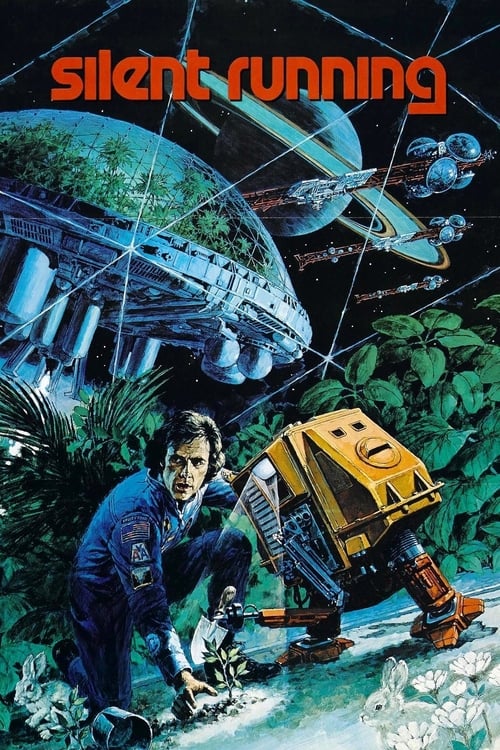
In a future where Earth's plant life is gone, the last forests survive in glass domes bolted to space freighters drifting near Saturn. Botanist Freeman Lowell has spent years tending them while his crewmates count the days until they can go home. Then the order comes down: destroy the domes, return the ships to commercial cargo duty. Lowell refuses — and finds himself alone in deep space with one surviving forest and three small maintenance robots for company.
The experience
Melancholy and slow-burning, more elegy than adventure — long quiet stretches inside the domes, punctuated by moments of real desperation. The little robots sneak up on you emotionally; by the end the film has you grieving for trees and machines alike. It's a gentle watch that leaves a lasting ache.
Performances
Bruce Dern carries the film nearly single-handed, playing a true believer whose devotion tips into something rawer and stranger — talking to plants and drones and making you feel every degree of his loneliness.
The craft
Douglas Trumbull, the effects wizard behind the most famous space visuals of the era, directs his own debut, and it shows: the freighter and its geodesic domes are gorgeous physical models that still hold up, shot with a tactile realism digital effects rarely match. The squat, waddling drone robots are a small miracle of practical design. It rewards a big screen.
Why it matters
One of the founding films of ecological science fiction, made just as the environmental movement was cresting — its lonely-caretaker-in-space premise and its endearing robots echo through decades of the genre that followed.
Snapshot
Silent Running is the directorial debut of Douglas Trumbull, the special-effects artist whose work on Stanley Kubrick's 2001: A Space Odyssey (1968) had made him one of the most sought-after technicians in science fiction. Set aboard the Valley Forge, one of a fleet of commercial space freighters carrying the last surviving forests of a denuded Earth in vast geodesic domes, the film follows Freeman Lowell (Bruce Dern), a botanist and ecologist who has devoted himself to tending these greenhouses while his crewmates treat the assignment as a tedious holding pattern. When the order comes to jettison and destroy the domes and return the ships to commercial service, Lowell rebels — killing his fellow crewmen, faking the destruction, and fleeing toward the rings of Saturn with the one surviving forest and his three small service robots, whom he reprograms and renames Huey, Dewey, and Louie. The result is a melancholy, intimate science-fiction parable: a film at once visually ambitious in the post-2001 manner and emotionally chamber-sized, built around a single conflicted man, a forest, and three machines. Made on a deliberately modest budget at the high-water mark of the early-1970s environmental movement, it became a touchstone of ecological science fiction and a foundational influence on the lonely-robot iconography that later films, from Star Wars to WALL·E, would inherit.
Industry & production
Silent Running emerged from a moment when Hollywood was tentatively backing young, low-budget filmmakers in the wake of Easy Rider's success, and when Universal in particular was experimenting with handing modest sums to first-time directors. Trumbull, who had built his reputation in the effects unit of 2001 and had subsequently contributed effects to The Andromeda Strain (1971), was given the chance to direct on a tight budget — figures commonly cited place it at roughly $1 million, a small sum even by the standards of the early 1970s for a special-effects-driven space picture. The producer was Michael Gruskoff. The economy of the production was itself a creative determinant: it pushed Trumbull toward ingenious, in-camera and model-based solutions and toward a confined, single-ship setting that kept the drama small and the spectacle controlled.
The screenplay is credited to Deric Washburn, Michael Cimino, and Steven Bochco — a trio whose later careers make the credit notable in retrospect. Cimino would go on to direct The Deer Hunter (1978) and Heaven's Gate (1980); Bochco would become one of the most important figures in American television drama (Hill Street Blues, L.A. Law, NYPD Blue); and Washburn would later collaborate with Cimino again on The Deer Hunter. Their script gave Trumbull a spare, fable-like structure on which to hang his images.
A distinctive production decision concerned the famous service robots. To realize the drones convincingly without resorting to obvious puppetry, Trumbull cast bilateral (double) amputee performers, who operated the squat robot shells from inside, walking on their hands so that the machines moved with an uncanny, top-heavy waddle and no visible human scale. This solution is among the most frequently cited facts of the film's making and accounts for much of the drones' peculiar charm and physical credibility. A significant portion of the live-action shooting took place aboard a decommissioned aircraft carrier, the USS Valley Forge, berthed in Long Beach, California — the ship lending both its name to the fictional freighter and its cavernous industrial interiors to the spacecraft's sets.
Technology
As a directorial debut by one of the era's premier effects supervisors, Silent Running is in large part a showcase of practical, photochemical special-effects technique, and it advanced the model-and-miniature craft that Trumbull had helped define on 2001. The spacecraft were realized through highly detailed miniatures photographed with the slow, controlled camera movements that lent 2001 its sense of weight and scale; the geodesic domes, the long latticed spine of the freighter, and the eventual passage through Saturn's rings were achieved through model work, matte painting, and optical compositing rather than any computer-generated means, which did not yet exist in usable form. The film is also historically important as an early credit for John Dykstra, a member of Trumbull's effects team who would, a few years later, lead the effects breakthroughs on Star Wars (1977) and develop the motion-control "Dykstraflex" system; the lineage from Silent Running's model photography to the motion-controlled effects revolution of the late 1970s runs directly through these collaborators. The drones, as noted, were a low-technology but inspired piece of physical engineering — performer-operated shells rather than radio-controlled or animatronic devices — and their success demonstrated how much could be accomplished through staging ingenuity rather than mechanical complexity.
Technique
Cinematography
The cinematography is credited to Charles F. Wheeler. Visually the film inherits the post-2001 vocabulary — clean, brightly lit spacecraft interiors, deliberate framing, and a contemplative pace — but it diverges from Kubrick's cool monumentality toward something warmer and more intimate, organized around the human and botanical presence at the film's center. The greenhouse domes are photographed with an almost documentary attention to real foliage, light, and growing things, the verdant interiors set against the sterile geometry of the ship's corridors. The film alternates between the spectacle of the exterior model shots — the freighter dwarfed by the gas giant, the domes glittering against black space — and tight, often handheld-feeling coverage of Dern moving through cramped, cluttered service spaces, an opposition of scale that mirrors its thematic contrast between cosmic indifference and a single life's stubborn care.
Editing
The editing serves a narrative that is, for a space-adventure film, strikingly patient and elliptical. The picture takes its time establishing Lowell's isolation and his estrangement from his crewmates before the violent turn that sends it into its long second movement aboard a ship now crewed only by one man and three robots. From that point the cutting settles into a slow, accumulating rhythm of solitude — Lowell and the drones tending the forest, playing cards, performing minor repairs — punctuated by the dwindling crises that drive toward the film's resolution. The editorial restraint, allowing long passages with little or no dialogue, is central to the film's elegiac tone and to its portrait of loneliness.
Mise-en-scène / staging
Trumbull's staging draws a continuous contrast between the living and the mechanical, the organic dome and the industrial hull. The recovered interiors of the Valley Forge aircraft carrier supply a convincingly worn, functional environment — pipes, hatches, grated walkways — that grounds the science fiction in tactile reality, while the forest domes are staged as fragile pockets of green life. The blocking of the drones is among the film's defining achievements: their small stature, deliberate gait, and silent attentiveness make them legible as characters through movement alone, and Trumbull repeatedly stages Lowell's scenes so that the robots function as companions, helpers, and finally as the only witnesses to his vigil. The famous late image of a single drone left to tend the surviving forest with a battered watering can is a triumph of staging and design economy, conveying the film's whole meaning in one composition.
Sound
The score is by Peter Schickele, a composer otherwise best known for his comic "P.D.Q. Bach" persona, who here writes in an earnest, pastoral-orchestral idiom suited to the film's ecological lament. Its most distinctive feature is the inclusion of two songs performed by the folk singer Joan Baez — "Rejoice in the Sun" and the title song "Silent Running" — whose plaintive, folk-protest sensibility ties the film explicitly to the environmental and countercultural currents of its moment. The use of a recognizable folk voice rather than a purely orchestral or electronic palette marks the film's tonal departure from the austere sound world of 2001 and underlines its emotional, advocacy-tinged register.
Performance
The film rests almost entirely on Bruce Dern, who is on screen for nearly its entire length and, for long stretches, the only human present. Dern plays Freeman Lowell as a true believer — passionate, eccentric, and increasingly unbalanced — a man whose love of the natural world tips into zealotry and, ultimately, murder. The performance refuses easy heroism: Lowell is sympathetic in his devotion yet disturbing in his willingness to kill for it, and Dern holds that ambivalence without resolving it, charting the character's slide into isolation and instability across the back half of the film. The supporting human roles, played by the crewmates dispatched early in the story, are necessarily brief; the film's other "performances" belong to the drones, whose characterization is entirely a matter of design, movement, and Lowell's projection of personality onto them.
Narrative & dramatic mode
Silent Running operates in the mode of the science-fiction parable or fable rather than the action-driven space adventure its premise might suggest. Its structure is essentially that of a tragedy of conviction: a man so committed to an ideal that he isolates himself absolutely from human society, paying for his fidelity with his sanity and finally his life, while securing the survival of the thing he loves. The dramatic engine is internal — Lowell's deteriorating psychology under the pressure of solitude and guilt — rather than external conflict, and after the early violence the film largely abandons antagonists in favor of a sustained study of one consciousness alone with its mission. The drones supply the film's emotional counterpoint and its only dialogue partners, and the gradual transfer of Lowell's care from human relationships to these machines and the forest is the narrative's true arc. The ending, with its single robot left tending the last forest as it drifts into deep space, resolves the plot not through rescue or triumph but through a bittersweet image of preservation purchased at the cost of the preserver.
Genre & cycle
The film belongs to the wave of serious, idea-driven American science fiction that followed 2001: A Space Odyssey and that flourished briefly in the early 1970s before the genre's late-decade turn toward blockbuster spectacle. It sits alongside contemporaries such as The Andromeda Strain (1971), THX 1138 (1971), and Soylent Green (1973) in a cycle of dystopian and ecological science-fiction films preoccupied with technology, environmental collapse, and the dehumanizing pressures of a managed future. Within that cycle Silent Running is the clearest expression of the era's environmentalist anxieties, imagining a future Earth so thoroughly stripped of nature that its last forests survive only as freight. It also helped inaugurate a durable subgenre — the story of a solitary human (or humanoid) alone in space with robot companions — and stands as a key early entry in the lineage of films about sympathetic, characterful service robots.
Authorship & method
Silent Running is most legible as the work of Douglas Trumbull translating his command of visual effects into a directorial vision, and its authorship is inseparable from his technical sensibility: the film's identity lies in the marriage of large-scale model spectacle with an intimate, almost handmade emotional core. Trumbull's method — building the picture around achievable practical effects, a single principal location, and one central performance — turned budgetary constraint into aesthetic principle. Among the key collaborators, the screenwriting trio of Deric Washburn, Michael Cimino, and Steven Bochco supplied the spare fable structure; cinematographer Charles F. Wheeler realized the contrast between organic dome and industrial hull; composer Peter Schickele, together with Joan Baez's songs, set the film's pastoral-elegiac tone; and the effects team, including the young John Dykstra, executed the model and optical work that carries the spectacle. Bruce Dern's near-solo performance functions as a form of co-authorship, giving the film's ecological argument its unsettling human face. The record indicates that Trumbull's effects expertise was the organizing intelligence of the production; it would be invention to assign specific creative decisions beyond what the credits and the well-documented production methods support.
Movement / national cinema
The film is a product of the "New Hollywood" of the early 1970s, the period in which the American studios, uncertain of their audience, briefly empowered young directors with personal visions and modest budgets. Trumbull was not a film-school auteur in the mold of his screenwriter Cimino but an effects specialist given a director's chair, and Silent Running belongs to the moment's openness to unconventional, even downbeat, genre filmmaking. It is also part of a specifically American strand of science fiction shaped by the contemporaneous environmental movement — the film's release came in the immediate aftermath of the first Earth Day (1970) and amid rising public alarm over pollution, overpopulation, and ecological destruction — making it as much a document of early-1970s American environmental consciousness as of any film movement.
Era / period
Silent Running is an unusually direct expression of its era. The early 1970s saw the environmental movement enter mainstream American consciousness, and the film's central conceit — an Earth that has lost all its plant life, its last forests maintained as an afterthought aboard corporate freighters until even that becomes uneconomical — dramatizes period anxieties about ecological collapse and the subordination of nature to commercial priorities with unusual clarity. The film's vision of a future in which a faceless corporate order coolly orders the destruction of the last forests to free up cargo capacity reflects a contemporary distrust of corporate and bureaucratic indifference to the natural world. Stylistically, too, it is of its moment: the folk-protest songs, the countercultural sympathy for the lone idealist against the system, and the post-2001 aesthetic of contemplative, hardware-realistic space travel all locate it precisely in the early 1970s.
Themes
The film's governing theme is environmentalism and the value of the natural world — the forest as something worth preserving for its own sake, even at terrible cost, against a civilization that has come to regard nature as expendable. Braided through this is a study of conviction and fanaticism: Lowell is both the film's conscience and its cautionary figure, a man whose love of life leads him to kill, and the film declines to fully endorse or condemn him. A third major theme is solitude and the relationship between human beings and machines: stripped of human company, Lowell invests the drones with personality, companionship, and finally trust, and the film treats this bond with a tenderness that anticipates decades of later science fiction about emotionally legible robots. Underlying all of these is a meditation on stewardship and sacrifice — the question of what one person owes to the future, and what they are willing to give up to honor it — crystallized in the closing image of a lone machine carrying a forest, and a watering can, into the dark.
Reception, canon & influence
On its 1972 release Silent Running was a modest commercial performer and drew a mixed critical response; reviewers tended to admire its visual achievement and its sincerity while finding its ecological message earnest or its science questionable, and the specific contemporary figures and notices are thin enough in the general record that detailed box-office claims would be speculative. Over the following decades, however, its reputation grew substantially, and it is now widely regarded as a classic of ecological science fiction and a significant early-1970s genre film.
Influences on the film run most obviously backward to 2001: A Space Odyssey, in whose effects unit Trumbull had worked and whose aesthetic of realistic, contemplative spaceflight Silent Running both inherits and humanizes. Its ecological premise draws directly on the environmental movement and the apocalyptic ecological literature and activism of the late 1960s and early 1970s, while the use of Joan Baez's voice ties it to the folk-protest tradition of the period.
Its influence forward is considerable and well attested. The drones Huey, Dewey, and Louie are frequently cited as a key precursor to the small, characterful, non-speaking service robots of later science fiction — most directly R2-D2 in Star Wars (1977), a connection strengthened by the presence of effects artist John Dykstra, who moved from Trumbull's team to lead the Star Wars effects work. The film's premise of a lone robot left to tend the last vegetation in a ruined ecological future is a transparent ancestor of Pixar's WALL·E (2008), which shares its silent, dutiful machine protagonist and its environmental lament. More broadly, Silent Running helped establish the template of intimate, character-driven, ecologically conscious science fiction and the enduring image of the robot as a sympathetic companion rather than a threat. For Douglas Trumbull, the film inaugurated a directing career he largely set aside in favor of effects supervision — he would go on to landmark work on Close Encounters of the Third Kind (1977) and Blade Runner (1982) and to direct Brainstorm (1983) — but Silent Running remains his most personal statement and a secure entry in the canon of 1970s science fiction.
A Deleuzian reading
The last image is the one you keep: a single small drone, dented and patient, standing inside the one surviving forest dome as it drifts off into the dark, watering the plants from a battered can.
The full Deleuzian reading of Silent Running →
Reception
A modest performer with mixed reviews in 1972, it slowly grew into one of the defining cult sci-fi films of the 70s — now routinely cited as the founding text of eco-science-fiction and a clear ancestor of WALL-E and Moon.
How Silent Running was received, from release to now →
Influences: the films it descends from and the films it influenced
- 2001: A Space Odyssey (1968) — Trumbull built his effects vocabulary on Kubrick's unit — motion-controlled model miniatures shot in slow, deep-focus passes — and recycled that exact discipline into the Valley Forge's drifting, contemplative freighter shots.
- The Andromeda Strain (1971) — Trumbull's own optical and split-screen effects work here, plus its procedural-realist treatment of functional lab/spacecraft hardware, feeds directly into Silent Running's clinical, instrument-dense interiors.
- Forbidden Planet (1956) — Robby the Robot established the benign mechanical servant as an autonomous on-screen 'character' with gait and personality — the non-threatening-companion template that Huey, Dewey and Louie miniaturize and humanize.
- Marooned (1969) — Its documentary-styled depiction of astronaut isolation and life-support procedure models the grounded, hardware-bound solitude that frames Dern's lone maintenance routine.
- Robinson Crusoe on Mars (1964) — The lone-survivor-in-space survival parable carried almost entirely by one sustained performance prefigures Dern's near-solo, man-tending-a-fragile-ecosystem structure.
- Star Wars (1977) — R2-D2's waddling, beeping, non-verbal service-droid pathos descends directly from the drones, and John Dykstra carried Trumbull's model-unit methods forward into the Dykstraflex motion-control camera rig.
- Close Encounters of the Third Kind (1977) — Trumbull's effects supervision extends his front-lit motion-control miniature and atmospheric-lighting craft from Silent Running's domes to the mothership's luminous underside.
- Alien (1979) — The lived-in industrial-hull realism and Dykstra-lineage motion-control miniatures stage the same organic-life-versus-cold-machinery contrast that defines the Valley Forge's dome-against-hull design.
- The Black Hole (1979) — V.I.N.C.E.N.T. and B.O.B. are cute, loyal, expressive companion robots cast in the Huey/Dewey/Louie mold — the sympathetic service-droid sidekick as emotional anchor.
- Blade Runner (1982) — Trumbull's miniature-cityscape work and his signature smoke-and-backlight atmospheric lighting carry his Silent Running effects sensibility into a fully realized future environment.
- Short Circuit (1986) — Johnny 5 extends the characterful, non-threatening robot built for empathy rather than menace, performed as a mechanical 'actor' with readable body language.
- WALL·E (2008) — A silent, dutiful machine tending the last surviving vegetation on a ruined ecological Earth — the premise and the wordless, gesture-only robot performance lifted almost whole from Silent Running.
- Moon (2009) — An explicit homage: a near-solo central performance and deliberately analog model-miniature effects (no CGI), plus a single robot companion, reviving Trumbull's intimate, handmade-spectacle approach.
- Sunshine (2007) — Its onboard oxygen-garden greenhouse and the crew-tending-a-fragile-payload-to-save-Earth structure echo the freighter's domed forests as both life-support and moral center.
- Interstellar (2014) — Ecological collapse on a dying Earth drives a botanical-salvation mission, realized with practical miniatures and a non-anthropomorphic but characterful robot (TARS) — Trumbull's eco-SF-with-real-models lineage at scale.
- Project Hail Mary (2026) — Originates the deep-space staging of a solitary man investing his emotional life in non-humanoid companions (the drones), the prototype of the human-plus-creature buddy unit.
- Gravity (2013) — The first major American space film to build its dramatic architecture entirely on a solo performer in an enclosed craft with minimal supporting cast, establishing the bottle-film space survival structure — one person, one vessel, one existential question — that Gravity formalizes into a genre template.
- THX 1138 (1971) — A contemporaneous New Hollywood SF parable that converts budget limits into a spare, design-driven aesthetic built around a single alienated protagonist resisting an indifferent system.
- Soylent Green (1973) — The same early-70s ecological-collapse parable mode — near-future Earth as exhausted ecosystem delivering a grim moral — staged as character drama rather than spectacle.
- Ikarie XB 1 (1963) — Inherits the lived-in, greenhouse-and-corridor starship with crew performing mundane maintenance routine, extending Ikarie's 'daily labor in space' domestic realism.
Similar films
- WALL·E (2008) — influence & lineage
- Moon (2009) — influence & lineage
- Blade Runner (1982) — influence & lineage
- 2001: A Space Odyssey (1968) — influence & lineage
- Forbidden Planet (1956) — influence & lineage
- Alien (1979) — influence & lineage
- Sunshine (2007) — influence & lineage
- Interstellar (2014) — influence & lineage