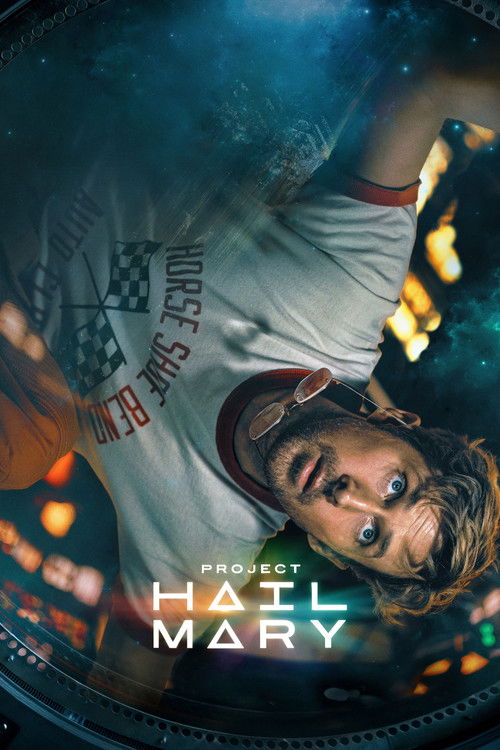
Project Hail Mary
2026 · Phil Lord
For when you want smart, optimistic escapism — a crowd-pleaser that respects your brain. Great for a night you need to believe cleverness and decency can actually save the day.
What it's about
A man wakes alone on a spaceship light-years from Earth with no memory of who he is or how he got there. As it comes back in pieces, he learns he's Ryland Grace, a science teacher sent on a desperate mission: figure out what's eating the sun and stop it before everything back home goes dark. All he has is his wits, chalkboard science, and some very unorthodox ideas.
The experience
A puzzle-box adventure that makes problem-solving feel thrilling — you're doing the science along with him, one improvised experiment at a time. It's suspenseful but fundamentally warm-hearted, more exhilarating than bleak, with real surprises in where the mission leads.
The craft
Adapted from Andy Weir's novel by directing duo Phil Lord and Christopher Miller, whose comic timing and invention loosen up the hard-sci-fi machinery. The film's central design challenge — how the story grows beyond one man alone in a ship — pays off in ways best left unspoiled, and the spacebound scale earns a big screen.
Why it matters
The marquee adaptation of one of the decade's most beloved science-fiction novels, and a striking pivot for Lord and Miller from animation and comedy into large-scale live-action sci-fi.
Snapshot
Project Hail Mary is the feature adaptation of Andy Weir's 2021 novel, mounted by Amazon MGM Studios with Ryan Gosling as the amnesiac science-teacher-turned-astronaut Ryland Grace. It belongs to the post-Martian wave of "hard" science-fiction cinema built around procedural problem-solving: a lone competent protagonist, marooned by catastrophe, reasoning his way toward survival with chalkboard physics and improvised engineering. What distinguishes the source material — and what the film's whole design problem turns on — is that the survival story becomes a first-contact story when Grace meets Rocky, a spider-like alien from a neighboring star whose species faces the same stellar plague. The picture is directed by Phil Lord, working in his long-standing partnership with Christopher Miller; it marks a conspicuous pivot for filmmakers best known for animation and comedy into earnest, large-canvas live-action science fiction. Because the film falls at or just beyond the edge of the documented record available here, several craft credits and reception specifics below are flagged as genuinely uncertain rather than asserted.
Industry & production
The project sits inside the reconstituted MGM under Amazon ownership, the same studio apparatus that has sought tentpole-scale literary IP with built-in recognition. Its commercial logic is legible: Weir's novel was a bestseller, and the property arrives pre-validated by The Martian (2015), which converted a similar premise into a major critical and box-office success. Gosling is attached both as star and producer, the kind of above-the-line anchoring that studios now use to de-risk original-feeling but expensive science fiction. The screenplay is by Drew Goddard, who adapted The Martian for Ridley Scott — a deliberate continuity of authorship that signals the studio's intent to reproduce that film's tone of optimistic, wisecracking competence. Reported casting includes Sandra Hüller in the role of the project's hard-nosed administrator (Eva Stratt in the novel), though precise ensemble details should be treated as provisional here.
The production's defining challenge is industrial as much as artistic: roughly half the story is a two-hander between a human and a non-humanoid alien who communicate through music and mathematics. Realizing Rocky convincingly — and sustaining a feature-length performance relationship with a creature that is not remotely anthropomorphic — is the single largest budget and pipeline question the film faces. The specific method chosen (digital creature animation, on-set puppetry, performance capture, or a hybrid) is not something I can confirm from the established record, and I will not invent it. Release was set for early 2026; detailed grosses and the final shape of the rollout are outside what can be responsibly stated here.
Technology
The material is a near-textbook case for contemporary virtual-production and creature-effects technology. The bulk of the action unfolds in a single confined spacecraft interior and in microgravity, conditions that the post-Gravity (2013) toolkit — LED volume walls, motion-controlled rigs, wire-and-rig assisted weightlessness, and extensive previsualization — was effectively built to serve. An LED-volume approach would let the production light Grace's face with the actual starfield and the cool blue glow of Astrophage-driven engineering, capturing reflections in-camera rather than reconstructing them in post; whether the film used a volume, traditional bluescreen, or built sets is not confirmed in the record available to me. Rocky's realization will rest on whatever creature pipeline was chosen, and the believability of the human–alien rapport depends on giving Gosling a physical eyeline and timing partner on set. These are the load-bearing technical bets of the picture; I flag them as demands the material imposes rather than as documented choices.
Technique
Cinematography
The novel's grammar is claustrophobic by necessity — one man, a few rooms, an oppressive awareness of distance from home — punctuated by vertiginous exteriors. A faithful adaptation invites a cinematography of contained, handheld-adjacent intimacy in the ship offset by the sublime scale of deep space and the alien vessel. I cannot reliably attribute the director of photography for this production from the record at hand, so I will not name one. What can be said is structural: the film must visually distinguish three registers — Grace's amnesiac present aboard the Hail Mary, the flashback world of Earth's mobilization against the crisis, and the shared space of the Grace–Rocky collaboration — and the cleanest tool for that separation is a disciplined palette and lensing scheme keyed to each.
Editing
The book's engine is its dual timeline: Grace recovers his memory in fragments, so the audience learns the stakes (the Astrophage catastrophe, the Hail Mary's nature as a one-way last resort) on a delay even as the present-tense survival problem advances. The adaptation's editorial spine is therefore the interleaving of recovered memory with onboard discovery — a structure that rewards withholding and precisely timed revelation. Mishandled, it stalls; handled well, each flashback recontextualizes the present. The specific editor is not something I can confirm here.
Mise-en-scène / staging
Production design carries unusual narrative weight: the interior of the Hail Mary must double as exposition, since Grace reads his own mission off the ship itself, and the contrast between human and Eridian engineering (Rocky breathes ammonia, perceives by sound, and tolerates conditions lethal to Grace) has to be staged so that incompatibility is legible at a glance — the famous "airlock" arrangement that lets two mutually toxic biologies share a workspace. The staging problem is to make collaboration across that barrier physically and dramatically clear without dialogue doing all the work.
Sound
Sound is not decorative in this story; it is the contact medium. Rocky communicates in musical tones, and the breakthrough of the relationship is a sound-design and (potentially) score problem before it is a verbal one. The film's sonic identity — how the alien "speaks," how the ship hums, how silence is deployed in vacuum — is arguably its most important craft dimension and the place where it most clearly cannot simply copy The Martian. The specific sound team and composer are not confirmed in the record available to me, and I decline to guess.
Performance
Gosling's task is the modern single-hander: hold the screen largely alone, carry exposition that is literally a man talking himself through physics, and modulate dread, humor, and wonder without a steady scene partner for long stretches. His established register — deadpan warmth, comic understatement — maps onto Grace's voice in the novel, which is wry and self-deprecating under pressure. The harder performance question is relational: the Grace–Rocky friendship is the emotional payload, and its success depends on Gosling acting convincingly with a non-human presence, however that presence was generated on set.
Narrative & dramatic mode
The dominant mode is the procedural of competence — drama generated by problem-solving rather than by interpersonal conflict — fused, unusually, with a sentimental first-contact friendship. The amnesia frame is a deliberate device: it lets the film run as a mystery (who am I, why am I here) layered over a thriller (the clock on Earth's extinction), so that the recovery of memory and the accumulation of scientific understanding advance on the same track. This is a story in which the antagonist is a phenomenon — Astrophage, the energy-eating microbe dimming the sun — not a villain, which keeps the dramatic engine cognitive and collaborative. The pivot from solitary survival to partnership is the structural hinge that distinguishes it from its closest models.
Genre & cycle
The film is a direct member of the 2010s–2020s hard-SF problem-solving cycle: Gravity (2013), Interstellar (2014), The Martian (2015), Arrival (2016), Ad Astra (2019). Within that cycle it sits at the optimistic, puzzle-driven end staked out by The Martian — science as adventure, ingenuity as heroism — while importing the contact-and-communication concerns of Arrival and, further back, the awe-tradition of 2001: A Space Odyssey (1968) and Close Encounters of the Third Kind (1977). Its buddy structure also pulls it, tonally, toward something rarer in the cycle: a comedy of mutual incomprehension between species, closer in spirit to a partnership picture than to the chilly metaphysics of much prestige space cinema.
Authorship & method
The signature authorial fact is the casting of Phil Lord (with Christopher Miller) as directors. Their body of work — Cloudy with a Chance of Meatballs (2009), 21 Jump Street (2012), The Lego Movie (2014), and as producers the Spider-Verse films — is rooted in animation, comedy, and metafictional play, not in sober live-action realism. Their brief, ill-fated tenure on Solo: A Star Wars Story (from which they departed in 2017) marks their prior large-scale live-action studio experience. Project Hail Mary therefore reads as a genuine stretch: the question their authorship raises is whether the warmth, comic timing, and emotional accessibility that define their animated work can carry an earnest survival drama — and, conversely, whether the Grace–Rocky friendship is precisely the material that rewards their gift for unlikely partnerships (the throughline from the Lego films to the Spider-Verse mentorships).
The countervailing authorial force is screenwriter Drew Goddard, whose résumé — Cloverfield (2008), The Cabin in the Woods (2012), and crucially the Oscar-nominated Martian screenplay — makes him the connective tissue between this film and the cycle it extends. Goddard specializes in genre architecture that is both rigorous and quippy, and his prior Weir adaptation makes him the closest thing the project has to a known-quantity translator of the author's voice. Gosling's role as producer-star completes the trio of decisive creative hands. Cinematographer, composer, and editor — the other key collaborators the brief asks about — cannot be reliably named from the record available here, and I have not invented attributions.
Movement / national cinema
This is a mainstream American studio production and does not belong to a movement in the art-historical sense. If it participates in anything larger, it is the contemporary Hollywood tendency to mount "smart" spectacle from literary science fiction — the studio bet that a recognizable hard-SF novel can anchor a four-quadrant event film. Its lineage is industrial and generic rather than national or stylistic.
Era / period
The film is a product of the streaming-consolidation era, specifically the Amazon-MGM configuration of the mid-2020s, in which legacy studio IP and star-producer packaging are deployed to justify high-cost original-feeling features for both theatrical and platform life. It also sits in a moment when virtual production and creature effects have matured enough to make a feature-length non-humanoid co-lead plausible — a technological precondition that simply did not exist for most of the genre's history. Period anxieties (planetary-scale environmental catastrophe, the fragility of the biosphere) are legible in the Astrophage premise, even though the novel routes them through optimism rather than despair.
Themes
The central theme is ingenuity as salvation — the conviction that disciplined reasoning, trial and error, and the willingness to be wrong can meet an extinction-level threat. Closely bound to it is communication across radical difference: the Grace–Rocky relationship argues that cooperation is possible between beings with nothing biologically in common, mediated by the universal languages of mathematics and music. A third strand is identity and memory — Grace literally reconstructs who he is, and the film ties self-knowledge to moral reckoning, since recovering his past means confronting how he came to be on a one-way mission. Beneath these runs a humanist faith in science as a collective, generous enterprise rather than a cold or hubristic one — the trait that most sharply separates this cycle's optimistic wing from its tragic one.
Reception, canon & influence
Backward influences on the film are unusually traceable. The immediate progenitor is The Martian — same author, same screenwriter, same procedural-optimism mode — and behind it the broader 2010s space cycle (Gravity, Interstellar) and the contact tradition (Arrival, Close Encounters, 2001). The buddy dynamic draws, consciously or not, on a long tradition of odd-couple partnership narratives, and the directors' own filmography supplies a template for emotionally legible relationships between mismatched figures.
Critical reception and box-office performance fall at or beyond the boundary of what can be responsibly reported here; I will not fabricate review consensus, ratings, or grosses. What can be said is that expectations were structured by The Martian's success and by curiosity about Lord and Miller working against type in earnest live-action.
Forward influence is too early to assess honestly. The film's most likely legacy, if it succeeds, lies in two areas: validating a non-humanoid alien as a feature-length co-lead (a creature-performance benchmark comparable to what motion-capture milestones did for earlier eras), and reinforcing the commercial case for adapting hard-SF literary properties as star-driven event films. Whether it achieves either is a claim that the available record does not yet support, and I leave it open rather than overstate it.
A Deleuzian reading
A man opens his eyes and does not know his own name.
The full Deleuzian reading of Project Hail Mary →
Reception
Book fans spent years bracing for an 'unfilmable' adaptation; instead it opened to 2026's biggest debut ($80M), a 94% Tomatometer and an 'A' CinemaScore, and rode word of mouth to nearly $700M worldwide. Four months on it's the year's consensus crowd-pleaser, with its July landing on Prime Video kicking off a whole second wave.
How Project Hail Mary was received, from release to now →
Influences: the films it descends from and the films it influenced
- The Martian (2015) — Same Andy Weir source and same Drew Goddard screenplay; the video-log confessional that converts solitary problem-solving into spoken narration is inherited wholesale as PHM's procedural-optimism engine.
- Apollo 13 (1995) — Codifies the competence-procedural where engineering-under-constraint — improvising a fix from only the parts aboard — is itself the dramatic climax, the 'work the problem' grammar PHM runs on.
- 2001: A Space Odyssey (1968) — Hard-SF discipline of depicting the isolated crew member and a non-anthropomorphic alien intelligence through formal restraint and silence rather than expository dialogue.
- Close Encounters of the Third Kind (1977) — Establishes first contact achieved through a shared sonic vocabulary — the five-tone motif as handshake — the founding template for sound-as-contact-medium.
- Contact (1997) — Stages the decoding of an alien transmission as a stepwise scientific procedural, making mathematics and signal the literal medium of communication-across-difference.
- Gravity (2013) — Single-hander space survival shot inside a custom LED light-box rig, the practical precursor to PHM's virtual-production LED volume for in-camera spaceflight lighting.
- Interstellar (2014) — Relativity-driven dual timeline in which physics literally separates loved ones across elapsed time, anchoring hard-SF spectacle to real equations rather than hand-waving.
- Cast Away (2000) — Proves a feature can rest on one actor performing opposite a mute non-human companion, the Wilson-as-scene-partner blueprint behind Grace acting opposite Rocky.
- Silent Running (1972) — Originates the deep-space staging of a solitary man investing his emotional life in non-humanoid companions (the drones), the prototype of the human-plus-creature buddy unit.
- The Lego Movie (2014) — Lord & Miller's method of making an unlikely-partners relationship emotionally legible through comic timing, the throughline that primes them for the Grace–Rocky friendship.
- Arrival (2016) — Builds an entire film around inventing a non-human language and dramatizing the labor of mutual translation — the direct model for treating communication itself as the plot mechanism.
- Life of Pi (2012) — A lone protagonist carries the film acting against a fully CG non-human co-lead, setting the photoreal-creature-performance benchmark a feature-length Rocky must clear.
- The Cabin in the Woods (2012) — Goddard's signature of rigorously engineered genre architecture delivered with quippy levity — the precise screenwriting voice he carries from here into PHM.
- Spider-Man: Into the Spider-Verse (2018) — Produced by Lord & Miller, it extends their recurring mentorship-between-mismatched-figures structure that the cross-species partnership in PHM directly continues.
- The Mandalorian (2019) — Pioneered the StageCraft LED-volume virtual production — real-time rendered environments lighting the actor in camera — the exact technology PHM's space interiors depend on.
- The Shape of Water (2017) — Sustains wordless intimacy across incompatible biologies with a non-humanoid creature, rendering communication-across-difference through creature design and gesture rather than speech.
- Avatar (2009) — Its performance-capture pipeline made a photoreal non-human character carry lead emotional weight, establishing the creature-as-co-lead craft standard PHM's Rocky inherits.
Similar films
- Interstellar (2014) — influence & lineage · same viewing thread
- The Martian (2015) — influence & lineage · same viewing thread
- Apollo 13 (1995) — influence & lineage · same viewing thread
- 2001: A Space Odyssey (1968) — influence & lineage · same viewing thread
- Arrival (2016) — influence & lineage · same viewing thread
- Gravity (2013) — influence & lineage
- Contact (1997) — influence & lineage · same viewing thread
- Sunshine (2007) — same viewing thread
All the films related to Project Hail Mary →
Watch it with: curated runs of related films
- Alone in the Void — A run of films about a single mind pitted against the vastness — rationing air, doing the math, reaching across impossible distance — best watched together for how survival keeps tipping into awe.